
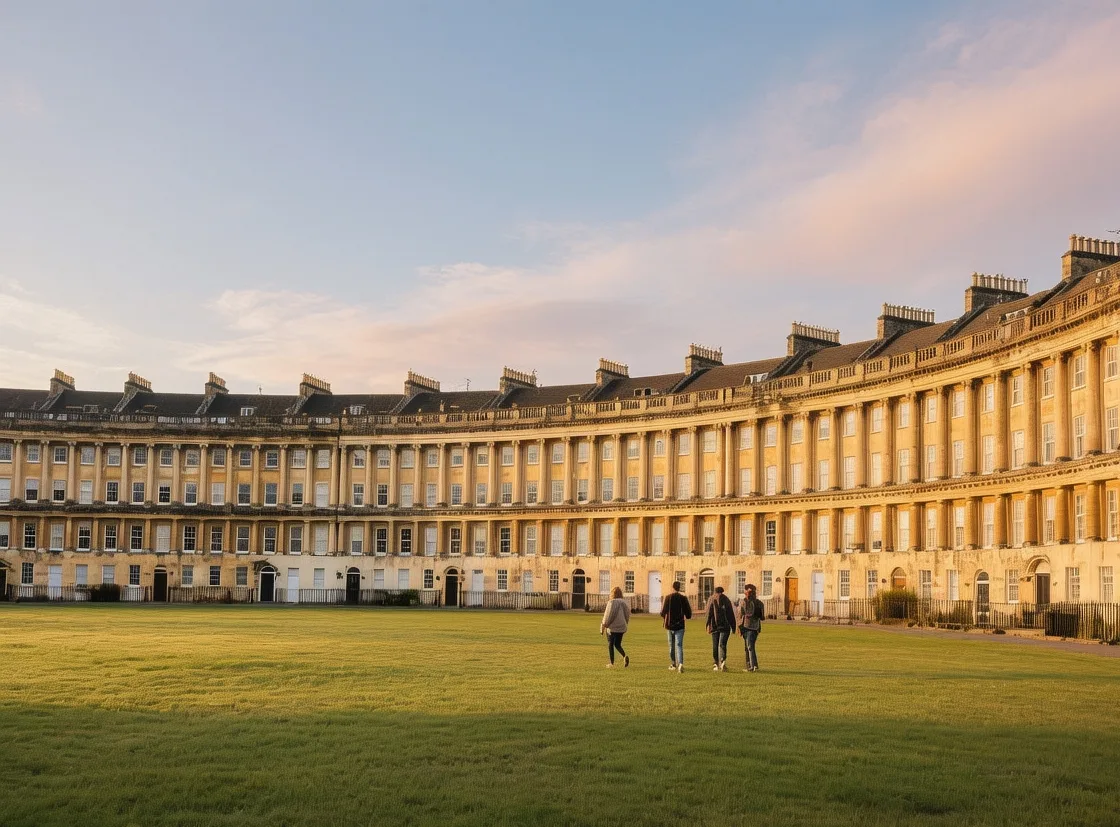
Bath Royal Crescent Georgian Grandeur Meets Somerset Elegance
The light strikes the stone—a warm, honeyed glow that seems to emanate from within the Bath limestone itself—as you stand on the manicured lawn at 7:15 AM, watching shadows stretch across the 150-meter curve. The air smells of cut grass and old mortar; the silence hums with the weight of 250 years of aristocratic history preserved in perfect symmetry. Built between 1767 and 1774 by John Wood the Younger, the Bath Royal Crescent consists of 30 terraced houses arranged in a sweeping crescent shape, fronted by 108 Ionic columns that stand sentinel over the city. You stand beneath the central pediment, where the Union Flag flutters against the sky, while the 46-foot-high facade reflects the ambition of the Georgian era. Every window tells a story: Beau Brummell adjusting his cravat, Jane Austen walking the streets, and modern residents maintaining the legacy. In 2026, as urban development threatens historic character globally, visiting the Bath Royal Crescent means engaging with a masterpiece of urban planning that prioritizes beauty over density. This place matters now because it remains the pinnacle of Georgian architecture, challenging visitors to slow down and appreciate the harmony of design in a fragmented world.
Why Bath Royal Crescent Embodies Georgian Architectural Perfection
The Bath Royal Crescent solves the urban design challenge of housing the aristocracy in a manner that projects unity and grandeur—a feat achieved through strict architectural control and visionary planning. When John Wood the Younger laid the foundation in 1767, he envisioned a crescent that overlooked the Royal Victoria Park, creating a private enclave for the wealthy within the public sphere. The facade spans 150 meters in length, utilizing Bath stone quarried from nearby Combe Down, chosen for its durability and warm color that glows in sunlight. Engineering-wise, the 30 houses share a unified front but possess individual rear structures, allowing for privacy behind the public mask of the 108 Ionic columns. The construction required precise masonry to ensure the curve remained true over 150 meters without visual distortion, a mathematical achievement for the 18th century. Today, the Bath Preservation Trust manages the site, balancing the needs of private residents with public access to the lawn and No. 1 Museum. This unique status ensures the Bath Royal Crescent remains not merely a street but a protected monument, blending residential function with architectural spectacle in a manner few urban spaces sustain.
The Best Time to Experience Bath Royal Crescent
For optimal lighting and manageable crowds, plan your visit between May 15–June 20 or September 10–October 15, when temperatures range from 15–22°C (59–72°F) and daylight extends until 8:30 PM. Arrive precisely at 7:00 AM when the lawn opens to beat the tour groups that typically converge by 10:00 AM; the morning light illuminates the stone facade beautifully without the glare of midday sun. Evening visits during summer offer a romantic atmosphere as the street lamps glow, though access to the lawn is restricted after dusk. Avoid July 25–August 31 when school holidays bring peak congestion, pushing pedestrian traffic on Brock Street to a standstill despite the wide pavements. Winter months (December–February) offer shorter lines but temperatures drop to 2–8°C (36–46°F), and the stone becomes uncomfortably cold to touch. For event schedules, verify the calendar at royalcrescent.co.uk/ before booking, as the Bath Festival can close sections unexpectedly. Tuesday and Thursday mornings typically see the lowest visitor volume, allowing for quieter contemplation on the grass.
Approximate Budget for a 7-Day Trip (2026)
Bath remains a premium destination, but staying in the city center provides immediate access to the Royal Crescent without excessive transport costs. These 2026 estimates assume a moderate travel style, accounting for approximately 3-4% annual inflation in UK hospitality and attraction pricing.
- Accommodation: £150–£350 per night for a double room in Bath City Centre, Widcombe, or Lansdown; budget hostels from £55/night in nearby Twerton
- Food: £55–90 per day—breakfast £10–15 (café pastry or full English), lunch £15–25 (pub meal or Sally Lunn's bun), dinner £30–50 (mid-range restaurant with wine); traditional cream tea £20
- Transportation: £15.00 daily average for local buses; Train from London Paddington to Bath £65 return; Taxi from station £15 minimum
- Attractions: No. 1 Royal Crescent £14.00 adult, Roman Baths £33.00, Bath Abbey £20.00 (tower tour), Jane Austen Centre £18.00, Thames cruise £18.00
- Miscellaneous: Souvenir guidebook £15, Bath salts £10, rain jacket (essential) £35, travel insurance £50 for week
Total for 7 days: £1,550–2,150 per person (excluding international flights)
7 Essential Bath Royal Crescent Experiences
- The Lawn Walk: Stroll the private grass area in front of the Crescent. Open 7:00 AM–dusk; the view of the curve is uninterrupted. The grass is meticulously maintained; stay on the paths to respect the preservation rules while photographing the facade.
- No. 1 Royal Crescent Museum: Tour the furnished townhouse showing Georgian life. Open 10:00 AM–5:00 PM; the rooms are decorated in 18th-century style. Look for the original kitchens and servants' quarters in the basement to understand the social hierarchy.
- The Circus Viewpoint: Walk down Bennett's Row to see the circular plaza nearby. Designed by John Wood the Elder; the three segments represent the architectural orders. The view from the center looking up at the facades offers a geometric contrast to the Crescent.
- Royal Victoria Park Picnic: Relax on the large green space behind the Crescent. Open dawn–dusk; the botanical garden is within the park. Bring a blanket to sit beneath the trees while watching children play on the historic playground equipment.
- Jane Austen Trail Walk: Follow the path the author walked during her residence. Starts at the Jane Austen Centre; the trail passes the Crescent. Listen to the audio guide to hear excerpts from Persuasion that reference these specific streets.
- Sunset Photography: Capture the stone glowing in the evening light. Best light occurs at 7:30 PM in summer; the warm hue highlights the Ionic columns. Use the park bench opposite the center house for a symmetrical composition without tourists in the frame.
- Brock Street Stroll: Walk the connecting road linking the Crescent to the Circus. The townhouses here are narrower but equally elegant. Notice the uniform railings and door knockers that maintain the architectural integrity of the entire district.
3 Hidden Gems Most Travelers Miss
- Bennett's Row Mews: This quiet lane behind the Crescent houses former coach houses converted into homes. Access via the path behind No. 10; open 24 hours. Most tourists stay on the main lawn, missing the quaint cobblestones and flower boxes that offer a glimpse of residential life.
- The View from Victoria Park: Stand on the hill behind the Crescent for a panoramic perspective. Access via the park paths; open dawn–dusk. This angle shows the full curve of the Crescent against the city skyline, revealing how the building dominates the landscape.
- St. James's Square: Located nearby, this smaller square features a central garden. Access via Gay Street; open during daylight hours. The railings and gate are original ironwork; it offers a quieter alternative to the bustling Crescent lawn for reading or reflection.
Cultural & Practical Tips
- Residential etiquette: The houses are private homes; do not knock on doors or peer into windows. Respect the privacy of the residents living behind the historic facades; keep noise levels down on the lawn.
- Photography rules: Photography is permitted on the lawn for personal use without flash. Tripods require permission for commercial shoots; respect signs indicating no photography inside the No. 1 Museum galleries.
- Lawn access: The grass is private property managed by the residents; stay on the designated paths. Dogs are permitted but must be kept on leads; clean up after pets to maintain the cleanliness of the area.
- Local phrases: Learn "Mind the gap" (watch the step), "Cheers" (thanks), and "Queue here" (wait in line); locals appreciate visitors who respect pedestrian flow on the narrow city streets.
- Weather preparedness: Bath is exposed to rain; carry a compact umbrella (£10 from Boots pharmacy) and waterproof layers. Stone surfaces become slippery when wet—wear shoes with good grip.
- Accessibility: The lawn has level access; wheelchair users can navigate the paths easily. No. 1 Museum has a lift; contact info@no1royalcrescent.org.uk 48 hours ahead to arrange assistance for entry.
- Respectful behavior: Do not sit on the railings or climb the columns; the stone is fragile. Keep voices lowered near the houses; this is a residential neighborhood as well as a tourist attraction.
Conclusion: Travel with Reverence, Not Just Checklists
The Bath Royal Crescent demands more than a snapshot beside the columns—it invites you to contemplate the weight of history resting on that sweeping curve. When you walk the lawn in 2026, tracing the same paths worn by Georgians for centuries, you're not just ticking a sightseeing box; you're witnessing the delicate balance between private residence and public heritage. As overtourism pressures historic landmarks, visiting mindfully means respecting the residential nature of this institution, understanding that behind the stone facade, real people live and maintain this legacy. Walk slowly across the grass, noticing how the light changes on the limestone; listen to the silence of the street not as emptiness but as preservation. Leave only footprints on the path, take only memories of architectural harmony, and carry forward the understanding that places like this endure because each generation chooses to honor them—not as backdrops, but as living testaments to design, history, and the enduring human desire for beauty.