
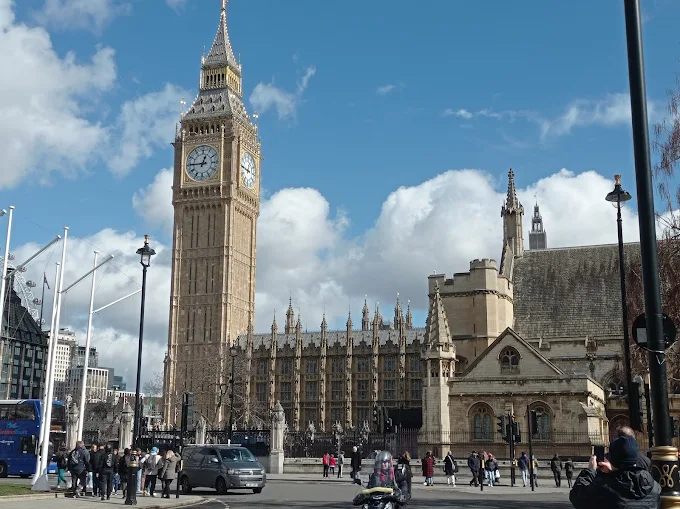
Big Ben & Houses of Parliament Victorian Grandeur Meets Democratic Heritage
The clock's deep bellow resonates across the Thames—four resonant notes that have marked British time since 1859, each chime traveling 17 miles through London's air. You stand on Westminster Bridge as dusk settles, watching the Gothic Revival spires of the Palace of Westminster pierce the lavender sky while the Elizabeth Tower—home to the great bell everyone calls Big Ben—glows amber against the deepening blue. The River Thames flows beneath you, carrying centuries of history in its tidal waters, while the 96.3-meter tower stands sentinel over the world's oldest continuous parliamentary democracy. Inside those honey-colored limestone walls, 1,100 rooms house debates that shape nations; outside, the intricate stonework of Charles Barry's masterpiece catches the last light of day. This isn't merely a landmark—it's the living heartbeat of British governance, where every carved gargoyle and stained-glass window tells a story of empire, reform, and resilience. In 2026, as the tower completes its most recent restoration chapter, visiting Big Ben and the Houses of Parliament means witnessing democracy's architectural cathedral at its most magnificent.
Why Big Ben & Houses of Parliament Embody Timeless Democratic Architecture
The Palace of Westminster rises from the Thames embankment as a testament to Victorian ambition and medieval inspiration—a 3.2-hectare complex containing over 1,100 rooms, 100 staircases, and 4.8 kilometers of passageways. When the original palace burned in the catastrophic fire of October 16, 1834, architect Charles Barry won the commission to rebuild, partnering with Augustus Welby Pugin to create the Perpendicular Gothic masterpiece you see today. Construction began in 1840 and continued for three decades, using 6,000 tons of iron for the structure alone and Anston limestone from Yorkshire for the distinctive honey-colored facade. The Elizabeth Tower—renamed from Clock Tower in 2012 to honor Queen Elizabeth II's Diamond Jubilee—houses the 13.7-ton Great Bell that gives us "Big Ben," though technically the name refers only to the bell itself, not the tower or clock. The clock mechanism, designed by Edmund Beckett Denison and astronomer George Airy, achieves remarkable precision through its double three-legged gravity escapement, maintaining accuracy within seconds per year despite wind, temperature, and atmospheric pressure changes. The tower's 334 limestone steps lead to the belfry where the bell strikes every hour, its sound broadcast worldwide as a symbol of British resilience—particularly during the Blitz when it continued chiming despite bomb damage. Today, the Houses of Parliament remain a working legislature where the House of Commons and House of Lords debate national policy, making this not a museum but a living institution where history unfolds daily behind those Gothic windows.
The Best Time to Experience Big Ben & Houses of Parliament
For optimal conditions, plan your visit between May 15–June 20 or September 10–October 15, when London's temperatures range from 15–22°C (59–72°F) and daylight stretches until 9:00 PM, giving you maximum hours for photography and exploration. The golden hour—7:30–9:00 PM in summer—bathes the limestone facade in warm amber light, while early morning (8:00–9:30 AM) offers the fewest crowds and clearest reflections in the Thames. Avoid December 15–January 5 when tourist crowds peak despite cold temperatures averaging 2–8°C (36–46°F), and steer clear of parliamentary sitting days (check parliament.uk for the legislative calendar) when security restrictions tighten and access becomes limited. Summer months (July–August) bring temperatures of 18–25°C (64–77°F) but also the heaviest visitor volumes, with queues exceeding 90 minutes for tower tours. For a magical experience, visit during the Remembrance Sunday period (second Sunday in November) when the Cenotaph ceremonies add profound historical context, though expect heightened security. The tower's illumination changes with parliamentary sessions—white lights indicate Commons is sitting, blue shows Lords in session—adding a dynamic element to evening visits. For current opening times and tour availability, verify at parliament.uk/bigben/ before your trip, as schedules shift with the legislative calendar and ongoing conservation work.
Approximate Budget for a 7-Day Trip (2026)
London ranks among Europe's pricier capitals, but strategic planning makes Westminster accessible. These 2026 estimates assume moderate travel style with occasional splurges, based on central London Zone 1-2 pricing and current inflation trends of approximately 3-4% annually.
- Accommodation: £120–£280 per night for a double room in Westminster, South Bank, or Covent Garden neighborhoods; budget hostels from £35/night in King's Cross
- Food: £45–75 per day—breakfast £8–12 (full English or café pastry), lunch £12–18 (pub sandwich or market stall), dinner £25–45 (mid-range restaurant with pint); afternoon tea at Parliament's Strangers' Bar from £35
- Transportation: £8.10 daily cap for Zones 1-2 using contactless/Oyster; Heathrow Express £25 one-way or Elizabeth Line £12.80; Thames Clipper river bus £8.60 single Westminster to Tower Bridge
- Attractions: Houses of Parliament tour £29.50 adult, Elizabeth Tower tour £25 (advance booking essential), Westminster Abbey £29, London Eye £32, Thames cruise £15
- Miscellaneous: Souvenir guidebook £12, postcards £5, umbrella (essential) £15, travel insurance £40 for week
Total for 7 days: £1,150–1,680 per person (excluding international flights)
7 Essential Big Ben & Houses of Parliament Experiences
- Elizabeth Tower Tour: Climb the 334 steps to the belfry where Big Ben hangs, hearing the bell's 13.7-ton resonance from meters away. Tours run Saturday-only, 9:15 AM–4:30 PM, booking 3-6 months ahead via parliament.uk; you'll pass the clock mechanism room where conservators still adjust timing with pre-decimal pennies.
- Westminster Bridge Photography at Blue Hour: Position yourself on the bridge's north side 30 minutes after sunset when the tower's illumination contrasts with deep blue sky; use a tripod for long exposures capturing Thames reflections and light trails from red buses crossing the span.
- House of Commons Gallery Visit: Watch democracy in action from the Stranger's Gallery during sitting hours (Monday–Thursday, 2:30–10:00 PM); arrive by 1:00 PM for queue entry, bringing photo ID and passing airport-style security—no phones allowed inside.
- Thames Riverside Walk: Stroll the Queen's Walk from Westminster Pier to Vauxhall at low tide, discovering the Parliamentary War Memorial and viewing the palace's riverside Gothic details invisible from street level; check tide times at environment.data.gov.uk.
- Westminster Hall Exploration: Enter the palace's oldest surviving space (built 1097–1099) free of charge during opening hours, marveling at the medieval hammerbeam roof spanning 20.7 meters without central supports—a carpentry masterpiece that survived the 1834 fire.
- Victoria Tower Gardens: Picnic in this riverside park south of the palace, photographing the Buxton Memorial Fountain commemorating slavery abolition while capturing the Victoria Tower's 98.5-meter height from ground level—the palace's tallest point.
- Evening Sound and Light: Experience the tower's chimes at midnight from Parliament Square, when the hourly broadcast reaches its most resonant; combine with a night walk through empty Westminster when the illuminated facade creates dramatic shadows.
3 Hidden Gems Most Travelers Miss
- St Stephen's Tower Roof Tour: Beyond the famous clock tower, this lesser-known turret offers panoramic views from 70 meters without the crowds. Access requires booking through the Parliamentary Heritage Team (heritage@parliament.uk) at least 8 weeks ahead; tours run monthly on select Fridays, limited to 12 people, £30 per person. You'll see the Victorian ironwork roof structure and chimney pots up close while guides explain the 1834 fire's destruction.
- Cromwell Green Garden: This enclosed courtyard on the palace's north side contains medieval stone fragments excavated during restoration, including pieces from the original 11th-century palace. Enter through the Member's Entrance on Bridge Street (ask security for garden access during weekday lunch hours 12:00–2:00 PM); look for the 14th-century vaulted undercroft visible through railings. Most visitors walk past without noticing this archaeological time capsule.
- Portcullis House Underground River: Beneath this modern parliamentary office building flows the River Tyburn, one of London's lost rivers, visible through a glass floor panel in the basement café. Access the café (open to public 8:00 AM–6:00 PM weekdays) at 1 Bridge Street, order a coffee, and look down at the medieval waterway that once supplied Westminster before being culverted in 1737. The building's architect Michael Hopkins designed this feature specifically to acknowledge the site's hydrological history.
Cultural & Practical Tips
- Security protocols: All visitors pass through airport-style screening; prohibited items include large bags (nothing over 40×30×20cm), sharp objects, and spray cans. Allow 30–45 minutes for security during peak hours (10:00 AM–3:00 PM).
- Dress code for galleries: While no formal dress code exists, smart casual attire respects the institution; avoid shorts, flip-flops, or clothing with political slogans when entering parliamentary spaces.
- Photography rules: Exterior photography is unrestricted, but interior photography is prohibited in most areas except designated tour routes where non-flash photography may be permitted—always ask guides. Mobile phones must be silenced and stowed in the House of Commons and Lords galleries.
- Local phrases: Learn "Mind the gap" (watch the step on the Tube), "Cheers" (thanks), and "Queue properly" (wait your turn in line)—Londoners appreciate visitors who respect queuing etiquette.
- Weather preparedness: London's maritime climate means rain can arrive any month; carry a compact umbrella (£10 from Boots pharmacy) and waterproof layers even in summer. Winter temperatures rarely drop below -2°C (28°F) but damp cold penetrates—layer wool or synthetic fabrics.
- Accessibility: The palace offers step-free access routes and wheelchair loans; book assistance 72 hours ahead via accessibility@parliament.uk. The Elizabeth Tower tour involves 334 steps with no elevator alternative.
- Respectful behavior: Lower your voice in Westminster Hall and avoid touching the 900-year-old stonework. During parliamentary sessions, remain silent in galleries and never interrupt proceedings—this is a working legislature, not a theater.
Conclusion: Travel with Reverence, Not Just Checklists
Big Ben and the Houses of Parliament demand more than a photograph and a quick Instagram caption—they invite you to stand in the continuum of democratic history, where every stone breathes stories of suffrage struggles, wartime defiance, and peaceful transitions of power. When you climb those 334 steps to hear Big Ben's bronze tongue strike the hour, you're not just ticking a sightseeing box; you're joining the millions who've paused at this riverside nexus to contemplate governance, time, and national identity. In 2026, as overtourism strains cities worldwide, visiting Westminster mindfully means choosing weekday mornings over weekend afternoons, respecting the working nature of this living institution, and understanding that behind the Gothic facade, real people debate policies affecting billions. Walk slowly along the Thames embankment, noticing how the limestone changes color with the light; listen to the chimes not as background noise but as a 167-year-old promise that time—and democracy—marches on. Leave only footprints, take only memories, and carry forward the understanding that places like this endure not because of their architecture alone, but because each generation chooses to value what they represent.