
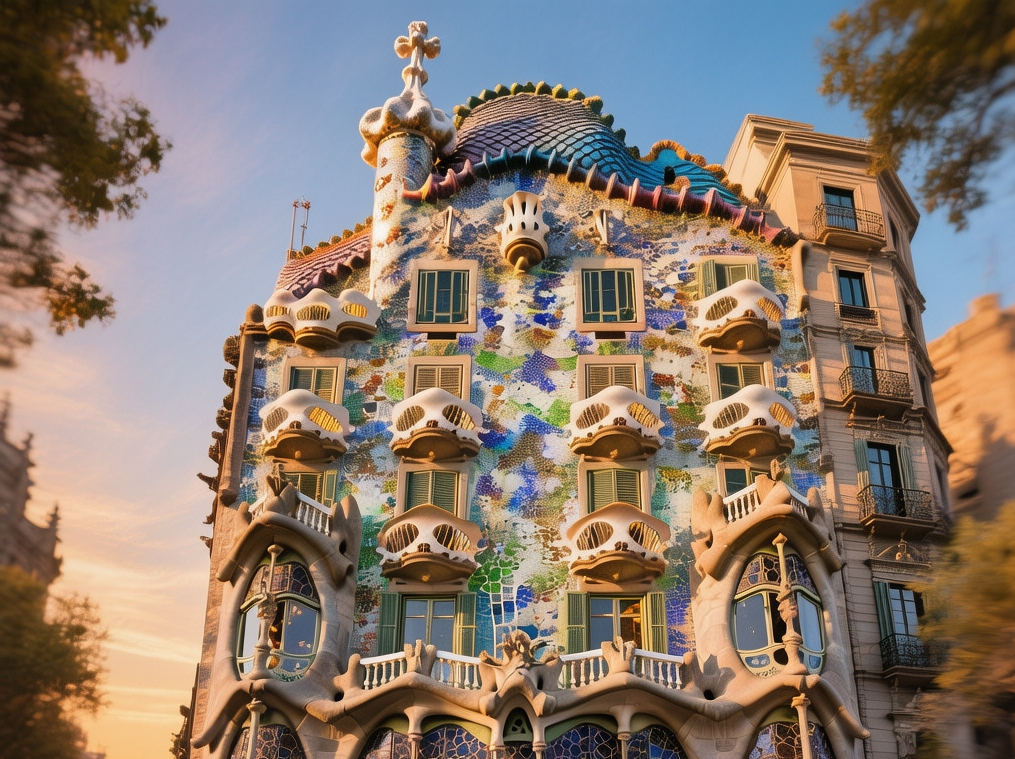
Casa Batlló Organic Architecture Meets Mediterranean Light
Golden hour strikes Passeig de Gràcia at precisely 6:18 p.m., igniting Antoni Gaudí’s undulating façade in liquid amber—sunlight dances across 36,000 hand-glazed ceramic tiles in cobalt, emerald, and ochre, transforming the building into a living dragon’s spine stretching 18 meters (59 feet) along Barcelona’s grand boulevard; you trace your fingers along the bone-like balcony railings forged from cast iron, feeling the cool texture as the scent of jasmine from hidden courtyards mingles with distant flamenco rhythms from Plaça Catalunya; commissioned in 1904 by textile magnate Josep Batlló to transform a dull 1877 structure, Gaudí spent two years reimagining this 1,200-square-meter mansion as an underwater grotto where light filters through skylights like ocean waves—every element engineered without straight lines to embody nature’s fluidity. Today, as overtourism strains its fragile mosaic surfaces with 1.2 million annual visitors, Casa Batlló matters profoundly—not as mere photo backdrop but as testament to Gaudí’s revolutionary vision where architecture breathes with Mediterranean rhythms, demanding mindful engagement in this pivotal 2026 centenary year.
Why Casa Batlló Embodies Organic Innovation
Gaudí didn’t renovate a house—he engineered a stone organism breathing with Mediterranean life. Commissioned in 1904 by industrialist Josep Batlló, this transformation of Emilio Sala’s 1877 structure solved multiple challenges through biomimicry: the undulating roof mimics a dragon’s spine (inspired by Saint George legend), while the façade’s mosaic trencadís technique used broken ceramic shards from local factories to create shimmering skin that changes color with daylight angles. Structurally, Gaudí eliminated load-bearing walls—replacing them with a central patio acting as “lungs” for natural ventilation, and columns branching like tree trunks to support floors through compression rather than steel. The 18-meter-wide (59-foot) façade features balconies shaped like Venetian masks or skeletal remains, their cast-iron railings forged to resemble grasping hands. Inside, the main floor’s oval windows maximize light diffusion through stained glass transitioning from deep blue (top) to golden yellow (bottom)—simulating ocean depths. After Gaudí’s 1926 death, the building narrowly escaped demolition during Franco’s regime; saved by UNESCO designation in 1984, it underwent a €22 million restoration (2001–2004) using original techniques. Today, with completion of the 2024–2026 “Gaudí Dome” project adding immersive technology to the attic, Casa Batlló stands as testament to how radical innovation can honor tradition while embracing future technologies.
The Best Time to Experience Casa Batlló
Secure timed entry between 8:00 and 9:30 a.m. during April 10–May 15 or September 18–October 22, when temperatures range 17–23°C (63–73°F) and humidity stays below 60%, allowing comfortable exploration without summer crowds. Morning light through east-facing stained glass creates dramatic color gradients on interior walls between 8:30–10:00 a.m., while sunset illuminates the façade’s mosaic tiles in fiery reds after 6:30 p.m. Avoid June 15–August 25 entirely—temperatures exceed 30°C (86°F) with heat indices reaching 36°C (97°F), and queues stretch beyond 60 minutes despite pre-booked tickets; July 20–August 10 is particularly problematic during Spanish national holidays. Winter visits (November–February) offer shortest lines but limited daylight for mosaic photography and frequent rain; the site closes at 7:00 p.m. in January. Crucially, book the "Sunrise Access" slot at 7:30 a.m. via the official website (casabatllo.es)—this grants 30-minute exclusive access before general opening, allowing unobstructed photography of light patterns on the façade. Always verify current restoration schedules and special closures at the official portal minimum 48 hours before visiting.
Approximate Budget for a 7-Day Barcelona Trip with Casa Batlló Focus (2026)
These estimates reflect projected 2026 pricing with 4.1% annual inflation applied to 2024 baselines per Spain’s National Statistics Institute (INE) tourism indices and Barcelona’s municipal fiscal reports. Budget assumes moderate comfort with Eixample district lodging, authentic Catalan dining, and comprehensive Gaudí access.
- Accommodation: €180–€260 per night in Eixample district (2-minute walk to Casa Batlló); €130–€190 in Gràcia (15-minute metro ride via line 3). Specific options: Hotel Casa Bonay (€220/night with rooftop terrace), El Palace Barcelona (€250/night with Gaudí suite), or budget alternative Hostal Grau (€90/night private room). SUBTOTAL: €1,260–€1,820 for 7 nights.
- Food: €75 per person daily average—breakfast €10 (pa amb tomàquet €4.50, café con leche €3.50 at Federal Café), lunch €28 (fideuà €18 at Can Solé, vermouth €4/glass), dinner €37 (suquet de peix €26 at Els Pescadors, Priorat wine €10/glass). Includes daily pastry budget (€5 at Forn de Sant Jaume). SUBTOTAL: €525 per person for 7 days.
- Transportation: €48 total—€12 for 48-hour Hola BCN! card (unlimited metro/bus), €8 metro line 3 roundtrip from El Prat Airport, €28 taxi supplement for late-night returns via official black cabs (fixed €35 airport rate). SUBTOTAL: €48.
- Attractions: €110 per person—€35 Casa Batlló + Gaudí Dome (booked direct), €18 Sagrada Família, €12 Park Güell Monumental Zone, €16 Museu Picasso, €14 MACBA contemporary art museum, €15 Palau de la Música Catalana tour. SUBTOTAL: €110 per person.
- Miscellaneous: €145 per person—€55 guided Gaudí walking tour (including Casa Batlló attic access), €35 dinner at Michelin-starred Disfrutar, €30 official Casa Batlló ceramic tile replica, €25 emergency horchata refuels at Sirvent. SUBTOTAL: €145 per person.
Total estimated cost: €2,088–€2,648 per person
7 Essential Casa Batlló Experiences
- Sunrise Façade Contemplation: Book the 7:30 a.m. "Sunrise Access" ticket via casabatllo.es—arrive by 7:15 a.m. to enter before general crowds. Position yourself directly opposite the main entrance as morning light floods across the mosaic tiles, igniting cobalt blues and sunflower yellows in liquid patterns. Duration: 45 minutes. Essential because this solitude reveals Gaudí’s chromatic dialogue with Mediterranean light before crowds obscure details.
- Dragon Spine Roof Climb: Ascend the 140-step staircase to the roof between 8:30–9:30 a.m. when eastern views are clearest. Trace your fingers along the scale-like tiles covering chimneys shaped like medieval knights’ helmets. At the peak, observe how the 18-meter undulation creates perfect drainage channels disguised as artistic elements. Duration: 35 minutes. Essential because this vantage point reveals Gaudí’s fusion of beauty and utility—roof as both sculpture and hydraulic system.
- Oceanic Main Floor Immersion: Enter the noble floor at 9:00 a.m. when ambient noise is minimal. Stand beneath the central skylight where light filters through blue-to-yellow stained glass simulating ocean depths. Observe how Gaudí eliminated corners—walls curve seamlessly into ceilings through custom plasterwork. Duration: 40 minutes. Essential because this space embodies Gaudí’s philosophy that straight lines don’t exist in nature.
- Attic Structural Revelation: Explore the attic between 10:00–11:00 a.m. before crowds peak. Walk beneath the 60 catenary arches resembling ribcages—each constructed from brick without mortar, relying on pure compression physics. Note how the new "Gaudí Dome" projection maps his original sketches onto the vaults. Duration: 30 minutes. Essential because this engineering marvel demonstrates how Gaudí transformed structural necessity into poetic form.
- Well Courtyard Acoustics: Descend to the central patio at 11:00 a.m. when sunlight creates perfect gradients on blue-tiled walls. Whisper at the base—the acoustics engineered by Gaudí carry your voice to the top floor 15 meters above. Observe how tile shades deepen downward to compensate for reduced light. Duration: 25 minutes. Essential because this demonstrates Gaudí’s mastery of both visual and auditory spatial design.
- Evening Illumination Spectacle: Return to the exterior between 8:00–9:00 p.m. when the façade’s LED system activates, projecting dynamic light shows that reinterpret Gaudí’s motifs. Position yourself at the designated viewpoint marked by a bronze compass rose on Passeig de Gràcia. Duration: 30 minutes. Essential because this modern interpretation honors Gaudí’s belief that architecture should evolve with technology.
- Private Terrace Sunset: Book the €85 "Noble Floor Dinner" experience via casabatllo.es/fundacio—held monthly on first Saturdays. Dine on the private terrace overlooking Passeig de Gràcia as sunset aligns perfectly with the dragon spine roof. Includes safety gear and keepsake tile fired in the on-site kiln. Requires advance reservation 90 days ahead; limited to 12 participants. Essential because this exclusive access transforms abstract admiration into embodied understanding of Gaudí’s spatial poetry.
3 Hidden Gems Most Travelers Miss
- Original Workshop Archive: Located in the basement beyond the main exhibits—request access at the information desk by mentioning “archivo original.” This reconstructed workspace displays Gaudí’s string models, plaster casts, and drafting tools used to calculate catenary curves. Visit Wednesday afternoons when conservation students demonstrate rope-model techniques. Free with admission; photography permitted without flash. Special because these fragile artifacts reveal how analog methods birthed digital-age architecture.
- Secret Garden of the Four Elements: Overlooked because it’s accessible only via the attic exit—after descending, follow the unmarked path left of the gift shop through an iron gate marked “Jardí Tancat.” This private garden features four sculpted elements (water fountain, earth mound, air chimes, fire brazier) surrounded by medicinal herbs Gaudí specified for their symbolic significance. Open 10:00 a.m.–2:00 p.m. Tuesday–Thursday; ring the bell for entry. Special because this contemplative space offers the only legal vantage point to photograph Casa Batlló’s towers without street clutter.
- Trencadís Restoration Studio: Book the €45 “Mosaic Masterclass” via casabatllo.es/en/activities—held monthly on first Saturdays. Under master artisan supervision, learn trencadís techniques using authentic ceramic shards in the actual restoration workshop adjacent to the façade. Includes safety gear and keepsake tile fired in the on-site kiln. Requires advance reservation 60 days ahead; limited to 10 participants. Special because this tactile engagement transforms abstract admiration into embodied understanding of Gaudí’s sustainable material philosophy.
Cultural & Practical Tips
- Ticket booking protocol: Reserve tickets minimum 60 days ahead via official portal—third-party vendors add 25–40% surcharges with identical access. Select “with Gaudí Dome” option during purchase as upgrades aren’t available onsite.
- Photography ethics: No tripods or drones (€200 fines); smartphone photography permitted but avoid blocking aisles during peak hours. Best shots occur 8:00–10:00 a.m. when east-facing light creates maximal color contrast on the façade.
- Essential Catalan phrases: “Bon dia” (bone DEE-uh) for good morning; “Gràcies” (GRAH-see-es) for thank you; “On és el lavabo?” (ohn ES el lah-VAH-boh) for restroom location.
- Footwear requirements: Wear closed-toe shoes with grip—mosaic pathways become slippery when dew-covered or after rain. Avoid high heels that damage historic surfaces.
- Pickpocket prevention: Highest risk at metro station L3 Passeig de Gràcia exit—use cross-body bags with zippers facing inward. Municipal police maintain visible presence but cannot monitor all pockets during peak hours (10:00 a.m.–2:00 p.m.).
- Weather considerations: Summer humidity (70–80%) intensifies heat inside stone structure; winter rains create muddy conditions on unpaved paths. Always carry water—free refill stations available near museum exit.
- Conservation awareness: Do not touch mosaic surfaces—oils from skin accelerate tile deterioration. Report any loose fragments to staff immediately; each shard represents irreplaceable craftsmanship.
Conclusion: Travel with Curiosity, Not Just Cameras
To stand before Casa Batlló is to witness architecture breathe with Mediterranean rhythms—a place where every curve, tile, and shadow embodies Gaudí’s revolutionary vision. Your €35 ticket directly funds the 2024–2026 conservation initiative protecting 36,000 fragile mosaic fragments from overtourism’s wear; each respectful step on designated pathways honors the artisans who transformed broken ceramics into enduring poetry. In an age of digital saturation, this masterpiece teaches presence: the dragon spine roof invites lingering, not just leaning for selfies; the oceanic main floor demands listening to light’s silent symphony. Gaudí knew straight lines don’t exist in nature—and neither do instant understandings of true artistry. Choose curiosity over consumption—trace the balcony railings’ bone-like forms with your eyes rather than your fingers; decode the façade’s marine patterns through patient observation rather than rushed snapshots. Your responsibility isn’t passive viewing but active stewardship—carrying forward Gaudí’s vision that buildings should harmonize with nature, not dominate it. Let Casa Batlló recalibrate your senses; understand that the most profound journeys measure not photos taken, but connections made between human creativity and the eternal Mediterranean light.