
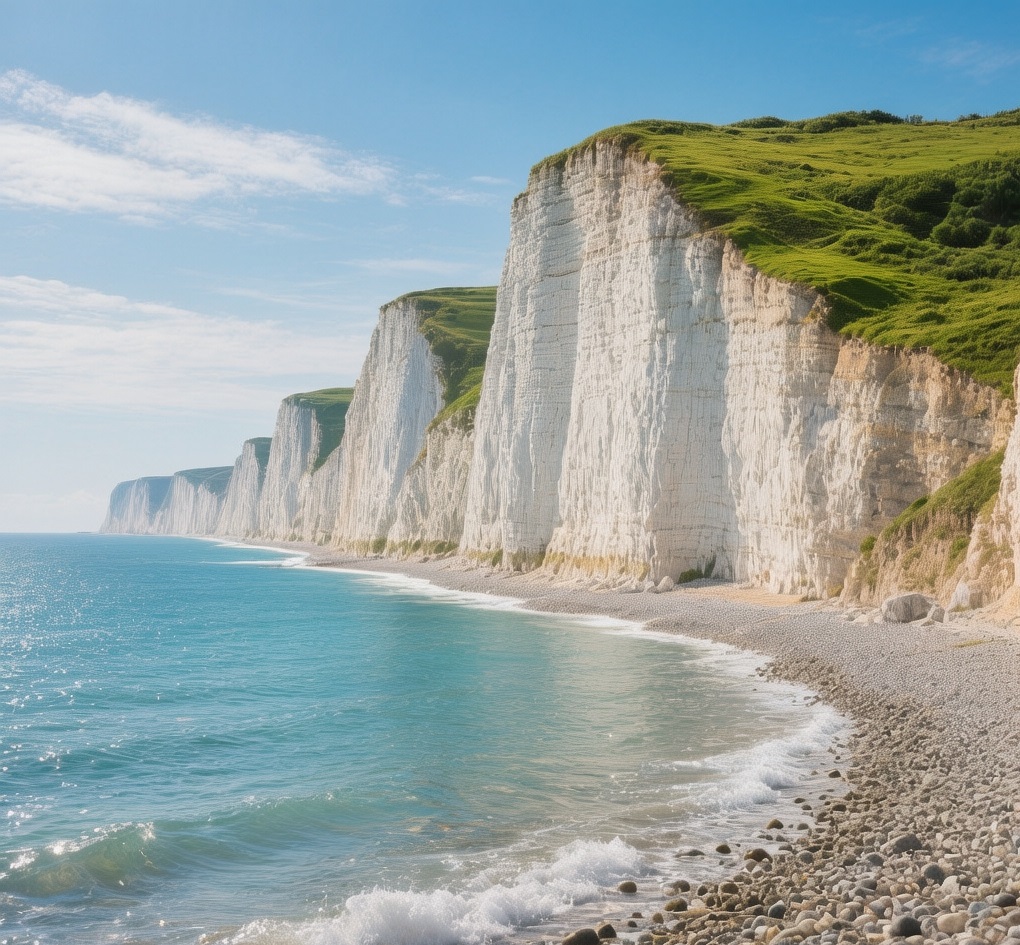
Dieppe Cliffs Chalk Majesty Meets the English Channel
The late afternoon sun gilds the Côte d’Albâtre—Alabaster Coast—as you stand on the grassy promontory just east of Dieppe. The air is sharp with salt and the faint, mineral scent of ancient stone. Below, the English Channel crashes against the base of the cliffs in a relentless, rhythmic roar, sending plumes of white spray skyward. These are not mere hills, but a geological fortress of Upper Coniacian chalk, their sheer faces rising to a staggering 106 meters (348 feet)—the highest in France [[6]]. Layers of dark flint are embedded within the white rock like veins of time, a testament to an ocean that covered this land over 85 million years ago. In 2026, as our world feels increasingly fragmented, the Dieppe cliffs offer a profound anchor—a place of raw, elemental power that reminds us of nature’s enduring scale and the deep, slow history written in its very bones.
Why Dieppe Cliffs Embodies Geological Grandeur
The Dieppe cliffs are the crowning glory of the 120-kilometer-long Côte d’Albâtre, a stretch of coastline defined by its dramatic sedimentary formations [[1]]. Their primary composition is a soft, white chalk from the Late Cretaceous period, specifically the Coniacian stage, which dates back approximately 89 to 86 million years [[2]]. This chalk is not uniform; it is interspersed with hard, dark bands of flint, a form of silica that formed on the ancient seafloor. These flint beds are crucial to the landscape’s character—they erode more slowly than the surrounding chalk, creating the cliffs’ distinctive stepped profile and providing the shingle for Dieppe’s famous pebble beaches [[7]]. The cliffs fulfill a vital need for the modern traveler: they are a living classroom, a place where the immense forces of geology and time are made visible and tangible. They stand as a natural monument to erosion and resilience, constantly reshaped by the sea yet maintaining their awe-inspiring height. For scientists and engineers, they are a critical site for studying coastal retreat and landslide dynamics, with some sections receding at measurable rates due to their composite structure [[4]].
The Best Time to Experience Dieppe Cliffs
To witness the cliffs in their most serene and spectacular light, plan your visit for the window of May 18–June 12, 2026. During these weeks, the risk of heavy rain is lower, and the coastal path is lush with spring wildflowers. Daytime temperatures are a comfortable 15°C to 18°C (59°F–64°F), perfect for long walks without the summer heat [[21]]. The absolute best time of day is 5:30–7:30 PM, when the setting sun casts a golden glow on the white chalk, making the entire coastline appear to burn with a soft, ethereal light. You must avoid the peak summer months of July and August, when crowds can congest the narrow paths and temperatures can feel muggy, reaching up to 22°C (72°F) [[21]]. Winter visits, from November to March, are strongly discouraged due to high winds, frequent rain, and the danger of landslides on the saturated cliffs. For the most current information on trail closures or weather warnings, always check the official Dieppe-Normandie Tourist Office website before your visit: uk.dieppetourisme.com [[16]].
Approximate Budget for a 7-Day Trip (2026)
This budget is calculated for a mid-range, self-catering trip to Dieppe in 2026, accounting for a 4% annual inflation rate as per INSEE standards. It assumes a focus on the town and its immediate natural surroundings.
- Accommodation: €70–€100 per night for a clean, well-located 2-star hotel or guesthouse in the town center or near the port. Staying in the heart of Dieppe provides easy walking access to the cliffs.
- Food: €40 per day. Breakfast (€6): a coffee and a pain au chocolat from a local boulangerie. Lunch (€12): a simple seafood platter or a hearty bowl of moules-frites (mussels and fries). Dinner (€22): a three-course meal at a traditional Norman restaurant featuring dishes like duck à l’orange or fresh scallops.
- Transportation: The most cost-effective way to reach Dieppe is by train from Paris (Gare Saint-Lazare to Dieppe, approximately 2 hours). A one-way ticket costs around €25 if booked in advance. Local transport is minimal; the town and cliffs are best explored on foot. Renting a car for a day to explore the wider Alabaster Coast would cost about €50.
- Attractions: Access to the cliff paths is free. However, a visit to the Château de Dieppe museum costs €7.50 for adults. A guided coastal walk with a local naturalist is a worthwhile splurge at €25 per person.
- Miscellaneous: Allow €50 for souvenirs (e.g., a jar of local apple jelly, a postcard set of the cliffs) and small experiences like a boat tour from the harbor to see the cliffs from the sea (€20).
Total Estimated Cost: €700–€900 for one person for 7 days.
5 Essential Dieppe Cliffs Experiences
- Walk the Promenade du Casino to the Eastern Cliffs: Start your journey at the iconic casino and follow the paved promenade east. The path gradually ascends, offering ever-more-dramatic views of the chalk walls. Go in the late afternoon to watch the light transform the white rock into a canvas of gold and rose.
- Descend to the Plage du Petit Berck: At low tide, you can carefully make your way down the public steps to this secluded pebble beach nestled directly beneath the cliffs. Feel the cool, smooth flint stones underfoot and listen to the amplified echo of the waves against the towering wall above you.
- Visit the Château de Dieppe Museum: Perched on a rocky spur overlooking the harbor, this 15th-century castle houses a fascinating museum. Its upper terraces provide a unique, elevated perspective of the western end of the cliffs and the vast expanse of the English Channel.
- Take a Boat Tour from the Harbor: See the cliffs from their most majestic angle—the sea. Local operators offer 1-hour tours that glide along the base of the 106-meter walls, allowing you to appreciate their true scale and spot seabirds nesting in the crevices.
- Photograph the Cliffs at Golden Hour: For photographers, the magic happens just before sunset. Set up your tripod on the headland near the old lighthouse for a panoramic shot where the white cliffs meet the deep blue water, often with a dramatic sky as a backdrop.
3 Hidden Gems Most Travelers Miss
- The Val de Scie Footpath: This quiet, wooded valley path runs inland from the town and offers a completely different perspective, looking up at the backs of the cliffs. It’s missed because it’s not on the main coastal route. Access is free from the D925 road; go in the morning for birdwatching opportunities.
- The Chapel of Notre-Dame-de-Bon-Secours: A tiny, whitewashed chapel perched on a cliff edge just west of the main town. It’s a place of pilgrimage and peace, often empty of tourists. To find it, follow the GR21 coastal trail west for about 2 kilometers from the port.
- The View from Cap d’Ailly: A short drive west of Dieppe, this is the highest point on the entire Alabaster Coast. The vista from here is unparalleled, stretching for miles in both directions. Most visitors stay in town, so this spot remains wonderfully quiet. Go at sunrise for a truly solitary experience.
Cultural & Practical Tips
- Respect the cliffs’ fragility: Never climb on the chalk faces or attempt to collect flint. The rock is soft and unstable, and your safety—and the preservation of the site—depends on staying on marked paths.
- Check the tide times: If you plan to walk on any beach at the cliff base, always consult the tide schedule. The sea can come in quickly, cutting off your return path.
- Learn a few key phrases: A simple “Bonjour” (bon-zhoor) and “Merci” (mair-see) will be warmly received by locals.
- Dress in layers: The weather on the coast is notoriously changeable. Even on a sunny day, the wind whipping off the Channel can be biting. A waterproof windbreaker is essential.
- Photography etiquette: While photography is encouraged, be mindful of other visitors on the narrow paths. Use a telephoto lens to capture details of the cliffs without getting too close to the edge.
Conclusion: Travel with Presence, Not Just Passports
To stand before the Dieppe cliffs in 2026 is to be humbled. Their silent, monumental presence is a powerful antidote to the noise and haste of modern life. This is not a place for a quick selfie; it is a sanctuary for deep observation and quiet contemplation. By traveling with presence—by feeling the wind, listening to the sea, and truly seeing the intricate layers of time in the rock—you participate in a form of respectful tourism that honors the landscape. Your mindful visit supports the local community that stewards this fragile ecosystem and ensures that these magnificent chalk sentinels will continue to inspire awe for generations to come. Slow down. Breathe. Let the grandeur of the Alabaster Coast wash over you.