
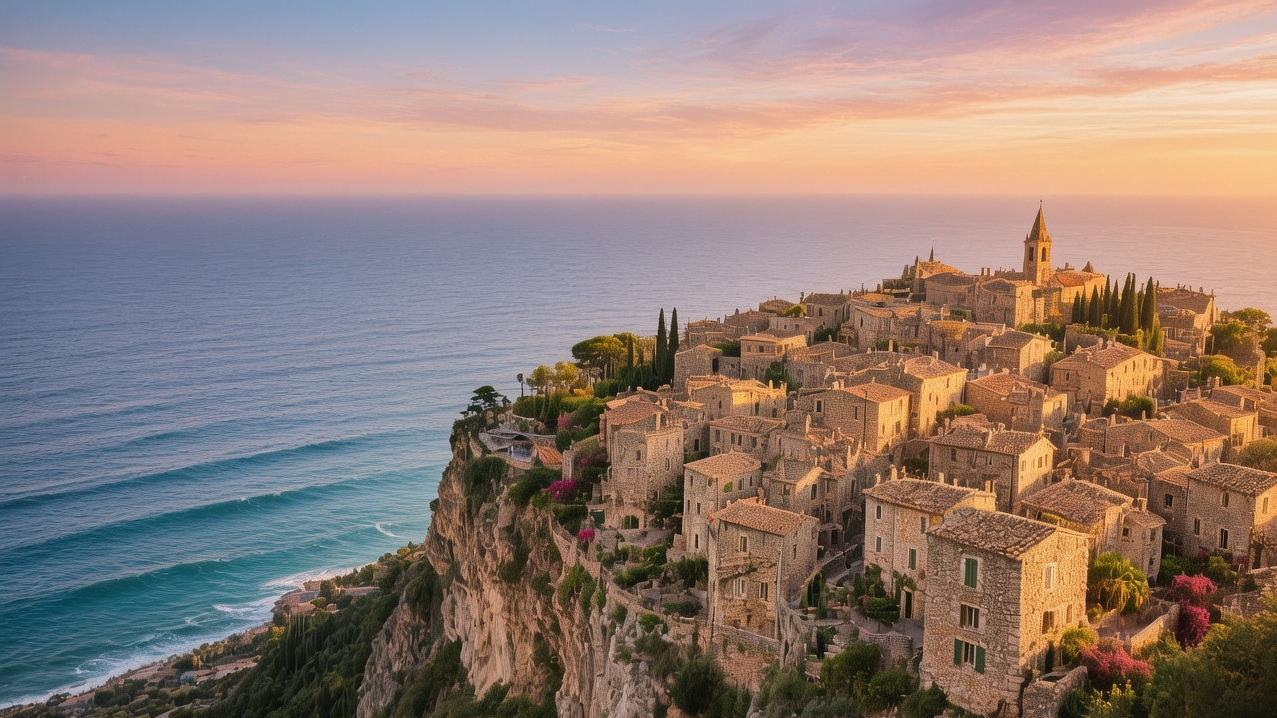
Èze Hilltop Village : Stone, Sky, and Mediterranean Light Converge
The climb begins not with a map, but with breath. As you ascend the steep, cobbled pathway from Èze-sur-Mer, the scent of jasmine and sea salt thickens with every switchback. Stone walls draped in bougainvillea give way to narrow passages where sunlight filters through archways worn smooth by eight centuries of footsteps. Then, cresting the final rise, the world falls away: the Mediterranean unfolds in impossible shades of turquoise and cobalt, Cap Ferrat curves like a sleeping dragon to the west, and the Alps shimmer as a faint white line on the northern horizon. This is not a stage set but a living village—where 700 residents still navigate staircases too narrow for cars, where gardeners tend century-old cacti on terraces suspended over the sea, and where every doorway frames a vista that once inspired Nietzsche's philosophical wanderings. In 2026, Èze hilltop village endures not as relic, but as testament to human resilience perched between sky and sea.
Why Visit Èze Hilltop Village?
Èze hilltop village represents more than postcard perfection—it embodies the French Riviera's most dramatic dialogue between geology and human ingenuity. Perched 429 meters above the Mediterranean on a rocky spur of the Esterel Massif, this medieval village evolved as a strategic fortress after Saracen raids in the 8th century. Unlike coastal resorts shaped by tourism, Èze's architecture emerged from necessity: houses built back-to-back created defensive walls, vaulted passageways channeled mistral winds for natural cooling, and cisterns carved into bedrock captured rainwater during sieges. Its survival through centuries of conflict—including near-total destruction during the War of the Austrian Succession—speaks to profound resilience. Today, the village maintains authentic function: the 14th-century Notre-Dame-de-l'Assomption church still holds Sunday Mass, local artisans craft perfumes in vaulted cellars using techniques unchanged since the 1920s, and the exotic garden cultivated by Swedish botanist Gustav Eiffel's grandson remains a living laboratory of Mediterranean-adapted flora. This continuity creates rare depth—where beauty serves purpose rather than performance.
The Best Time to Visit Èze Hilltop Village
For optimal conditions—golden light on stone pathways, manageable crowds, and comfortable climbing temperatures—visit between April 20 and May 15 or September 18–October 5. These windows deliver daytime temperatures of 17–23°C (63–73°F), creating ideal conditions for ascending the 300-step Chemin du Nietzsche without summer's oppressive heat. Mornings between 8:00–9:30 AM offer the most dramatic illumination: low-angle light transforms limestone walls to honey-gold while casting long shadows that accentuate architectural details without harsh glare—a critical window before tour buses arrive from Nice. September provides a second excellent opportunity: warm days, departing crowds, and autumn light that intensifies the terracotta tones in weathered rooftops while sea temperatures peak at 22°C for coastal swimming below. Avoid July 15–August 20 when temperatures exceed 32°C (90°F), narrow passages become uncomfortably congested, and the scent of sun-warmed stone mixes with overwhelming perfume samples from crowded boutiques. Note that winter months (November–February) offer stark beauty and complete solitude, though many artisan workshops close Monday–Wednesday and mistral winds can exceed 80 km/h.
Approximate Budget for a 7-Day Trip (2026)
Based on 2025 benchmarks adjusted for 4% inflation (per INSEE and Côte d'Azur Tourism Board projections), here's a realistic mid-range budget for a Riviera-focused itinerary:
- Accommodation: €120–€170 per night for a family-run guesthouse in Èze Village or a boutique hotel in Èze-sur-Mer with shuttle service—essential for experiencing village atmosphere after day-trippers depart.
- Food: €95–€115 per day—breakfast at lodging, lunch of socca and salade Niçoise at village café (€24–€30), dinner featuring locally caught sea bream with Bellet wine (€55–€70).
- Transportation: €35 for a 7-day Zou! Pass (covers regional buses). Bus 83 from Nice to Èze-sur-Mer: €2.30 one-way (25 minutes). Village shuttle from lower town: €2 round-trip.
- Attractions: Jardin Exotique entry: €7.50. Fragonard perfume factory tour: free. Chapel of Sainte-Croix visit: free. Ferry to Cap Ferrat: €14. Allocate €90 total.
- Miscellaneous: €60 for artisanal olive oil from Moulin de la Presse, locally distilled rosemary eau-de-vie, or handmade santons from Place du Château market.
Total Estimated Cost: €1,250–€1,750 for seven days, excluding international flights.
5 Essential Èze Hilltop Village Experiences
- Jardin Exotique d'Èze: The village's crown jewel—a terraced garden clinging to the cliff edge with 600+ cactus and succulent species. Visit at 8:30 AM when morning light ignites the spines of golden barrel cacti against sea views.
- Chemin du Nietzsche: The philosopher's contemplative path descending 300 steps to Èze-sur-Mer—walk slowly at dawn to experience the same solitude that inspired his meditations on eternal recurrence.
- Place du Château: The village's main square where plane trees shade café tables—observe daily life as elderly residents play pétanque and shopkeepers arrange displays of lavender and olive wood.
- Notre-Dame-de-l'Assomption: The 14th-century parish church with exposed stone walls and minimal restoration—sit quietly in a wooden pew to absorb centuries of whispered prayers.
- Panoramic Viewpoint (Rue du Château): The eastern terrace offering the Riviera's most dramatic vista—from Monte Carlo to Cap d'Ail—best experienced between 5:00–6:00 PM when alpenglow transforms the sea to liquid gold.
3 Hidden Gems Most Travelers Miss
- Rue du Temple Secret Passage: Behind No. 9, an unmarked archway leads to a hidden courtyard with a 12th-century cistern and views into private gardens where bougainvillea spills over ancient stone—locals call it "le jardin des philosophes."
- Atelier du Parfumeur: A working perfume laboratory hidden in a vaulted cellar at 4 Rue du Château—observe master perfumer Jean-Louis Perrodo blending scents using techniques unchanged since 1924 (open Wednesday mornings by appointment).
- Chapelle des Pénitents Blancs: A secluded 17th-century chapel accessible via stone staircase behind the tourist office—features rare frescoes depicting medieval penitential rites rarely shown to visitors.
Cultural & Practical Tips
- Footwear is Non-Negotiable: Cobblestones are uneven and polished smooth by centuries of use. Wear grippy-soled shoes with ankle support—sandals cause dangerous slips on steep passages, especially after morning dew.
- Respect Residential Spaces: Over 80% of buildings remain private homes. Never photograph interiors through windows or block narrow passages—many streets are less than 80cm wide and serve as essential thoroughfares.
- Learn Key Phrases: "Bonjour," "Merci," and "Une eau de senteur d'Èze, s'il vous plaît" (local scented water) show respect in this proudly Provençal community.
- Photography Protocol: Never use tripods on narrow streets—they obstruct passage and endanger residents. Best architectural shots captured between 8:00–9:30 AM when eastern light illuminates stone textures without crowds.
- Support Authentic Artisans: Purchase perfumes directly from Fragonard or Galimard workshops rather than souvenir shops—look for "Fabriqué à Èze" certification guaranteeing local production.
Conclusion: Travel with Vertical Reverence, Not Just a Camera
Èze hilltop village endures not as attraction to be consumed, but as lesson in vertical living—where every stone staircase represents adaptation to impossible terrain, and every terrace garden demonstrates harmony with scarcity. As a conscious traveler, your presence should honor this legacy: ascend slowly to appreciate the engineering that made this village survivable, support the dozen remaining families who maintain ancestral homes against commercial pressure, and understand that your footsteps tread ground where generations have measured time by sun position rather than clocks. Sit quietly on the eastern ramparts at dusk and watch light fade across the Mediterranean—the same light that illuminated Nietzsche's contemplations and medieval watchmen scanning for pirates. By approaching Èze not as backdrop for social media, but as sanctuary demanding quiet respect, you help ensure these stones continue to shelter not just history, but humanity—for those who recognize that true beauty resides not in perfection, but in the dignified persistence of life on the edge of sky and sea.