
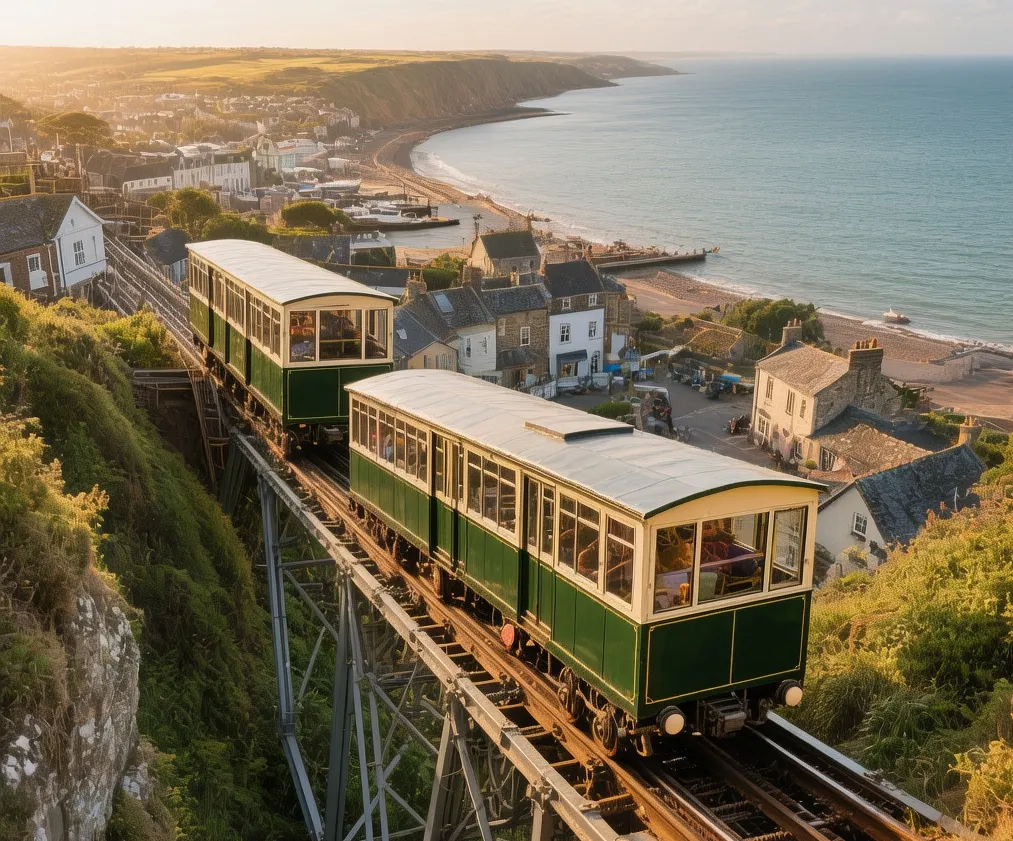
Lynton & Lynmouth Cliff Railway Victorian Engineering Meets Coastal Drama
Water gurgles through the ballast tanks as the car ascends—climbing 152 meters (500 feet) of sheer cliff face while the Bristol Channel spreads out below like a sheet of hammered steel. You stand inside the wooden carriage of the Lynton & Lynmouth Cliff Railway, the scent of old varnish and salt air mixing in the confined space, while the counterweight car descends from the summit station 396 meters (1,299 feet) away. Opened in 1890 by Sir George Croydon Marks, this water-balanced funicular solved a critical isolation problem for the twin towns, connecting the harbor village of Lynmouth to the clifftop resort of Lynton without steam or electricity. As you watch the landscape tilt through the window, listening to the rhythmic clank of the cable, you realize this place matters now more than ever: in an era of high-speed transit, the Lynton & Lynmouth Cliff Railway remains a testament to sustainable gravity-powered travel, preserving a unique Victorian heritage that continues to define North Devon's identity in 2026.
Why Lynton & Lynmouth Cliff Railway Embodies Engineering Heritage
The Lynton & Lynmouth Cliff Railway is not merely a tourist attraction; it is a functioning monument to 19th-century innovation. Built to connect two towns separated by a 152-meter (500-foot) vertical drop, the railway solved a logistical problem that had stifled local trade for centuries. The engineering relies on a simple yet brilliant water-balance system: each car holds a 700-gallon (3,180-liter) tank, and by filling the upper car with water from the West Lyn River, it becomes heavier than the lower car, pulling it up the 1-in-1.75 gradient. This technical design eliminated the need for external power sources, making it one of the most energy-efficient transport systems ever built.
Today, it fulfills a cultural need for connection to a slower, more deliberate pace of life. Managed by the Lynton & Lynmouth Cliff Railway Company, the site hosts over 150,000 annual visitors who ride the same cars as Edwardian tourists. The structure showcases Victorian ironwork and timber framing, creating a layered narrative of coastal adaptation. When you step onto the platform, you traverse a space where fishermen once hauled nets and where Victorian engineers marveled at the mechanics. The Lynton & Lynmouth Cliff Railway represents a continuous thread of community resilience, preserved by the very organization that now maintains the track against the corrosive power of the Atlantic salt air and the erosion of time.
The Best Time to Experience Lynton & Lynmouth Cliff Railway
To witness the Lynton & Lynmouth Cliff Railway in optimal atmospheric conditions, plan your visit between May 18 and June 12. During this window, temperatures average 13-18°C (55-64°F), and daylight extends until 9:15 PM, maximizing time for the ride and coastal walks. The best light for photography occurs between 7:30-9:30 AM when morning mist lifts off the channel, and 6:00-8:00 PM for golden hour illumination on the white cars. Visiting early also allows you to ride before tour coaches arrive from Barnstaple, typically between 11:00 AM and 3:00 PM.
Autumn offers a secondary window—specifically September 10 to October 15—when summer crowds dissipate and the heathland turns russet and gold. Temperatures remain mild at 12-17°C (54-63°F), though daylight hours shorten rapidly. Avoid July 25 to August 25 when school holidays push visitor numbers above 1,000 daily, creating queues at the stations and limited seating in cafes. Winter months (November-February) offer solitude but challenging conditions; the railway operates on a reduced schedule, and sunset occurs as early as 4:05 PM in December. For current operating hours and maintenance notices, .
Approximate Budget for a 7-Day Trip (2026)
Exploring the Lynton & Lynmouth Cliff Railway and the wider Exmoor coast requires moderate budgeting, as North Devon commands premium prices during peak season. The following budget reflects mid-range travel for one person in 2026, accounting for approximately 4.5% UK inflation (ONS data, January 2026). Prices assume a base in Lynton or Lynmouth for optimal access to the railway and coastal paths.
- Accommodation: £90-£150 per night for a B&B or guesthouse in Lynton town center (6 nights = £540-£900). Budget options: £50-£70 for hostels in Lynmouth or camping at Valley of Rocks.
- Food: £50-70 per day total • Breakfast: £10-15 (Full English at The Rising Sun) • Lunch: £15-20 (Fish and chips at The Rock House) • Dinner: £25-35 (Seafood platter at The Castle Hotel or The Old Ship)
- Transportation: • Train London Paddington to Barnstaple + Bus 300: £75-130 return • Local bus (Route 300): £4.50 day pass • Car rental (recommended): £65/day plus fuel £1.58/liter • Parking at Lynton: £8/day (March-October)
- Attractions: • Cliff Railway Return Ticket: £5.50 • Valley of Rocks Entry: Free • Watersmeet House (National Trust): £12 • Free: Coastal path, harbor view, churchyard
- Miscellaneous: • Ordnance Survey Explorer Map 94: £10.99 • Local artisan souvenirs: £25 • Travel insurance: £40-60 for week • Waterproof gear rental: £20
Total estimated cost: £1,400-£1,750 for 7 days (excluding international flights)
5 Essential Lynton & Lynmouth Experiences
- Ride the Cliff Railway at Sunrise: Arrive at the Lower Station by 8:00 AM to experience the climb before crowds. The view encompasses the harbor and the Bristol Channel. Bring a windbreaker; exposure at the summit creates wind chill 5°C below valley temperatures. Spend 20 minutes photographing the cars before shops open. This experience connects you to the daily rhythm of the Victorian commuters.
- Walk the Valley of Rocks: Dedicate 90 minutes to the inland path from the Upper Station. The route climbs 100 meters to clifftops offering panoramic views of the sea stacks. The scent of gorse and thrift fills the air. Wear sturdy shoes; paths are uneven and exposed. This experience connects the railway to the wider geological landscape of the North Devon Heritage Coast.
- Visit the Railway Museum: Located at the Upper Station, this small exhibit houses photographs and models of the construction. Entry is included with ticket. Spend 30 minutes examining the archives. The scent of old paper and wood fills the room. Open 10:00 AM-5:00 PM daily. This context enriches your ride, showing the progression from concept to the longest water-balanced railway in the world.
- Explore Lynmouth Harbor: Walk down from the Lower Station to the waterfront. The harbor is 200 meters long and backed by Victorian buildings. Spend 60 minutes watching the fishing boats. Best visited at high tide when the water reaches the quay. This experience provides a tangible connection to the maritime industry that necessitated the railway.
- Hike to Watersmeet: Take the bus or walk 3 kilometers east to this National Trust property. The gorge features a waterfall and ancient oak trees. Entry is £12. Spend 90 minutes walking the riverside paths. The sound of water rushing over stones is deafening after rain. This experience demonstrates the natural beauty that drew Victorian tourists to the area initially.
3 Hidden Gems Most Travelers Miss
- Rhenish Tower: While crowds cluster at the stations, this 19th-century folly 1 kilometer west remains surprisingly quiet. Access via the footpath from Lynton (parking at SS725485). The tower offers a secluded view over the valley. Visit between 3:00-5:00 PM when light hits the stone. No facilities exist—bring water. The National Trust notes this area has high historical interest due to its connection to the local estate.
- Countisbury Church: Located 2 kilometers east, grid reference SS735475, lies a hilltop church with panoramic views. Access via a public footpath from the B3223 road. The churchyard offers a raw view of the coastline. Visit during weekday mornings when the site is empty. No facilities exist—bring snacks. This spot demonstrates the spiritual history of the headland, offering a view of the railway from above.
- East Lyn River Path: Contact the visitor center (+44 (0)1598 753486) for access updates to this riverside trail. The site features quiet pools and woodland. Access is restricted to footpath only; no vehicles. The space offers a tangible connection to the quieter side of the valley. This site reveals the acoustic properties of the river, showing how the water moves without the noise of the sea.
Cultural & Practical Tips
- Respect the queue: The cars hold 40 passengers each. Follow staff instructions regarding boarding. Keep voices low in the carriage. The Company reports 5-10 incidents annually due to visitors blocking doors.
- Understand the terrain: Lynton is steep and cobbled. Check www.cliffrailwaylynton.co.uk for weather warnings. Never run on wet stones. If paths are closed, respect the barriers. The coastguard monitors the area closely.
- Leave no trace: Remove all litter, including biodegradable items. The Town Council collects 8 tonnes of waste annually from the stations. Do not remove stones or plants—this violates the Wildlife and Countryside Act 1981. Photograph specimens in situ instead.
- Learn local terminology: "Funicular" (cable railway); "Ballast" (water tank); "Gradient" (slope). Using these terms shows respect for engineering heritage and helps guides assist you better during tours.
- Photography guidelines: Tripods are permitted on the platforms but restricted inside the cars during busy periods. Drone use requires written permission from the Company and Civil Aviation Authority—apply 6 weeks in advance. Respect other visitors; do not block pathways for extended shoots during peak hours (11:00 AM-3:00 PM).
- Weather preparedness: The cliff is exposed; wind chill is common even in summer. Pack waterproof layers; Devon showers are sudden. Wear sturdy shoes with grippy soles—granite becomes slippery when wet. Sun protection is essential; reflection from sea increases UV exposure by 25%.
- Accessibility considerations: The railway is wheelchair accessible with assistance. The stations have step access. Alternative viewing exists from the harbor. Request an accessibility map at the ticket office upon arrival.
Conclusion: Travel with Respect, Not Just Consumption
The Lynton & Lynmouth Cliff Railway does not exist merely to be ridden—it exists to be understood as a living piece of history. When you step into these cars in 2026, you are not observing a static museum; you are entering a space where water still powers the ascent and gravity still guides the descent. The engineers who laid the track are gone, but their calculations remain embedded in the gradient. The passengers who marveled at the view are gone, but their footsteps still echo on the platforms. This is not heritage frozen in amber—it is heritage living, breathing, enduring.
So slow down. Sit on the harbor wall for ten minutes without your phone. Listen to the wind that once carried the sounds of sailing ships and now carries the laughter of families. Buy your lunch from a café whose owners pay rates that support the local community. Donate to the Railway Preservation Fund rather than purchasing plastic souvenirs. Leave only footprints on wooden platforms, take only memories of water and stone, carry home only the profound understanding that some things—engineering, community, natural beauty—cannot be rushed, cannot be owned, can only be honored. The railway will still climb in 2126 if we choose stewardship over exploitation today.