
Oristano Sartiglia Festival Medieval Ritual Meets Carnival Magic
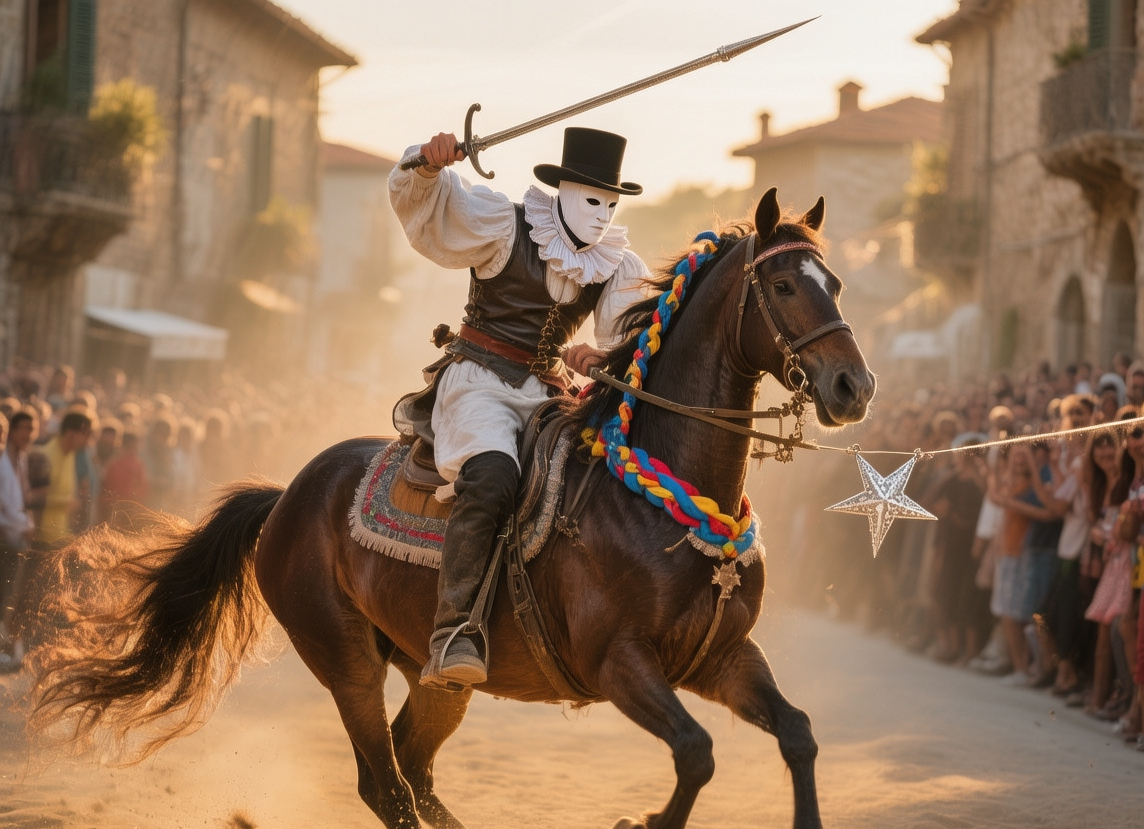
Golden hour transforms Corso Garibaldi into a river of masked riders as the Su Componidori—Oristano’s mysterious carnival king—gallops toward the suspended star. His black velvet mask hides all but intense eyes; his silver-embroidered jacket glints with 300-year-old symbols; and in his hand, a slender sword seeks the paper star that promises prosperity for Sardinia’s coming year. Around you, 15,000 spectators hold their breath as hooves thunder on cobblestones still damp from morning rain, the scent of myrtle and woodsmoke hanging in the 12°C (54°F) February air. This isn’t mere spectacle but sacred ritual—dating to 1433 when Spanish rulers merged Catalan equestrian games with pre-Christian fertility rites to combat plague and drought. The star’s seven points represent the days of creation; piercing it without tearing guarantees abundance. In 2026, as global festivals flatten into Instagram moments, the Sartiglia matters precisely because it refuses commodification—a living covenant where every gallop echoes centuries of resilience, and every mask conceals devotion, not performance.
Why Oristano Sartiglia Embodies Sacred Continuity
The Sartiglia solves a fundamental human need: how to confront uncertainty through collective ritual. Born in 1433 during a devastating plague, Oristano’s guilds (gremi) created this festival to invoke divine protection—merging Spanish equestrian traditions with Nuragic-era star worship. The technical precision is staggering: the paper star (sa stella), measuring exactly 30 centimeters in diameter with seven points representing creation days, hangs 3.2 meters above Corso Garibaldi; riders must spear its center while galloping at 25 km/h without breaking the fragile structure. The Su Componidori’s identity remains secret until the final moment—a tradition since 1600 requiring months of preparation: his mask is carved from olive wood by the Gremio dei Contadini (Farmers’ Guild); his jacket embroidered with silver thread depicting wheat sheaves and pomegranates (symbols of fertility); and his sword blessed by the Archbishop of Oristano. Historically, the festival served practical purposes: guilds demonstrated economic strength through elaborate costumes; successful star-piercing predicted harvest quality; and the post-ritual feast redistributed food to the poor. Today, the Sartiglia fulfills deeper needs—preserving Sardinian identity against homogenization, with 1,200 participants (including 120 horsemen) training for months under strict protocols maintained by the five historic guilds. Critically, the festival’s power lies in its unbroken continuity: despite Mussolini’s 1930s ban and modern tourism pressures, the core ritual remains unchanged—proof that some traditions resist even time’s erosion.
The Best Time to Experience Oristiano Sartiglia Festival
For authentic immersion, visit during the festival dates: **Sunday, February 15 and Tuesday, February 17, 2026**—the traditional Carnival weekend before Lent. Arrive in Oristano by February 14 to witness preparations: the vestizione (masking ceremony) begins at 10:00 AM on festival days at the Gremio dei Contadini headquarters. Secure viewing spots along Corso Garibaldi by 13:00 PM for the main parade (14:00–18:00), when temperatures average 10–14°C (50–57°F)—cool enough for layered traditional wool garments but rarely rainy [[38]]. Avoid arriving after 13:30 PM when crowds exceed 15,000 and streets become impassable. Winter visits outside festival dates (November–January) offer solitude but miss the cultural heartbeat; summer months (June–August) see temperatures exceeding 32°C (90°F) with no festival activities. For real-time updates on parade routes and weather contingencies, verify with the Comune di Oristano’s official portal at comune.oristano.it one week before departure, as rare heavy rains may adjust start times.
Approximate Budget for a 7-Day Trip
This budget reflects mid-range cultural travel centered on the Sartiglia festival, using 2026 projected pricing with 3.8% inflation adjustment from 2024 baseline figures per ISTAT regional data. All costs in euros (€).
- Accommodation: €95–€140 per night for historic B&B or 3-star hotel in Oristano center (e.g., Hotel Mistral or B&B Sa Sciga); includes proximity to parade routes and breakfast featuring local cheeses
- Food: €48 per day average—breakfast €10 (fresh ricotta and pane carasau), lunch €16 (panino with roast lamb at festival kiosk), dinner €22 (primo of malloreddus pasta with sausage, secondo of grilled goat at family-run trattoria)
- Transportation: €230 total—Cagliari Elmas Airport to Oristano via ARST bus line 1072 (€7.50, 2h); daily car rental €45 including fuel for coastal excursions; parking €5/day near city center
- Attractions: Guided Sartiglia history tour €25; Museo del Duomo €6; Cavalieri della Sartiglia demonstration €15; traditional mask-making workshop €20
- Miscellaneous: €75—hand-embroidered festival scarf €30, Sardinian wine tasting €25, donation to guild preservation fund €20
Total estimated cost: €1,030–€1,260 for seven days
6 Essential Oristano Sartiglia Experiences
- Witness the Vestizione Masking Ceremony: Arrive at Gremio dei Contadini (Via Duomo 32) by 9:30 AM on festival days to observe the sacred robing of Su Componidori. The 90-minute ritual involves layering symbolic garments while guild elders chant in Sardinian—photography is prohibited during this intimate moment.
- Secure Prime Parade Viewing: Position yourself at the intersection of Corso Garibaldi and Via Mazzini by 13:00 PM for optimal sightlines. The 4-hour parade features 120 horsemen performing su passu torrau (rearing maneuvers) before attempting to spear the star—bring a small stool for comfort.
- Attend the Star-Piercing Ritual: Stand near Piazza Eleonora at 16:30 PM when the climax occurs. The tension is palpable as Su Componidori makes three attempts; if successful, confetti cannons explode and the crowd erupts in "Viva sa Sartiglia!"
- Explore the Guild Workshops: Visit Gremio dei Falegnami (Carpenters’ Guild) on non-festival days to see star-making demonstrations. The paper stars are crafted from mulberry bark using 17th-century molds—each takes 3 hours to complete.
- Taste Festival Specialties: Sample aranzada (orange blossom cake) and seadas (cheese-filled pastries) at Pasticceria Urru (open 8:00–20:00 during festival). These sweets were historically offered to riders for luck—still blessed by local priests today.
- Join the Post-Parade Feast: Follow locals to Piazza Roma after 18:00 PM for communal dining. Guilds distribute free culurgiones (stuffed pasta) and cannonau wine—this tradition of sharing ensures no one leaves hungry.
3 Hidden Gems Most Travelers Miss
- Archivio Storico della Sartiglia: In Oristano’s town hall basement, unpublished guild records from 1600–1800 document rider lineages. Email archivio@comune.oristano.it 72 hours ahead specifying interest in “Documenti Sartiglia 1600–1800”; bring ID for the 30-minute viewing.
- Casa del Componidori Retired Riders: Located on Via Trento, this unmarked house hosts former Su Componidori who share stories (Saturdays 11:00–13:00). Ask the florist next door for access—donation of €5 supports their pension fund.
- Santuario di Nostra Signora di Bonu Ispiro: A 20-minute drive from Oristano, this 15th-century sanctuary houses ex-voto paintings thanking the Virgin for successful star-piercing. Visit at dawn (7:00–9:00 AM) when light illuminates the frescoes; the path starts opposite the old mill.
Cultural & Practical Tips
- Dress in layers—even in February, standing for hours requires thermal base layers under wool garments; locals wear traditional sa berritta hats for warmth.
- Learn key phrases—“Sa die d’e sòccussu” (SAH dee-eh deh SOH-koo-soo) means “good health” in Sardinian; use it when greeting guild members.
- Respect photography rules—no flash or drones during rituals; handheld cameras permitted only during parades (not ceremonies).
- Carry cash—many festival kiosks and artisan stalls don’t accept cards; ATMs near Piazza Eleonora often run out during peak hours.
- Avoid blocking parade routes—authorities enforce strict no-standing zones; follow yellow-jacketed stewards’ directions promptly.
- Support preservation by purchasing official guild scarves (€25) from the tourist office—proceeds fund apprentice training programs.
- Stay hydrated—despite cool temperatures, crowds create dehydration risk; refill water bottles at the fountain in Piazza Eleonora.
Conclusion: Travel with Reverence, Not Just Curiosity
To witness the Sartiglia is to stand at the intersection of faith and fortitude—a place where medieval ritual defies modern superficiality. In 2026, as festivals worldwide prioritize spectacle over substance, Oristano’s celebration remains defiantly authentic: its masks conceal devotion, its gallops carry centuries of hope, and its star-piercing ritual demands skill, not staging. Your presence here carries consequence—the €25 history tour fee sustains guild apprenticeships, yet your gaze must move beyond aesthetics to honor the living tradition. True engagement means slowing to feel the cobblestones vibrate beneath hooves, understanding that preservation requires both financial support and respectful distance. Leave no trace beyond awe; take no fragment beyond memories. For the Sartiglia endures not as entertainment, but as a covenant written in silver thread and starlight—a testament to what happens when communities choose continuity over convenience, and ritual over routine.