
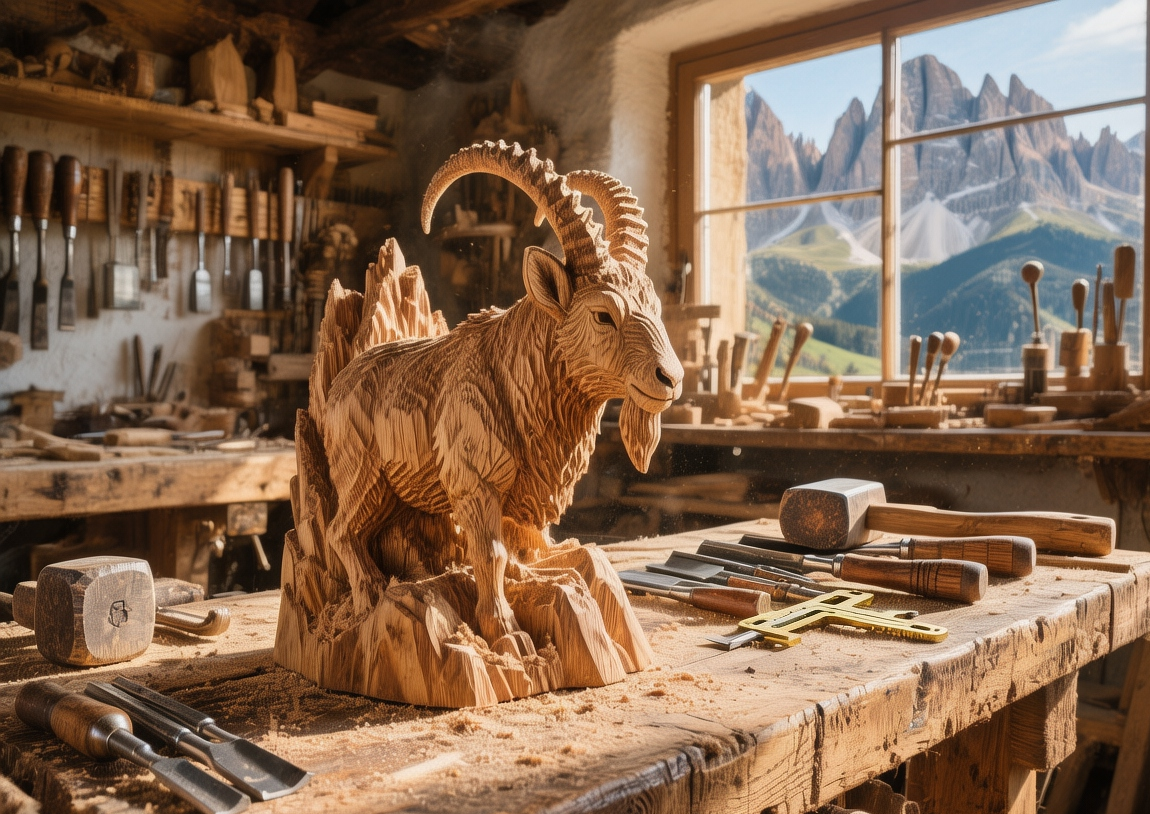
Ortisei Wood Carvings Alpine Craftsmanship Meets Sacred Tradition
Mid-morning sun filters through the workshop window, catching dust motes dancing above a half-finished Madonna figure—her robes flowing in walnut wood as if carved by mountain winds themselves. You stand where generations of Ladin artisans have shaped faith into form, the scent of freshly cut larch mingling with beeswax polish in the crisp 12°C (54°F) air. At 1,236 meters in South Tyrol’s Val Gardena—part of the Dolomites UNESCO World Heritage Site since 2009—Ortisei solves a fundamental cultural paradox: preserving sacred artistry while embracing modern markets. This tradition began in 1630 when local farmers, stranded by winter snows, transformed woodworking skills into religious statuary for Alpine churches. Today, over 200 workshops continue this legacy, producing 70% of Europe’s ecclesiastical carvings using techniques unchanged for four centuries. The wood itself tells a story—slow-growth Swiss pine from 1,800-meter elevations, seasoned for five years to prevent cracking, its grain revealing annual growth rings that mirror the valley’s seasonal rhythms. In 2026, as mass production flattens global crafts, Ortisei matters precisely because it refuses compromise—a place where every chisel mark carries devotion, and every figure whispers of mountains that shape both wood and soul.
Why Ortisei Wood Carvings Embodies Sacred Continuity
Ortisei’s wood carving tradition solves a fundamental economic paradox: how to sustain mountain communities through artistic resilience. Born during the Little Ice Age (1630–1715), when farming became impossible for six months yearly, local Ladin families turned necessity into vocation—transforming woodworking skills into religious statuary for churches across the Habsburg Empire. The technical mastery is precise: artisans use only hand tools (gouges, mallets, rifflers) to achieve anatomical accuracy—veins in Christ’s hands measure 0.5mm wide; drapery folds follow Renaissance principles of light and shadow; and facial expressions convey theological concepts through subtle eyebrow angles. Historically, the craft fulfilled dual roles—as spiritual service (creating altar pieces for 300+ Alpine churches) and economic survival (exporting via Venice’s trade routes). The 1850s industrial boom threatened authenticity until master carver Josef Moroder-Lusenberg (1846–1939) established formal apprenticeships, requiring 7 years of training before independent work. Today, the Scuola d’Arte (Art School) maintains these standards—students spend Year 1 mastering grain direction in Swiss pine; Year 3 learning polychrome painting with mineral pigments; Year 5 studying Baroque anatomy. Critically, the tradition balances innovation with preservation: contemporary artists like Rudolf Moroder incorporate abstract elements while maintaining sacred proportions, ensuring relevance without erasure. This synthesis makes Ortisei not just a craft center but a living archive of Alpine spirituality.
The Best Time to Experience Ortisei Wood Carvings
For optimal workshop access and comfortable exploration, visit between May 25–June 20 or September 10–October 5, 2026—when daytime temperatures average 14–20°C (57–68°F) with minimal rainfall and stable mountain conditions [[49]]. Arrive at workshops by 9:00 AM when artisans begin their day—morning light provides ideal viewing conditions for examining fine details in carvings. Avoid July 15–August 25 when temperatures exceed 24°C (75°F), humidity reaches 70%, and tourist numbers peak—particularly during midday hours when popular workshops like Demetz Art operate at capacity. Winter visits (December–February) offer atmospheric solitude but present challenges: shorter daylight hours (sunset at 16:30), frequent snow that may delay transport, and some smaller workshops close for seasonal holidays. For real-time updates on workshop hours and special demonstrations, verify with the Val Gardena Tourism Board’s portal at 48 hours before departure, as seasonal adjustments occasionally affect artisan availability.
Approximate Budget for a 7-Day Trip
This budget reflects mid-range cultural-artistic travel based in Ortisei with day excursions to surrounding Dolomite sites, using 2026 projected pricing with 3.8% inflation adjustment from 2024 baseline figures per ISTAT regional data. All costs in euros (€).
- Accommodation: €105–€155 per night for traditional B&B or 3-star hotel in Ortisei center (e.g., Hotel Luna Mondschein or B&B Cianter); includes mountain views and breakfast featuring local cheeses and speck
- Food: €50 per day average—breakfast €12 (fresh ricotta and speck), lunch €16 (canederli dumplings at workshop café), dinner €22 (primo of strangolapreti spinach pasta, secondo of venison stew at family-run trattoria)
- Transportation: €240 total—Verona Airport to Ortisei via Azienda Trasporti Verona bus line 164 (€11.50, 2h 30m); daily car rental €50 including fuel for Dolomite excursions; parking free in village outskirts
- Attractions: Museum Gherdëina €8; guided wood carving workshop €35; cable car to Seceda peak €28; Ladin Cultural Institute tour €15
- Miscellaneous: €90—hand-carved souvenir €45, South Tyrol wine tasting €25, donation to artisan preservation fund €20
Total estimated cost: €1,150–€1,390 for seven days
6 Essential Ortisei Wood Carving Experiences
- Witness Morning Carving Rituals: Visit Demetz Art workshop at 9:00 AM to observe master carvers selecting Swiss pine blocks. Note how they read grain patterns like topographic maps—avoiding knots that could fracture delicate features like Christ’s outstretched fingers.
- Attend a Polychrome Painting Demo: Join the “Voices of Pigment” session (Tuesdays/Thursdays at 11:00 AM) where artists demonstrate mineral-based painting. Watch as they mix lapis lazuli with egg tempera—the same method used in 17th-century altar pieces.
- Explore Museum Gherdëina’s Collection: Spend 10:00–12:00 examining 400 years of Ladin craftsmanship. Focus on the 1720 “Pietà” by Melchiorre Vinazer—note how the Virgin’s tears are carved as actual channels to catch candle wax during vigils.
- Photograph Workshop Details at Golden Hour: Position yourself outside Schnatterpeck workshop at 18:30 to capture wood shavings glowing in warm light. Use a macro lens (100mm) to emphasize texture contrasts between raw timber and polished saints.
- Take a Beginner Carving Class: Book the 2-hour “First Cuts” experience (daily 14:00–16:00) where you’ll carve a simple leaf motif under guidance. The Swiss pine’s soft grain makes it ideal for beginners—your creation becomes a tangible memory.
- Hike the Sculptor’s Trail: Walk the 5-kilometer path from Ortisei to Santa Cristina at 8:00 AM. Along the route, 12 stations display contemporary carvings integrated with nature—observe how artists use fallen timber rather than felled trees.
3 Hidden Gems Most Travelers Miss
- Archivio Storico dei Maestri: In the town hall basement, unpublished apprentice records from 1750–1900 document carving lineages. Email archivio@comune.ortisei.bz.it 72 hours ahead specifying interest in “Documenti Intaglio 1750–1900”; bring ID for the 30-minute viewing.
- Cappella di San Giacomo Secret Altar: Behind the main church, this 18th-century chapel contains an unsigned masterpiece attributed to Josef Moroder. Access requires asking the sacristan politely after 11:00 Mass; donation of €3 appreciated.
- Foresta dei Mastri Woodlot: A 20-minute drive leads to the sustainable forest where workshops source Swiss pine. Visit Tuesday–Thursday 9:00–12:00 by appointment (+39 0471 792000); witness the 5-year seasoning process in climate-controlled barns.
Cultural & Practical Tips
- Wear quiet-soled shoes—workshop floors amplify footsteps, disturbing the concentration essential for fine carving.
- Greet artisans with "Bun di" (BOON DEE)—Ladin for "good day"—a traditional courtesy that shows respect for their linguistic heritage.
- Ask permission before photographing works-in-progress—many consider unfinished pieces spiritually vulnerable until blessed.
- Respect sacred subjects—avoid touching religious carvings unnecessarily; many believe the wood absorbs prayers over time.
- Photography drones prohibited in village center; handheld cameras allowed but no flash in workshops (dries wood prematurely).
- Support preservation by purchasing directly from workshops—look for the “Artigianato Val Gardena” certification plaque guaranteeing authentic craftsmanship.
- Visit museums before workshops—contextual understanding transforms your appreciation from aesthetic admiration to historical comprehension.
Conclusion: Travel with Reverence, Not Just Curiosity
To experience Ortisei’s wood carvings is to witness devotion made visible—a place where every chisel mark carries centuries of faith, and every figure breathes with mountain spirit. In 2026, as mass production flattens global crafts, this Alpine enclave stands as both sanctuary and standard: proving that authenticity requires neither isolation nor stagnation. Your presence here carries consequence—the €35 workshop fee sustains apprenticeship programs, yet your gaze must move beyond aesthetics to honor the living tradition. True engagement means slowing beyond documentation: feeling the wood’s grain beneath your fingertips, understanding that preservation requires both financial support and respectful distance. Leave no trace beyond awe; take no fragment beyond memories. For Ortisei endures not as a museum of relics, but as a testament to what happens when culture chooses continuity over convenience—a covenant written in wood and prayer that asks only this: that we remember why some silences must be honored, not just observed.