
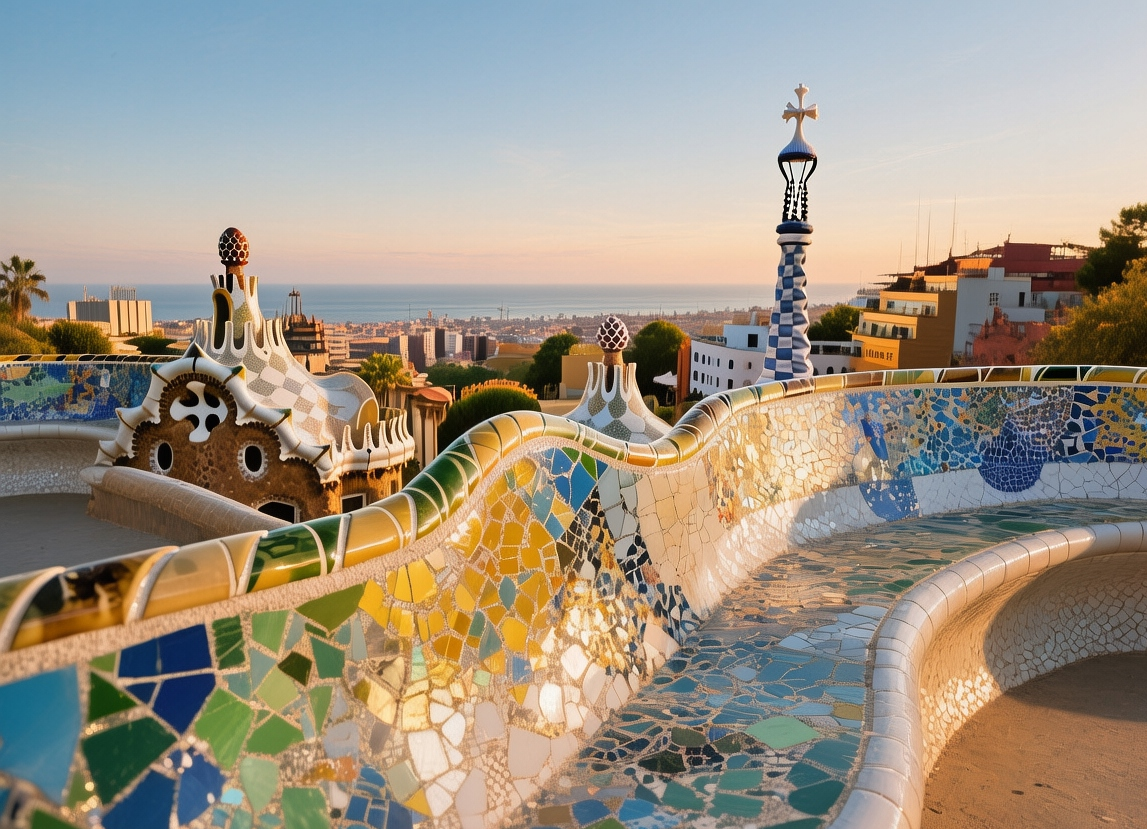
Park Güell Mosaic Whimsy Meets Mediterranean Light
Dawn breaks over Barcelona at 6:42 a.m., gilding the undulating mosaic bench that snakes 110 meters (361 feet) along Park Güell’s main terrace—sunlight ignites Antoni Gaudí’s trencadís technique, where 120,000 shards of broken ceramic tile, glass, and marble coalesce into marine patterns that shimmer like fish scales against the cobalt sea stretching to the horizon; you run your fingers along the cool, uneven surface—each fragment hand-placed by artisans between 1900 and 1914 under Gaudí’s exacting direction—and hear the distant chime of the park’s original dragon fountain, its glazed scales still intact after 112 years; commissioned by Eusebi Güell as an exclusive residential garden city on Carmel Hill, this UNESCO site was abandoned as a housing project after only two homes sold, yet transformed into Barcelona’s most poetic public space when the city acquired it in 1926. Today, as overtourism strains its fragile mosaic pathways with 12,000 daily visitors, Park Güell matters more than ever—not as photo backdrop but as living manifesto of Gaudí’s belief that nature’s curves should replace straight lines, making your mindful presence an act of preservation for this 2026 centenary year.
Why Park Güell Embodies Organic Urbanism
Gaudí didn’t design a park—he engineered a stone organism breathing with Mediterranean rhythms. Commissioned in 1900 by industrialist Eusebi Güell, this 17-hectare (42-acre) hillside was conceived as a self-contained garden city with 60 luxury plots, communal spaces, and revolutionary infrastructure—yet only two houses sold (including Gaudí’s own residence, now a museum). The project’s failure birthed genius: Gaudí repurposed the space into a public sanctuary where architecture dissolves into landscape. His engineering marvels solved practical problems through biomimicry—the Hypostyle Room’s 86 Doric columns mimic tree trunks supporting a vaulted ceiling while channeling rainwater into cisterns below; the famous mosaic bench’s serpentine form follows the hill’s natural contours, providing panoramic views without disrupting terrain. The trencadís technique—using waste materials from local factories—was both ecological and aesthetic: broken tiles from Pujol i Bausis ceramics and discarded glass bottles were transformed into shimmering skin for structures like the Dragon Stairway guardian. Every element serves dual purposes: the colonnaded viaducts double as drainage channels during storms; the Austria Gardens’ winding paths follow sun exposure patterns for optimal shade. After Gaudí’s 1926 death, the city preserved his vision, opening it as a municipal park in 1926. Today, with completion of the 2024–2026 restoration funded by Barcelona’s €8.2 million conservation initiative, Park Güell stands as testament to how failed real estate ventures can become humanity’s shared heritage when guided by artistic integrity.
The Best Time to Experience Park Güell
Secure timed entry between 8:00 and 9:30 a.m. during April 10–May 15 or September 18–October 22, when temperatures range 17–23°C (63–73°F) and humidity stays below 60%, allowing comfortable exploration of mosaic pathways without summer crowds. Morning light through the colonnades creates dramatic shadows on the Hypostyle Room’s capitals between 8:00–10:00 a.m., while sunset illuminates the mosaic bench’s eastern curve in golden hues after 6:30 p.m. Avoid June 15–August 25 entirely—temperatures exceed 30°C (86°F) with heat indices reaching 36°C (97°F), and queues stretch beyond 60 minutes despite pre-booked tickets; July 20–August 10 is particularly problematic during Spanish national holidays. Winter visits (November–February) offer shortest lines but limited daylight for mosaic photography and frequent rain; the site closes at 5:30 p.m. in January. Crucially, book the "Sunrise Access" slot at 7:30 a.m. via the official website (parkguell.barcelona)—this grants 30-minute exclusive access before general opening, allowing unobstructed photography of light patterns on the mosaic bench. Always verify current restoration schedules and special closures at the official portal minimum 48 hours before visiting, as conservation work occasionally restricts areas.
Approximate Budget for a 7-Day Barcelona Trip with Park Güell Focus (2026)
These estimates reflect projected 2026 pricing with 4.1% annual inflation applied to 2024 baselines per Spain’s National Statistics Institute (INE) tourism indices and Barcelona’s municipal fiscal reports. Budget assumes moderate comfort with Gràcia district lodging, authentic Catalan dining, and comprehensive site access including early-morning experiences.
- Accommodation: €140–€210 per night in Gràcia district (10-minute walk to Park Güell); €100–€160 in Eixample (15-minute metro ride via line 3). Specific options: Hotel Casa Bonay (€195/night with rooftop terrace), El Palace Barcelona (€210/night with Gaudí suite), or budget alternative Hostal Grau (€80/night private room). SUBTOTAL: €980–€1,470 for 7 nights.
- Food: €65 per person daily average—breakfast €8 (pa amb tomàquet €3.50, café con leche €2.50 at Federal Café), lunch €22 (fideuà €16 at Can Solé, vermouth €4/glass), dinner €35 (suquet de peix €24 at Els Pescadors, Priorat wine €9/glass). Includes daily pastry budget (€4 at Forn de Sant Jaume). SUBTOTAL: €455 per person for 7 days.
- Transportation: €48 total—€12 for 48-hour Hola BCN! card (unlimited metro/bus), €8 metro line 3 roundtrip from El Prat Airport, €28 taxi supplement for late-night returns via official black cabs (fixed €35 airport rate). SUBTOTAL: €48.
- Attractions: €85 per person—€12 Park Güell Monumental Zone (booked direct), €18 Sagrada Família, €16 Casa Batlló, €14 Museu Picasso, €12 Montjuïc Castle cable car, €13 Tibidabo Amusement Park. SUBTOTAL: €85 per person.
- Miscellaneous: €115 per person—€40 guided Gaudí walking tour (including Park Güell mosaic workshop), €30 dinner at Michelin-starred Disfrutar, €25 official Park Güell ceramic tile replica, €20 emergency horchata refuels at Sirvent. SUBTOTAL: €115 per person.
Total estimated cost: €1,688–€2,178 per person
6 Essential Park Güell Experiences
- Sunrise Mosaic Contemplation: Book the 7:30 a.m. "Sunrise Access" ticket via parkguell.barcelona—arrive by 7:15 a.m. to enter before general crowds. Position yourself at the western end of the mosaic bench as morning light floods across the Mediterranean, igniting blue and green trencadís fragments into liquid patterns. Duration: 45 minutes. Essential because this solitude reveals Gaudí’s chromatic dialogue with the sea—colors progressing from deep ocean blues to sunlit golds as light moves eastward.
- Hypostyle Room Acoustic Experiment: Enter the forest of 86 columns between 8:30–9:30 a.m. when ambient noise is minimal. Stand at the central capital and whisper—the acoustics engineered by Gaudí carry your voice to the opposite corner 30 meters away. Observe how rainwater channels through hidden gutters into the cistern below, visible through floor grates. Duration: 25 minutes. Essential because this demonstrates Gaudí’s fusion of beauty and utility—columns as both structural support and hydraulic system.
- Dragon Stairway Symbolism Decoding: Approach the iconic salamander at 9:00 a.m. when eastern light highlights its glazed scales. Trace the four elements represented: water (mosaic waves at base), earth (stone steps), air (wings), and fire (orange glaze). Note how the creature’s open mouth functions as a fountain spout during rains—a detail missed by midday crowds. Duration: 20 minutes. Essential because this guardian embodies Gaudí’s alchemical philosophy where nature’s forces converge in single forms.
- Austria Gardens Forest Bathing: After exiting the Monumental Zone, explore the free-access Austria Gardens via Carretera del Carmel entrance. Follow the winding path past Gaudí’s original olive trees to the highest viewpoint overlooking the entire park. Visit between 10:00–11:00 a.m. when sunlight filters through pines creating dappled patterns on dry-stone walls. Duration: 40 minutes. Essential because this tranquil zone reveals Gaudí’s respect for native Mediterranean flora—olives, pines, and carob trees arranged to maximize shade and wind protection.
- Gaudí House Museum Context: Tour the pink house where Gaudí lived 1906–1925, included in Monumental Zone ticket. Focus on the study where he designed Park Güell’s details—observe original drafting tools and ceramic samples used for trencadís. Visit at 11:00 a.m. when fewer tour groups crowd the small rooms. Duration: 35 minutes. Essential because this intimate space reveals the human scale behind monumental artistry—Gaudí’s modest bedroom contrasts sharply with his grand visions.
- Golden Hour Panorama: Return to the main terrace between 6:30–7:30 p.m. during spring/autumn when sunset aligns perfectly with the mosaic bench’s curve. Position yourself at the eastern end where the bench frames Barcelona’s skyline with Sagrada Família’s cranes silhouetted against the dying light. Duration: 30 minutes. Essential because this perspective connects Park Güell to Gaudí’s larger urban tapestry—nature and city in harmonious dialogue.
3 Hidden Gems Most Travelers Miss
- Portico of the Washerwoman Secret Passage: Overlooked because it’s accessible only via the free-access zone near Carrer d’Olot—enter through the unmarked iron gate beside the parking lot (open 8:00 a.m.–8:00 p.m.). This colonnade features Gaudí’s original dry-stone construction technique where stones are stacked without mortar, following natural weight distribution. Visit Tuesday mornings when conservation students demonstrate traditional repair methods. Free access; photography permitted. Special because this passage reveals Gaudí’s engineering philosophy before decorative elements were added—pure structural poetry.
- Viaduct del Torrent de les Camil·les Acoustic Arch: Located between the Austria Gardens and Monumental Zone—stand beneath the central arch at precisely 11:00 a.m. when sunlight creates a perfect circle of light on the pathway below. Whisper into the eastern column and hear your voice echo clearly from the western counterpart—a demonstration of Gaudí’s acoustic engineering using parabolic curves. Open during regular park hours. Special because this interactive experience transforms passive viewing into participatory discovery, revealing sound as architectural material.
- Trencadís Workshop Observation: Book the €35 “Mosaic Masterclass” via parkguell.barcelona/en/activities—held monthly on first Saturdays. Under master artisan supervision, learn trencadís techniques using authentic ceramic shards in the actual restoration workshop adjacent to the mosaic bench. Includes safety gear and keepsake tile fired in the on-site kiln. Requires advance reservation 60 days ahead; limited to 10 participants. Special because this tactile engagement transforms abstract admiration into embodied understanding of Gaudí’s sustainable material philosophy.
Cultural & Practical Tips
- Monumental Zone access protocol: Only 1,400 visitors allowed hourly—reserve tickets minimum 60 days ahead via official portal. Third-party vendors add 25–40% surcharges with identical access. Free access to non-monumental zones requires no ticket but offers limited Gaudí structures.
- Photography ethics: No drones (€200 fines); tripods prohibited in Monumental Zone. Best shots occur 8:00–10:00 a.m. when east-facing mosaics glow without harsh shadows. Never climb on mosaic structures—fragments detach easily under pressure.
- Essential Catalan phrases: “Bon dia” (bone DEE-uh) for good morning; “Gràcies” (GRAH-see-es) for thank you; “On és el lavabo?” (ohn ES el lah-VAH-boh) for restroom location.
- Footwear requirements: Wear closed-toe shoes with grip—mosaic pathways become slippery when dew-covered or after rain. Avoid high heels that damage historic surfaces.
- Pickpocket prevention: Highest risk at metro station L3 Vallcarca exit—use cross-body bags with zippers facing inward. Municipal police maintain visible presence but cannot monitor all pockets during peak hours (10:00 a.m.–2:00 p.m.).
- Weather considerations: Summer humidity (70–80%) intensifies heat on exposed terraces; winter rains create muddy conditions on unpaved paths. Always carry water—free refill stations available near Gaudí House Museum.
- Conservation awareness: Do not touch mosaic surfaces—oils from skin accelerate tile deterioration. Report any loose fragments to staff immediately; each shard represents irreplaceable craftsmanship.
Conclusion: Travel with Curiosity, Not Just Cameras
To wander Park Güell is to step inside Gaudí’s mind—a place where architecture breathes with Mediterranean rhythms and waste becomes wonder. Your €12 ticket directly funds the 2024–2026 conservation initiative protecting 120,000 fragile mosaic fragments from overtourism’s wear; each respectful step on designated pathways honors the artisans who transformed broken ceramics into enduring poetry. In an age of digital saturation, this hilltop sanctuary teaches presence: the mosaic bench’s curves invite lingering, not just leaning for selfies; the Hypostyle Room’s columns demand listening, not just looking. Gaudí knew straight lines don’t exist in nature—and neither do instant understandings of true artistry. Choose curiosity over consumption—trace the salamander’s scales with your eyes rather than your fingers; decode the bench’s marine patterns through patient observation rather than rushed snapshots. Your responsibility isn’t passive viewing but active stewardship—carrying forward Gaudí’s vision that cities should harmonize with nature, not dominate it. Let Park Güell recalibrate your senses; understand that the most profound journeys measure not photos taken, but connections made between human creativity and the eternal Mediterranean light.