
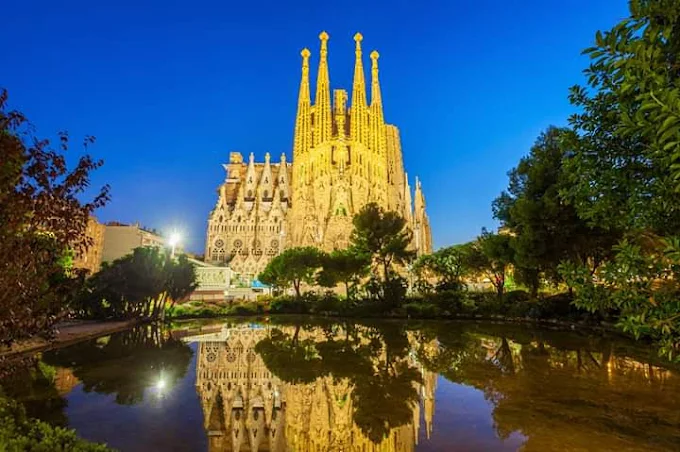
Sagrada Família in 2026: Where Sacred Geometry Meets Living Stone
Morning light pierces the eastern stained-glass windows at precisely 9:14 a.m., transforming Antoni Gaudí’s forest of stone columns into a living kaleidoscope—crimson, emerald, and sapphire shards dance across the nave floor while the scent of aged limestone mingles with beeswax from votive candles near the crypt where Gaudí himself rests; you stand beneath hyperbolic paraboloids soaring 75 meters (246 feet) toward a vaulted ceiling engineered without right angles, each column branching like a tree trunk to support a roof weighing 12,000 tons through principles of natural compression rather than steel reinforcement; construction began in 1882 under architect Francisco de Paula del Villar before Gaudí assumed control in 1883, dedicating his final 43 years to this “expiatory temple” funded entirely by private donations—a radical departure from state-sponsored cathedrals of the era. Today, as cranes silhouette against the unfinished towers like skeletal fingers reaching for heaven, this UNESCO site matters profoundly: it embodies humanity’s capacity to merge faith, nature, and mathematics across generations, with completion projected for 2026—the centenary of Gaudí’s death—making your visit not merely tourism but participation in a 144-year act of collective devotion.
Why Sagrada Família Embodies Organic Architecture
Gaudí didn’t design a building—he engineered a stone forest governed by natural laws. Appointed lead architect in 1883 after rejecting Francisco de Paula del Villar’s neo-Gothic plan, he solved structural challenges through biomimicry: columns branch like trees using fractal geometry to distribute weight, while hyperbolic paraboloid vaults channel forces along curves found in seed pods and seashells. The Nativity Façade’s 120 sculpted figures celebrate Christ’s birth through organic forms—lizards, turtles, and flowering vines carved directly into stone—while the Passion Façade’s stark angularity depicts suffering through mathematical precision. Gaudí pioneered techniques still revolutionary today: he suspended weighted strings from ceilings to model inverted arches (photographing them to create blueprints), calculated load distributions using hanging rope models, and specified Montjuïc sandstone for its crystalline structure that hardens with age. His genius lay in merging spirituality with engineering—each of the 18 planned towers holds symbolic meaning: 12 for apostles (100–110 meters tall), 4 for evangelists (120 meters), one for Virgin Mary (120 meters), and the central Jesus tower (170 meters/558 feet)—taller than Barcelona’s highest hill to ensure visibility across the city. After Gaudí’s 1926 death, only 15–25% was complete; the Spanish Civil War destroyed his workshop models in 1936, forcing modern architects to reconstruct plans from fragmented photographs. Today, advanced CAD software and 3D printing accelerate progress, yet every stone is still hand-finished by artisans using Gaudí’s original chiseling techniques—proving that true innovation honors tradition while embracing technology.
The Best Time to Experience Sagrada Família
Secure timed entry between 9:00 and 10:30 a.m. during April 15–May 20 or September 10–October 15, when temperatures range 18–24°C (64–75°F) and humidity stays below 65%, allowing optimal stained-glass illumination without summer crowds. Morning light through the eastern Nativity Façade windows creates the most dramatic color effects between 9:00–11:00 a.m., while afternoon sun ignites the western Passion Façade in fiery reds after 4:00 p.m. Avoid June 20–August 25 entirely—temperatures exceed 32°C (90°F) with heat indices reaching 38°C (100°F), and queues stretch beyond 90 minutes despite pre-booked tickets; July 15–August 10 is particularly problematic during Spanish national holidays. Winter visits (November–February) offer shortest lines but limited daylight for color effects and frequent rain; the site closes at 5:00 p.m. in January. Crucially, book the "Early Access" slot at 8:30 a.m. via the official website (sagradafamilia.org)—this grants 30-minute exclusive access before general opening, allowing unobstructed photography of light patterns on the nave floor. Always verify current tower access schedules and special closures at the official portal minimum 48 hours before visiting, as construction phases occasionally restrict areas.
Approximate Budget for a 7-Day Barcelona Trip with Sagrada Focus (2026)
These estimates reflect projected 2026 pricing with 4.1% annual inflation applied to 2024 baselines per Spain’s National Statistics Institute (INE) tourism indices and Barcelona’s municipal fiscal reports. Budget assumes moderate comfort with Eixample district lodging, authentic Catalan dining, and comprehensive site access including tower climbs.
- Accommodation: €150–€220 per night in Eixample district (5-minute walk to Sagrada); €100–€160 in Gràcia (15-minute metro ride via line 5). Specific options: Hotel Brummell (€185/night with rooftop terrace), Casa Camper (€210/night with bicycle rental), or budget alternative Hostal Grau (€85/night private room). SUBTOTAL: €1,050–€1,540 for 7 nights.
- Food: €65 per person daily average—breakfast €8 (pa amb tomàquet €3.50, café con leche €2.50 at Federal Café), lunch €22 (fideuà €16 at Can Solé, vermouth €4/glass), dinner €35 (suquet de peix €24 at Els Pescadors, Priorat wine €9/glass). Includes daily pastry budget (€4 at Forn de Sant Jaume). SUBTOTAL: €455 per person for 7 days.
- Transportation: €48 total—€12 for 48-hour Hola BCN! card (unlimited metro/bus), €8 metro line 5 roundtrip from El Prat Airport, €28 taxi supplement for late-night returns via official black cabs (fixed €35 airport rate). SUBTOTAL: €48.
- Attractions: €92 per person—€32 Sagrada Família + towers (booked direct), €18 Park Güell, €16 Casa Batlló, €14 Museu Picasso, €12 Montjuïc Castle cable car. SUBTOTAL: €92 per person.
- Miscellaneous: €120 per person—€45 guided Gaudí walking tour (including Sagrada crypt access), €30 dinner at Michelin-starred Disfrutar, €25 official Sagrada workshop ceramic tile, €20 emergency horchata refuels at Sirvent. SUBTOTAL: €120 per person.
Total estimated cost: €1,765–€2,255 per person
7 Essential Sagrada Família Experiences
- Early Access Light Symphony: Book the 8:30 a.m. "Early Access" ticket via sagradafamilia.org—arrive by 8:15 a.m. to enter before general crowds. Position yourself in the central nave facing the Nativity Façade as morning light floods through stained glass, casting emerald and gold patterns that shift every seven minutes. Duration: 45 minutes. Essential because this solitude reveals Gaudí’s chromatic theology—colors progressing from warm (earthly life) to cool (divine transcendence) as light moves westward.
- Nativity Tower Descent: Climb the 360-step Nativity Tower (included in ticket) between 10:00–11:30 a.m. when eastern views are clearest. Descend slowly through the spiral staircase, pausing at landings to observe sculptor Josep Maria Subirachs’ intricate details: lizards with pearl eyes, angels playing violins, and the Tree of Life canopy. At the base, touch the bronze door handle shaped like a wheat sheaf—symbolizing Eucharistic abundance. Duration: 35 minutes. Essential because descending (rather than ascending) allows contemplation of craftsmanship without fatigue.
- Crypt Communion with Gaudí: Visit the crypt beneath the apse where Gaudí’s tomb lies beneath a simple stone slab. Attend the 9:00 a.m. weekday Mass (open to public) when Gregorian chants resonate through stone columns, or come at 1:00 p.m. when sunlight filters through rose windows onto his resting place. Duration: 25 minutes. Essential because this intimate space reveals Gaudí’s humility—he chose burial here rather than a grand monument, embodying his belief that “my client is not in a hurry.”
- Passion Façade Mathematical Meditation: Approach the western façade between 4:30–5:30 p.m. when afternoon sun highlights Josep Maria Subirachs’ stark sculptures. Stand precisely 28 meters back—the optimal distance to see the magic square above Christ’s head where all rows sum to 33 (Christ’s age at crucifixion). Trace the diagonal wounds carved into stone that align with sunset rays during equinoxes. Duration: 30 minutes. Essential because this façade’s geometric rigor contrasts Nativity’s organic joy, revealing Gaudí’s theological duality.
- Workshop Observation Gallery: After exiting the main nave, take the elevator to the museum level overlooking the active workshop. Watch artisans carving stone using Gaudí’s original templates while engineers operate 3D printers creating scale models for the Glory Façade. Visit Tuesday mornings when master sculptor Jordi Bonet (Gaudí’s successor’s grandson) often gives impromptu explanations. Duration: 20 minutes. Essential because witnessing live construction connects you to the 144-year continuum of devotion.
- Glory Façade Future Vision: Walk around the southern perimeter to view the unfinished Glory Façade—the largest and most complex, depicting Hell, Purgatory, and Heaven. Use the official Sagrada app’s AR feature to overlay completed projections onto the scaffolding. Stand at the designated viewpoint marked by a bronze compass rose where Gaudí positioned his original workshop. Duration: 25 minutes. Essential because this preview reveals how the final composition will unify all theological themes upon 2026 completion.
- Acoustic Resonance Experiment: Return at 7:00 p.m. during summer “Evening Concerts” (book separately) or simply clap once in the central crossing at any quiet moment. Listen as sound travels along parabolic vaults to the opposite side—a demonstration of Gaudí’s acoustic engineering where whispers carry 40 meters without amplification. Duration: 10 minutes. Essential because this auditory experience proves the building functions as a living instrument, not just visual spectacle.
3 Hidden Gems Most Travelers Miss
- Gaudí’s Original Workshop Replica: Located in the basement museum beyond the main exhibits—request access at the information desk by mentioning “taller original.” This reconstructed workspace displays Gaudí’s string models, plaster casts, and drafting tools used to calculate catenary curves. Visit Wednesday afternoons when conservation students demonstrate rope-model techniques. Free with admission; photography permitted without flash. Special because these fragile artifacts reveal how analog methods birthed digital-age architecture.
- Secret Garden of the Evangelists: Overlooked because it’s accessible only via the Passion Tower exit—after descending, follow the unmarked path left of the gift shop through an iron gate marked “Jardí Tancat.” This private garden features four sculpted evangelist symbols (angel, lion, ox, eagle) surrounded by medicinal herbs Gaudí specified for their biblical significance. Open 10:00 a.m.–2:00 p.m. Tuesday–Thursday; ring the bell for entry. Special because this contemplative space offers the only legal vantage point to photograph Sagrada’s towers without street clutter.
- Stonecutter’s Apprentice Experience: Book the €65 “Tallista per un Dia” workshop via sagradafamilia.org/fundacio—held monthly on first Saturdays. Under master artisan supervision, carve a small limestone piece using traditional chisels in the actual workshop adjacent to construction zones. Includes safety gear and keepsake tile fired in the on-site kiln. Requires advance reservation 90 days ahead; limited to 12 participants. Special because this tactile engagement transforms abstract admiration into embodied understanding of Gaudí’s material philosophy.
Cultural & Practical Tips
- Dress code enforcement: Shoulders and knees covered for all genders—carry a lightweight scarf (€10 at gift shop) if needed. Security checks occur at all entrances; avoid backpacks larger than 40x35x15cm.
- Photography ethics: No tripods or drones (€200 fines); smartphone photography permitted but avoid blocking aisles during services. Best shots occur 9:00–11:00 a.m. when east-facing light creates maximal color contrast.
- Essential Catalan phrases: “Bon dia” (bone DEE-uh) for good morning; “Gràcies” (GRAH-see-es) for thank you; “On és el lavabo?” (ohn ES el lah-VAH-boh) for restroom location.
- Tower climb preparation: Nativity Tower has 360 steps (no elevator down); Passion Tower has 300 steps with steeper inclines. Not recommended for vertigo sufferers or those with mobility issues—check accessibility options online.
- Pickpocket prevention: Highest risk at metro stations L2/L5 Sagrada Família stops—use cross-body bags with zippers facing inward. Municipal police maintain visible presence but cannot monitor all pockets during peak hours (11:00 a.m.–3:00 p.m.).
- Weather considerations: Summer humidity (70–80%) intensifies heat inside stone structure; winter rains create slippery conditions on tower staircases. Always carry water—free refill stations available near museum exit.
- Booking protocol: Reserve tickets minimum 60 days ahead via official portal—third-party vendors add 25–40% surcharges with identical access. Select “with towers” option during purchase as upgrades aren’t available onsite.
Conclusion: Travel with Devotion, Not Just Documentation
To stand within Sagrada Família is to occupy sacred space where faith, nature, and mathematics converge across centuries—a continuum demanding more than digital documentation. Your €32 ticket directly funds the final construction phase, ensuring Gaudí’s vision completes in 2026 as intended; each respectful step on protected stone honors the 144-year chain of artisans who transformed quarry rock into spiritual poetry. In an age of instant gratification, this cathedral teaches patience: Gaudí knew he wouldn’t see completion, yet worked with unwavering conviction that “my client is God—and He is not in a hurry.” Choose presence over productivity—linger where light patterns shift on column bases rather than rushing to capture the “perfect shot.” Listen for echoes not of tourist chatter but of chisels striking stone, connecting you to generations who believed beauty could redeem the world. Your responsibility isn’t passive observation but active stewardship—carrying its story forward with accuracy and awe. Let Sagrada Família recalibrate your relationship with time itself; understand that the most profound journeys measure not kilometers traveled, but depths of wonder plumbed through slow, devoted attention.