
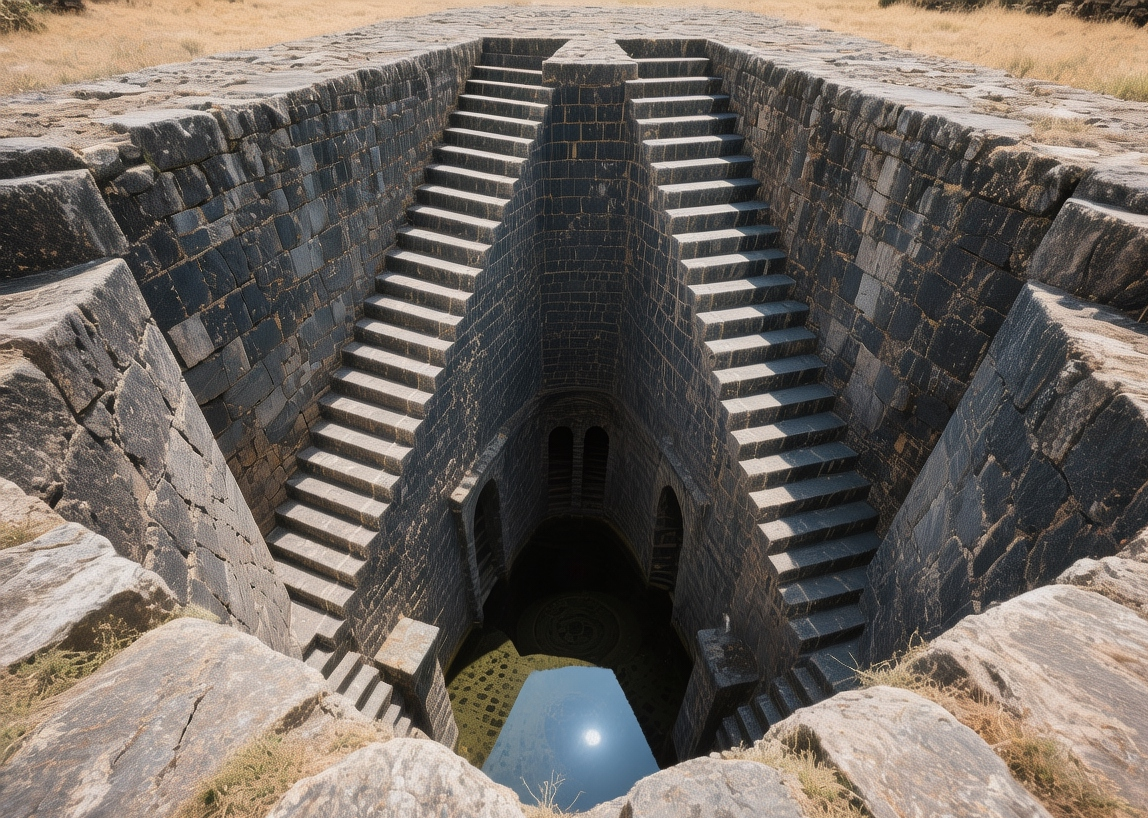
Santa Cristina Sacred Well Bronze Age Precision Meets Celestial Light
Equinox morning light fractures through the sacred well’s elliptical opening—casting a perfect golden disc onto the water’s surface 18 meters below. You stand where Nuragic priests once gathered 3,000 years ago, the only sounds the gentle drip of spring water and your own breath in the cool 14°C (57°F) air. The well’s walls—built without mortar from 24 perfectly fitted basalt blocks—rise in flawless concentric circles, each stone weighing over 1,000 kilograms yet aligned with such precision that not even a blade of wild fennel can slip between them. At 39°48′N latitude in west-central Sardinia, this temple solved a fundamental human need: connecting earthly rituals with cosmic cycles. Carbon dating confirms construction between 1200–1100 BCE, when Nuragic builders engineered this subterranean chamber to align with the moon’s 18.6-year cycle and the sun’s equinoxes—a feat of prehistoric astronomy that predates Stonehenge’s lunar alignments. In 2026, as digital noise drowns out deep time, Santa Cristina matters precisely because it demands presence—a place where silence isn’t absence but conversation with ancestors who mapped the heavens with stone and water.
Why Santa Cristina Sacred Well Embodies Astronomical Mastery
Santa Cristina solves a fundamental spiritual paradox: how to make the cosmos tangible through engineering. Built between 1200–1100 BCE during the Nuragic civilization’s peak, this sacred well temple represents Europe’s most precise prehistoric astronomical instrument. The technical specifications are staggering: the elliptical staircase descends 18 meters through 24 perfectly fitted basalt blocks (each 1.2 meters high and weighing 1,000+ kg) to a circular chamber 6 meters in diameter; the water source—a natural spring fed by Monte Arci’s aquifer—maintains constant 14°C (57°F) temperature year-round; and the well’s orientation aligns with the moon’s major standstill every 18.6 years, when its light perfectly illuminates the water surface. Most remarkably, during spring and autumn equinoxes, the rising sun shines directly through the well’s entrance, casting a perfect circle of light onto the sacred pool—a phenomenon requiring calculations of latitude, solstice angles, and stone placement accurate to within 0.5 degrees. Historically, the well fulfilled multiple roles: a ritual site for water worship (the Nuragic believed springs were portals to the underworld), a community gathering place for seasonal festivals, and an astronomical observatory that guided agricultural cycles. The surrounding complex—including a ceremonial courtyard and auxiliary buildings—suggests this was a regional pilgrimage site, where people traveled from across Sardinia to witness celestial events that connected their daily lives to cosmic rhythms.
The Best Time to Experience Santa Cristina Sacred Well
For optimal celestial alignment viewing, visit during the equinox windows: **March 18–22 or September 20–24, 2026**—when sunrise (approximately 6:45–7:15 AM) creates the perfect light phenomenon. Arrive by 6:30 AM to secure position in the ceremonial courtyard before crowds gather; temperatures average 12–16°C (54–61°F) with minimal rainfall [[44]]. For general visits, May 15–June 12 or September 25–October 15 offer comfortable exploration conditions with daytime temperatures of 20–25°C (68–77°F). Avoid July 15–August 25 when temperatures exceed 32°C (90°F) and tourist numbers peak—particularly during midday hours when the site’s single shaded area becomes crowded. Winter visits (November–February) offer solitude but present challenges: shorter daylight hours (sunset at 17:15), frequent rain that makes the stone staircase slippery, and reduced opening hours. For real-time updates on opening times and special equinox events, verify with the Comune di Paulilatino’s portal at pozzosantacristina one week before departure, as seasonal adjustments occasionally affect access.
Approximate Budget for a 7-Day Trip (2026)
This budget reflects mid-range cultural-historical travel based in Oristano with day excursions to Santa Cristina and surrounding Nuragic sites, using 2026 projected pricing with 3.8% inflation adjustment from 2024 baseline figures per ISTAT regional data. All costs in euros (€).
- Accommodation: €80–€115 per night for agriturismo or B&B in Oristano (e.g., Agriturismo Sa Sciga or B&B Su Nuraxi); includes traditional breakfast with pecorino cheese and homemade bread
- Food: €42 per day average—breakfast €8 (fresh ricotta and pane carasau), lunch €14 (panino with roast lamb at local bar), dinner €20 (primo of malloreddus pasta with mint, secondo of grilled goat at family-run trattoria)
- Transportation: €220 total—Cagliari Elmas Airport to Oristano via ARST bus line 1072 (€7.50, 2h 15m); daily car rental €48 including fuel for Nuragic site exploration; parking free at Santa Cristina
- Attractions: Santa Cristina well temple €6; guided archaeology tour €22; Tharros archaeological site €8.50; Museo Civico di Cabras €5
- Miscellaneous: €65—handwoven textile souvenir €30, Sardinian wine tasting €20, donation to Nuragic preservation fund €15
Total estimated cost: €930–€1,120 for seven days
6 Essential Santa Cristina Sacred Well Experiences
- Witness the Equinox Light Phenomenon: Arrive by 6:30 AM during March 18–22 or September 20–24 to see the rising sun cast a perfect golden disc onto the sacred pool 18 meters below. Position yourself in the ceremonial courtyard for the full effect—bring a small flashlight to navigate the staircase safely in pre-dawn darkness.
- Descend the Elliptical Staircase: Carefully navigate the 24-step descent between 9:00–11:00 AM when ambient light reveals construction details. Note how each basalt block is precisely fitted without mortar—run your fingers along the joints to feel the Nuragic masons’ extraordinary craftsmanship.
- Attend a Celestial Alignment Demonstration: Join the “Voices of the Stars” session (Tuesdays/Thursdays at 11:00 AM) where archaeologists explain the well’s astronomical functions. Learn how the 18.6-year lunar cycle alignment helped ancient farmers predict rainfall patterns.
- Photograph the Water Reflections: Visit between 10:00–12:00 when sunlight creates mirror-like reflections on the sacred pool. Use a polarizing filter to reduce glare and capture the perfect symmetry between stone walls and their watery counterparts.
- Explore the Ceremonial Courtyard: Walk the surrounding complex between 8:00–10:00 AM to understand the well’s context. Look for the original drainage channels that prevented flooding during autumn rains—evidence of sophisticated hydraulic engineering.
- Listen to the Stone Silence: Sit alone in the upper chamber for 15 minutes—close your eyes to hear what Nuragic priests heard: the drip of spring water, the whisper of wind through the elliptical opening, the weight of 3,000 years in every carved groove.
3 Hidden Gems Most Travelers Miss
- Nuragic Village of Santa Cristina: Located 300 meters east of the well, these reconstructed huts demonstrate daily life contemporary to the temple. Visit Tuesday–Sunday 10:00–17:00; demonstrations of bronze casting occur at 11:00 and 15:00.
- Monte Arci Obsidian Workshop: Hidden in the hills 12 kilometers northeast, this archaeological site shows how ancient Sardinians mined the volcanic glass used in ritual objects. Visit by appointment (+39 0783 250011); tours available Wednesdays/Saturdays at 10:00 AM.
- Archivio Storico dei Ritrovamenti: In Paulilatino’s town hall basement, unpublished excavation notes from 1915–1930 document the well’s discovery. Email archivio@comune.paulilatino.or.it 72 hours ahead specifying interest in “Documenti Santa Cristina 1915–1930”; bring ID for the 30-minute viewing.
Cultural & Practical Tips
- Wear sturdy closed-toe shoes with grip soles—the basalt staircase becomes dangerously slick after morning dew or rare rain showers; sandals risk serious falls on the 45-degree incline.
- Greet site custodians with "Sa die d’e sòccussu" (SAH dee-eh deh SOH-koo-soo)—Sardinian for "good health"—a traditional blessing acknowledging their role as cultural stewards.
- Carry a small flashlight—even during daytime visits, the lower chamber remains dim; avoid phone flashlights which disturb other visitors’ experience.
- Respect the site’s spiritual significance—many Sardinians view it as a sacred ancestral space; avoid loud conversations or eating within the ceremonial courtyard.
- Photography drones are prohibited; handheld cameras permitted but no tripods during peak hours (11:00–15:00) to avoid obstructing narrow pathways.
- Support preservation by purchasing the official site guidebook (€10)—proceeds fund ongoing archaeological research by the University of Cagliari.
- Visit during low humidity months (May–June, September–October) when condensation doesn’t obscure the water’s reflective surface.
Conclusion: Travel with Reverence, Not Just Curiosity
To stand within Santa Cristina’s sacred well is to confront time not as a linear progression but as a layered presence—where every stone whispers of Bronze Age ingenuity, every water droplet holds the memory of celestial alignments. In 2026, as tourism increasingly prioritizes convenience over connection, this temple remains defiantly contemplative: demanding nothing but attention, rewarding patience with profound continuity. Your presence here carries consequence—the €6 entrance fee directly funds archaeological conservation, yet your haste could diminish the silence these stones require to speak. True engagement means slowing beyond documentation: sitting with the weight of 3,000 years in your bones, tracing mortarless joints with reverent imagination, understanding that preservation requires both financial support and mindful presence. Leave no trace beyond awe; take no fragment beyond photographs. For Santa Cristina endures not as a relic behind glass, but as a living dialogue between earth and sky—a testament to human resilience that asks only this: that we remember why some silences must be honored, not just observed.