
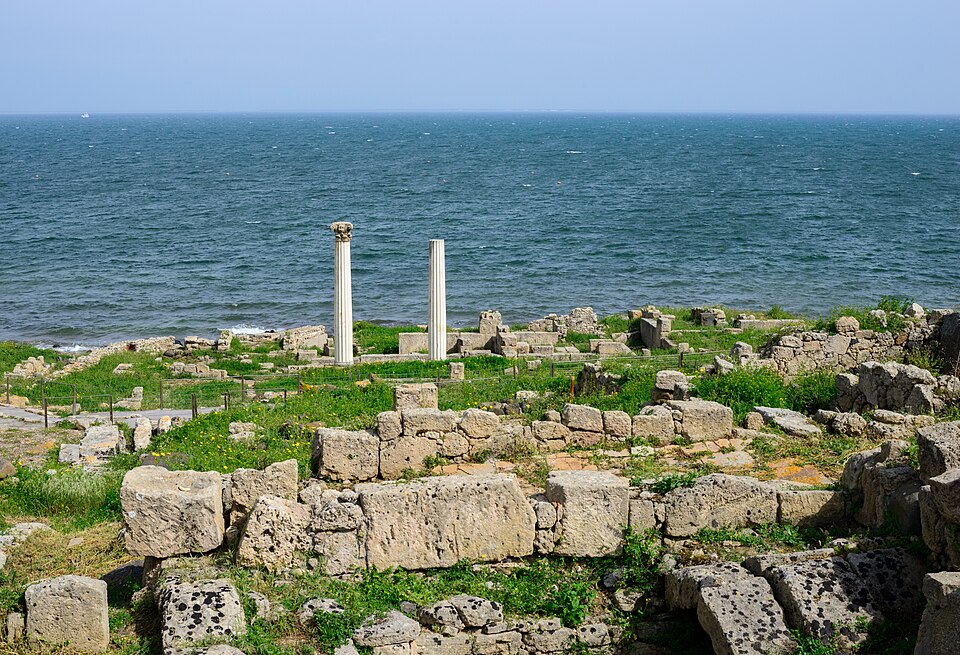
Tharros Peninsula Phoenician Stones Meet Mediterranean Light
The Mediterranean exhales at golden hour—warm salt air carrying whispers across twenty-eight centuries as the sun dips behind Capo San Marco’s limestone spine. You stand where Phoenician merchants once bartered Tyrian purple dye for Sardinian silver, where Roman senators strolled colonnaded streets now reduced to foundations whispering beneath wild fennel and sea lavender. Two Corinthian columns, fractured yet defiant, catch the last light at 19:47—casting elongated shadows across the cardo maximus that once measured precisely 4.8 meters wide. The Tyrrhenian Sea crashes rhythmically against the western ruins, its turquoise waters having claimed the ancient harbor’s breakwater but sparing the tophet’s sacred precinct where Carthaginian mothers once made unthinkable offerings. At 39°52′N latitude, this promontory witnessed empires rise and fall: Phoenician foundations from the eighth century BCE, Punic temples honoring Tanit, Roman baths with hypocaust systems still visible in cross-section, all abandoned by 1050 CE when malaria and Saracen raids drove survivors inland to Oristano. In 2026, as overtourism threatens Mediterranean heritage, the Tharros peninsula matters precisely because its geography enforces reverence—demanding physical presence, rewarding patience, and refusing to be conquered by convenience.
Why Tharros Peninsula Embodies Layered Time
The Tharros peninsula solves a fundamental coastal paradox: how to create sanctuary through strategic visibility. Founded circa 750 BCE by Phoenician traders from Tyre seeking Sardinia’s silver and lead deposits, the settlement solved a critical maritime problem: providing a sheltered harbor midway between Carthage and Iberia along the treacherous western Sardinian coast. The Phoenicians engineered a sophisticated breakwater using opus signinum mortar mixed with crushed pottery—a technique that withstood Tyrrhenian storms for three centuries before Carthaginian expansion transformed the settlement into a regional administrative capital. When Rome seized Sardinia in 238 BCE following the First Punic War, they didn’t demolish but repurposed: converting the Punic tophet into a forum measuring 62 by 41 meters, constructing baths with triple-heating systems (frigidarium, tepidarium, calidarium) fed by an aqueduct spanning 4.7 kilometers from Monte Arci’s springs, and erecting a theater carved directly into the promontory’s bedrock capable of seating 1,200 spectators. Most remarkably, the artisan quarter reveals specialized workshops where glassblowers, potters, and metalworkers operated side-by-side—a proto-industrial district with drainage channels precisely 30 centimeters deep. Abandoned not through conquest but gradual depopulation between 900–1050 CE as malaria-carrying mosquitoes bred in the lagoon and Saracen raids intensified, Tharros offers archaeologists a rare “frozen moment” where urban evolution remains legible without violent destruction layers obscuring earlier phases.
The Best Time to Experience Tharros Peninsula
For optimal light and manageable crowds, visit between May 20–June 15 or September 8–October 3, 2026—when daytime temperatures average 22–26°C (72–79°F) with sea breezes moderating afternoon heat. Arrive precisely at opening (9:00 AM) or during the golden hour window of 16:30–18:30 to photograph the ruins without harsh midday shadows; the low-angle sun during these periods illuminates the stratigraphy of Phoenician foundations beneath Roman paving stones with remarkable clarity. Avoid July 15–August 25 when temperatures exceed 32°C (90°F), humidity reaches 78%, and daily visitor numbers surpass 1,200—creating bottlenecks at the narrow pathways between the tophet and baths. Winter visits (November–February) offer solitude but present challenges: the site closes at 16:00 with last admission at 15:15, and rain can render the unpaved upper sections slippery; average temperatures of 8–14°C (46–57°F) demand layered clothing. For current opening hours and any weather-related closures, verify with CoopCulture’s official portal at 48 hours before your visit, as Sardinia’s regional museum directorate occasionally adjusts schedules during excavation seasons.
Approximate Budget for a 7-Day Trip
This budget reflects mid-range cultural travel based in Cabras with day trips to the Tharros peninsula and surrounding Sinis sites, using 2026 projected pricing with 3.8% inflation adjustment from 2024 baseline figures per ISTAT regional tourism data. All costs in euros (€).
- Accommodation: €85–€130 per night for agriturismo or 3-star hotel in Cabras (e.g., Sa Cottilla B&B or Villa Canu); Oristano offers more options at €70–€110 but adds 25-minute daily drive to site
- Food: €42 per day average—breakfast €8 (cornetto and cappuccino at local bar), lunch €14 (panino with bottarga at Spiaggia di San Giovanni kiosk), dinner €20 (primo of malloreddus pasta with saffron, secondo of grilled orata fish at family-run trattoria)
- Transportation: €185 total—Cagliari Elmas Airport to Cabras via ARST bus line 1072 (€7.50, 2h 15m); daily car rental from Cabras €45 including fuel for Sinis Peninsula exploration; parking at Tharros site €3.50/day
- Attractions: Tharros archaeological site €8.50 (combined ticket with Spanish Tower); Civic Museum of Cabras €5; boat tour to Seu Island €28
- Miscellaneous: €65—bottarga (cured mullet roe) souvenir €22/100g, guided archaeology tour €35, beach equipment rental €10
Total estimated cost: €1,045–€1,260 for seven days
6 Essential Tharros Peninsula Experiences
- Walk the Sacred Axis at Dawn: Enter immediately at 9:00 AM and proceed directly to the Punic tophet on the northern promontory—arrive before tour groups to experience this open-air sanctuary alone. Stand where stelae once marked child sacrifices to Ba'al Hammon; the sea wind carries the scent of wild thyme as sunlight catches the ritual basin's carved channels. Allow 25 minutes here before crowds arrive.
- Trace the Roman Aqueduct's Path: From the baths' castellum aquae (water distribution tank), follow the stone channel eastward for 300 meters where the gradient drops precisely 1.2 meters per 100 meters—engineering that maintained constant water pressure for fountains and thermal pools. Kneel to examine the lead pipe fragments still embedded in stone conduits.
- Photograph the Twin Columns at Golden Hour: Position yourself west of the forum ruins between 17:45–18:30 facing east; the setting sun backlights the two remaining Corinthian columns (each 6.4 meters tall with acanthus leaf capitals) creating dramatic silhouettes against the Tyrrhenian Sea. Use a polarizing filter to reduce glare on the white limestone.
- Descend into the Hypogeum Necropolis: Locate the unmarked entrance 120 meters north of the main ticket booth—a narrow staircase carved into Capo San Marco’s volcanic rock leading to chamber tombs from the seventh century BCE. Bring a headlamp; the air temperature drops 8°C underground where Punic families interred ancestors in loculi carved with geometric patterns.
- Swim from Spiaggia di San Giovanni di Sinis: After 14:00, exit the archaeological site and walk 400 meters south to the public beach where the ruins meet the sea. Wade into water so transparent you'll see Roman pottery shards resting on white sand at 3-meter depth—swim parallel to shore for 200 meters to view submerged foundation walls of the ancient harbor.
- Climb the Spanish Tower at Sunset: Purchase the combined ticket (€8.50) granting access to the 16th-century watchtower perched on Tharros’ highest point. Ascend the 47 spiral steps to the observation deck at 19:15; from 28 meters elevation, you'll witness the entire archaeological site bathed in apricot light while scanning for dolphins in the channel between mainland and Mal di Ventre island.
3 Hidden Gems Most Travelers Miss
- Is Arutas Beach's Quartz Sands: Drive 3.2 kilometers south of Tharros along SP6 to this extraordinary beach where wave action has polished granite into millions of rice-grain-sized quartz crystals that chime when walked upon. Arrive before 10:00 AM to secure parking; the phenomenon is most audible at low tide (check Oristano port authority tide tables at . Most tourists bypass this for more famous Costa Smeralda beaches.
- San Giovanni di Sinis Byzantine Church Hypogeum: Located 800 meters north of the main Tharros entrance in the tiny village of San Giovanni di Sinis, this sixth-century paleochristian church contains a rarely visited underground chamber where early Christians repurposed a Punic tomb. Visit between 11:00–13:00 when the volunteer custodian (signposted "Custode") unlocks the gate; leave a €2 donation in the wooden box to support preservation.
- Pozzo di Santa Cristina Nuragic Well Temple: Though not within Tharros proper, this 3,000-year-old sacred well 15 kilometers inland represents the indigenous culture that preceded Phoenician arrival. The elliptical staircase descends 18 meters to a water chamber where, during equinoxes, sunlight perfectly illuminates the sacred pool—a feat of Bronze Age astronomy. Open 10:00–17:00 Tuesday–Sunday; closed Mondays.
Cultural & Practical Tips
- Wear sturdy closed-toe shoes with grip soles—the site’s volcanic rock surfaces become dangerously slick after morning dew or rare rain showers; sandals risk ankle injuries on uneven paving stones.
- Carry 1.5 liters of water minimum; the single water fountain near the ticket booth often runs dry by midday during summer months, and dehydration risk escalates rapidly in the exposed promontory location.
- Greet site custodians with "Bonu dì" (BOH-noo dee)—Sardinian for "good day"—rather than standard Italian; locals appreciate recognition of their distinct linguistic heritage.
- Photography is permitted without tripods; drones require prior authorization from Soprintendenza Archeologia Belle Arti e Paesaggio per la Città Metropolitana di Cagliari e le Province di Oristano e Sud Sardegna (email: saba.cagliari@beniculturali.it).
- Never remove pottery fragments or stones—what appears as insignificant rubble may be cataloged evidence; site monitors conduct random bag checks at exits during peak season.
- Visit the Civic Museum of Cabras first to view the Giganti di Mont'e Prama (3rd-century BCE Nuragic stone warriors) excavated near Tharros; contextual understanding transforms your site experience from aesthetic appreciation to historical comprehension.
- Respect the marine protected area status—no collecting shells, disturbing seagrass meadows (Posidonia oceanica), or feeding fish within 500 meters of the shoreline adjacent to ruins.
Conclusion: Travel with Reverence, Not Just Curiosity
To walk the Tharros peninsula is to tread upon consecrated ground—not merely in the religious sense of its tophet and temples, but in the profound human continuity it represents. Each limestone block you photograph funded a child’s education in Tyre; each mosaic fragment once cooled a senator’s feet after a day governing provinces. In 2026, as Sardinia experiences a 63% surge in tourism interest, our presence here carries consequence: the €8.50 entrance fee directly funds ongoing excavations by the University of Cagliari’s archaeology department, yet our footfalls simultaneously accelerate erosion on 2,800-year-old paving stones. True engagement demands slowing beyond the Instagram moment—kneeling to trace Phoenician mason marks with your fingertips, sitting silently as the 17:00 sea breeze carries the same salt scent that greeted Carthaginian sailors, understanding that preservation requires both financial support and physical restraint. Leave no trace beyond footprints; take no fragment beyond photographs. For Tharros endures not as a backdrop for our adventures but as a testament to civilizations that mastered maritime trade, hydraulic engineering, and sacred geometry—only to surrender gracefully to sea and time. In honoring that surrender, we learn our own place in the continuum: temporary stewards of beauty that will outlast us, if we prove worthy.