
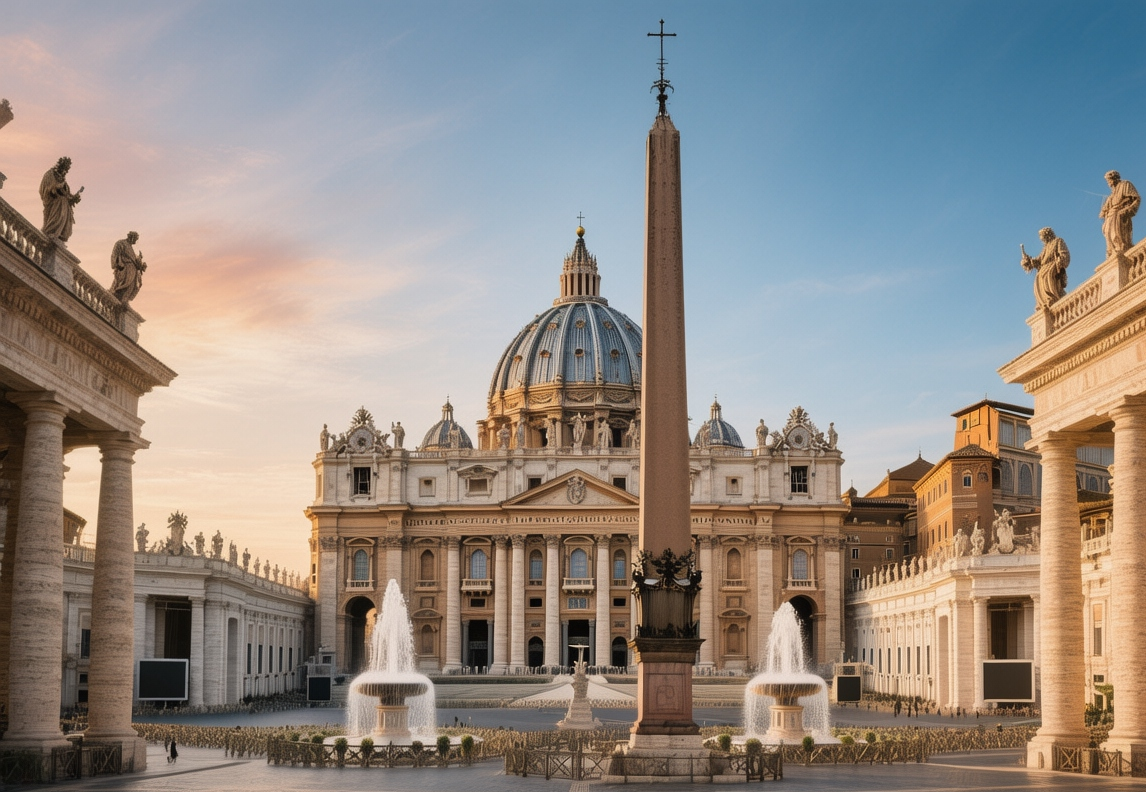
Vatican City Renaissance Genius Meets Sacred Silence
The afternoon sun strikes Michelangelo's dome at precisely 4:17 p.m., transforming travertine into liquid gold while casting elongated shadows across Bernini's colonnade—a stone embrace of 284 columns that guides pilgrims toward the basilica's bronze doors; inside, the air carries the faint scent of beeswax and aged parchment as whispers bounce off gilded mosaics replacing original Renaissance frescoes, their 30,000 square meters of tesserae catching candlelight near Michelangelo's Pietà, carved when he was merely twenty-four and signed only once in his career; commissioned by Pope Julius II in 1506 to replace Old St. Peter's—a crumbling 4th-century basilica unable to contain swelling Renaissance pilgrim crowds—this 22,000-square-meter sanctuary solved both spiritual and engineering crises through Bramante's Greek cross plan and Michelangelo's 136-meter dome, an architectural marvel requiring 452 steps to reach the lantern where Rome unfolds like a living map below; today this microstate matters profoundly as climate-controlled preservation battles humidity damage to Michelangelo's Sistine frescoes while overtourism strains infrastructure, making your intentional visit an act of cultural stewardship in an era when sacred spaces risk becoming mere backdrops for digital validation.
Why Vatican City Embodies Spiritual Engineering
Rising from a 15th-century crisis of crumbling infrastructure and chaotic pilgrimage flows, Vatican City's current form emerged through Renaissance ambition—Pope Nicholas V initiated rebuilding in 1450 after witnessing pilgrims trampling each other during Jubilee Year crowds at the dilapidated Constantinian basilica. Bramante's 1506 design established the Greek cross foundation, but it was Michelangelo at age seventy-one who reimagined the dome's double-shell structure: an inner shell of 42 meters diameter supporting the outer lantern, engineered with sixteen concealed ribs distributing weight across four massive piers each measuring 24 meters thick. Completed in 1590 by Giacomo della Porta after Michelangelo's death, the dome soars 136.57 meters above the crypt where St. Peter's bones rest beneath Bernini's 95-foot bronze Baldacchino. This wasn't mere aesthetics; it was theological engineering—light flooding through the lantern's oculus symbolized divine presence while the colonnade's elliptical arms (designed 1656–1667) created what Bernini called "the motherly arms of Mother Church," guiding 300,000 annual pilgrims with mathematical precision. The Sistine Chapel's 40.5-meter ceiling, painted 1508–1512 while Michelangelo lay on custom scaffolding he engineered himself, solved the problem of visual storytelling for illiterate masses through 343 figures narrating Genesis to Last Judgment—pigments mixed with honey and wine to resist Vatican humidity. Today these structures endure not as relics but as active spiritual infrastructure where 20,000 daily visitors traverse spaces designed for contemplation, demanding we honor their dual identity as both museum and living sanctuary.
The Best Time to Experience Vatican City
Secure timed entry between 7:30 and 8:30 a.m. during April 10–May 15 or September 20–October 10 when temperatures range 16–22°C (61–72°F) and humidity remains below 65%, allowing comfortable dome climbs without midday heat exhaustion. The Sistine Chapel's acoustics are clearest before 10:00 a.m. when crowd noise hasn't yet created a 75-decibel hum that obscures guide whispers. Avoid June 15–August 25 entirely—temperatures exceed 35°C (95°F) with heat indices reaching 42°C (108°F), and queues for security screening stretch beyond 90 minutes despite pre-booked tickets; July 25–August 10 is particularly problematic during Italian national holidays when domestic tourism peaks. Winter visits (November–February) offer shortest lines but limited daylight for dome photography and frequent rain; the Vatican Museums close at 2:00 p.m. on December 24 and 31. Crucially, book the "Last Entry" slot at 3:30 p.m. on Tuesdays or Thursdays—crowds thin dramatically after 4:00 p.m. as day-trippers depart, granting near-private viewing of the Sistine Chapel's western wall during golden hour when sunset light filters through high windows. Always verify current opening schedules and papal audience closures at the official Musei Vaticani portal (museivaticani.va) minimum 48 hours before visiting.
Approximate Budget for a 7-Day Rome Trip with Vatican Focus
These estimates reflect projected 2026 pricing with 4.3% annual inflation applied to 2024 baselines per ISTAT tourism indices and Vatican City's 2025 fiscal report. Budget assumes moderate comfort with Vatican-adjacent lodging, authentic dining, and comprehensive site access including restricted areas.
- Accommodation: €160–€240 per night in Prati district (5-minute walk to Vatican Museums); €110–€170 in Trastevere with 12-minute tram ride via line 8
- Food: €70 per day average—breakfast €9 (maritozzo cream bun and espresso at Roscioli Bakery), lunch €25 (cacio e pepe at Pizzarium Bonci), dinner €36 (saltimbocca alla romana with Frascati wine at Il Pagliaccio)
- Transportation: €42 total—€14 for 72-hour Roma Pass (unlimited metro/bus), €8 metro line A roundtrip (Ottaviano station), €20 taxi from Fiumicino Airport via official white cabs with fixed €53 rate
- Attractions: €86 total—€27 Vatican Museums + Sistine Chapel (booked direct), €10 St. Peter's dome climb (stairs option), €18 Scavi Tour of necropolis beneath basilica (booked 60 days ahead), €16 Castel Sant'Angelo, €15 Borghese Gallery reservation
- Miscellaneous: €110 total—€45 guided Vatican Gardens tour (reservation essential), €32 dinner at Michelin-starred Aroma overlooking dome, €20 official Vatican Pharmacy skincare purchase, €13 for emergency espresso refuels
Total estimated cost: €1,428–€1,638 per person
6 Essential Vatican City Experiences
- Dome Climb at First Light: Enter St. Peter's at 7:00 a.m. opening, bypassing main queues by using the right-side entrance near Swiss Guard post. Ascend all 551 steps (€10) rather than elevator—halfway up, exit onto the terrace encircling the drum where you'll stand eye-level with Bernini's 1.7-meter marble angels and watch sunlight ignite the Tiber River below; continue to the lantern for Rome's most profound panorama spanning 47 kilometers on clear days.
- Sistine Chapel's Final Hour: Book 3:30 p.m. entry via official portal, then deliberately linger in the Raphael Rooms until 4:15 p.m. when crowds thin by 70%. Position yourself on the western bench facing the Last Judgment—as afternoon light slants through high windows, the fresco's ultramarine blues (made from crushed lapis lazuli worth more than gold in 1541) glow with supernatural intensity while guard whispers fade into contemplative silence.
- Scavi Tour Necropolis Descent: Reserve exactly 60 days ahead at uffizi.scavi@fabricspetri.va for the 90-minute underground tour. Descend 12 meters beneath the basilica into the Vatican Necropolis where you'll stand before Wall G where St. Peter's bones were authenticated in 1968—observe the red plaster graffiti reading "Petros eni" (Peter is within) scratched by 2nd-century pilgrims in flickering lamplight.
- Pietà's Contemplative Moment: Approach Michelangelo's Pietà immediately after 7:00 a.m. entry before barriers form. Stand precisely three meters back—the optimal distance where Mary's youthful face (carved from a single Carrara marble block) reveals its theological paradox: eternal virginity holding her crucified son, her drapery cascading in 27 distinct folds that catch morning light filtering through the chapel's single window.
- Bernini's Baldacchino Perspective Shift: After entering the basilica's nave, walk slowly toward the altar while observing how Bernini's 95-foot bronze canopy appears to grow lighter despite weighing 95 tons—this optical illusion results from decreasing column thickness toward the top. Then circle behind the Baldacchino to discover the hidden sunken floor where eight bronze angels support St. Peter's tomb, visible only through a grated opening.
- Papal Audience Participation: Attend Wednesday General Audience (book free tickets 30 days ahead via prefettura.va). Arrive by 8:00 a.m. to secure front-row standing space in St. Peter's Square—when the Pope's white jeep navigates Bernini's colonnade at 9:30 a.m., you'll witness spontaneous multilingual prayers rising from 40,000 pilgrims, a living tapestry of global Catholicism beneath the obelisk that witnessed Nero's persecutions.
3 Hidden Gems Most Travelers Miss
- Vatican Mosaic Studio (Laboratorio delle Pietre Dure): Located beyond the Sistine Chapel exit near the spiral Bramante Staircase—request access at the exit desk by saying "Vorrei vedere il laboratorio" (I'd like to see the workshop). Master artisans restore 16th-century mosaics using techniques unchanged since 1576; visit Tuesday mornings when restorers work on fragments from Raphael's lost Transfiguration. Free with museum ticket; photography prohibited but observation permitted through glass partition.
- St. Anne's Gate Secret Entrance: Skip 90-minute security lines by entering Vatican Museums through Portone di Sant'Anna on Via di Porta Angelica—open 8:00–10:00 a.m. exclusively for visitors with pre-booked tickets who mention "biglietto prenotato" to Swiss Guards. This medieval gate passes directly into the Cortile della Pigna courtyard, bypassing main entrance chaos while offering intimate views of the bronze pinecone sculpture that inspired Bramante's dome design.
- Vatican Pharmacy Exclusive Formulations: Beyond St. Peter's Square at Via Belvedere 12—enter the world's oldest operating pharmacy (founded 1564) requiring no Vatican ticket. Purchase the lavender-scented hand cream developed for Pope John Paul II (€18) or the thermal water spray sourced from Vatican-owned springs near Viterbo; pharmacists wear white coats and speak English fluently. Open 9:00 a.m.–1:00 p.m. Monday–Friday; closed weekends and papal holidays.
Cultural & Practical Tips
- Strict dress code enforced: shoulders and knees covered for all genders—carry a €5 sarong from vendors outside if needed, but avoid purchasing as proceeds rarely support local communities; silk scarves (€12–€20) from Prati boutiques serve as elegant, reusable solutions.
- Maintain absolute silence within Sistine Chapel—guards issue verbal warnings then escort violators out; place phones in airplane mode before entry to resist temptation.
- Photography without flash permitted everywhere except Sistine Chapel (total ban) and St. Peter's tomb area; selfie sticks incur €50 fines under Vatican Law No. XVIII/2023.
- Greet Swiss Guards with "Buon giorno, guardia svizzera" (bwon JOR-no, GUAR-dee-ah ZVEET-ser-ah)—they often share queue-jumping tips for lesser-known entrances when treated with respect.
- Validate metro tickets before boarding at Ottaviano station—unvalidated tickets carry €120 fines despite functioning turnstiles; inspectors patrol platforms between 9:00–11:00 a.m. daily.
- Carry minimum €1 coins for St. Peter's restroom access (€1 fee) and €2 coins for Vatican post office stamps—sending postcards with Vatican City cancellation marks costs €3.50 but creates meaningful souvenirs.
- Book all Vatican experiences minimum 60 days ahead via official portals—third-party vendors add 30–50% surcharges with identical access and no customer service recourse.
Conclusion: Travel with Reverence, Not Just Reservations
To stand beneath Michelangelo's dome is to occupy space where faith and human genius converged across five centuries—a continuity demanding more than transactional tourism. Your €27 ticket directly funds the Vatican's €18 million annual conservation effort battling microclimate damage to frescoes; each respectful step on protected marble honors the artisans who spent lifetimes carving details meant for God's eyes alone. In 2026, as overtourism threatens sacred silence, choose presence over productivity—linger where candle smoke curls around Bernini's colonnade rather than rushing to capture the "perfect shot." Listen for echoes not of papal proclamations but of resilience: this microstate survived sackings, schisms, and secularization because beauty persisted as active spiritual infrastructure. Your responsibility isn't passive observation but active stewardship—carrying its story forward with accuracy and awe. Let Vatican City teach you that true pilgrimage lies not in checking sites off lists, but in allowing stone and light to recalibrate your soul; in understanding that the most profound journeys measure not kilometers traveled, but depths plumbed within.