
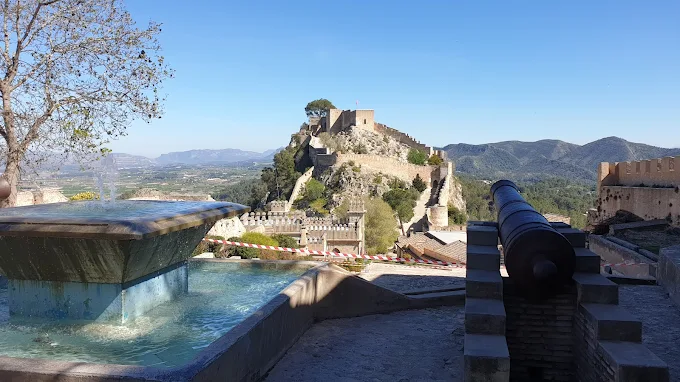
Xàtiva Castle Medieval Stone Meets Valencian Sun
The sun dips below the Sierra Grossa as the limestone ramparts glow amber—heat radiating from 2.5 kilometers of fortified walls that have watched over the valley for 2,000 years. You stand at the highest point of the Xàtiva Castle, breathing air scented with wild rosemary and ancient dust, listening to the distant hum of traffic from the town 380 meters below. This is not a single fortress but a dual citadel—the Castell Major and Castell Menor—linked by a winding path that traces the spine of the mountain like a stone dragon. The silence here is heavy with history; it is the silence of the Borgia family who walked these halls in the 15th century, of the defenders who fell during the War of Spanish Succession in 1707, and of the prisoners who scratched their names into the dungeon walls. In 2026, as modern development encroaches on historic landscapes, the Xàtiva Castle matters because it remains a defiant monument to resilience—demanding visitors climb not just for the view, but to witness the layers of conflict and culture that built the Valencian identity.
Why Xàtiva Castle Embodies Valencian Resistance
The Xàtiva Castle solves a fundamental strategic problem: how to control the fertile valley of the Canyoles River while defending against invasion from the coast and the interior. This 2,500-meter fortified enclosure is one of the largest castle complexes in Spain, spanning two distinct peaks connected by a fortified ridge. The historical significance is profound; inhabited since the Neolithic era, the site was expanded by the Romans, fortified by the Moors in the 8th century, and conquered by James I of Aragón in 1244. It served as the birthplace of the Borgia dynasty (Pope Callixtus III and Alexander VI), who used the fortress as a political stronghold during the Renaissance. The technical engineering is staggering: the walls utilize tapial (rammed earth) and limestone masonry, with towers spaced every 30 meters to eliminate blind spots for archers.
Tragedy defines the modern identity of the site. In 1707, during the War of Spanish Succession, Philip V's troops burned the town of Xàtiva to the ground as punishment for supporting the Habsburg claimant. The castle was partially demolished, and legend holds that the king ordered a portrait of himself to be hung upside down in the local museum—a tradition that continues to this day as an act of defiance. Conservation efforts, managed by the Generalitat Valenciana, employ 25 conservators to stabilize the crumbling ramparts. The 2020–2025 restoration project (€5.5 million investment) focused on reinforcing the Castell Menor's keep and clearing vegetation that threatened the masonry. This preservation fulfills a need for tangible connection to the past; in 2026, amidst sanitized heritage sites, the Xàtiva Castle offers a raw, unvarnished encounter with a history where stone remembers blood.
The Best Time to Experience Xàtiva Castle
For optimal hiking conditions—when the stone is cool to the touch and the visibility extends to the Mediterranean—target March 15–May 25 or September 20–November 10. During these windows, daytime temperatures in Xàtiva range 18–26°C (64–79°F), while evenings cool to 10–15°C (50–59°F), perfect for sunset viewing without summer heat. For photography and atmosphere, arrive at the ticket office by 9:30–10:00 AM, when the morning light illuminates the facade before tour buses arrive from Valencia.
The golden hour before sunset—approximately 8:30–9:30 PM in June, 7:00–8:00 PM in October—casts warm amber light onto the limestone blocks, creating ideal conditions for capturing the texture of medieval masonry against the darkening sky. Visit Tuesday through Thursday to avoid weekend crowds from Valencia and Alicante; Saturday afternoons see visitor numbers exceed 1,500 people, creating bottlenecks at the narrowest points of the ramparts. Avoid July 1–August 31 unless you tolerate temperatures exceeding 35°C (95°F) and zero shade on the exposed walls; similarly, avoid December 24–January 6 when the site closes for holidays or operates on reduced hours.
Verify current opening hours and ticket availability at the official Xàtiva Tourism website: https://xativaturismo.com/ or call the Visitor Center at +34 962 280 040.
Approximate Budget for a 7-Day Trip (2026)
This budget reflects mid-range travel with comfortable accommodations, quality dining, and cultural experiences—based on 2025 pricing adjusted for Spain's projected 3.2% inflation rate for 2026. Xàtiva is a affordable destination compared to Valencia, but transport costs add up if staying in the city. This itinerary assumes a mix of 3 nights in Xàtiva and 4 nights in Valencia for regional exploration.
Accommodation: €80–€160 per night
- 3-star hotel in Xàtiva old town: €80–€110 (Hotel Montsant)
- Boutique hotel in Valencia center: €130–€160 (Hotel Sorolla)
- Rural apartment (self-catering): €90–€130 (requires 3-night minimum)
Food: €40–€70 per day
- Breakfast: €6–€10 (coffee, pastry, toast at local café)
- Lunch: €15–€25 (menú del día: paella, meat, or fish with wine)
- Dinner: €20–€35 (traditional restaurant: steak, wine, dessert)
Transportation:
- Train Valencia to Xàtiva (RENFE): €6.50 one-way, 45 minutes
- Local bus within Xàtiva: €1.50 per ride
- Rental car (7 days, compact): €260–€330 (for rural exploration)
- Fuel for regional exploration (350 km): €55–€65
Attractions & Experiences:
- Xàtiva Castle entry: €4
- Museum of Fine Arts entry: €3
- Guided castle tour: €12
- Valencia City of Arts ticket: €30
- Wine tasting (Utiel-Requena): €20
Miscellaneous:
- Local wine (Utiel-Requena DO, bottle): €8–€18
- Souvenirs and art prints: €30–€60
- Travel insurance (7 days): €35–€55
- Emergency fund: €100 (recommended)
Total for 7 days (mid-range): €1,300–€1,750 per person (excluding international flights)
6 Essential Xàtiva Castle Experiences
- Walk the Ramparts from Castell Menor to Major: This is the core experience of the Xàtiva Castle. Enter through the main gate at 10:00 AM. The path winds along the ridge for 1.5 kilometers. The stone is uneven; wear sturdy shoes. You'll pass the Prison of San Felipe and the Tower of Philip V. Allow 2 hours. The views encompass the valley and the Sierra de Mariola. Photography is permitted; respect barriers near unstable walls. This experience offers the full scale of the fortification.
- Visit the Museum of Fine Arts: Located inside the castle complex. Open Tuesday–Sunday, 10:00 AM–6:00 PM. Entry €3 (included in some combo tickets). The collection features paintings from the 15th–19th centuries, including works by Ribera and Goya. The highlight is the upside-down portrait of Philip V. Allow 60 minutes. This experience contextualizes the 1707 burning of the town. Photography permitted without flash.
- Explore the Cistern of the Castle: Located in the Castell Major. Access via a guided tour at 12:00 PM. The cistern could hold 500,000 liters of water, sustaining the garrison during sieges. The acoustics amplify the sound of dripping water. Allow 30 minutes. This engineering feat reveals how the castle survived months of isolation. Booking required at the ticket office. This experience is often missed by independent walkers.
- Climb the Tower of Homage: The highest point of the Castell Menor (380 meters elevation). Climb the 80 stone steps at 4:00 PM. The view from the top reveals the layout of the town below and the railway station where tourists arrive. Best visited when light hits the valley. Entry included in castle ticket. Allow 45 minutes. The wind can be strong; bring a jacket. This viewpoint offers the best photo opportunity.
- Walk the Town Walls (Muralla): The fortifications extend down into the old town. Access via the Portal de Sant Josep. The path is paved and suitable for evening strolls. Walk at 7:00 PM when the stones cool down. The view looks up at the castle you just visited. Allow 60 minutes. This experience connects the fortress to the urban fabric. Free to access; no ticket required.
- Dine in the Old Town: Experience local cuisine at Restaurant La Muralla (Carrer de Montcada 12). Reserve a table for 9:00 PM. Order all i pebre (eel stew) or paella de conill (rabbit paella). The terrace overlooks the Collegiate Church. Prices average €30 per person without wine. This meal connects you to the gastronomic traditions of the Costera region. Wine pairing: Bobal from Utiel-Requena (€15 per bottle).
3 Hidden Gems Most Travelers Miss
- Hermitage of Santa Anna: Located on a hill opposite the castle, this 16th-century chapel offers a unique view of the fortress. Access via a 20-minute hike from the town center. Entry free; open daylight hours. The interior features simple frescoes. It is overlooked because it requires a climb. Best visited at sunset when the castle glows. No facilities exist; bring water. This spot offers the best photographic angle of the Xàtiva Castle.
- Arab Baths (Baños Árabes): Located in the town center at Carrer de les Basses 6. Entry €2; open Tuesday–Saturday, 10:00 AM–2:00 PM. The 12th-century structure features horseshoe arches and star-shaped skylights. It is special because it predates the Christian conquest. Visit at 11:00 AM when the light penetrates the domes. This site reveals the Islamic heritage often overshadowed by the castle.
- Prison Graffiti: In the dungeons of the Castell Menor, look closely at the walls near the entrance. Prisoners from the 18th century carved names, dates, and religious symbols into the soft stone. No guide points this out; you must look with a flashlight. It is overlooked because visitors rush through the dark corridors. Best visited during the guided tour. This detail humanizes the history of incarceration.
Cultural & Practical Tips
- Language etiquette: Valencian (Catalan) and Spanish are spoken. Key phrases: Bon dia (BON DEE-ah = good morning), Si us plau (see oos PLAW = please), Gràcies (GRAH-see-es = thank you), Parla anglès? (PAR-lah ang-LES = do you speak English?). Using Valencian greetings shows respect for local identity.
- Hydration is critical: There are no water fountains or shops on the castle mountain. Carry at least 1.5 liters of water per person. Temperatures on the exposed stone are 5°C higher than in the town. Dehydration risks are high in summer. This is the most important safety tip for visiting the Xàtiva Castle.
- Footwear imperative: The paths are paved with irregular stones and loose gravel. Heels and smooth-soled shoes are dangerous. Wear hiking boots or sneakers with grip. The descent to the town is steep; trekking poles are helpful for those with knee issues.
- Photography guidelines: Flash photography is prohibited inside the museum and cisterns. Tripods are permitted on the ramparts but cannot block pathways. Drones require permission from the town council (email turisme@xativa.es 14 days ahead). Best light for exterior photos is early morning or late evening.
- Accessibility considerations: The castle is NOT wheelchair accessible due to stairs and uneven terrain. The museum has a ramp, but the ramparts do not. Inform staff at the ticket office for assistance; they can suggest alternative viewing points from the town. Taxis can drop off at the lower gate, but not higher.
- Weather considerations: Xàtiva is one of the hottest towns in Spain. The Garbí wind can bring relief in summer. Check forecasts at meteocat.gencat.cat before traveling. Summer temperatures exceed 35°C; sun protection is critical. Wear SPF 50+ and hats. Winter nights can drop to 5°C; layer clothing.
- Ticket strategy: Buy the combined ticket (Castle + Museum + Monastery) for €8 to save 20%. Tickets are valid for 3 days. Keep the ticket safe; it is not replaceable. This pass is essential for a comprehensive experience of the heritage sites.
Conclusion: Travel with Memory, Not Just Checklists
The Xàtiva Castle does not exist merely for your Instagram feed—it stands as a silent witness to two millennia of siege, faith, and defiance. What it deserves is your memory: the willingness to walk slowly across the ramparts without rushing to the next landmark, to understand that the stone beneath your feet supported armies and prisoners alike, to recognize that this landscape is a palimpsest of human endeavor first and a tourist attraction second. In 2026, as historical narratives are increasingly contested, Xàtiva offers a model of preservation—demonstrating how towns can honor their past without freezing it in time. Sit on the wall overlooking the valley not to check a box, but to watch the light change on the Sierra Grossa. Eat the local rabbit not for novelty, but to taste the continuity of the land. Let the arches teach you that endurance is quiet. Travel to Xàtiva not to consume history, but to honor it, ensuring your visit respects the legacy of those who built this stone chronicle and whose legacy remains etched in every block.