
Ålesund Art Nouveau Nordic Fire Rose Meets European Elegance
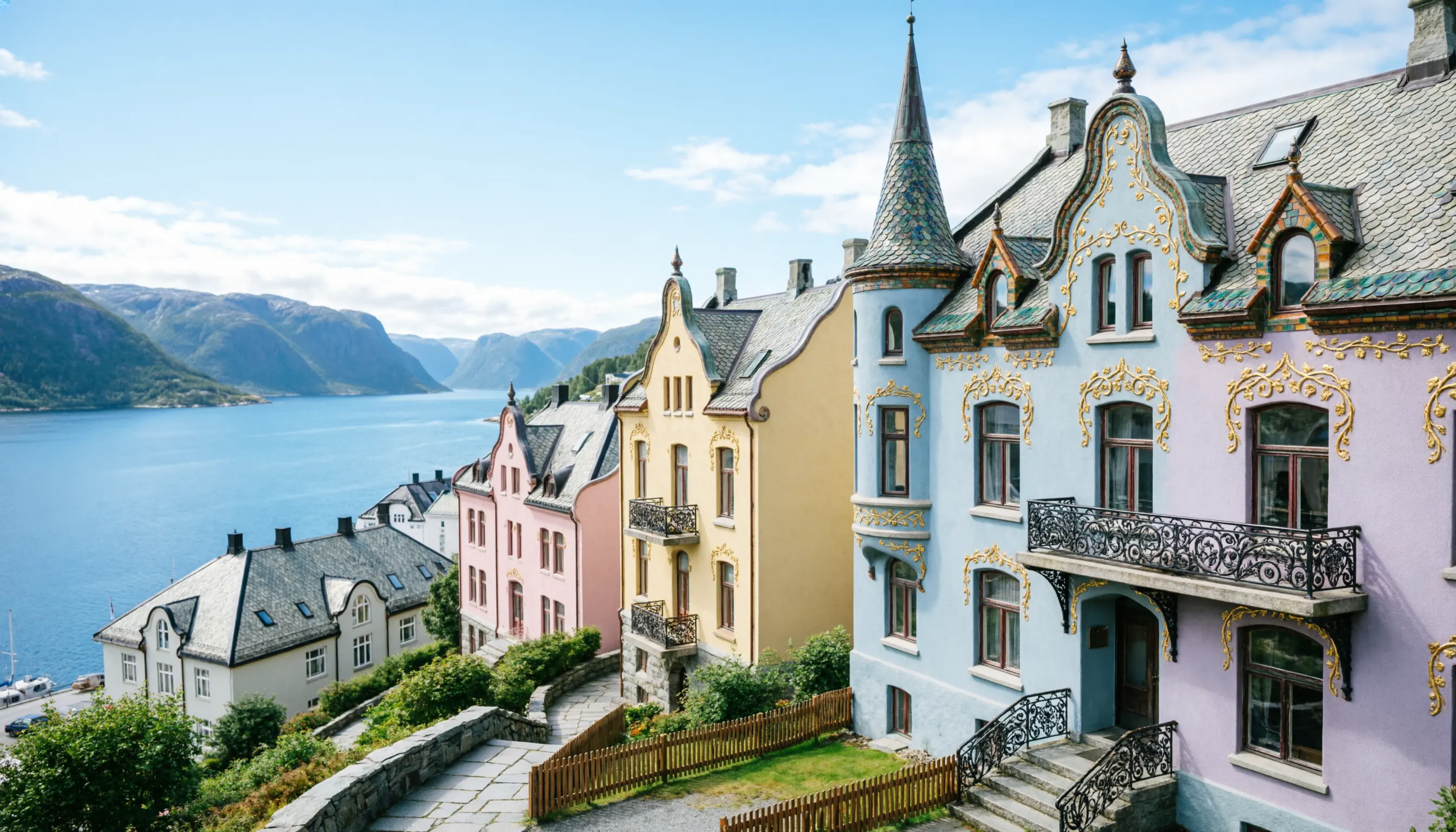
The morning light breaks over Storfjorden—pale gold spilling across slate-blue waters—as you stand on Apotekergata, surrounded by turrets and towers that seem to defy their own weight. It is 8:17 AM on a crisp March morning, and the only sounds are the distant cry of gulls and the soft shuffle of your boots on cobblestones still damp from overnight rain. These buildings—rebuilt between 1905 and 1910 after the catastrophic fire of January 23, 1904—stand as Norway's most complete collection of Jugendstil architecture, a style that swept Europe between 1890 and 1910. You trace your fingers along the cool, carved stone of a facade: dragons coil around doorways, peacocks spread their tails in mosaic tile, and floral motifs cascade down corners like frozen waterfalls. This is not merely architecture—it is resilience carved in stone, a testament to a town that refused to be defined by disaster. In 2026, as mass tourism reshapes destinations worldwide, Ålesund remains a place where you can still walk through history without jostling crowds, where Art Nouveau isn't preserved behind glass but lived within, breathed daily by residents who call these ornate buildings home.
Why Ålesund Embodies Art Nouveau Perfection
On that fateful night of January 23, 1904, a fire broke out in a cellar at 2:00 AM, fueled by strong winds that swept through the wooden town at 20 meters per second. Within hours, 850 buildings burned to the ground—leaving only 230 people with homes in a town of 11,000. Yet from those ashes rose something extraordinary: a complete urban reinvention in the Art Nouveau style, making Ålesund the world's most concentrated collection of Jugendstil architecture. The reconstruction, completed by 1910, employed over 200 craftsmen who carved local granite into fantastical forms: spiraling towers reaching 40 meters skyward, asymmetrical facades adorned with national romantic motifs, and stained glass windows depicting Norse mythology alongside Art Nouveau's signature whiplash curves.
What makes Ålesund unique isn't merely the quantity of Art Nouveau buildings—over 300 structures survive today—but the quality and coherence of the ensemble. Architects like Hagbarth Schytte-Berg, Sverre Knudsen, and Christian Fürst studied in Dresden and Berlin, bringing continental sophistication to Norwegian materials. They solved a critical problem: how to create fire-resistant buildings that also expressed Norway's emerging national identity. The solution was local granite (quarried from nearby islands), slate roofs, and decorative elements that merged international Art Nouveau with Viking-age ornamentation. The result is a townscape where every corner reveals a new surprise: the Svaneapoteket (Swan Pharmacy) with its dragon-carved interior, the Brosundet canal lined with gabled warehouses, and the distinctive corner towers that give the skyline its fairy-tale silhouette.
The Best Time to Experience Ålesund Art Nouveau
For the optimal Ålesund Art Nouveau experience, plan your visit between May 18 and June 12—the sweet spot when daylight stretches to 19 hours, temperatures hover between 12–18°C (54–64°F), and the summer crowds haven't yet descended. During this window, you can photograph the ornate facades in the soft, golden light that persists until 11:00 PM, then wake at 4:00 AM to watch sunrise paint the turrets in rose and apricot hues. The September 5–22 period offers equally compelling conditions: crisp air at 8–14°C (46–57°F), fewer tourists, and the dramatic contrast of autumn colors against pale granite.
Avoid July 15–August 15, when cruise ship arrivals peak (up to 6,000 passengers daily) and accommodation prices surge 40%. Winter months (November–February) present challenges: temperatures drop to -2 to 4°C (28–39°F), daylight shrinks to 5–6 hours, and many Art Nouveau buildings close for renovation. For current weather conditions and cruise ship schedules, verify at visitalesund.com and the Norwegian Meteorological Institute at yr.no. The absolute best time for photographers? June 21 (summer solstice) at 10:30 PM, when the sun barely dips below the horizon, bathing the town in perpetual twilight.
Approximate Budget for a 7-Day Trip (2026)
Ålesund sits in Norway's mid-range cost spectrum—more affordable than Oslo or Bergen, but still reflecting Scandinavian price levels. The following budget assumes moderate travel style: comfortable 3–4 star accommodation, mix of casual and one fine-dining experience, public transportation, and paid entry to major attractions. Prices reflect 2026 estimates with 3.2% inflation adjustment from 2025 Norwegian Statistics Bureau data.
- Accommodation: €120–€180 per night for a double room in a central Art Nouveau hotel (Hotel Brosundet or Thon Hotel Ålesund); budget hostels start at €45/night
- Food: €65–€85 per day: breakfast €12 (included at most hotels), lunch €18 (fish soup or open-faced sandwiches), dinner €35–€45 (fresh cod or lamb with local beer)
- Transportation: €45 total: airport bus line 10 (€12 round-trip), local bus day pass €8, ferry to Godøy island €15, rental car optional at €65/day
- Attractions: €78 total: Jugendstilsenteret (Art Nouveau Centre) €14, Mount Aksla viewpoint free, Atlantic Sea Park €22, guided architecture walk €18, boat tour €24
- Miscellaneous: €100: souvenirs (hand-carved troll €25, local aquavit €35), café stops €20, emergency buffer €20
Total for 7 days: €1,218–€1,450 per person (based on double occupancy)
6 Essential Ålesund Art Nouveau Experiences
- Climb the 418 Steps to Mount Aksla at Sunrise: Begin your day at 5:30 AM (in summer) or 8:00 AM (in winter) for the definitive Ålesund panorama. The steep climb takes 20–25 minutes, passing through Fjellstua Park. From the viewing platform at 118 meters elevation, you'll see the entire Art Nouveau ensemble spread across three islands—Apøya, Nørvøya, and Aspøya—with the sun illuminating the distinctive corner towers and turrets. Bring a windbreaker; even in summer, temperatures at the summit are 3–4°C cooler than sea level.
- Explore Jugendstilsenteret (Art Nouveau Centre): Located in the former Svaneapoteket (Swan Pharmacy) at Apotekergata 16, this museum opens at 10:00 AM daily. Spend 90 minutes examining original architectural drawings, stained glass panels, and the stunning dragon-carved interior that survived the 1904 fire. The multimedia presentation (available in 8 languages) explains how Norwegian craftsmen adapted French and Belgian Art Nouveau to local materials. Don't miss the basement exhibition showing the fire's devastation through photographs taken January 24, 1904.
- Walk the Brosundet Canal at Blue Hour: At 9:45 PM in June (or 3:30 PM in December), position yourself on the bridge connecting Nørvøya and Apøya. The canal, lined with gabled warehouses rebuilt in 1906–1908, reflects the ornate facades in still water. The golden-hour light (which lasts nearly two hours in summer) transforms the pale granite to honey and rose tones. This is the single best photography location in town—arrive 15 minutes early to secure an unobstructed viewpoint.
- Enter the Functional Art Nouveau Buildings: Unlike many historic districts where facades are preserved but interiors modernized, Ålesund's Art Nouveau buildings remain functional. Step into the lobby of Hotel Brosundet (formerly a warehouse, converted 1907) to see original stained glass and carved woodwork. Visit the post office at Kongens gate 18, where the 1908 interior features peacock motifs and flowing organic lines. These aren't museums—they're living spaces where you can experience Art Nouveau as intended: integrated into daily life.
- Take the Atlantic Road Detour: Rent a car for a half-day trip (87 km, 1 hour 15 minutes each way) to drive the Atlantic Ocean Road (Atlanterhavsveien), completed in 1989 but echoing the same engineering boldness that rebuilt Ålesund. The 8.3-kilometer route connects islands with eight bridges, including the dramatic Storseisundet Bridge with its 23-meter arch. Leave Ålesund at 2:00 PM to catch the late-afternoon light on the white-capped waves crashing against the road's concrete barriers.
- Join a Guided Architecture Walk: Book the 2-hour "Jugendstil by Foot" tour (€18, departs daily at 11:00 AM from Tourist Information) led by certified guides who reveal details invisible to casual observers: the Masonic symbols carved above doorways, the significance of dragon versus lion motifs, and how architects incorporated Norwegian folk tales into decorative elements. Guides point out subtle differences between early reconstruction (1905–1907, more conservative) and later buildings (1908–1910, more ornate and experimental).
3 Hidden Gems Most Travelers Miss
- Apotekergata 7's Secret Courtyard: Behind the unassuming facade at Apotekergata 7 lies a hidden courtyard accessible through a narrow passage (1.2 meters wide) marked only by a small "Gårdsplass" sign. Enter between 10:00 AM and 4:00 PM to discover an intact 1907 Art Nouveau garden with original ironwork gates, a fountain carved with water nymphs, and a rear facade more ornate than the street-facing side. Locals use this as a shortcut; tourists rarely discover it. The courtyard is private property but open to respectful visitors—do not photograph residents' windows.
- Sukkertoppen Viewpoint at Dusk: While everyone climbs Mount Aksla, the smaller hill of Sukkertoppen (Sugar Top) on Aspøya island offers equally stunning views with zero crowds. Access via the residential street Sukkertoppen (bus 3, stop "Aspøy kirke," then 8-minute walk). The 15-minute climb rewards you with a 360-degree panorama of the Art Nouveau town, fishing boats in the harbor, and the open sea beyond. Best visited at 8:30 PM in summer when the light turns the buildings golden. Bring a flashlight for the descent; the path is unlit.
- Kiperviktorget Market's Art Nouveau Details: The covered market hall at Kiperviktorget, built in 1909, features subtle Art Nouveau elements most visitors overlook: the cast-iron support columns with floral capitals, the stained glass skylight depicting local fish species, and the original tile work in the entrance vestibule. Visit on Saturday mornings (9:00 AM–2:00 PM) when local farmers sell brown cheese (brunost), cloudberries, and smoked salmon. Ask the elderly fishmonger at stall 12 (Magnus, 78 years old, working there since 1967) to point out the hidden carvings—he knows every detail of the building's history.
Cultural & Practical Tips
- Respect the living architecture: These are not museum pieces but homes and businesses. Keep voices low in residential courtyards, never photograph through windows, and ask permission before photographing shop interiors. The Art Nouveau district is a UNESCO tentative list site precisely because it remains functional.
- Learn three Norwegian phrases: Takk (tahk—thank you), Unnskyld (oon-shuld—excuse me), and Snakker du engelsk? (snah-ker doo eng-elsk—do you speak English?). Norwegians appreciate the effort, though 90% speak excellent English.
- Photography guidelines: Tripods require permits in the Art Nouveau Centre (€10, available at reception). Drone flights are prohibited in the town center without special permission from the Norwegian Civil Aviation Authority (apply 30 days in advance at luftfartstilsynet.no). Street photography is permitted, but blur faces if individuals are clearly identifiable.
- Weather preparedness: Even in summer, pack waterproof layers—Ålesund receives 1,800mm of rain annually, distributed across 230 days. Temperatures can shift 10°C within an hour. The wind off the fjord averages 15 km/h, making it feel 3–4°C cooler than the thermometer reads.
- Dining etiquette: Dinner is served 5:00–8:00 PM; restaurants close kitchens by 9:00 PM. Tipping is not expected (service included) but rounding up 5–10% is appreciated for exceptional service. Try local specialties: skrei (winter cod, in season January–March), fårikål (lamb and cabbage stew, autumn dish), and kransekake (almond ring cake).
- Accessibility note: The Art Nouveau district features cobblestone streets and steep hills—challenging for wheelchairs. The Jugendstilsenteret has elevator access, but many historic buildings have steps. Request the accessible route map at the tourist information center (open year-round, 9:00 AM–5:00 PM).
- Emergency contacts: Medical emergencies: 113. Police: 112. Tourist information: +47 70 10 20 30. The nearest hospital (Ålesund Sjukehus) is 2 km from the center, with 24-hour emergency services.
Conclusion: Travel with Reverence, Not Just Sightseeing
Ålesund's Art Nouveau district teaches us that destruction can birth beauty—that from the ashes of 850 burned buildings emerged a masterpiece of urban design. But this beauty is fragile, not because the granite will crumble (it will stand for centuries) but because the soul of the place depends on remaining a living neighborhood, not a theme park. When you walk these streets in 2026, you're not just observing architecture; you're witnessing a community's ongoing relationship with its history. The woman hanging laundry from her 1908 apartment window, the fisherman repairing nets on the Brosundet quay, the children cycling past dragon-carved doorways on their way to school—these are the guardians of Ålesund's Art Nouveau legacy.
So slow down. Sit in a café for an hour, watching how the light changes on the ornate facades. Buy your lunch from the market hall and eat it on the quay, listening to the gulls and the lapping water. Climb those 418 steps not to check a box but to understand why this town, rising from fire and water, chose beauty over mere utility. In an age of overtourism and Instagram-driven travel, Ålesund asks something different of you: not just to see, but to witness; not just to photograph, but to remember that these buildings are someone's home. Travel with reverence, and you'll discover that Ålesund's greatest treasure isn't its Art Nouveau architecture—it's the quiet dignity of a town that rebuilt itself with grace.