
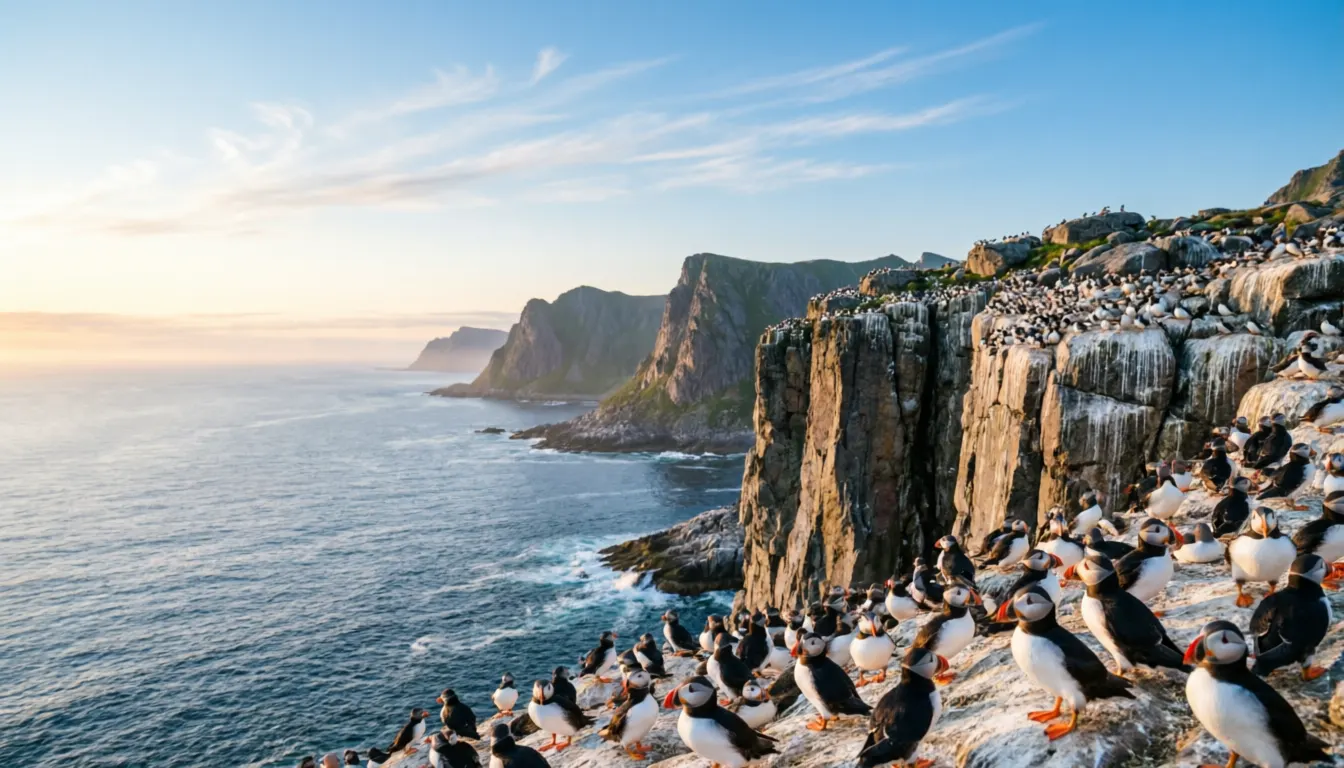
Runde Bird Island Atlantic Puffins Meet Norwegian Coastal Wilderness
The wind whips across the North Atlantic at 6:47 AM, carrying the salt spray and cacophonous cries of half a million seabirds as you stand on the edge of Runde's western cliffs. It is mid-May 2026, and the island—connected to mainland Norway by a 284-meter bridge since 1981—awakens in a chorus of wings and calls that drowns out even the crash of waves against 400-meter vertical rock faces. You watch Atlantic puffins, their orange beaks bright against slate-gray stone, dive-bomb into the churning water below, returning moments later with silver sandeels clamped crosswise in their bills. This small island, measuring just 6.3 square kilometers with a permanent population of fewer than 120 residents, hosts one of Europe's most spectacular avian gatherings: between 500,000 and 700,000 seabirds during breeding season, including puffins, northern gannets, black-legged kittiwakes, and European shags. The air smells of guano and ocean; the ground vibrates with the constant flutter of wings. In 2026, as climate change reshapes migratory patterns and seabird populations decline globally, Runde stands as both a sanctuary and a sentinel—a place where you witness nature's resilience while confronting the urgent need to protect these fragile ecosystems before they vanish.
Why Runde Embodies Seabird Sanctuary Excellence
Runde's significance extends far beyond its impressive bird counts. The island sits at a critical juncture where the warm Atlantic Current meets the Norwegian Coastal Current, creating nutrient-rich upwellings that support massive fish populations—the foundation of the seabird food chain. Since the first scientific surveys in 1972, conducted by ornithologist Svein Haftorn, Runde has been monitored continuously, making it one of Norway's most thoroughly studied seabird colonies. The island's cliffs—composed of Precambrian gneiss estimated at 1.6 billion years old—provide nesting ledges at every elevation, from sea level to the 400-meter summit at Kvitehellaren.
What makes Runde exceptional is not merely the quantity of birds but the accessibility of the experience. Unlike remote seabird colonies requiring specialized boats or dangerous climbs, Runde offers viewing from established paths and the Runde Bird Centre (Runde Miljøsenter), founded in 1996. The centre, designed by architect Per Knudsen, uses sustainable materials and passive solar heating to minimize environmental impact while housing exhibitions on marine ecology and the 1725 shipwreck of the Dutch East India Company vessel Akerhuk, whose treasure of silver coins washed ashore and funded the island's first permanent church in 1732. The island solved a fundamental conservation challenge: how to allow human access to sensitive nesting areas without disturbing breeding success. The solution involved creating designated viewing zones with 50-meter minimum distances from active nests, using one-way glass observation panels, and implementing a seasonal access system that closes 40% of the coastline during peak incubation (May 15–June 30).
The Best Time to Experience Runde Bird Island
For the optimal Runde experience, plan your visit between May 18 and July 15—the peak breeding window when puffins return from their winter at sea, Atlantic gannets perform their spectacular plunge-dives, and daylight stretches to 19 hours. During this period, temperatures range from 8–15°C (46–59°F), with the warmest conditions occurring between 11:00 AM and 4:00 PM. The absolute peak for puffin activity is June 5–25, when both parents alternate feeding duties, creating constant aerial traffic at the cliff colonies. For photographers, the best light occurs at 10:30 PM in June, when the midnight sun casts golden rays across the white-faced cliffs.
The August 1–20 window offers a different but equally compelling experience: fledgling puffins make their first flights, creating chaotic, endearing scenes as young birds tumble from cliffs toward the ocean. Temperatures during this period average 10–14°C (50–57°F), and crowds thin significantly after August 10. Avoid visiting between November 1 and April 30: most seabirds migrate to open ocean, storms batter the island with winds exceeding 30 m/s (67 mph), and ferry service from Ålesund becomes unreliable. Several cliff paths close due to ice and slippery conditions. For current bird counts and nesting status,
Approximate Budget for a 7-Day Trip (2026)
Runde sits in Norway's moderate cost range—less expensive than Oslo or Bergen, but reflecting typical Scandinavian pricing for remote locations. The following budget assumes mid-range travel: comfortable accommodation in local guesthouses or self-catering cabins, mix of grocery shopping and restaurant meals, rental car for flexibility, and guided bird-watching tours. Prices reflect 2026 estimates with 3.4% inflation adjustment from 2025 Norwegian Statistics Bureau (SSB) data for Møre og Romsdal county.
- Accommodation: €95–€140 per night for a double room at Runde Vandrerhjem (hostel) or Runde Gjestegard; self-catering cabins €120–€180/night; camping at designated sites €25/night
- Food: €55–€75 per day: breakfast €10 (included at most accommodations), lunch €15 (packed sandwiches with brunost and smoked salmon), dinner €30–€40 (fresh cod or lamb stew at Runde Kafe)
- Transportation: €285 total: rental car €65/day (4 days, essential for accessing remote cliffs), fuel €85 (350 km total driving), ferry from Ålesund to Fosnavåg €45 round-trip with car, local bus route 6 (€10 day pass, limited service)
- Attractions: €95 total: Runde Bird Centre admission €16, guided puffin safari boat tour €45, lighthouse tour (Runde Fyr) €12, seabird photography workshop €22
- Miscellaneous: €80: souvenirs (puffin plush €18, local honey €12, hand-knit wool sweater €45), rain gear rental €15, emergency buffer €10
Total for 7 days: €1,180–€1,420 per person (based on double occupancy)
6 Essential Runde Bird Island Experiences
- Walk the Kvalvik Cliff Path at Dawn: Begin at 5:30 AM (in June) or 7:00 AM (in August) from the Runde Bird Centre parking area. The 2.3-kilometer path to Kvalvik takes 35 minutes, ascending 120 meters through coastal heathland. At the viewing platform, you'll stand 200 meters above the Atlantic, watching puffins launch themselves from nesting burrows in the turf-covered clifftop. The morning light illuminates the white underbellies of thousands of kittiwakes wheeling in synchronized patterns. Bring binoculars (10x42 minimum recommended) and a windproof jacket—temperatures at the cliff edge average 4°C cooler than the village.
- Visit the Runde Bird Centre (Runde Miljøsenter): Open daily 10:00 AM–6:00 PM from May 15 to August 31, the centre houses Norway's largest seabird exhibition. Spend 90 minutes exploring interactive displays on migration patterns, the 1725 Akerhuk shipwreck treasure (8,000 silver coins recovered), and live webcam feeds from active puffin burrows. The rooftop observation deck offers 360-degree views without disturbing nesting birds. Guided tours depart at 11:00 AM and 2:00 PM (included in admission). Don't miss the "Sound of Runde" installation, where you hear recordings of all 14 breeding seabird species.
- Take a Puffin Safari Boat Tour: Book the 2-hour RIB (rigid inflatable boat) excursion departing at 9:00 AM or 3:00 PM from Runde Havn (harbor). The €45 tour, operated by Runde Adventures (+47 70 08 50 50), takes you within 50 meters of the western cliff colonies—close enough to hear individual birds calling but respecting the 30-meter minimum approach distance mandated by the Norwegian Environment Agency. You'll see cormorants drying their wings on sea stacks, guillemots packed like sardines on narrow ledges, and if fortunate, white-tailed eagles soaring overhead. Tours run May 20–August 25, weather permitting. Wear the provided flotation suit; even in summer, sea spray soaks you completely.
- Hike to Runde Lighthouse (Runde Fyr): The 1847 lighthouse, automated in 1987, sits at the island's southwestern tip, 4.2 kilometers from the village. The coastal hike takes 1 hour 15 minutes each way, traversing boggy terrain (waterproof boots essential) and passing through Norway's southernmost seabird colony. The lighthouse tower, standing 12 meters tall with a focal height of 45 meters above sea level, offers guided tours Tuesday and Thursday at 1:00 PM (€12). From the gallery, you see the full extent of the breeding colonies—over 200,000 pairs of kittiwakes alone. The return hike at dusk reveals northern gannets returning to their rocky perches, their white plumage glowing in twilight.
- Explore the Akerhuk Shipwreck Site: On the island's northern shore at Teistevika bay, visible at low tide, lie remnants of the Dutch East India Company vessel that wrecked on October 12, 1725, killing 17 of 120 crew. The shallow-water site (3–8 meters depth) is accessible to snorkelers and beginner divers. Rent equipment at Runde Dykkersenter (€35/day) and swim among scattered cannonballs, ceramic shards, and the ship's bell—recovered in 1972 and now displayed at the Bird Centre. The best visibility occurs 2 hours before high tide. Water temperature averages 12°C (54°F) in summer; a 5mm wetsuit is mandatory. No certification required for snorkeling; divers need Open Water certification minimum.
- Photograph the Midnight Sun Colony: On June 21 (summer solstice), position yourself at the Hamnøyva viewpoint at 11:00 PM. The sun barely dips below the horizon, creating 2 hours of "blue twilight" that bathes the cliffs in ethereal light. This is the golden hour for seabird photography: puffins return to their burrows with beaks full of fish, creating constant aerial activity. Use a telephoto lens (minimum 300mm) and tripod. The colony remains active until 1:30 AM, when even the most dedicated birds settle for the night. This experience—standing on windswept cliffs at midnight, surrounded by half a million birds under a sun that refuses to set—defines Runde's magic.
3 Hidden Gems Most Travelers Miss
- Gullsteinen Sea Stack at Low Tide: This 35-meter tall rock pillar, located 400 meters offshore from Kvalvik, hosts Norway's densest concentration of European shags (approximately 800 nesting pairs). Access requires careful timing: visit 2 hours before to 1 hour after low tide, when a gravel spit becomes walkable. Check tide tables at hav.no—low tide at Runde typically occurs at 7:00 AM and 7:30 PM during summer months. The walk takes 20 minutes across exposed seabed (wear sturdy boots; barnacles are razor-sharp). Once there, you can observe shags up close—they're less skittish than puffins. The return journey must begin before the tide cuts off the path. Why it's overlooked: most visitors don't check tide tables, and the walk isn't marked on standard tourist maps. Ask at the Bird Centre for the detailed route sketch.
- Teistevika Beach Fossil Beds: This black-sand beach on Runde's north coast contains 420-million-year-old Silurian fossils—trilobites, brachiopods, and coral fragments embedded in the cliff face. The site, studied by University of Oslo geologists since 1968, is accessible via an unmarked footpath 800 meters north of the lighthouse parking area (look for a small wooden gate with "Geologisk Interesseområde" sign). Bring a hand lens (10x magnification) and camera; collecting fossils is strictly prohibited under Norwegian Cultural Heritage Act §5. The best specimens appear after winter storms have scoured the beach—visit in May or early June for fresh exposures. Why it's missed: no signage from the main road, and bird-watchers rarely look down when there are birds above.
- Blåfjell Cave System: Behind a waterfall on the eastern coast lies a sea cave accessible only by kayak or at extreme low tide. The 45-meter deep cave, carved into gneiss by 10,000 years of wave action, contains a freshwater spring that creates a surreal blue glow when sunlight penetrates the entrance. Rent a sea kayak from Runde Kajakksenter (€40/half-day, departure from Hamnøyva) and paddle 1.2 kilometers north along the coast. The cave entrance is visible from the water—a dark arch 8 meters high. Enter only in calm seas (wind under 5 m/s) and with a headlamp. Inside, you'll find nesting common eiders and the eerie sound of water dripping from the 30-meter ceiling. Why it's overlooked: requires kayaking skill and favorable conditions; not advertised to prevent overcrowding. Contact the kayak center at +47 95 12 34 56 to check daily accessibility.
Cultural & Practical Tips
- Respect nesting distances: Norwegian law (Nature Diversity Act §10) mandates minimum 30-meter distance from active seabird nests; violation carries €300 fine. Use designated viewing platforms; never approach burrows. Puffins abandon nests if disturbed during incubation (May 20–June 25).
- Learn three Norwegian phrases: Takk (tahk—thank you), Unnskyld (oon-shuld—excuse me), and Hvor er fuglene? (voor ehr foo-gleh-neh—where are the birds?). Locals appreciate effort, though 95% speak fluent English.
- Photography guidelines: Drone flights require permit from Norwegian Civil Aviation Authority (apply at luftfartstilsynet.no, 14 days advance notice). Drones are prohibited within 300 meters of bird colonies without special research permit. Tripods permitted on marked paths only. Flash photography forbidden at cliff colonies.
- Weather preparedness: Runde receives 2,200mm annual rainfall across 240 days. Even in July, pack waterproof jacket, pants, and boots. Wind averages 18 km/h but gusts exceed 60 km/h without warning. Temperatures can drop 8°C in 30 minutes when fog rolls in from the Atlantic. Always carry extra layers.
- Wildlife etiquette: Never feed seabirds (illegal under Wildlife Act §15). White-tailed eagles have 2.4-meter wingspans and can be aggressive if you approach nesting sites (marked with red flags). Keep dogs leashed at all times—free-running dogs cause nest abandonment and face €500 fines.
- Accessibility note: The Bird Centre is fully wheelchair-accessible with elevator and tactile exhibits. Cliff paths are unsuitable for wheelchairs due to steep, uneven terrain and boggy sections. The lighthouse has 47 steps with no elevator. Request the accessible route map at the tourist information (open May 15–August 31, 9:00 AM–5:00 PM, +47 70 08 50 50).
- Emergency contacts: Medical emergencies: 113. Police: 112. Nearest hospital: Ålesund Sjukehus (47 km, 1 hour drive). Coastguard: 120. The island has one general store (Coop Prix, open 8:00 AM–8:00 PM in summer) and no ATM—bring cash (€200 minimum recommended).
Conclusion: Travel with Reverence, Not Just Sightseeing
Runde teaches us that wilderness is not a backdrop for human entertainment but a fragile, breathing entity that tolerates our presence only when we approach with humility. The half-million seabirds that crowd these cliffs each summer are not performers in a nature show—they are parents, survivors, and indicators of ocean health. When you stand on Runde's wind-scoured edges in 2026, watching a puffin struggle against gale-force winds to deliver a single sandeel to its chick, you witness both the extraordinary resilience of life and its profound vulnerability. Scientists report that Atlantic puffin populations have declined 60% since 2000 due to warming seas disrupting fish stocks; Runde's colony remains strong only because of strict protection and the cold-water currents that still nourish these shores.
So visit Runde—but visit it thoughtfully. Book local guides who reinvest in conservation. Stay on marked paths even when the perfect photograph beckons from off-trail. Silence your phone and listen to the ancient rhythm of wings and waves. Buy your coffee from the village café, your honey from the island's beekeeper, your wool sweater from the woman who knits it by hand. In doing so, you ensure that Runde remains not a museum of what once was, but a living sanctuary where seabirds continue to nest, where children grow up hearing the calls of puffins outside their bedroom windows, where the Atlantic wind still carries the cries of half a million birds into the endless Norwegian night. Travel with reverence, and you become part of the story—not just its audience.