
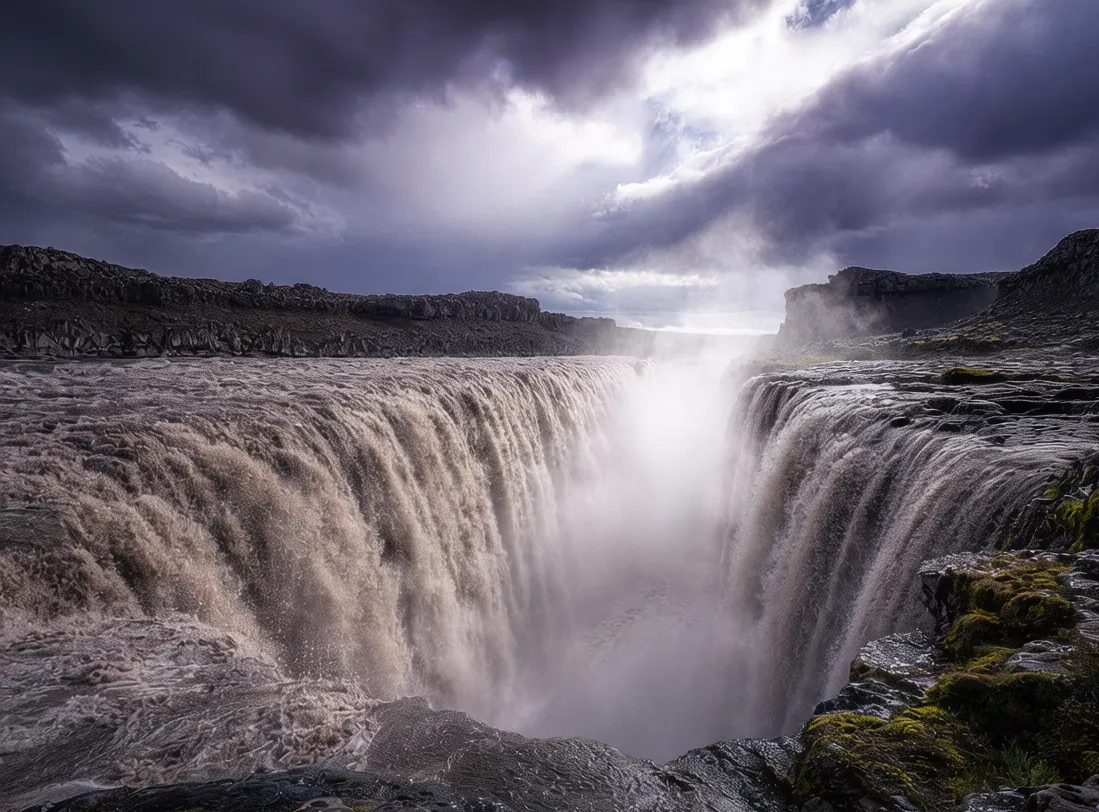
Dettifoss Waterfall Raw Power Meets Volcanic Wilderness
The ground trembles beneath your feet—a deep, resonant vibration that travels up through your boots and settles in your bones. You stand at the edge of a basalt canyon, and before you, the Jökulsá á Fjöllum river hurls itself over a 44-meter (144-foot) precipice with a violence that defies description. This is Dettifoss waterfall, the most powerful waterfall in Europe, where 200 cubic meters of glacial water crash down every second, creating a thunderous roar that drowns out thought itself. Mist rises in perpetual columns, catching the pale Arctic sun in fleeting rainbows that dance across the black volcanic rock. The canyon walls, stained orange and brown by centuries of mineral deposits, frame the falls like a natural amphitheater designed by geological giants. This isn't just water falling; it's the raw force of Vatnajökull glacier—Europe's largest ice cap—unleashing its meltwater into the void. In 2026, as climate change accelerates glacial retreat and alters river flows globally, the Dettifoss waterfall matters now more than ever—a visceral reminder of nature's untamed power that demands respect from the 300,000 annual visitors who come to witness its fury.
Why Dettifoss Waterfall Embodies Icelandic Power
The Dettifoss waterfall represents far more than a scenic destination—it is Iceland's most accessible demonstration of raw hydrological force and volcanic geology. Located within Vatnajökull National Park since 2008, the waterfall sits in the northern highlands, fed by the Jökulsá á Fjöllum river that drains 7,800 square kilometers of the Vatnajökull ice cap. The falls drop 44 meters (144 feet) over a width of 100 meters (328 feet), creating a curtain of water so powerful it has carved a canyon 500 meters long and 100 meters deep over thousands of years. This geological phenomenon solves a critical educational need: providing visitors with a tangible example of how water, given enough time and volume, can dismantle mountains.
Technical specifications highlight the engineering of nature itself. The average flow rate is 200 cubic meters per second, but during spring melt, it can exceed 1,000 cubic meters per second—equivalent to the flow of the entire Thames River at London. The water temperature remains a constant 2–4°C (36–39°F) year-round, chilled by its glacial origins. The basalt rock formations surrounding the falls date back 10,000 years to the last Ice Age, when glacial retreat exposed the volcanic bedrock. Designated a protected natural monument in 1996 before being absorbed into the larger national park, the site draws 300,000+ visitors annually. The Dettifoss waterfall fulfills a human need for connection to elemental power, offering a visual and visceral link to the forces that shaped the North Atlantic region. It proves that preservation and accessibility can coexist when managed with scientific rigor, ensuring the canyon remains intact for future generations to study and admire.
The Best Time to Experience Dettifoss Waterfall
Timing your visit to the Dettifoss waterfall requires balancing road accessibility, water volume, and crowd density. For optimal conditions combining accessible roads with maximum flow, target June 15–August 31. During these summer months, temperatures range from 8–15°C (46–59°F), and both access routes—Route 862 (west side) and Route 864 (east side)—are open and passable for standard vehicles. Daylight stretches 20–24 hours, allowing visits between 8:00–10:00 PM when the light is soft and crowds thin. The waterfall flows strongest during this period due to glacial melt. However, this is peak season; arrive before 9:00 AM to avoid tour buses.
For winter photography and ice formations, visit between November 1 and March 31. Temperatures drop to -5–5°C (23–41°F), and the waterfall often freezes partially, creating spectacular ice sculptures around the canyon edges. However, Route 864 (east side) closes completely in winter, and Route 862 (west side) requires a 4x4 vehicle with winter tires. Plan your visit between 11:00 AM–3:00 PM for maximum daylight. However, avoid December 20–January 10 unless prepared for extreme weather; storms can close both routes temporarily, and daylight shrinks to 4–5 hours. Also skip July 10–August 10 if you dislike congestion; this peak window brings 2,000+ daily visitors. For real-time road conditions and weather.
Approximate Budget for a 7-Day Trip (2026)
Exploring the Dettifoss waterfall anchors a week-long North Iceland adventure. This budget assumes a 7-day trip based in Akureyri or Mývatn with day trips to the waterfall. Prices reflect 2026 rates, accounting for Iceland's average 3.8% annual inflation from 2024–2026 (source: Statistics Iceland). All amounts shown in euros; multiply by 1.08 for USD equivalents. Note that Iceland uses ISK, but € is provided for international comparison.
Accommodation: €150–€320 per night
• Budget guesthouse in Akureyri (near Dettifoss): €150–€200
• Mid-range hotel (Mývatn area): €220–€280
• Luxury (Hotel Laxá or similar): €380–€550
• Camping (seasonal, Mývatn): €25 per person
Food: €55–€95 per day
• Breakfast: €12–€18 (hotel buffet or bakery pastry + coffee)
• Lunch: €18–€28 (Icelandic lamb soup, fish of the day, or hot dog)
• Dinner: €25–€49 (pan-fried Arctic char or traditional lamb)
• Groceries (self-catering): €35/day
Transportation:
• Keflavík Airport to Akureyri Flight: €120 round-trip
• Rental car (4x4 SUV, 7 days): €450 + €180 fuel
• North Iceland day tour: €110
• Reykjavík city bus (Strætó): €3.50 per ride
• Dettifoss parking: Free
Attractions:
• Dettifoss viewpoint: Free
• Mývatn Nature Baths: €45
• Hverir geothermal area: Free
• Perlan Museum: €30
• Blue Lagoon day trip: €110
• Golden Circle tour: €95
• Whale watching Akureyri: €85
Miscellaneous:
• Icelandic wool sweater (lopapeysa): €110–€180
• Thermal base layers: €90
• Travel insurance: €55
• Souvenirs (lava rock, handicrafts): €40
• Tips (not expected but appreciated): €25
Total for 7 days (mid-range): €2,350–€2,700 per person
Total (budget-conscious): €1,550–€1,800 per person
6 Essential Dettifoss Waterfall Experiences
1. View from the West Bank (Route 862): Park at the designated lot and walk 5 minutes to the viewing platform. This side offers the most dramatic perspective, looking directly at the falls. Visit at 8:00–9:00 AM to avoid crowds. The spray will soak you; bring a waterproof jacket. This is the most accessible viewpoint and the one featured in Ridley Scott's Prometheus.
2. Descend to the Canyon Floor: Follow the marked path down to the river level on the west side. The descent is steep and takes 15 minutes. Visit at 10:00 AM–12:00 PM when light penetrates the canyon. The perspective looks up at the thundering water. Bring sturdy boots; the path is slippery. This experience reveals the true scale of the falls.
3. Explore the East Bank (Route 864): Drive the gravel road to the eastern viewpoint. This side offers a different angle, looking across the canyon. Visit at 2:00–4:00 PM for optimal lighting. The path is less maintained but offers solitude. This perspective emphasizes the width of the waterfall.
4. Photograph the Mist and Rainbows: Position yourself at the viewing platform with the sun behind you. The best light occurs between 10:00 AM–12:00 PM when the sun illuminates the spray. Use a polarizing filter to enhance the rainbow colors. Bring a tripod; the ground vibrates from the water's power. This is the iconic shot that defines North Iceland.
5. Combine with Selfoss Waterfall: Drive 2 kilometers upstream to Selfoss, a horseshoe-shaped waterfall. The hike is 1 kilometer each way. Visit at 3:00–5:00 PM. The contrast between the thunderous Dettifoss and the elegant Selfoss is striking. This combination reveals the full power of the Jökulsá river system.
6. Visit the Information Center: Located at the west parking lot, this center offers exhibits on the canyon's geology. Open 9:00 AM–6:00 PM (summer). Entry: Free. Use the restrooms and buy snacks here. The staff provide updates on trail conditions. This context transforms the visit from tourism to education.
3 Hidden Gems Most Travelers Miss
• Hafragilsfoss Waterfall: Located 5 kilometers downstream from Dettifoss on Route 862. This smaller cascade features similar basalt columns but sees 90% fewer visitors. Access requires a 30-minute hike from the main road. Why overlooked: Unmarked on basic maps; requires asking rangers for directions. Best visited at 9:00–10:00 AM. Insider tip: Bring a map; the trail is less maintained than the main route.
• Ásbyrgi Canyon: Located 30 kilometers north of Dettifoss. This horseshoe-shaped canyon was formed by ancient glacial floods. Access via Route 864. Why overlooked: Requires a detour; most tourists head straight to Mývatn. Coordinates: 66.0833° N, 16.3833° W. Best visited at 7:00–8:00 AM for sunrise. The silence is profound.
• Hljóðaklettar Echo Rocks: Located within Ásbyrgi canyon. These volcanic rock formations create natural echo chambers. Access via hiking trails. Why overlooked: Requires physical effort; tour buses skip it. Best visited at 6:00–7:00 PM for sunset photography. Insider tip: Shout into the rock chambers; the echoes are mesmerizing.
Cultural & Practical Tips
• Stay on marked trails: The soil around Dettifoss waterfall is fragile and erodes easily. Straying from the path damages vegetation and destabilizes slopes. Fines apply for off-trail hiking. This ensures the canyon remains accessible for future visitors.
• Weather preparation: North Iceland experiences rapid weather changes. Even in summer, bring waterproof layers and windproof jackets. Temperatures at the falls average 3–5°C cooler than Akureyri. Check www.vedur.is for forecasts before hiking.
• Learn these Icelandic phrases:
— Takk (tahk): Thank you
— Góðan daginn (go-than dy-in): Good day
— Dettifoss (det-ee-foss): The waterfall's name
— Fallegt (fah-lekt): Beautiful
Icelanders appreciate effort; pronunciation matters less than attempting the language.
• Photography guidelines: Tripods permitted on viewing platforms but cannot block paths. Drone use strictly prohibited without special permit from the Icelandic Transport Authority. Best light: Morning (8:00–10:00 AM) or evening (8:00–10:00 PM). Respect other visitors; don't monopolize the railing.
• Footwear requirements: The trail is gravel and stone. Wear sturdy hiking boots with ankle support. Avoid sneakers or flip-flops. In winter, crampons are mandatory; the path freezes and becomes dangerously slick. Rent gear at the visitor center if needed.
• Respect the power: Never climb on the rocks near the waterfall. The spray makes surfaces extremely slippery. Multiple accidents have occurred when visitors ventured too close. Stay behind safety barriers. The canyon edges are unstable and can collapse without warning.
Conclusion: Travel with Reverence, Not Just Photography
The Dettifoss waterfall demands more than a perfect Instagram shot—it asks for reverence. As you stand before that thundering curtain of water, recognizing that you're not just visiting a landmark; you're entering a zone where geological history is written in stone and water. In 2026, as climate change alters glacial flows, Dettifoss offers both wonder and warning: that nature's beauty is finite, that respect outweighs curiosity, and that future generations deserve to experience this landscape safely. Slow down. Listen to the roar that carved this canyon. Feel the mist that carries glacial silt. Understand that this waterfall exists as both masterpiece and victim. When you visit the Dettifoss waterfall in 2026, don't just capture the power for social media—contemplate the forces that created it. Don't just check a box—honor the fragility of this ecosystem. Iceland preserves this site not as a playground, but as a teacher. Learn. Reflect. Carry this reverence home. The world needs more guardians of wild places, not just conquerors of views.