
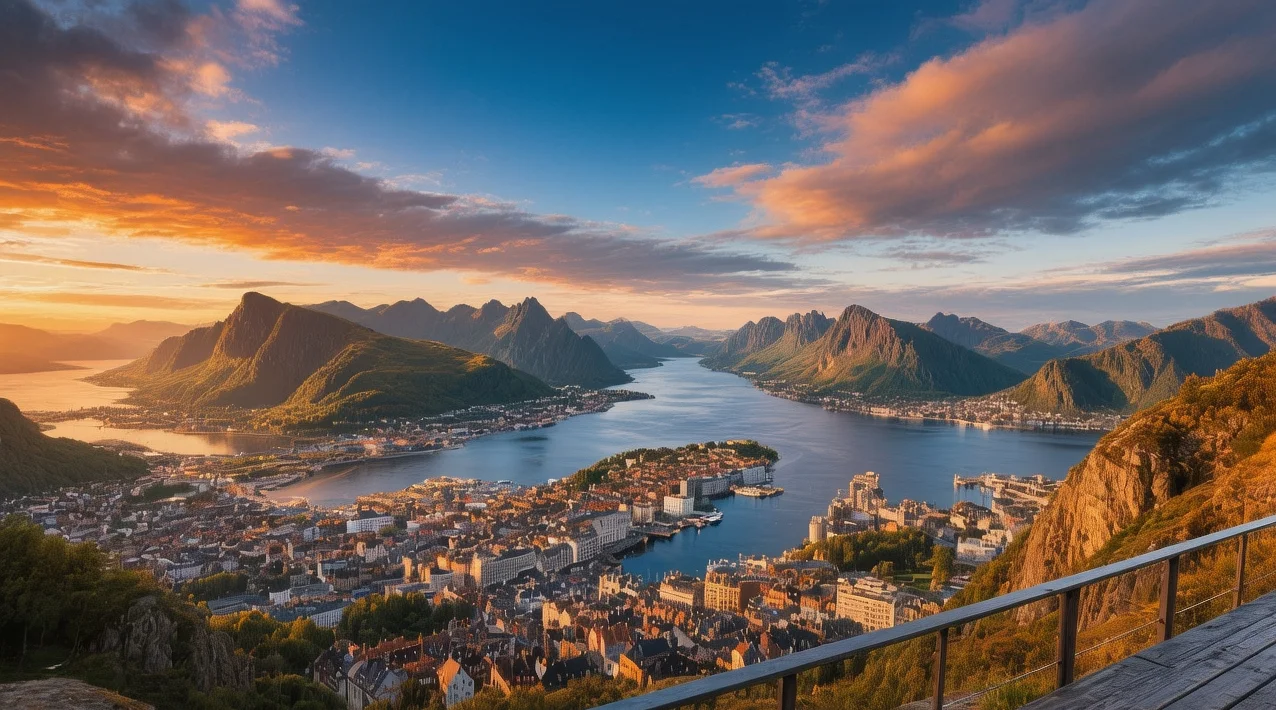
Fløyen Mountain Funicular Engineering Meets Norwegian Fjord Vistas
The Fløibanen funicular car glides upward with a gentle whir, climbing 320 meters (1,050 feet) through ancient beech forest as Bergen's terracotta rooftops shrink below. Outside your window, the North Sea light shifts—sometimes golden, often gray, always dramatic—illuminating the seven mountains that cradle this Hanseatic port city. Inside, passengers press against the glass: cruise ship passengers clutching cameras, local hikers with trekking poles, families pointing at the colorful bryggen wharf houses now 300 meters beneath them. At the summit, the air carries the crisp bite of the North Atlantic mixed with pine resin; the silence breaks only when wind gusts sweep across the plateau or when children's laughter echoes from the troll sculptures hidden in the woods. This is where Bergen reveals itself—not as a postcard, but as a living dialogue between medieval commerce and raw Nordic nature. In 2026, as sustainable tourism reshapes how we experience iconic viewpoints, Fløyen matters more than ever: it remains accessible to all while demanding we slow down, look deeper, and understand that some vistas aren't just seen—they're earned through presence.
Why Fløyen Mountain Embodies Bergen's Mountain Soul
Fløyen—pronounced "FLOY-en"—isn't Bergen's highest peak (that honor belongs to Ulriken at 643 meters), yet it captures the city's essence with unmatched intimacy. Since 1896, when engineer Peter Christian Bøckmann first proposed a funicular to make the mountain accessible, Fløyen has served as Bergen's living room—a place where locals and visitors converge to read the weather, spot incoming storms, or simply breathe air unpolluted by harbor diesel. The Fløibanen itself represents a marvel of late-19th-century engineering: two counterbalanced cars connected by a 960-meter cable, powered initially by steam engines, now by electricity, making the 5-8 minute ascent with 17-degree gradient precision.
What makes Fløyen irreplaceable is its dual identity. By day, it's a family playground: the Skogstrollene (Forest Trolls)—eleven whimsical wooden sculptures by artist Varvara Marakulina installed in 2015—lure children along winding forest paths where birch and beech create emerald cathedrals. By dusk, it transforms into a photographer's sanctuary, offering 360-degree panoramas that encompass the UNESCO-listed Bryggen district, the bustling Vågen harbor, and the labyrinthine waterways where Viking ships once docked. Geologically, Fløyen consists of Precambrian gneiss over 900 million years old, its bedrock sculpted by Ice Age glaciers that carved the fjords now visible to the west.
The mountain solved a fundamental human need: the desire to see one's home from above. Before the funicular, only the fit and determined could make the steep climb; today, over 1.2 million passengers annually ride the Fløibanen, making it Norway's most visited tourist attraction outside Oslo. Yet hiking trails remain—seven marked routes ranging from 20-minute strolls to 4-hour treks connecting to neighboring peaks—preserving the mountain's democratic spirit. In an era of overtourism, Fløyen endures because it refuses to be just a viewpoint; it's an ecosystem, a cultural touchstone, and a reminder that Bergen's true beauty lies not in its buildings but in the wild heights that watch over them.
The Best Time to Experience Fløyen Mountain
Timing transforms Fløyen from a simple overlook into a multisensory experience. For optimal conditions with minimal crowds, target May 15–June 20 or September 5–25. During these windows, temperatures hover between 12–18°C (54–64°F), daylight stretches to 18+ hours in June, and the beech forest explodes with spring green or autumn amber. The sweet spot for photography: 8:00–10:00 AM when morning mist still clings to the fjords, or 7:00–9:00 PM during summer's extended golden hour.
Winter enthusiasts should visit December 15–March 10 for snow-covered landscapes, though temperatures drop to -2 to 4°C (28–39°F) with frequent rain-snow mix. The Fløibanen operates year-round except during extreme weather closures (typically 3–5 days annually), and winter reveals a different magic: frozen waterfalls, cross-country ski trails, and the possibility of spotting the northern lights from the summit during clear, cold nights—rare but unforgettable when they occur.
Avoid July 10–August 15 if crowd intolerance ranks high: cruise ship season peaks, with 5–8 ships docking daily, depositing 15,000+ visitors who converge on Fløyen by mid-morning. Wait times for the funicular can exceed 90 minutes, and summit viewing platforms become shoulder-to-shoulder affairs. Similarly, Norwegian school holidays (week 14 in spring, weeks 27–32 in summer, week 40 in autumn) see local family surges.
For real-time conditions, check the official Fløibanen website (www.floibanen.com) or the Yr.no meteorological service for hour-by-hour forecasts. Bergen's weather changes rapidly—what's sunny at 9:00 AM may be fog-shrouded by noon—so build flexibility into your itinerary.
Approximate Budget for a 7-Day Trip (2026)
Bergen ranks among Europe's pricier destinations, reflecting Norway's high wages and quality of life standards. This budget assumes mid-range travel: comfortable but not luxurious, prioritizing experiences over extravagance. Prices reflect 2026 estimates with 3-4% inflation adjustment from 2024 baseline data.
- Accommodation: €140–€220 per night for a double room in a 3-star hotel or quality Airbnb in Sentrum or Nordnes neighborhoods. Budget hostels: €45–€65 per bed. Luxury options (Hotel Norge, The Opera Hotel): €280–€450 per night.
- Food: €65–€95 per day per person
- Breakfast: €12–€18 (hotel buffet or café with coffee, bread, cheese, jam)
- Lunch: €18–€28 (fish soup €22, open-faced salmon sandwich €24, or food market stall €15)
- Dinner: €35–€55 (restaurant main course: fish and chips €32, reindeer stew €42, pasta €28; add €12 for wine/beer)
- Transportation:
- Fløibanen funicular round-trip: €22 adults, €11 children (6–15), free under 6
- Bergen Airport Flybussen express bus: €14 one-way, €24 round-trip
- Local bus/tram day pass: €12; 7-day pass: €52
- Fjord cruise (Norway in a Nutshell day trip): €185–€245
- Attractions:
- Hanseatic Museum: €16
- Bergenhus Fortress: Free (towers €10)
- KODE Art Museums: €20 (all four locations)
- Guided Bryggen walking tour: €28
- Ulriken cable car: €24 round-trip
- Miscellaneous:
- Souvenirs: wooden troll figurine €15–€35, Norwegian wool sweater €80–€150
- Coffee and waffle at Fløien café: €18
- Travel insurance (7 days): €35–€55
- Sim card/eSIM: €15–€25
Total for 7 days (mid-range, per person, double occupancy): €1,450–€1,850
Budget travelers can reduce costs to €850–€1,100 by staying in hostels, cooking some meals, and prioritizing free hiking over paid attractions. Luxury seekers should budget €2,800+ for boutique hotels, fine dining, and private tours.
6 Essential Fløyen Mountain Experiences
- Ride the Fløibanen at Sunrise: Board the first departure (7:00 AM in summer, 8:30 AM in winter) to claim the viewing platform before crowds arrive. Position yourself on the right side of the car for optimal city views during ascent. As Bergen awakens below—fishing boats departing Vågen harbor, bakery lights flickering on in narrow streets—you'll understand why locals consider this ritual sacred. Bring a thermos of coffee; the summit café doesn't open until 9:00 AM.
- Hunt for the Forest Trolls: Follow the orange-marked "Troll Path" (2.5 km, 45 minutes) from the summit station to discover all eleven Skogstrollene sculptures. Each troll has personality: some hide behind mossy boulders, others peek from hollow trees. Children receive a free troll-hunting map at the tourist office. The largest troll, "Blåmann," stands 3 meters tall and guards a hidden clearing perfect for picnics.
- Hike to Rundemanen Summit: For the adventurous, continue beyond Fløyen's 320 meters to Rundemanen's 568-meter peak via the red-marked trail (3.5 km one-way, 2 hours). This ridge walk offers uninterrupted forest immersion and culminates in a stone cairn with views stretching to the Hardangerfjord on clear days. Pack rain gear—weather shifts rapidly at altitude.
- Dine at Fløien Folklore Restaurant: At the summit, this wooden lodge serves traditional Norwegian fare with panoramic windows framing the city. Order the fårikål (lamb and cabbage stew, seasonal September–March) or torskesuppe (cod soup) while watching cruise ships navigate the narrow harbor entrance. The outdoor terrace, heated with infrared lamps, operates year-round.
- Walk Down via Stølen Path: Instead of riding the funicular back, descend on foot via the 2.8-km Stølen trail (45–60 minutes). This route passes historic mountain farms (støler) where sheep still graze in summer, crosses wooden bridges over mountain streams, and ends near the Bergen Public Library. Wear sturdy shoes—the path is well-maintained but steep and slippery when wet.
- Photograph the Seven Mountains: From the main viewing platform, identify all seven peaks surrounding Bergen: Fløyen (320m), Ulriken (643m), Damsgårdsfjellet (350m), Sandviksfjellet (417m), Løvstakken (477m), Blåmanen (554m), and Lyderhorn (396m). Download the "Bergen Peaks" app for augmented reality identification. Best light: late afternoon when western sun illuminates the fjord-side mountains.
3 Hidden Gems Most Travelers Miss
- Skomakerdiket Reservoir: This serene mountain lake sits at 280 meters elevation, 20 minutes uphill from the Fløibanen station via an unmarked but well-trodden path (ask locals for "dammen bak Fløien"). Surrounded by birch trees and granite boulders, it reflects the sky like a mirror and hosts resident ducks year-round. In winter, when temperatures drop below -5°C, it freezes into a natural skating rink used by locals—bring your own skates. Access: From summit, follow signs toward "Rundemanen" for 400 meters, then turn left at the fork marked with blue paint.
- Lille Frøken's Secret Bench: A solitary wooden bench carved with the date "1923" sits 150 meters off the main trail near coordinates 60.3925°N, 5.3372°E. Local legend claims it was built by a heartbroken engineer who proposed to his sweetheart on Fløyen and was rejected; he returned every Sunday for 40 years to watch the sunset. The bench faces west, offering an unobstructed view of the Sotra Bridge and open sea—perfect for solitary contemplation. Most visitors never venture this far; you'll likely have it to yourself.
- Fløysletten Alpine Garden: Tucked behind the main restaurant, this small botanical collection showcases 40+ species of Norwegian alpine plants with informational plaques in Norwegian and English. Open May–September, it's maintained by the Bergen Botanical Society and features rare arctic flowers that bloom for just 2–3 weeks in June. Volunteer gardeners work Tuesday and Thursday mornings (10:00 AM–12:00 PM) and welcome visitors who want to learn about mountain flora. Entry is free; donations support conservation efforts.
Cultural & Practical Tips
- Weather preparedness: Bergen averages 230 rainy days annually. Pack a waterproof jacket (not umbrella—wind makes them useless), layered clothing, and waterproof hiking shoes. Temperatures drop 3–4°C per 300 meters elevation gain; summit can be 8°C cooler than the city.
- Norwegian friluftsliv (outdoor life): Embrace the local philosophy of "free air life"—being outdoors in nature is considered essential to wellbeing, not a leisure activity. Locals hike in rain, snow, and wind; don't let weather cancel your plans unless conditions are dangerous.
- Useful phrases:
- "Takk" (tahk) = Thank you
- "Unnskyld" (oon-shool) = Excuse me/Sorry
- "Hvor er...?" (voor ehr) = Where is...?
- "Hvor mye koster det?" (voor my-eh kos-tehr deh) = How much does it cost?
- Photography etiquette: Drones require permission from Luftfartstilsynet (Norwegian Civil Aviation Authority) and are prohibited within 150 meters of people without consent. Respect hikers' privacy; ask before photographing individuals. The summit viewing platform has designated "selfie spots" to prevent congestion.
- Payment methods: Norway is nearly cashless. Bring a credit/debit card with chip-and-PIN; most places don't accept cash. Mobile payment (Vipps) is ubiquitous but requires Norwegian phone number—stick to cards as a visitor.
- Wildlife awareness: While rare on Fløyen itself, moose and red deer inhabit Bergen's higher peaks. If hiking to Rundemanen or beyond, make noise on trails to avoid surprising animals. Never feed wildlife—it's illegal and dangerous.
- Accessibility: The Fløibanen funicular is wheelchair-accessible with assistance; summit restaurant and main viewing platform have ramp access. However, forest trails are not suitable for wheelchairs or strollers due to roots and uneven terrain. Alternative: take the funicular, enjoy summit views, and return without hiking.
Conclusion: Travel with Wonder, Not Just Checklists
Fløyen Mountain doesn't demand much—no technical climbing skills, no expensive permits, no dawn wake-up calls unless you choose them. Yet it offers everything: perspective, beauty, history, and the quiet reminder that some of life's best moments arrive when we stop rushing and start noticing. In 2026, as overtourism strains iconic destinations worldwide, Fløyen teaches a different way: ride the funicular, yes, but then wander off the main path. Sit on that weathered bench overlooking the reservoir. Watch how the light transforms the city from gold to gray to indigo. Let children lead you to the next troll sculpture, their small hands pulling you forward with excitement that hasn't yet learned cynicism.
This mountain has watched over Bergen for 900 million years; it can spare a few hours of your time. Travel here not to collect a photo for Instagram but to understand why Norwegians consider access to nature a fundamental right, not a luxury. Leave only footprints; take only memories; and when you descend back to the colorful chaos of Bryggen's wharf, carry with you the mountain's quiet wisdom: that beauty endures when we treat it with reverence, not consumption.