
Ulriken Cable Car Alpine Engineering Meets Seven Mountains Majesty
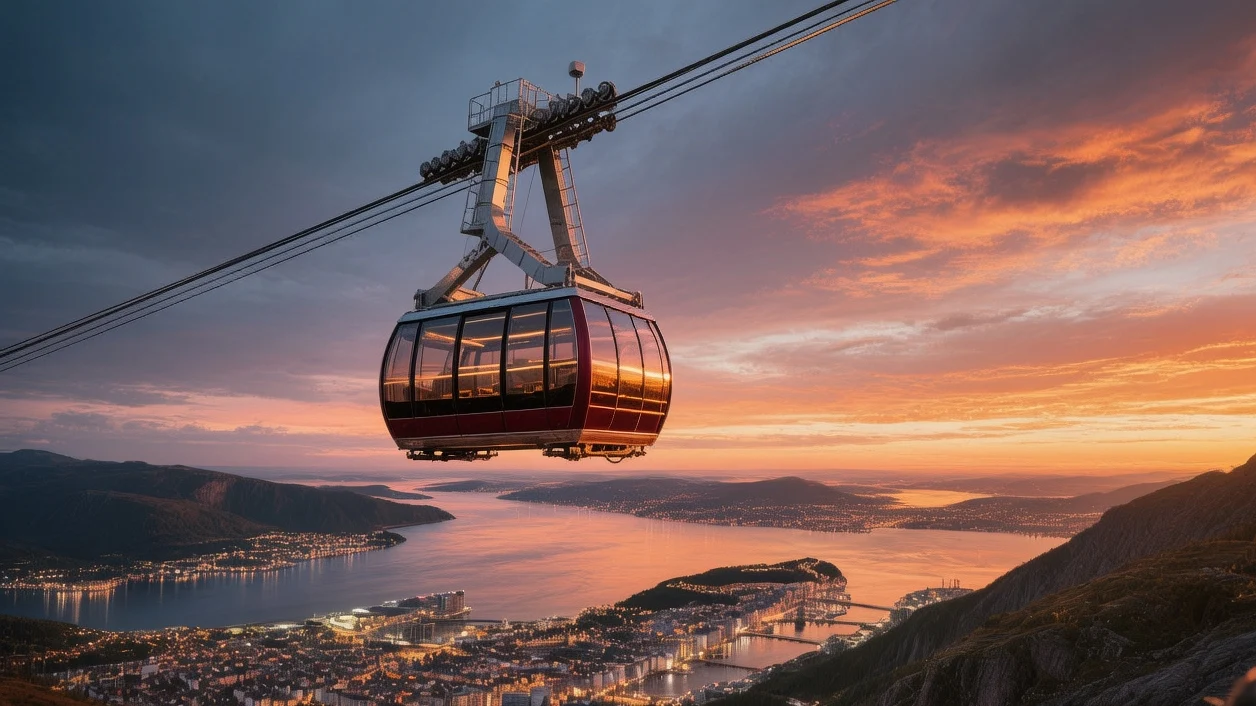
The cable car cabin sways gently as it begins its ascent—climbing 643 meters (2,110 feet) up Norway's steepest aerial tramway, a 2,800-meter journey that transforms Bergen's colorful waterfront into a miniature model of terracotta and timber. Inside, the air hums with anticipation: families press against the panoramic windows, hikers adjust their backpacks, and photographers check their lenses as the city sprawls beneath them like a living postcard. Outside, the North Atlantic wind whips through ancient granite slopes while gulls circle on thermal currents, their cries barely audible through the double-glazed cabin. The engineering is remarkable—a 1961 original upgraded in 2019 with modern gondolas that glide along cables tensioned to withstand Arctic storms, carrying up to 120 passengers per hour up a gradient that reaches 38 degrees at its steepest point. Seven minutes. That's all it takes to leave the rain-soaked streets of Bryggen behind and enter a realm where clouds drift below your feet and the Hardangerfjord stretches toward distant snow-capped peaks. In 2026, as mass tourism threatens to overwhelm Europe's iconic viewpoints, the Ulriken cable car matters because it offers something increasingly rare: genuine altitude without pretense, breathtaking vistas without exclusivity, and a reminder that sometimes the best way to understand a city is to rise above it.
Why Ulriken Cable Car Embodies Bergen's Vertical Soul
Ulriken—Bergen's tallest sentinel at 643 meters—has watched over this Hanseatic port for millennia, but it wasn't until June 15, 1961, that ordinary citizens could reach its summit without a grueling two-hour climb. The Ulriksbanen cable car solved a fundamental problem: how to make Bergen's most spectacular viewpoint accessible to all, not just the athletic few. Engineer Søren Nielsen designed Norway's steepest aerial tramway using Swiss-made cables and Austrian gondola technology, creating a system that could handle the mountain's notorious weather—120 km/h winds, freezing rain, and sudden fog banks that reduce visibility to zero.
The original 1961 installation featured four-person cabins that made the journey in 10 minutes; today's modernized system, upgraded in 2019 with a NOK 85 million (€7.2 million) investment, boasts eight-person gondolas with heated seats and panoramic windows, completing the ascent in just 7 minutes. The cable system operates on a simple but brilliant principle: two counterbalanced cabins connected by a 2,850-meter steel cable, powered by electric motors that consume less energy than a typical household washing machine per round trip. The gradient varies from 12 degrees at the base to 38 degrees near the summit, making it one of Europe's steepest passenger cable cars.
What makes the Ulriken cable car culturally significant is its democratic spirit. Unlike exclusive mountain resorts where access requires expensive equipment or memberships, Ulriksbanen charges just NOK 260 (€22) for a round trip—less than a museum ticket in many European capitals. This accessibility has made it Bergen's most popular attraction after Bryggen, drawing over 400,000 passengers annually. At the summit, the mountain fulfills multiple needs: it's a playground for hikers tackling the 9-km trail to Mount Fløyen, a dining destination at the Ulriken Restaurant (open since 1962), and an adventure hub offering ziplining (introduced in 2017) and paragliding launches. The cable car doesn't just transport bodies; it elevates perspectives, literally and figuratively, reminding visitors that Bergen's true character lies not in its UNESCO-listed wharf but in the wild heights that cradle it.
The Best Time to Experience Ulriken Cable Car
For optimal conditions balancing weather, crowds, and light quality, target May 20–June 25 or September 1–25. During these windows, temperatures range from 10–16°C (50–61°F) at the summit, daylight extends to 19 hours in June, and the probability of clear views exceeds 60% according to Bergen Meteorological Institute data. The golden hour magic happens between 9:00–11:00 PM in late June when the midnight sun casts amber light across the fjords, or 7:00–9:00 AM year-round when morning mist creates dramatic layering effects over the city.
Winter enthusiasts should visit December 10–March 15 for snow-covered landscapes and the possibility of northern lights visibility from the summit (clear nights only, aurora activity permitting). Summit temperatures drop to -5 to 2°C (23–36°F) with frequent wind chill making it feel 5–8 degrees colder. The cable car operates year-round with occasional weather-related closures—typically 8–12 days annually, mostly during January–February storm season.
Avoid July 15–August 20 if you dislike crowds: cruise ship season peaks with 6–10 vessels docking daily, depositing 20,000+ passengers who converge on Ulriken by mid-morning. Queue times regularly exceed 60 minutes, and summit viewing platforms become congested. Norwegian school holidays (week 28–32) see additional local family surges. Similarly, avoid Norwegian Constitution Day (May 17) when the cable car operates limited hours due to private celebrations.
For real-time status, check www.ulriken.no or call +47 55 32 14 80. The website updates every 15 minutes with wind speeds, visibility, and queue estimates. Download the Yr.no app for hour-by-hour forecasts—Bergen's weather changes so rapidly that a sunny 10:00 AM can become fog-bound by noon.
Approximate Budget for a 7-Day Trip (2026)
Bergen ranks among Scandinavia's pricier destinations, reflecting Norway's high standard of living and strong labor protections. This budget assumes mid-range travel prioritizing experiences over luxury, with prices adjusted for 3-4% annual inflation from 2024 baselines.
- Accommodation: €130–€210 per night for a double room in a 3-star hotel or quality Airbnb in Sentrum, Nordnes, or Sandviken neighborhoods. Budget hostels (HI Bergen, Citybox): €40–€60 per bed. Upscale options (Hotel Norge, Thon Hotel Rosenkrantz): €260–€420 per night.
- Food: €60–€90 per day per person
- Breakfast: €10–€16 (hotel buffet or café with coffee, brunost cheese, knekkebrød crispbread)
- Lunch: €16–€26 (fish cakes €20, Bergen fish soup €24, or food hall stall €14)
- Dinner: €34–€52 (restaurant main: cod loin €36, lamb rack €44, vegetarian pasta €26; add €11 for local beer)
- Transportation:
- Ulriken cable car round-trip: €22 adults, €11 children (4–15), free under 4
- Bergen Airport Flybussen: €13 one-way, €22 round-trip
- Local bus day pass: €11; 7-day pass: €48
- Fjord cruise (Show Fjord tour): €65–€95
- Attractions:
- Bryggen Museum: €12
- Hanseatic Museum: €15
- KODE Art Museums (all four): €18
- Fløibanen funicular: €20 round-trip
- Guided city walking tour: €25
- Miscellaneous:
- Souvenirs: Viking-themed magnet €8, Norwegian wool mittens €45, local aquavit bottle €35
- Summit café waffle with jam and cream: €9
- Travel insurance (7 days): €30–€50
- eSIM data plan: €12–€20
Total for 7 days (mid-range, per person, double occupancy): €1,380–€1,750
Budget travelers can reduce costs to €800–€1,050 by staying in hostels, preparing picnic lunches from supermarket purchases (Rema 1000, Kiwi), and prioritizing free hiking trails. Luxury seekers should budget €2,600+ for boutique hotels, fine dining at restaurants like Lysverket, and private fjord charters.
6 Essential Ulriken Cable Car Experiences
- Ride at First Light: Board the first departure (7:30 AM in summer, 9:00 AM in winter) to experience the mountain before crowds arrive. Position yourself on the right side of the cabin for optimal views of Bergen's harbor and the seven mountains. As you ascend, watch the city awaken: fishing boats depart Vågen harbor, bakery lights flicker on in narrow streets, and the morning sun illuminates Bryggen's Hanseatic facades. Bring a thermos of coffee; the summit café opens at 9:30 AM.
- Hike the Vidden Trail: From Ulriken's summit, follow the red-marked trail across the mountain plateau to Mount Fløyen—a 9-km (5.6-mile) traverse taking 3–4 hours that showcases Bergen's alpine tundra ecosystem. The path crosses boggy terrain, granite outcrops, and small mountain lakes. Pack waterproof layers, snacks, and a physical map (mobile signal is unreliable). This is Norway's friluftsliv (outdoor life) philosophy in action: challenging but accessible, wild but navigable.
- Dine at Ulriken Restaurant: At 643 meters, Norway's highest restaurant serves traditional Norwegian cuisine with 360-degree panoramic windows. Order the rakfisk (fermented trout, adventurous eaters only) or fenalår (cured lamb leg) while watching weather systems roll in from the North Sea. The outdoor terrace, heated with infrared lamps, operates May–September. Reserve tables in summer via +47 55 32 14 80.
- Try the Zipline: From May to September, Ulriken offers Norway's highest zipline—1,145 meters long, dropping 380 meters from summit to base at speeds reaching 80 km/h (50 mph). The 10-minute experience costs NOK 495 (€42) and requires advance booking. Safety equipment is provided; minimum age is 8 years, maximum weight 120 kg. The adrenaline rush is matched only by the aerial perspective of Bergen's urban-natural interface.
- Photograph the Seven Mountains: From the summit viewing platform, identify all seven peaks: Ulriken (643m), Fløyen (320m), Damsgårdsfjellet (350m), Sandviksfjellet (417m), Løvstakken (477m), Blåmanen (554m), and Lyderhorn (396m). Download the "Bergen Peaks AR" app for augmented reality identification. Best light for photography: late afternoon (6:00–9:00 PM in summer) when western sun creates dramatic shadows across the fjord-side mountains.
- Descend on Foot via Stoltzekleiven: For the fit and determined, hike down via the legendary Stoltzekleiven trail—900 stone steps built by local legend Stoltze (1961–2015) as a tribute to his mother. The 1.2-km descent takes 25–35 minutes and passes through birch forest with intermittent city views. Start from the upper cable car station, follow signs marked "Stoltzekleiven," and finish in the Sandviken neighborhood. Wear sturdy shoes; the steps are uneven and slippery when wet.
3 Hidden Gems Most Travelers Miss
- Ulriken's Alpine Garden: Tucked behind the restaurant at coordinates 60.3892°N, 5.3625°E, this small botanical collection showcases 35+ species of Arctic and alpine plants with informational plaques in Norwegian and English. Open June–August, it's maintained by the Bergen Botanical Society and features rare mountain flowers that bloom for just 2–3 weeks in July. Volunteer gardeners work Wednesday mornings (10:00 AM–12:00 PM) and welcome visitors interested in high-altitude flora. Entry is free; donations support conservation.
- The Old Cable Car Foundation: Near the lower station, weathered concrete pillars from the 1961 original installation remain visible—now overgrown with ferns and moss. Local historians have placed a small information board (in Norwegian only) explaining the engineering challenges faced by builder Søren Nielsen. Most visitors rush past to board the modern gondolas, but this quiet spot offers a tangible connection to Bergen's mid-century modernization. Visit during weekday afternoons when the area is least crowded.
- Midnight Sun Meditation Spot: At the summit's northeastern edge, a flat granite outcropping (unmarked, 150 meters from the restaurant) faces east toward the Hardangerfjord. During the summer solstice period (June 15–30), this spot receives direct sunlight from 11:30 PM to 1:30 AM—perfect for experiencing Norway's famous midnight sun without crowds. Bring a headlamp for the walk back, and check tide tables if planning to descend via coastal trails afterward. Locals know this spot; visitors rarely do.
Cultural & Practical Tips
- Weather reality: Bergen averages 230 rainy days annually, and Ulriken's summit is windier and colder than the city. Pack waterproof jacket (not umbrella—wind renders them useless), layered clothing, and waterproof hiking shoes. Summit temperatures average 5–7°C (9–13°F) cooler than Bergen center.
- Norwegian friluftsliv etiquette: Embrace the cultural philosophy that outdoor access is a right, not a privilege. Locals hike in all weather conditions; don't let rain cancel your plans unless winds exceed 20 m/s (cable car closure threshold). Greet fellow hikers with "hei" (hey) on trails—it's customary.
- Useful phrases:
- "Takk" (tahk) = Thank you
- "Unnskyld" (oon-shool) = Excuse me
- "Hvor er Ulriksbanen?" (voor ehr oo-riks-bah-nen) = Where is the Ulriken cable car?
- "Hvor mye koster det?" (voor my-eh kos-tehr deh) = How much does it cost?
- Photography guidelines: Drones require permission from Luftfartstilsynet (Norwegian Civil Aviation Authority) and are prohibited within 150 meters of people without consent. Respect other visitors' privacy; ask before photographing individuals. The summit platform has designated photo spots to prevent congestion during peak hours.
- Payment methods: Norway is nearly cashless. Bring a credit/debit card with chip-and-PIN capability; most venues don't accept cash. Mobile payment (Vipps) is ubiquitous but requires a Norwegian phone number—stick to cards as a visitor.
- Accessibility considerations: The cable car is wheelchair-accessible with advance notice (call +47 55 32 14 80). Summit restaurant and main viewing platform have ramp access. However, hiking trails are unsuitable for wheelchairs or strollers due to uneven terrain, roots, and steep sections.
- Safety awareness: Stay on marked trails—Bergen's mountains have claimed lives when hikers ventured off-path in fog. If weather deteriorates rapidly, descend immediately via cable car rather than hiking. The mountain's microclimate can shift from clear to whiteout conditions in 15 minutes.
Conclusion: Travel with Reverence, Not Just Checklists
The Ulriken cable car asks little of you—just the price of a ticket and seven minutes of patience—yet it offers everything: perspective, beauty, and the humbling realization that you are small against the sweep of fjord and mountain. In 2026, as overtourism strains Europe's iconic destinations, Ulriken teaches a different way: ride the gondola, yes, but then linger. Sit on that windswept bench overlooking the Hardangerfjord. Watch how the light transforms Bergen from gold to gray to indigo. Let the mountain's silence seep into your bones, erasing the noise of notifications and itineraries.
This peak has stood sentinel for 900 million years; it can spare a few hours of your time. Travel here not to collect a photo for social media but to understand why Norwegians consider mountain access a fundamental right. Leave only footprints; take only memories; and when you descend back to Bryggen's colorful chaos, carry with you the mountain's quiet wisdom: that true elevation comes not from altitude but from attention, and that the best way to honor a place is to experience it slowly, respectfully, and with wonder intact.