
Golden Circle - Þingvellir Tectonic Plates Meet Viking Democracy
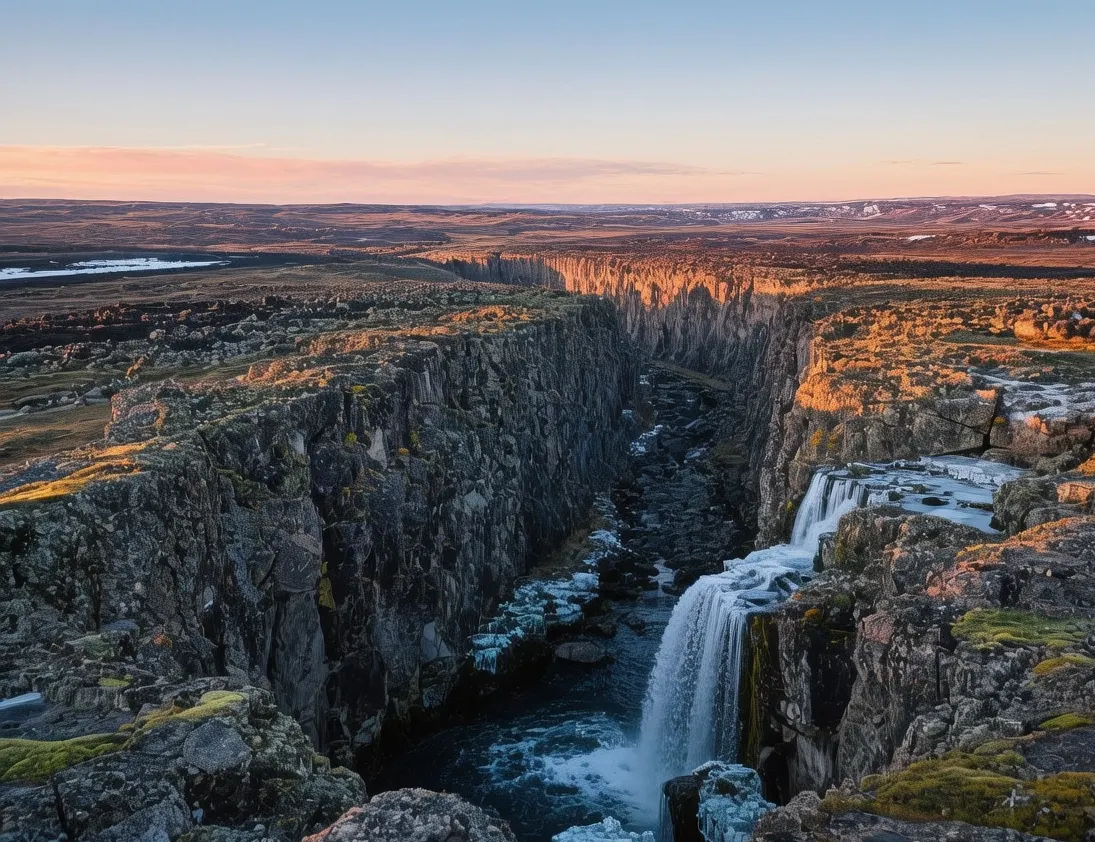
Dawn breaks over the Þingvellir rift valley—a silence so profound you hear the whisper of wind through volcanic grass before the first bird calls. The Almannagjá gorge rises before you, a 7.7-kilometer-long fissure carved by centuries of tectonic drift, where the North American and Eurasian plates pull apart at 2 centimeters per year. Mist clings to the Öxarárfoss waterfall as it cascades 13 meters into a crystal pool below, the same water that quenched the thirst of Viking chieftains who gathered here in 930 AD to establish the world's oldest parliament. You stand at Lögberg—the Law Rock—where lawspeakers recited Iceland's legal code from memory for over eight centuries, their voices echoing across this amphitheater of basalt and lava. The ground beneath your feet isn't just soil; it's a geological scar marking where continents divorce, a cultural cradle where democracy was born, and a sacred landscape that shaped a nation's soul. In 2026, as the world grapples with democratic backsliding and climate uncertainty, Golden Circle - Þingvellir matters more than ever—a living testament to human governance and Earth's raw power existing in fragile harmony.
Why Golden Circle - Þingvellir Embodies Icelandic Identity
The Golden Circle - Þingvellir isn't merely a tourist circuit—it's the geological and cultural spine of Iceland, a place where the planet's mechanics and human civilization intersect with extraordinary clarity. Established as Alþingi in 930 AD by Viking settlers led by Úlfljótr, this rift valley became the world's first parliamentary democracy, predating Westminster by over three centuries. For 847 years, chieftains from across Iceland gathered here during the two-week assembly period in late June, camping in turf booths along the riverbanks while lawspeakers—starting with Úlfljótr himself—recited the entire legal code from memory at Lögberg.
The geological drama is equally compelling: Þingvellir sits within the Mid-Atlantic Ridge, where the North American plate (moving west at 20mm/year) and Eurasian plate (moving east at 20mm/year) create a 7.7-kilometer-wide rift valley. The Almannagjá fault scarp rises 40 meters above the valley floor, while the Hrafnagjá fault on the opposite side drops 180 meters below the surface. This isn't abstract geology—it's visible, tangible, and constantly evolving. The Silfra fissure, filled with glacial meltwater filtered through porous lava for up to 100 years, offers visibility exceeding 100 meters, making it one of the world's clearest diving sites.
Designated a UNESCO World Heritage Site in 2004, Golden Circle - Þingvellir fulfills a profound human need: connection to origins. The park encompasses 237 square kilometers of protected landscape, including Lake Þingvallavatn—Iceland's largest natural lake at 84 square kilometers and 114 meters deep. The Öxará river, artificially diverted in the 12th century to create Öxarárfoss waterfall, demonstrates medieval engineering prowess. Today, over 1 million visitors annually walk the same paths as the Vikings, creating a living dialogue between past and present.
The site solved a critical problem for medieval Iceland: how to govern a dispersed population without a king. By creating a centralized assembly with legislative and judicial functions, the settlers established a system that lasted until 1798—nearly nine centuries of continuous governance. This legacy makes Golden Circle - Þingvellir not just a destination, but a pilgrimage to the roots of democracy itself.
The Best Time to Experience Golden Circle - Þingvellir
Timing your visit to Golden Circle - Þingvellir requires understanding Iceland's extreme seasonal variations and your tolerance for crowds versus weather challenges. For optimal conditions, target May 15–June 10 or September 5–25. During these windows, temperatures range from 7–12°C (45–54°F), daylight stretches 16–20 hours, and tourist numbers remain 40% below peak summer levels. The landscape bursts with lupine flowers in June, while September offers dramatic autumn colors against black lava fields.
For Northern Lights hunters combined with daylight exploration, visit September 20–October 15. Temperatures drop to 2–7°C (36–45°F), but aurora activity increases significantly after the autumn equinox. Plan your Þingvellir visit for 2:00–5:00 PM when the low-angle sun creates spectacular shadows in the Almannagjá gorge, then stay overnight nearby for aurora viewing after 9:00 PM.
Winter visitors (November–March) face temperatures of -5 to 4°C (23–39°F) and only 4–7 hours of daylight, but gain access to ice caves in the lava fields and the surreal experience of snow-covered rift valleys. The Silfra fissure maintains a constant 2–4°C (36–39°F) year-round, making winter diving possible with proper drysuit training.
Avoid June 15–August 15 if possible—this peak season brings 3,000–5,000 daily visitors, crowded parking lots by 10:00 AM, and accommodation prices 60% higher than shoulder season. The worst period: July 1–20, when cruise ship excursions and family vacations converge. Also skip December 20–January 5 unless prepared for potential road closures due to snowstorms and limited services.
For real-time conditions, check the Icelandic Road .
Approximate Budget for a 7-Day Trip (2026)
Exploring Golden Circle - Þingvellir anchors a week-long Icelandic adventure. This budget assumes a 7-day trip based in Reykjavík with day trips to Þingvellir and surrounding Golden Circle sites (Geysir, Gullfoss). Prices reflect 2026 rates, accounting for Iceland's average 3.8% annual inflation from 2024–2026 (source: Statistics Iceland). All amounts shown in euros; multiply by 1.08 for USD equivalents.
Accommodation: €150–€320 per night
• Budget guesthouse in Reykjavík (101 or 105 district): €150–€200
• Mid-range hotel (Laugardalur area): €220–€280
• Luxury (Hotel Borg or Tower Suites): €380–€550
• Camping at Þingvellir (seasonal): €25 per person
Food: €55–€95 per day
• Breakfast: €12–€18 (hotel buffet or bakery pastry + coffee)
• Lunch: €18–€28 (Icelandic lamb soup, fish of the day, or hot dog at Bæjarins Beztu)
• Dinner: €25–€49 (pan-fried Arctic char at Fish Company or traditional hákarl tasting)
• Groceries (self-catering): €35/day
Transportation:
• Keflavík Airport to Reykjavík Flybus: €32 round-trip
• Golden Circle day tour (Þingvellir/Geysir/Gullfoss): €85
• Rental car (compact SUV, 7 days): €380 + €140 fuel
• Reykjavík city bus (Strætó): €3.20 per ride
• Þingvellir parking fee: €7 per vehicle
Attractions:
• Þingvellir National Park: Free (parking €7)
• Silfra snorkeling tour: €145 (includes drysuit, guide, hot chocolate)
• Silfra diving (certified divers): €195
• Geysir geothermal area: Free
• Gullfoss waterfall: Free
• Friðheimar tomato farm lunch: €38
• Perlan Museum: €30
Miscellaneous:
• Icelandic wool sweater (lopapeysa): €110–€180
• Thermal base layers: €85
• Travel insurance: €55
• Souvenirs (lava rock, handicrafts): €40
• Tips (not expected but appreciated): €25
Total for 7 days (mid-range): €2,180–€2,520 per person
Total (budget-conscious): €1,450–€1,680 per person
6 Essential Golden Circle - Þingvellir Experiences
1. Walk the Almannagjá Gorge at Dawn: Arrive at the park entrance by 7:00 AM (summer) or 9:30 AM (winter) to experience the rift valley before tour buses descend. Park at the main visitor center and follow the marked trail into Almannagjá—the 40-meter-high fault scarp creates natural acoustics that amplify every footstep. The basalt columns glisten with morning dew; Arctic terns dive overhead, protective of their nests. Walk 1.2 kilometers to Öxarárfoss waterfall, where the river disappears into a fissure before plunging into the pool. This is where Vikings gathered to hear laws recited—stand at the exact spot and imagine 10,000 people camped along the riverbanks.
2. Snorkel the Silfra Fissure: Book the 8:00 AM slot with a certified operator (Arctic Adventures or DIVE.IS). The 45-minute drive from Reykjavík arrives at 9:00 AM for gear fitting. Silfra's water temperature stays at 2–4°C (36–39°F) year-round, filtered through lava for up to a century, creating visibility exceeding 100 meters. You'll touch both tectonic plates simultaneously—North America on your left, Eurasia on your right—as you drift through the 600-meter-long fissure. The "Silfra Cathedral" section drops to 21 meters depth, where sunlight creates ethereal blue columns through the crystal water. No swimming ability required, but you must be 16+ and medically fit.
3. Stand at Lögberg (Law Rock): Located 300 meters from the visitor center, this natural amphitheater served as Iceland's supreme court and parliament for 847 years. Arrive at 2:00 PM when the sun illuminates the basalt formations without creating harsh shadows. The information board explains how lawspeakers memorized the entire legal code—over 300 laws—reciting them verbatim over three days. Touch the rock where chieftains swore oaths; listen for the wind whistling through the gorge, carrying echoes of medieval debates. This is democracy's birthplace—treat it with reverence.
4. Explore the Drekkingarhylur Pool: A 15-minute walk from Lögberg lies this unmarked pool where, until 1829, women convicted of infanticide were drowned. The site remains unmarked by design—a somber reminder of Iceland's harsh justice system. The pool feeds from a natural spring, maintaining 5°C (41°F) year-round. Stand quietly at the edge; the stillness here is profound. Most tour groups skip this location, making it a moment for reflection on Iceland's complex history beyond the romanticized Viking narrative.
5. Hike to the Valahnúkar viewpoints: This 3.5-kilometer loop (allow 90 minutes) climbs 120 meters above the rift valley, offering panoramic views of Lake Þingvallavatn and the surrounding lava fields. Start at the Hakin information board near the camping area. The trail crosses volcanic scree, ancient lava flows, and birch woodland—Iceland's largest native forest, protected since 1900. At the summit (453 meters elevation), you'll see the full extent of the tectonic rift and, on clear days, the Snæfellsjökull glacier 120 kilometers away. Best hiked at 4:00–6:00 PM for golden hour photography.
6. Visit the Þingvellir Church: Built in 1859 using timber from Norway, this small white church stands on the site where Christianity was officially adopted in 1000 AD. Open daily 10:00 AM–5:00 PM (May–September), the church contains a 13th-century altar stone and a bell cast in 1645. The cemetery holds graves of notable Icelanders, including the first president of the republic, Sveinn Björnsson. The adjacent farmhouse, Þingvallabær, operated continuously from the 10th century until 1967. Enter respectfully; this is an active cultural site, not just a photo opportunity.
3 Hidden Gems Most Travelers Miss
• Nikulásargjá Fissure: Located 800 meters north of the main parking area, this lesser-known rift offers the same tectonic drama as Silfra without the crowds. Access requires a short scramble down a 3-meter slope—wear sturdy boots. The fissure extends 200 meters with crystal-clear pools perfect for photography. Best visited at 7:00–8:00 AM or after 6:00 PM when the light creates blue reflections in the water. No swimming allowed (protected area), but the viewing platforms offer intimate perspectives of the plate boundary. Coordinates: 64.2617° N, 21.1289° W. Why overlooked: No tour buses stop here; most visitors don't venture beyond the marked trails.
• Þingvallavatn Shore Walk to Sandvík: This 4-kilometer coastal path follows Iceland's largest lake from the visitor center to a black sand beach where Arctic char spawn. Start at 3:00 PM for 90-minute walk; bring binoculars to spot the 13 bird species nesting in the area, including the pink-footed goose. The beach features unusual hexagonal basalt columns formed by rapid cooling of lava meeting water. At the far end, a small hot spring (38°C/100°F) emerges from the lakeshore—locals know to mix the hot spring water with cold lake water for a natural spa experience. Access: Follow the marked trail from the camping area. Why overlooked: Requires independent exploration; not on standard tour itineraries.
• Midgard Base Center Archaeological Site: Located 2 km from Þingvellir on Route 36, this privately-run center (open June–August, 10:00 AM–6:00 PM, entry €12) houses Viking-age artifacts excavated from the park and offers reconstructed turf houses you can enter. The owner, historian Jón Víðir Sigurðsson, provides personal tours explaining daily Viking life beyond the parliament—how they farmed, built homes, and survived Iceland's harsh climate. The center's café serves traditional rúgbrauð (rye bread baked underground using geothermal heat) with smoked lamb. Contact: +354 482 2220. Why overlooked: Sits between Þingvellir and Geysir; tour buses rush past without stopping.
Cultural & Practical Tips
• Respect the sacred landscape: Þingvellir isn't just a park—it's Iceland's most sacred site, where the nation was born. Never climb on the Law Rock, remove stones from the rift valley, or disturb archaeological remains. The 1907 Act protecting Þingvellir prohibits altering the landscape in any way. Stay on marked trails; the fragile moss takes 50–100 years to regenerate once damaged.
• Weather preparedness is non-negotiable: Iceland's weather changes every 15 minutes. Even in July, bring waterproof jacket, windproof layers, and warm hat. Temperatures at Þingvellir average 3–5°C cooler than Reykjavík due to elevation (120 meters above sea level) and lake effect. Wind chill can make 10°C (50°F) feel like 2°C (36°F). Check www.vedur.is before departing.
• Learn these Icelandic phrases:
— Takk (tahk): Thank you
— Góðan daginn (go-than dy-in): Good day
— Þingvellir (thing-vet-lir): The park's name (Þ = "th" sound)
— Almannagjá (owl-man-na-gyow): The main gorge
Icelanders appreciate effort; pronunciation matters less than attempting the language.
• Photography guidelines: Tripods permitted without permit for personal use. Commercial photography requires advance permission from the Þingvellir National Park Office (+354 482 2660). Drone use prohibited without special permit (apply 4 weeks ahead at loftleidings.is). Best light: 6:00–8:00 AM and 8:00–10:00 PM in summer; 11:00 AM–2:00 PM in winter when sun is highest.
• Wildlife etiquette: Arctic terns nest throughout the park May–August. They dive-bomb intruders within 50 meters of nests—if you hear loud chirping, you're too close. Back away slowly; don't swat at them (they're protected under Icelandic law). Keep dogs leashed at all times; free-roaming pets disturb nesting birds and sheep grazing in designated areas.
• Facilities and accessibility: The visitor center has free Wi-Fi, café (open 9:00 AM–6:00 PM May–Sept), and restrooms. The main trails are wheelchair-accessible (gravel paths, max 5% grade), but the gorge trails require stairs. Electric wheelchairs available free at visitor center (reserve 48 hours ahead: thingvellir@thingvellir.is). No ATMs in the park—bring cash for parking (€7 coin/card machine).
• Seasonal considerations: Roads to Þingvellir (Routes 36, 36A, 36B) are paved and open year-round, but winter storms can cause temporary closures. Check road.is before traveling November–March. The Silfra fissure operates year-round, but surface conditions can make access difficult in heavy snow. Camping at Þingvellir only permitted June 1–September 15 at designated sites (booking required at tjalda.is).
Conclusion: Travel with Reverence, Not Just Sightseeing
The Golden Circle - Þingvellir demands more than casual observation—it asks for reverence. As you stand where Vikings forged a nation and continents divorce, recognize that you're not just visiting a destination; you're witnessing the intersection of human aspiration and geological inevitability. In 2026, as democracy faces global challenges and climate change accelerates tectonic instability, Þingvellir offers both warning and hope: that systems can endure for centuries when built on shared values, and that Earth's forces, while relentless, create beauty through destruction.
Slow down. Touch the basalt where laws were recited from memory. Feel the 2–4°C water of Silfra filtering through a century of lava. Watch how the light changes in Almannagjá from dawn to dusk. Understand that this landscape shaped a people who believed in governance by consensus, in law over might, in community over individualism. When you visit Golden Circle - Þingvellir in 2026, don't just photograph the rift valley—contemplate the chasms we're creating in our own societies. Don't just snorkel between continents—consider what divides us and what bridges might exist. Iceland preserved this place not as a museum, but as a living classroom. Learn. Reflect. Carry these lessons beyond the park boundaries. The world needs more pilgrims to democracy's birthplace, not just tourists checking boxes.