
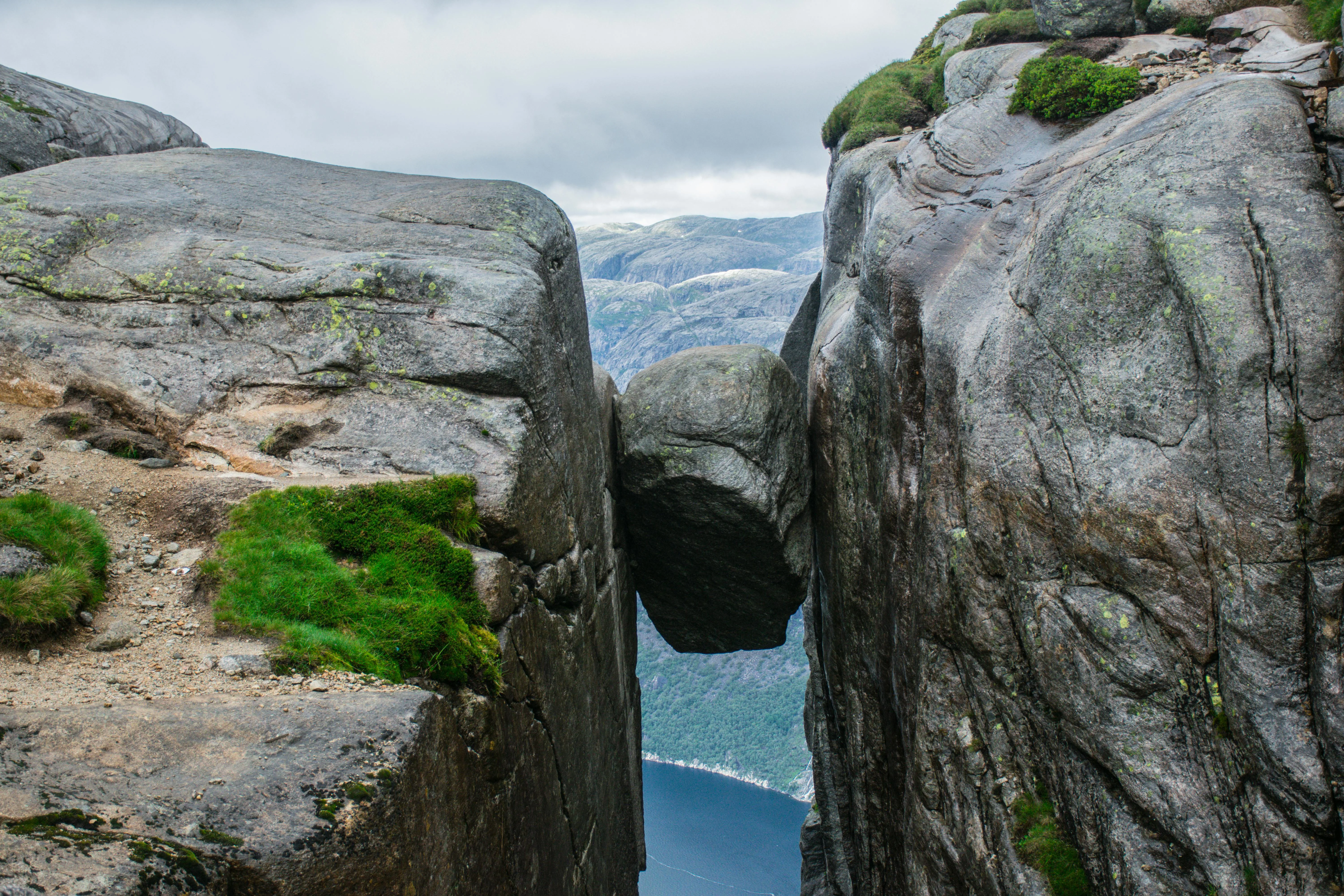
Kjeragbolten Boulder Gravity-Defying Stone Meets Norwegian Courage
The wind whips across the mountain plateau, carrying the sharp tang of Arctic air and the distant roar of Lysefjord 1,084 meters (3,556 feet) below. You stand before Kjeragbolten—a five-cubic-meter boulder wedged precariously in a mountain crevasse, suspended between two vertical cliffs by nothing but friction and geological chance. The stone, deposited by glaciers over 10,000 years ago during the last Ice Age, hangs in a gap that measures barely two meters wide, creating one of the world's most audacious natural photo opportunities. Your heart pounds as you watch another traveler step onto the boulder, arms outstretched, toes gripping the wet granite while the fjord yawns beneath. The hike to reach this point has taken three hours—12 kilometers of relentless ascent through mist-shrouded valleys and exposed plateaus where weather shifts in minutes. In 2026, as adventure tourism becomes increasingly curated and sanitized, Kjeragbolten matters because it remains raw and unfiltered—a place where courage is not manufactured but summoned, where the only safety net is your own resolve, reminding us that some experiences still demand everything we have.
Why Kjeragbolten Boulder Embodies Norwegian Adventure Spirit
Kjeragbolten is not merely a geological curiosity; it is the ultimate expression of Norway's relationship with its dramatic landscape. The boulder itself is a glacial erratic—a massive chunk of granite measuring approximately 5 cubic meters and weighing an estimated 10 tons—that became wedged in a natural fissure during the retreat of the Scandinavian Ice Sheet around 9,000 BCE. This geological accident solves a fundamental human need: the desire to test ourselves against nature's grandeur without artificial aids. Unlike engineered attractions, Kjeragbolten offers pure, unmediated confrontation with height and exposure.
The site's cultural significance has evolved dramatically since the first tourists began making the pilgrimage in the 1980s. What was once a little-known local landmark has become an international icon of adventure travel, drawing over 100,000 visitors annually to this remote corner of Rogaland county. The Norwegian Trekking Association (DNT) maintains the trail, which gains 570 meters elevation over its 12-kilometer length, with an average gradient of 9%—steep enough to challenge fitness but achievable for determined hikers. The trail engineering includes wooden boardwalks over boggy sections, stone steps on steep pitches, and red T-paint markers that guide the way through Norway's notorious fog.
Geologically, the mountain consists of Precambrian gneiss over 1 billion years old, among the oldest rock formations on Earth. The crevasse holding the boulder was formed by frost wedging—water seeping into cracks, freezing, expanding, and gradually splitting the bedrock. Modern geologists from the Geological Survey of Norway (NGU) monitor the boulder's stability, though measurements show it remains firmly wedged with negligible movement. In 2026, Kjeragbolten fulfills a psychological need increasingly rare in modern life: the opportunity for genuine, unscripted bravery. It represents Norway's gift to adventure seekers—a place where the only equipment required is courage, and the only reward is the knowledge that you stood, however briefly, on the edge of everything.
The Best Time to Experience Kjeragbolten Boulder
For optimal conditions balancing safety, accessibility, and weather stability, target June 20–August 25. During this window, temperatures range from 8–16°C (46–61°F) at the summit, and snow patches on the trail have mostly melted. Daylight extends to 18 hours, allowing for early starts that avoid afternoon cloud buildup. The best visibility occurs between 7:00–10:00 AM when morning air is clearest and before crowds converge on the boulder. Ferry connections from Stavanger to Lysebotn operate at full frequency during this period, with departures every 2 hours.
For experienced winter hikers, visit March 15–April 30 when the trail transforms into a snowshoe or ski mountaineering objective. Temperatures drop to -8 to 2°C (18–36°F), and the landscape becomes a winter wonderland. However, winter attempts require crampons, ice axes, avalanche training, and preferably a certified guide. Avoid July 15–August 5 if you dislike crowds: this peak period sees 800+ hikers daily, creating queues at the boulder that can exceed 45 minutes. Also avoid visiting during high winds (>25 m/s), heavy rain, or fog when visibility drops below 50 meters—the exposed plateau becomes dangerous in poor conditions. For real-time trail status, check www.lysefjorden.no or call +47 51 43 43 50. Weather forecasts are available via Yr.no, updated hourly.
Approximate Budget for a 7-Day Trip (2026)
Traveling to the Kjeragbolten region involves moderate-to-high costs typical of Western Norway's remote areas. This budget assumes mid-range travel with 3-4% inflation adjustment from 2024 baselines. Prices are estimated in Euros (€); local currency is Norwegian Krone (NOK). Costs reflect Stavanger and Lysebotn areas.
- Accommodation: €150–€240 per night for a double room in a 3-star hotel in Stavanger or near trailhead. Budget hostels (STA Hostel Stavanger): €50–€70 per bed. Upscale options (Radisson Blu Royal Hotel): €280–€450 per night.
- Food: €70–€100 per day per person
- Breakfast: €14–€20 (hotel buffet with bread, cheese, jam)
- Lunch: €20–€32 (mountain café sandwich €26, soup €28, or grocery picnic €18)
- Dinner: €36–€55 (restaurant main: lamb €42, fish €40, pasta €30; add €12 for beer)
- Transportation:
- Bus (Stavanger–Øygardstøl trailhead): €35 round-trip
- Ferry (Stavanger–Lysebotn): €45 one-way, €80 round-trip
- Car rental (7 days, 4WD): €550–€750 including fuel
- Bergen Airport Flybussen: €15 one-way, €25 round-trip
- Attractions:
- Kjeragbolten Hike: Free (trail access)
- Guided Kjerag hike: €120 per person
- Preikestolen (Pulpit Rock) visit: Free
- Lysefjord RIB boat safari: €85
- Norwegian Petroleum Museum: €18
- Miscellaneous:
- Souvenirs: Troll figurine €20, wool sweater €95, postcards €5
- Hiking gear rental (poles/boots): €35
- Travel insurance (7 days, adventure coverage): €45–€65
- eSIM data plan: €20–€30
Total for 7 days (mid-range, per person, double occupancy): €1,850–€2,350
Budget travelers can reduce costs to €1,200–€1,500 by camping (€30 per night), cooking meals, and using public transport. Luxury seekers should budget €4,000+ for private guides and fine dining.
6 Essential Kjeragbolten Experiences
- Hike to Kjeragbolten: Start at Øygardstøl trailhead by 7:00 AM to beat crowds and afternoon weather changes. The 12-kilometer (7.5-mile) round-trip takes 4–6 hours total, gaining 570 meters elevation. The trail is marked with red T-paint; follow it through birch forest, across boulder fields, and over exposed plateau. The final approach requires scrambling over wet granite. Spend 15–20 minutes on the boulder itself—long enough for photos but not so long that you tire. Bring 2 liters of water, high-energy snacks, and waterproof layers. The descent is harder on knees; trekking poles help significantly.
- Stand on the Boulder: This is the moment you've hiked for. Approach slowly, testing the stone's surface for moisture. The granite is often wet from mist; wipe your boots on the dry rock beside the boulder before stepping on. Position yourself in the center, arms out for balance, and look down only when ready. The view through your legs to the fjord 1,084 meters below is vertigo-inducing. Breathe deeply; the adrenaline is normal. Have a companion photograph from the cliff edge—never stand on the boulder alone. The experience lasts seconds but memories endure decades.
- Explore Kjerag Mountain Plateau: Beyond the boulder, the Kjerag plateau extends for kilometers, offering additional viewpoints and photo opportunities. Hike 20 minutes beyond the boulder to Kjeragfjellet summit (1,110 meters) for 360-degree views encompassing Lysefjord, Preikestolen, and on clear days, the North Sea. The terrain is exposed and windy; stay on marked paths. This area sees 10% of the foot traffic that visits the boulder, offering solitude and perspective. Bring a map; fog can descend rapidly, disorienting even experienced hikers.
- Drive the Lysebotn Scenic Route: After the hike, drive or take the ferry to Lysebotn village at the fjord's end. The road from Lysebotn to Sirdal includes 27 hairpin turns and the 4.3-kilometer Lysebotn Tunnel, one of Norway's most dramatic drives. The journey takes 2 hours but rewards with waterfalls plunging directly into the fjord and viewpoints that rival the hike itself. Stop at Flørli for the world's longest wooden staircase (4,444 steps). This route provides context for the landscape you've just traversed from above.
- Take a Lysefjord Cruise: Complement the mountain perspective with a boat view. Depart Stavanger harbor at 9:00 AM for a 3-hour rib boat safari through Lysefjord. You'll see Kjeragbolten from below—a tiny speck in a massive cliff face—appreciating the scale impossible to grasp from above. The speedboat ride is exhilarating, with waves splashing over the bow. Guides explain geology and local history. Wear waterproof gear; you will get wet. This dual perspective—top and bottom—provides complete understanding of the landscape's magnitude.
- Watch Sunset from Øygardstøl: After descending, don't rush away. The parking area at Øygardstøl (700 meters elevation) offers stunning sunset views over the valley. Grab coffee at the mountain café and watch light transform the peaks you just climbed. In summer, sunset occurs after 10:00 PM, giving ample time to recover. The café serves traditional Norwegian waffles with brown cheese and jam—perfect post-hike fuel. This quiet moment of reflection completes the experience, allowing you to process the day's achievement while surrounded by the mountains that challenged you.
3 Hidden Gems Most Travelers Miss
- Øygardstøl Mountain Farm: Located at the trailhead, this historic farm (coordinates 59.0167°N, 6.4333°E) dates to 1640 and offers cultural context often overlooked by rushing hikers. Open June–September, Tuesday–Thursday 11:00 AM–4:00 PM. The farm demonstrates traditional Norwegian mountain agriculture with grazing sheep and historic buildings. They serve homemade meals using local ingredients—book tables in advance (+47 51 43 43 50). It is missed because most visitors focus solely on the boulder. The farm provides insight into how humans have lived in this harsh landscape for centuries. Entry is free; meals cost €25–€35.
- Buafossen Waterfall: On the drive to Øygardstøl from Stavanger, this 165-meter waterfall cascades beside Road 500 near Sørnes. There is a small pull-off parking area (coordinates 59.0500°N, 6.3167°E). Most visitors drive past en route to Kjerag. Stop here for a 10-minute photo opportunity. The mist creates permanent rainbows in afternoon sun. A short 5-minute trail leads to a viewing platform. Best visited in late spring when snowmelt maximizes flow. It is a free, accessible natural spectacle requiring no hiking. The waterfall's power provides a preview of the region's dramatic hydrology.
- Kjeragvatnet Lake: A small alpine lake located 30 minutes beyond Kjeragbolten on the plateau (coordinates 59.0083°N, 6.4583°E). This glacial tarn sits at 950 meters elevation and reflects the surrounding peaks perfectly on calm days. It is overlooked because most hikers turn around after visiting the boulder. The walk requires crossing additional boulder fields but rewards with profound solitude. No facilities exist; bring all supplies. Best visited on weekdays when the boulder is crowded. The lake's stillness contrasts with the adrenaline of the boulder, offering meditation space. Wild reindeer sometimes graze nearby at dawn.
Cultural & Practical Tips
- Safety First: Kjeragbolten has no safety equipment—no railings, no harnesses, no nets. The boulder is naturally wedged but wet granite is slippery. Do not attempt in rain, snow, or high winds. Three people have died falling from Kjeragbolten since 2010; respect the danger. Children under 10 should not stand on the boulder. Turn back if you feel uncomfortable; the view from the cliff edge is equally spectacular. Your safety is your responsibility; rescue operations are dangerous and costly.
- Proper Footwear: Wear sturdy hiking boots with aggressive tread and ankle support. Trail runners are insufficient for the wet granite and boulder fields. The trail includes sections of bare rock that become treacherous when wet. Rent boots in Stavanger if needed (€15/day). Do not attempt in sneakers, sandals, or flip-flops—this is dangerous and disrespectful to the mountain. Proper gear prevents injuries and increases enjoyment significantly.
- Useful Phrases:
- "Takk" (tahk) = Thank you
- "Hvor er stien?" (voor ehr stee-en) = Where is the trail?
- "Er det trygt?" (ehr deh trygt) = Is it safe?
- "Jeg trenger hjelp" (yai tren-ger yelp) = I need help
- Photography Guidelines: Drones are prohibited without permission from the Norwegian Environment Agency. Respect other visitors; do not monopolize the boulder for extended photo sessions. The dynamic range is extreme; expose for highlights to retain sky detail. Use a wide-angle lens to capture scale. Never risk your life for a photo—edges crumble. Ask fellow hikers to photograph you; most are happy to help. Wait your turn patiently; queues form during peak hours.
- Weather Preparedness: Mountain weather changes rapidly. Pack waterproof jacket, windproof layers, warm hat, and gloves even in summer. Temperatures at the summit average 6–8°C cooler than Stavanger. Fog can reduce visibility to zero in minutes; if this happens, stay on the marked trail and consider turning back. Check Yr.no hourly forecasts before departing. Do not rely on valley weather to predict summit conditions.
- Physical Fitness: The hike requires moderate-to-good fitness. You should be comfortable walking 12 kilometers with 570 meters elevation gain. The trail includes steep sections, boulder scrambling, and exposed plateaus. Train beforehand with stair climbing and hill walking. If you have knee or heart problems, consult a doctor before attempting. The descent is harder on joints; trekking poles reduce impact by 25%. Take your time; there is no prize for speed.
- Leave No Trace: Pack out all trash. There are no bins on the mountain. Use toilets at the trailhead before starting. Do not deface the boulder or surrounding rock. Respect wildlife; do not approach reindeer. Keep the mountain pristine for future visitors. Organic waste like fruit peels must also be packed out—they take months to decompose in Arctic conditions.
Conclusion: Travel with Courage, Not Just Checklists
Kjeragbolten is not a backdrop for Instagram; it is a test of character carved in granite. In 2026, as adventure becomes increasingly packaged and risk-free, this boulder wedged in a mountain crevasse offers something increasingly rare: genuine confrontation with fear. Travel here not to collect a photo but to discover what you're made of. Feel the wind; hear your heartbeat; understand that courage is not the absence of fear but action despite it. Leave only footprints; take only the knowledge that you stood on stone suspended between earth and sky. When you descend back to the valley, carry the mountain's lesson with you: that we are capable of more than we believe. For in the end, the true value of Kjeragbolten is not the image you share, but the transformation you undergo—the quiet knowing that when life presents its own precarious boulders, you have already proven you can stand firm.