
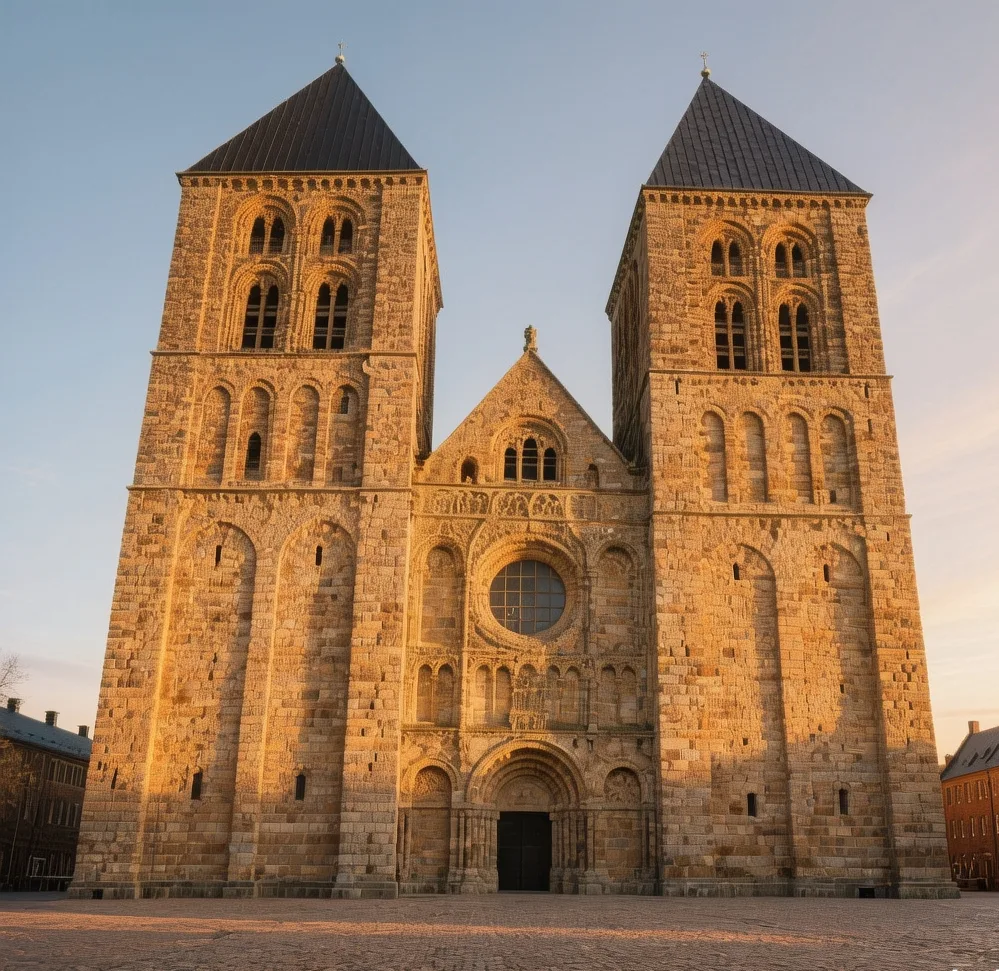
Lund Cathedral Romanesque Stone Meets Scandinavian Soul
The bells of Lund Cathedral chime across the cobblestone streets at precisely 12:00 PM—a sound that has echoed through this ancient university town for nearly nine centuries. You stand before the western façade, where weathered sandstone blocks tell stories of archbishops and pilgrims, of medieval devotion and modern wonder. Inside, the Horologium Mirabile Lundense—that miraculous astronomical clock from 1424—awaits its daily performance, its mechanical figures processing past scenes of the Nativity and the Three Kings. The air carries the faint scent of candle wax and old stone, while shafts of Nordic light pierce through narrow Romanesque windows, illuminating dust motes dancing above pillars that have supported this sacred space since 1145. This is not merely a church; it is Scandinavia's oldest continuously functioning cathedral, a living testament to the region's transformation from Viking Age to Christian kingdom. In 2026, as mass tourism reshapes European heritage sites, Lund Cathedral remains refreshingly authentic—a place where you can still hear your footsteps echo through the crypt and feel the weight of history without fighting through crowds. This matters now more than ever: in an age of digital distraction and superficial travel, Lund offers something increasingly rare—the chance to stand in genuine continuity with the past.
Why Lund Cathedral Embodies Medieval Scandinavian Majesty
Lund Cathedral stands as the architectural crown jewel of Scania, representing a pivotal moment when Sweden's southernmost province became the ecclesiastical heart of medieval Scandinavia. Construction began in the 1080s under King Canute the Holy, with consecration occurring around 1145—making it one of the oldest stone buildings in all of Northern Europe. The cathedral solved a critical political and spiritual need: establishing Lund as the archbishopric for all of Scandinavia in 1103, elevating this modest settlement into a power center rivaling Copenhagen and Stockholm. Built primarily from local sandstone quarried just kilometers away, the structure measures 77 meters in length with twin western towers rising 55 meters skyward—a formidable presence visible from miles across the flat Skåne countryside. The Romanesque architecture features characteristic rounded arches, thick load-bearing walls up to 2 meters in thickness, and a crypt supported by 24 massive pillars carved from single blocks of stone. Inside, you'll find the famous Finjamannen—a 12th-century stone relief depicting a man wrestling a lion, symbolizing the struggle between good and evil. The cathedral's astronomical clock, reconstructed in 1923 based on the 1424 original, represents one of the oldest functioning mechanical timepieces in the world, its intricate gears tracking not just hours but lunar phases and religious feast days. This is engineering as theology—medieval craftsmen encoding the cosmos into brass and iron, creating a machine that literally tells time while reminding viewers of eternity.
The Best Time to Experience Lund Cathedral
For the optimal Lund Cathedral experience, target May 15–June 20 or September 5–October 10 when tourist numbers remain manageable and the Swedish light creates magical atmospheric conditions. During these windows, daytime temperatures hover between 12–18°C (54–64°F), perfect for walking the cobblestone streets before seeking the cathedral's cool interior. The astronomical clock performs its full procession daily at 12:00 PM and 3:00 PM (15:00), though Sunday performances occur only at 12:00 PM following the morning service. Arrive between 8:30–9:30 AM for morning light streaming through the eastern windows—this golden hour illuminates the crypt's ancient pillars without the midday crowds. Avoid July 1–August 15 when Swedish school holidays bring peak visitor numbers, and steer clear of December 23–26 when the cathedral closes for Christmas preparations and family services. Winter visits (November–February) offer atmospheric candlelit services but limited daylight—sunset occurs as early as 3:00 PM in December. For current opening hours and service schedules, verify at www.svenskakyrkan.se/lund before your visit, as special events and restoration work can affect access. The cathedral remains open Monday–Saturday 9:00 AM–6:00 PM (April–September) and 10:00 AM–4:00 PM (October–March), with Sunday hours beginning at 1:00 PM.
Approximate Budget for a 7-Day Trip (2026)
Lund offers exceptional value compared to Stockholm or Copenhagen, with costs reflecting its university town character rather than capital city premiums. The following estimates assume moderate travel style—comfortable but not luxury accommodations, mix of self-catering and restaurant meals, and use of public transportation. Prices reflect 2026 rates with approximately 3% annual inflation from 2024 baseline data.
- Accommodation: €85–€140 per night for a double room in central Lund (near Lilla Torg or Kyrkogatan); budget hostels start at €35/night; upscale hotels near the cathedral average €180–€250/night
- Food: €45–€65 per day total
- Breakfast: €8–€12 (hotel buffet or café smörgås with coffee)
- Lunch: €15–€20 (dagens lunch—daily special including main, salad, bread, and drink)
- Dinner: €22–€33 (restaurant main course; try Skånsk spettekaka dessert for €8)
- Transportation:
- Copenhagen Airport to Lund: €18 one-way via Øresundståg train (35 minutes)
- Local buses in Lund: €3.50 single ticket; €12 day pass
- Bicycle rental: €15/day (Lund is extremely bike-friendly)
- Day trip to Malmö: €8 round-trip train ticket (12 minutes)
- Attractions:
- Lund Cathedral: Free entry (donations welcome); tower climb €5
- Historical Museum: €8 adults, free under 19
- Botanical Garden: Free
- Kulturen open-air museum: €14
- Miscellaneous:
- Cathedral guidebook: €6
- Local crafts at Lilla Torg market: €15–€40
- Fika (coffee + cinnamon bun): €5–€7
- Evening organ concert: €15–€25
Total estimated cost for 7 days: €850–€1,200 per person (excluding international flights)
7 Essential Lund Cathedral Experiences
- Witness the Astronomical Clock's Daily Procession: Position yourself before the Horologium Mirabile Lundense at 11:58 AM or 2:58 PM to secure a viewing spot. When the clock strikes, mechanical figures of the Three Kings process past the Nativity scene while trumpets sound—a 2-minute performance that has captivated visitors since 1424. The upper dial displays time, lunar phases, and the current position of the sun through the zodiac; study it carefully to understand medieval cosmology encoded in brass gears.
- Descend into the 12th-Century Crypt: Enter through the northern transept to access Scandinavia's best-preserved Romanesque crypt. The air grows noticeably cooler as you descend the stone steps into this atmospheric space supported by 24 massive pillars. Look for the column depicting a figure wrestling a lion—the famous Finjamannen relief dating to 1120. The crypt houses the tomb of Archbishop Eskil and maintains an eerie silence broken only by dripping water and whispered prayers.
- Climb the South Tower for Panoramic Views: Purchase your €5 tower ticket at the cathedral shop, then ascend 167 narrow stone steps to the viewing platform at 42 meters. The climb is steep and claustrophobic in sections, but the reward is a 360-degree vista across Lund's red-tiled roofs, the Øresund strait visible on clear days, and Denmark's coastline 20 kilometers away. Best lighting for photography occurs between 4:00–6:00 PM in summer.
- Attend an Evening Organ Concert: The cathedral's magnificent Marcussen organ—featuring 57 stops and over 4,000 pipes—comes alive during Wednesday evening concerts (June–August, 7:00 PM). The acoustics in this 800-year-old space create an otherworldly sound experience; Bach's Toccata and Fugue in D Minor resonates through the vaulted ceilings in ways that recordings cannot capture. Arrive 20 minutes early for seating.
- Trace the Giant's Footprint Legend: Near the northern entrance, locate the stone carving said to be the Devil's footprint—actually a medieval measurement standard, but local legend claims a giant (or the Devil) left it when fleeing the consecrated church. This 30-centimeter impression in the sandstone has been touched by countless pilgrims seeking good luck. The story reflects how Lund's conversion from Norse paganism to Christianity was negotiated through folklore and compromise.
- Explore the Treasury Museum: Hidden in the cathedral's northwest corner, the small treasury (€4 entry) displays medieval liturgical objects including a 14th-century silver chalice, embroidered vestments, and fragments of the original 12th-century wooden doors. The highlight is the golden reliquary from 1250, containing bones of Saint Lawrence, Lund's patron saint. Photography is prohibited here to preserve the delicate textiles.
- Experience Midnight Sun Services: If visiting between June 10–July 5, attend the special evening service (9:00 PM) when natural light still streams through the windows despite the late hour. The cathedral remains bathed in golden twilight, creating a surreal atmosphere where time seems suspended. This is when Lund's northern latitude becomes most apparent—and most magical.
3 Hidden Gems Most Travelers Miss
- The Archbishop's Palace Ruins (Biskopshuset): Located directly behind the cathedral's eastern apse, these 12th-century ruins are often overlooked by visitors rushing to the main church. The remaining walls reveal the scale of medieval ecclesiastical power—this was once Scandinavia's most important administrative center. Access through the cathedral gift shop's back door (ask for the key; no additional fee). The overgrown garden contains original foundation stones and offers a peaceful spot for reflection. Visit between 10:00 AM–3:00 PM when staff can provide historical context.
- Domkyrkoforum's Underground Chapel: This modern 2006 addition by architect Ralph Erskine sits beneath the cathedral plaza, creating a striking contrast between contemporary concrete and medieval stone. The chapel hosts daily meditation sessions at 8:00 AM (open to all faiths) and features a minimalist design with a single shaft of natural light piercing the darkness. Enter through the glass pavilion on Kyrkogatan; ring the bell for access. This space represents Lund's ongoing evolution as a living religious center, not merely a museum piece.
- The Cathedral Library's Medieval Manuscripts: By appointment only, scholars and serious history enthusiasts can view the cathedral's collection of 12th–15th century illuminated manuscripts. Contact the cathedral archivist at arkiv@lund.domkyrka.se at least two weeks in advance. The collection includes a 12th-century psalter with original Romanesque illuminations and the Liber David choir books from 1430. Visits limited to Tuesday and Thursday afternoons, maximum 4 people per session. This is genuine scholarly access rarely available at major European cathedrals.
Cultural & Practical Tips
- Photography etiquette: Photography is permitted in the main nave without flash, but prohibited during services and in the treasury. The astronomical clock cannot be photographed during its performance (11:58 AM–12:02 PM and 2:58–3:02 PM) to respect other viewers' experience. Tripods require special permission from the cathedral office.
- Dress code: While Sweden is generally casual, the cathedral requests modest attire—shoulders and knees covered. This is strictly enforced during services but loosely applied during tourist hours. Carry a light scarf to drape over tank tops in summer.
- Swedish church customs: It's acceptable to sit in the pews for quiet reflection even if you're not attending a service. Light a candle (€2 donation) in the memorial chapel if you wish to honor someone. During services, stand when others stand—this typically occurs during hymns and the Gospel reading.
- Essential Swedish phrases:
- "Tack" (tahk) = Thank you
- "Ursäkta" (oor-shek-tah) = Excuse me
- "När är nästa gudstjänst?" (nair air nes-tah goods-tienst) = When is the next service?
- Accessibility: The main nave is wheelchair accessible via the southern entrance, but the crypt and tower climb are not accessible to those with mobility limitations. The treasury has a small step but staff can provide a portable ramp with advance notice. Hearing loop systems are installed throughout for those with hearing aids.
- Weather considerations: Lund's coastal location means weather can shift rapidly—carry layers even in summer. The cathedral interior remains 16–18°C (61–64°F) year-round due to thick stone walls, so bring a light jacket regardless of outdoor temperature.
- Safety: Lund is exceptionally safe, but watch for bicycles—they have right of way everywhere and move silently. The cathedral area is well-lit and patrolled, but keep valuables secure during crowded clock performances when pickpockets occasionally operate.
Conclusion: Travel with Reverence, Not Just Tourism
Lund Cathedral demands something different from you than the checklist mentality of modern travel. This is not a place to snap a selfie and move on; it's a space that asks you to slow down, to listen to the silence between the bell tolls, to trace with your eyes the tool marks left by stonemasons who died eight centuries ago. When you stand before that astronomical clock, watching wooden kings process past a mechanical Bethlehem, you're witnessing a continuous tradition—people have gathered at this exact spot, at this exact hour, since before Columbus sailed to the Americas. That continuity is fragile. Every year, the sandstone façade erodes another millimeter; every touch leaves microscopic oils that accelerate decay; every flash photograph fades medieval pigments by imperceptible degrees. Travel here with reverence: speak softly, move deliberately, contribute to the preservation fund, and leave only your gratitude. In return, Lund Cathedral offers something increasingly precious in our accelerated world—the chance to stand in deep time, to feel the weight and wonder of human continuity, to remember that we are temporary custodians of beauty that outlasts us all. This is why we travel: not to consume places, but to be transformed by them.