
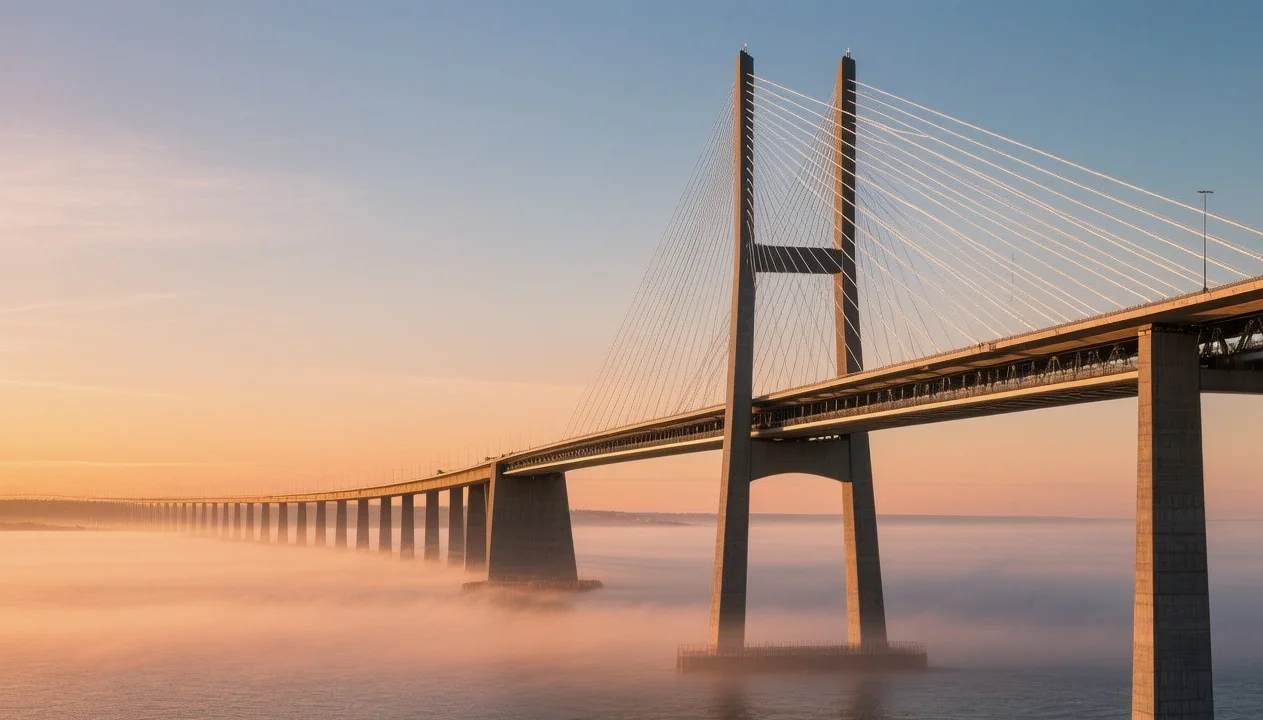
Öresund Bridge Scandinavian Engineering Meets Nordic Seas
The morning mist clings to the Øresund Strait—a silvery veil that parts slowly as the first commuter trains rumble across the 7,845-meter span. You stand on the Danish side near Kastrup, watching the cable-stayed structure emerge from the haze like a geometric mirage: 204 meters tall at its highest pylon, carrying both cars and trains between two nations that have shared this waterway for over a millennium. The bridge doesn't simply cross water—it stitches together Copenhagen's cobblestone charm with Malmö's modernist edge, creating a seamless 16-kilometer link that includes an artificial island and an underwater tunnel. Since its inauguration on July 1, 2000, this architectural marvel has carried over 300 million passengers, transforming what was once a 45-minute ferry journey into a 20-minute drive. In 2026, as climate consciousness reshapes European travel and cross-border cooperation becomes ever more vital, the Öresund Bridge stands as more than infrastructure—it embodies a vision of connected Scandinavia that feels both timeless and urgently contemporary.
Why the Öresund Bridge Embodies Scandinavian Unity
The Öresund Bridge represents one of the most ambitious infrastructure projects of the late 20th century—a physical manifestation of the vision to unite Denmark and Sweden after centuries of rivalry. The project, which cost 30.1 billion Danish kroner (approximately €4 billion), required the collaboration of over 3,500 workers from both nations and took seven years to complete. Engineers from Arup and SETEC faced extraordinary challenges: creating a structure that wouldn't interfere with Copenhagen Airport's flight paths while maintaining clearance for maritime traffic, resulting in the innovative combination of bridge, artificial island (Peberholm), and 4-kilometer immersed tunnel.
The bridge solved a fundamental geographic problem that had separated the Scandinavian Peninsula from continental Europe since the last Ice Age. Before 2000, travelers relied on ferries that operated in all weather conditions—a unreliable connection that limited economic integration between the Øresund Region's 4 million inhabitants. The structure's 204-meter-high pylons support cables that stretch across the main navigation channel, allowing ships up to 57 meters in height to pass beneath while trains and vehicles traverse above. The artificial island Peberholm, constructed from 11 million cubic meters of material dredged from the strait, serves as the transition point where the bridge becomes a tunnel—an engineering solution that preserves both aviation and maritime routes.
Beyond its technical achievements, the bridge has fundamentally transformed the region's economy and culture. Daily commuters now flow between Copenhagen's €8,000-per-square-meter housing market and Malmö's more accessible €4,500 average, creating a transnational labor market that employs over 8,000 daily cross-border workers. The structure has become an icon of Scandinavian design—functional, elegant, and environmentally conscious—proving that infrastructure can be both utilitarian and beautiful.
The Best Time to Experience the Öresund Bridge
For the most dramatic crossing experience, plan your visit between May 20 and June 25, when the Nordic light creates ethereal conditions that photographers dream about. During this period, temperatures hover between 15–22°C (59–72°F), and the extended daylight hours—sunset arrives as late as 10:00 PM—mean you can witness the bridge in multiple lighting conditions during a single evening. The optimal viewing window occurs between 8:30–10:00 PM, when the low-angle sun casts long shadows across the cables and the water takes on a golden-pink hue that reflects off the steel structure.
Winter crossings (December–February) offer their own stark beauty, with temperatures ranging from -2 to 4°C (28–39°F) and the possibility of ice formations around the Peberholm island. However, frequent storms and reduced daylight (sunset around 3:30 PM in December) make this season less ideal for first-time visitors. The bridge remains operational year-round, but strong winds exceeding 25 m/s can temporarily close the structure to high-profile vehicles.
Avoid the peak tourist season of July 15–August 15, when traffic volumes increase by 40% and accommodation prices in both Copenhagen and Malmö surge by 60–80%. The Swedish school holiday period (weeks 27–31) creates particularly heavy congestion. For current traffic conditions and weather forecasts, verify conditions at oresundsbron.com before your crossing.
Approximate Budget for a 7-Day Trip (2026)
This budget assumes a mid-range travel style with comfortable accommodations, local dining, and public transportation. Prices reflect 2026 rates with an estimated 3.5% inflation adjustment from 2024 baseline data. The budget covers a week split between Copenhagen (4 nights) and Malmö (3 nights), maximizing your experience of both sides of the bridge.
Accommodation:
• Copenhagen (Vesterbro/Nørrebro neighborhoods): €120–€180 per night for a double room in a boutique hotel or quality Airbnb
• Malmö (Möllevången/Centrum areas): €80–€130 per night for comparable lodging
Food:
• Breakfast: €8–12 (café pastry and coffee, or supermarket options for €4)
• Lunch: €15–20 (smørrebrød in Copenhagen, falafel plate in Malmö)
• Dinner: €30–45 (mid-range restaurant with local beer/wine)
• Daily food total: €53–77
Transportation:
• Copenhagen Airport to city center (Metro Line M2): €4.20
• Öresund Bridge crossing by train (Copenhagen–Malmö): €14 one-way, €26 round-trip
• Regional day pass (Øresund Around ticket): €45 per day for unlimited travel
• Bridge toll by car: €52 one-way (DKK 390)
Attractions:
• Malmöhus Castle Museum: €12
• Copenhagen's Tivoli Gardens: €18 entry + ride packages from €35
• Turning Torso observation deck: €15
• Bridge visitor center (Lærkevej): Free
Miscellaneous:
• Bridge commemorative coin set: €8
• Local SIM card with data: €15
• Travel insurance (7 days): €25–40
• Souvenirs (design items, local crafts): €40–100
Total estimated cost for 7 days: €1,150–€1,450 per person (excluding international flights)
6 Essential Öresund Bridge Experiences
1. Drive the Bridge at Sunset: Rent a car and time your crossing for 8:00–9:30 PM during summer months. Enter from the Danish side at Kastrup, paying the €52 toll at the automated booth (credit cards accepted). As you ascend the bridge's gentle incline, you'll experience a 360-degree panorama: Copenhagen's spires to the south, Malmö's modern skyline to the north, and the endless expanse of the Øresund Strait below. Pull over at the designated viewing area on Peberholm island (accessible only by special permit, but visible from the bridge) to photograph the transition point where the structure disappears into the tunnel.
2. Cross by Train for the Local Experience: Board the Øresundståg regional train at Copenhagen Central Station (København H) or Kastrup Airport. The 20-minute journey costs €14 and runs every 20 minutes during peak hours. Sit on the right side when traveling toward Sweden for optimal views of the cable-stayed section. Watch as the train plunges into the 4-kilometer tunnel at Peberholm, emerging moments later in Malmö Central—a journey that compresses centuries of Scandinavian history into a single commute.
3. Walk the Coastal Path at Amager Strandpark: Three kilometers south of the bridge's Danish terminus, this artificial beach park offers the best ground-level perspective of the structure. Arrive at 7:00 AM on a weekday morning to witness the bridge silhouetted against the rising sun while locals cycle along the 4.6-kilometer coastal path. The bridge appears as a delicate line against the horizon, its scale only becoming apparent as ships pass beneath and you realize the 57-meter clearance height.
4. Visit the Turning Torso at Blue Hour: Malmö's 190-meter residential tower, designed by Santiago Calatrava, provides a stunning foreground for bridge photography. Climb to the 54th-floor observation deck (€15, open until 10:00 PM in summer) 30 minutes before sunset. As the sky transitions from blue to indigo, watch the bridge's LED lighting system activate—subtle white illumination that traces the cables without creating light pollution. This is the view that convinced producers to feature both structures in the Nordic noir series "The Bridge" (Bron/Broen).
5. Cycle the Øresund Route: Rent a bicycle in Copenhagen (€12–18 per day) and follow National Cycle Route 1 along the coast toward Malmö. While you cannot cycle directly across the bridge, the 15-kilometer coastal path offers continuous views and ends at Ribersborg Beach in Malmö, where you can photograph the bridge from the Swedish perspective. Stop at the listed 18th-century Ribersborgs Kallbadhus (cold bath house) for a traditional Swedish fika (coffee and cinnamon bun, €8) while contemplating the structure that makes this binational cycling adventure possible.
6. Experience the Bridge from Below by Kayak: Join a guided sea kayaking tour from either Copenhagen's Islands Brygge (€65, 3 hours) or Malmö's Västra Hamnen (€58, 2.5 hours). Paddle beneath the bridge's 204-meter pylons to appreciate the engineering scale that's impossible to grasp from above. Tours operate May–September, departing at 10:00 AM and 2:00 PM. You'll pass the Peberholm island—now a protected nature reserve home to over 500 plant species and rare birds—learning how this artificial landmass has become an unexpected ecological success story.
3 Hidden Gems Most Travelers Miss
• Peberholm Island Nature Reserve: While the artificial island is technically restricted, the Danish Society for Nature Conservation offers guided botanical tours four times per year (typically May, June, August, and September). These €35 tours require advance booking at +45 35 36 70 70 and provide rare access to this 130-hectare ecosystem where southern and northern European species coexist. The island has become a crucial stopover for migratory birds, with over 250 species recorded. Bring binoculars and wear sturdy boots—the terrain includes gravel, grass, and coastal marsh.
• Lernacken Beach Viewing Point: Located 8 kilometers south of Malmö, this lesser-known beach offers an unobstructed southern perspective of the bridge that few tourists discover. Take bus 144 from Malmö Central (25 minutes, €3.50) to the Lernacken stop. The beach's limestone formations create natural foreground interest for photography, and the shallow waters reflect the bridge beautifully at dawn. Visit during low tide (check tide tables at smhi.se) when the exposed seabed creates mirror-like conditions. A small café (open 10:00 AM–6:00 PM, May–September) serves Swedish pastries and coffee.
• The Bridge's Original Construction Exhibition: Tucked inside the Øresundsbrokonsortiet headquarters at Lærkevej 2, Copenhagen, this small but fascinating exhibition displays original blueprints, scale models, and photographs from the 1995–2000 construction period. Entry is free but requires 48-hour advance email reservation to info@oresundsbron.com. The exhibition includes a 1:100 scale model you can walk around and a video showing the tunnel immersion process. Open Tuesday and Thursday, 1:00–4:00 PM. The staff includes engineers who worked on the project and can answer technical questions about the bridge's construction.
Cultural & Practical Tips
• Currency Awareness: Denmark uses the Danish krone (DKK), while Sweden uses the Swedish krona (SEK). The bridge toll is charged in DKK (€52 = DKK 390), but trains accept both currencies. Credit cards work universally, but inform your bank of cross-border travel to avoid fraud alerts. The exchange rate typically hovers around 1 EUR = 7.45 DKK = 11.2 SEK (2026 estimates).
• Border Crossing Protocol: While both countries belong to the Schengen Area, temporary border controls may be in effect. Carry your passport or EU national ID card at all times. Swedish police conduct random checks on trains—have your identification readily accessible. Non-EU citizens should verify visa requirements for both countries, as entry to one doesn't guarantee entry to the other during control periods.
• Photography Etiquette: Drone photography requires special permission from both Danish and Swedish aviation authorities (contact Trafikstyrelsen at +45 45 24 02 00 or Transportstyrelsen at +46 10 495 80 00). Handheld photography is unrestricted, but respect privacy when photographing from residential areas. The bridge is illuminated from dusk until midnight with energy-efficient LED lighting that adjusts intensity based on maritime traffic.
• Weather Preparedness: The Øresund Strait creates its own microclimate—conditions can differ significantly between Copenhagen and Malmö. Check both Danish (dmi.dk) and Swedish (smhi.se) weather forecasts. Wind speeds on the bridge can be 30–40% higher than ground level. In winter, black ice can form on the bridge deck even when temperatures at either end are above freezing.
• Local Phrases: While English proficiency is near-universal, learning basic greetings shows respect. Danish: "Goddag" (GOH-they, good day), "Tak" (tahk, thank you). Swedish: "Hej" (hay, hello), "Tack" (tahk, thank you). Pronunciation is similar, but Danish has a distinctive "stød" (glottal stop) that Swedes don't use.
• Sustainable Travel: The bridge's train service is powered by 100% renewable energy (wind and hydroelectric). Choose rail over car travel when possible—the train produces 90% less CO₂ per passenger. Both Copenhagen and Malmö have extensive bike-sharing systems (Bycyklen in Copenhagen, Malmö by bike in Sweden) costing €2–3 per hour.
• Emergency Contacts: Pan-European emergency number: 112 (works in both countries). Bridge incident hotline: +45 32 21 22 22 (Denmark) or +46 40 35 50 00 (Sweden). For non-emergency medical care, Denmark's emergency line is +45 70 13 14 13; Sweden's is 1177.
Conclusion: Travel with Connection, Not Just Transit
The Öresund Bridge teaches us that the journey between two points can be more meaningful than either destination alone. In an era when borders seem to harden and isolationism gains traction, this structure stands as a 16-kilometer argument for connection—for the idea that what separates us (water, history, language) can be transformed into what binds us. When you cross in 2026, whether by train, car, or kayak, you're not simply traveling from Denmark to Sweden; you're participating in a quarter-century experiment in binational cooperation that has reshaped 4 million lives.
Resist the urge to treat the bridge as a checkbox on your Scandinavian itinerary. Instead, slow down. Watch how the morning light transforms the cables from steel gray to rose gold. Notice the commuter reading a newspaper in Danish, the tourist photographing from the train window, the cargo ship passing beneath with millimeter precision. This is infrastructure as poetry—functional, yes, but also profoundly human. The bridge doesn't just span water; it spans the distance between "them" and "us," between "here" and "there." Cross it mindfully, and you'll understand that the most important destinations aren't places, but perspectives.