
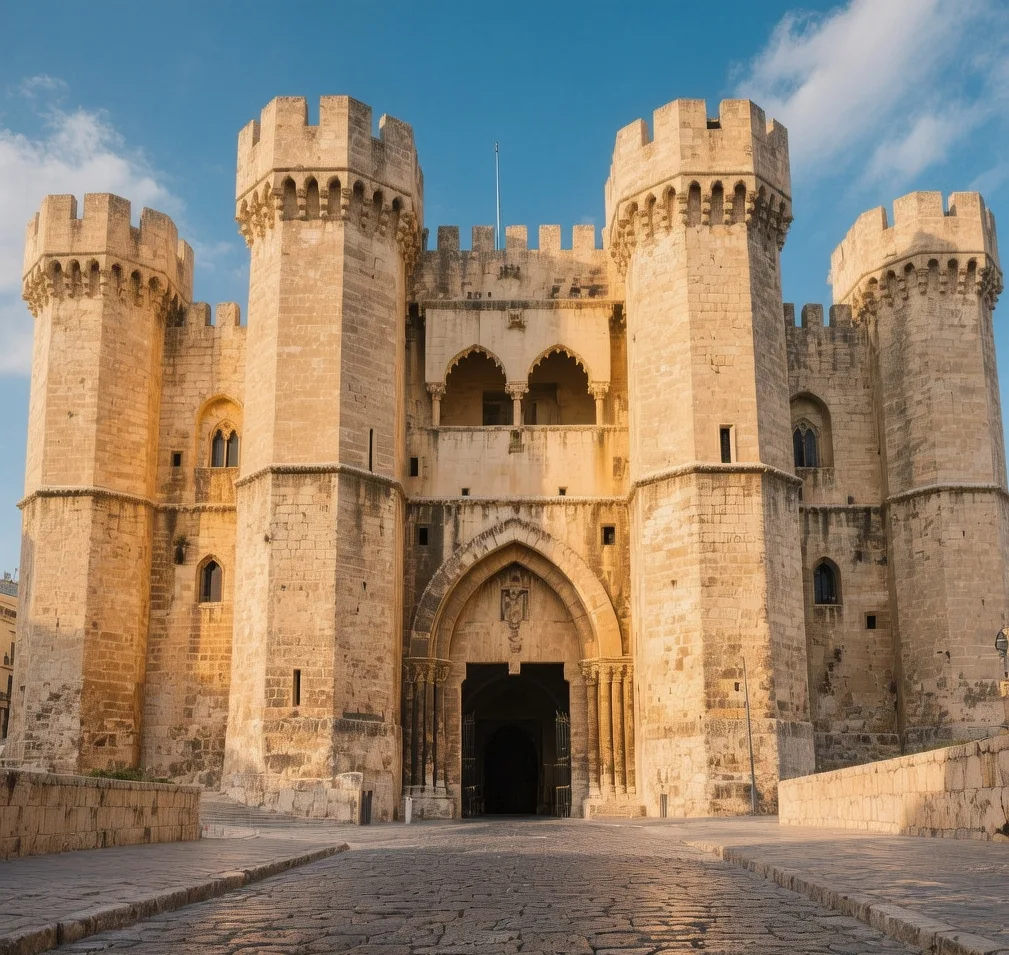
Palace of the Grand Master: Where Gothic Fortification Meets Aegean Sovereignty
Morning light spills across the cobblestones of Ippoton Street—the Avenue of the Knights—casting long shadows beneath arched porticoes. The air carries the scent of sea salt and crushed bougainvillea, mixing with the distant clatter of café chairs being unfolded. At the end of this imposing processional route stands the Palace of the Grand Master, a colossal rectangular mass of golden sandstone that seems to have grown directly from the bedrock of Rhodes. Measuring roughly 80 meters (262 feet) in length and rising to a formidable height, its austere façade is punctuated by slit windows and reinforced corner towers. This is not merely a building; it is a fortress of faith and power, conceived by the Knights Hospitaller to project absolute authority over the eastern Mediterranean. Inside, mosaic floors salvaged from ancient Kos and towering vaulted chambers whisper of banquets, sieges, and sovereign intrigue. It matters because it remains the most complete surviving medieval fortress-palace in the region—a physical testament to the collision between East and West.
Why the Palace of the Grand Master Embodies Medieval Sovereignty
The Knights of the Order of St. John arrived on Rhodes in the early fourteenth century, immediately facing a critical strategic problem: how to defend a remote, wealthy outpost against the relentless Ottoman fleets. The Palace of the Grand Master solved this by functioning as both the administrative nerve center and the ultimate defensive redoubt of the island. Originally constructed atop a ruined Byzantine citadel—likely dating to the seventh century—the structure was systematically rebuilt under the Grand Masters Pierre d'Aubusson and Fabrizio del Carretto in the late fifteenth century. They enveloped the interior in ribbed cross-vaults supported by massive pointed arches, utilizing a core building material of local poros stone sheathed in harder limestone. The engineering is brutally practical: walls exceed 3 meters (10 feet) in thickness at the base, specifically designed to absorb the kinetic impact of early cannon fire. Statistically, the complex housed roughly fifty knights and hundreds of support staff during its peak, managing a maritime empire that stretched across the Dodecanese. It fulfilled a profound psychological need as well. By crowning the highest point of the old city, the palace visually dominated the commercial harbor, signaling to both arriving merchants and approaching enemy galleys that this territory belonged to an unstoppable, divinely sanctioned military machine.
The Best Time to Experience the Palace of the Grand Master
To appreciate the Palace of the Grand Master without the interference of dense crowds, plan your visit between October 12 and November 5. During this window, the ambient temperature sits comfortably between 20°C and 24°C (68°F–75°F), allowing you to explore the sun-baked courtyards without physical strain. Arrive precisely at 8:00–9:30 AM, right as the heavy iron gates open. At this hour, the golden limestone glows under a low, lateral sun, and the echoing vastness of the Great Hall feels genuinely medieval. You should actively avoid July 15 through August 25, when temperatures routinely exceed 35°C (95°F) and cruise ship passengers flood the Old Town, turning the intimate halls into a claustrophobic shuffling line. Spring offers a secondary window from April 18 to May 20, with mild mornings around 18°C (64°F), though occasional light rain can occur. For ticketing, schedules, and conservation updates, always consult the official tourism portal before making your journey: https://palaceofthegrandmaster.com/.
Approximate Budget for a 7-Day Trip
Calculating the cost of a cultural immersion in Rhodes requires looking beyond basic package deals, focusing instead on the price of quality and proximity. Staying inside the medieval walls commands a premium, but it fundamentally alters your experience of the Palace of the Grand Master, allowing you to walk its environs in profound silence after dark.
- • Accommodation: €110–€180 per night (boutique stone guesthouse within the Old Town moat walls)
- • Food: €65 per day (breakfast €8 at a neighborhood bakery, lunch €15 for a souvlaki wrap and local wine, dinner €42 for grilled octopus, pitaroudia chickpea fritters, and a carafe of white wine at a taverna near Mandraki Harbor)
- • Transportation: €42 total (€26 for a round-trip airport shuttle bus; €16 for local urban buses or a day-pass for exploring the wider island)
- • Attractions: €28 individual prices listed (Palace of the Grand Master: €6; Archaeological Museum: €6; Medieval Moat walk: free; Palace interior mosaic exhibition: included in base ticket; Marine Aquarium: €5; Toll for the bus to Lindos: €11)
- • Miscellaneous: €45 (local ceramic plate from an Old Town workshop: €22; two bottles of Rhodian Ambelouria wine: €15; sunscreen and bottled water: €8)
Total: €905–€1,295
6 Essential Palace of the Grand Master Experiences
- Navigating the Avenue of the Knights: Approach the palace via this 200-meter (656-foot) processional street just after 8:00 AM. Run your fingers along the cold, carved escutcheons above the doorways—each marking the lodge of a different tongue of the Order. The acoustics here amplify every footstep, creating a reverent hush.
- Standing in the Great Hall: Enter the double-height reception chamber on the upper floor. Look up to see the massive restored polychrome marble floors and the austere stone vaulting. Stand in the exact center to experience how the space absorbs sound, feeling the sudden chilling drop in temperature that the incredibly thick walls maintain year-round.
- Studying the Hellenistic Mosaics: Located primarily in the ground-floor chambers, these ancient floor depictions of Medusa and marine creatures were excavated from the island of Kos and installed by Italian restorers. Observe the tiny tesserae up close; the blues and greens remain startlingly vivid against the bare stone walls.
- Exploring the Inner Courtyard: Pause in the shadowed, austere square bordered by arcaded walkways. Notice the distinct architectural shift between the original medieval stonework and the smoother, Italian-era repairs. The echoing trickle of a small central fountain provides a meditative auditory backdrop.
- Walking the Elevated Battlements: Exit the palace to traverse the adjacent fortified walls near the Tower of Naillac. Look outward toward the commercial port to understand the precise sightlines the Grand Master had over approaching maritime traffic, sensing the tactical paranoia required to hold an island.
- Viewing the Palace at Night: Return to Ippoton Street after 10:00 PM. The palace is closed, but strategic amber uplighting washes the stone façade in a dramatic, theatrical glow, isolating the massive structure against the inky sky and allowing you to photograph it without a single tourist in the frame.
3 Hidden Gems Most Travelers Miss
- The Byzantine Substructure Vaults: Located directly beneath the palace’s ground floor, these damp, dimly lit barrel-vaulted chambers predate the Knights by centuries. Access is through a low doorway on the northern exterior wall, often gated but occasionally opened by site guards upon polite request (best attempted between 9:00 and 10:00 AM on weekdays). Most walk past because there is no exterior signage, but the exposed ancient stonework reveals the original seventh-century foundations of the acropolis.
- The Cannon Foundry Ruins near the Moat: A 10-minute walk clockwise along the exterior moat from the palace entrance lies an overgrown stretch containing the remnants of an Ottoman-era cannon foundry. Look for a gap in the outer fortification wall. It is overlooked because the moat path is unpaved and lined with thorny brambles. Insider tip: wear closed-toe shoes and visit in late afternoon when the setting sun backlights the surviving brick arches beautifully.
- The Chapel of St. John: Tucked into an interior corner of the palace’s upper courtyard, this small, unadorned stone chapel is frequently bypassed by groups rushing to the Great Hall. It features original medieval altar stonework that was meticulously pieced back together using historical masonry techniques. There is no separate ticket required; you simply step through a heavy wooden door. Arrive before 11:00 AM to have the quiet space entirely to yourself.
Cultural & Practical Tips
- • Dress modestly when exploring the palace and surrounding medieval churches; while there is no strict enforced dress code, covering shoulders and knees is a mark of respect that locals deeply appreciate.
- • Master a few basic Greek phrases: say "Kalimera" (kah-lee-MEH-rah) for good morning, and "Efharisto" (eff-hah-RIS-toh) for thank you—using these consistently softens interactions with Old Town vendors.
- • Photography is permitted inside the palace, but tripods and flash are strictly forbidden; to capture the dark interiors, stabilize your smartphone against a stone wall or pillar and use a long-exposure application.
- • The cobblestones throughout the Old Town—known locally as chochlakia—are incredibly slick, even when dry. Wear shoes with heavily textured rubber soles; sandals with smooth leather bottoms frequently cause dangerous slips on the inclined streets.
- • Be mindful of the meltemi, the strong seasonal northern wind that dominates the Aegean between mid-July and mid-August. It can suddenly gust through the arched avenues, blowing loose items like hats and maps into unreachable moat areas.
- • Carry small coins (€1 and €2) for purchasing bottled water from the venerable street vendors near the palace entrance; they rarely break large bills early in the morning.
- • Support preservation efforts by refraining from touching the exposed mosaics or leaning against the fragile restored frescoes; the oils from human skin accelerate the degradation of the ancient lime mortars.
Conclusion: Travel with Reverence, Not Just Itinerary
The Palace of the Grand Master is far more than a checkbox on a Mediterranean cruise itinerary. To walk its corridors is to trace the fault lines of empires—the clash of Crusader ambition against Ottoman resilience, layered atop a silent Byzantine substrate. When you choose to travel with reverence rather than merely passing through, you become an active participant in the preservation of this narrative. Slow down. Resist the urge to photograph every mosaic and instead sit in the courtyard, feeling the cool stone beneath you, listening to the wind funnel through the battlements. Mindful travel recognizes that ancient walls possess a finite tolerance for the friction of millions of passing footsteps. By engaging deeply—studying the chisel marks on a Gothic arch, acknowledging the immense labor of the medieval masons who carved them—you shift from being a consumer of history to a steward of its survival. Let the sheer weight of the fortress settle into your bones. That is where the true treasure of Rhodes resides.