
Lindos Acropolis: Where Dorian Stone Meets Aegean Infinity
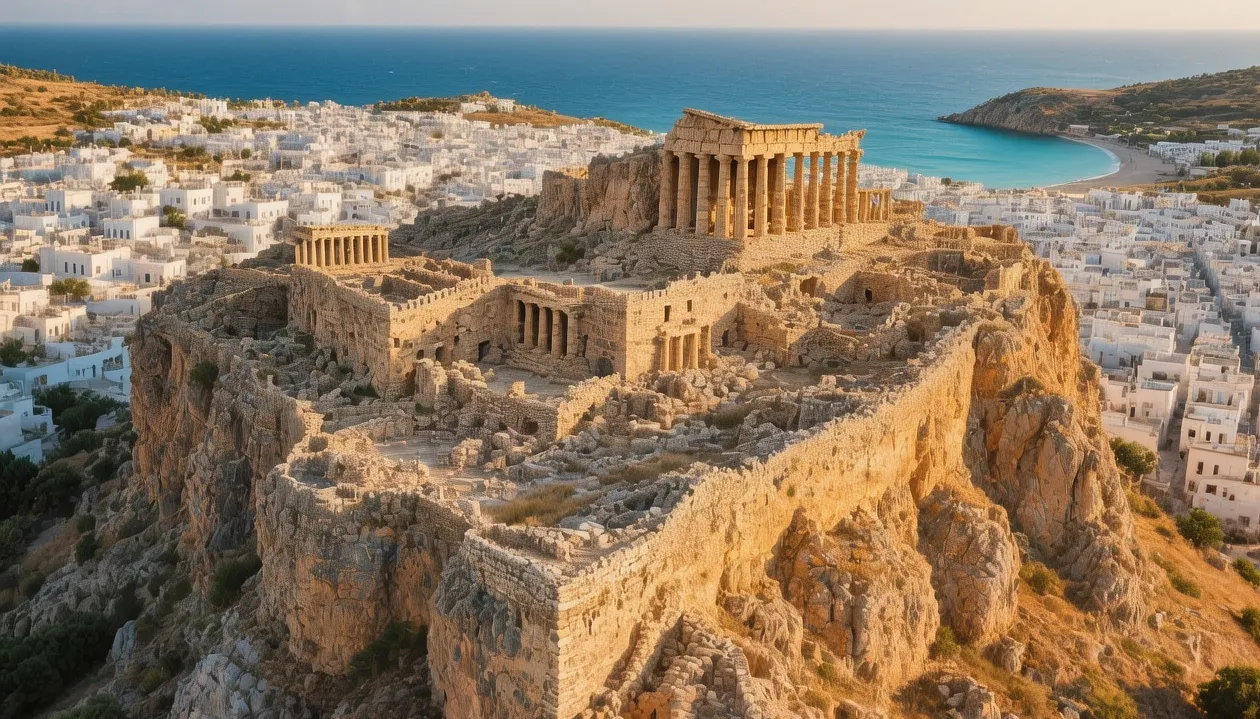
The first rays of dawn bleed coral and gold across the caldera-like bay, striking the 116-meter (380-foot) rocky outcrop with startling precision. The scent of wild thyme, baking in the emerging heat, mingles with the briny air. Below, the labyrinth of whitewashed houses slumbers beneath a tangle of bougainvillea, but up here, atop the Lindos Acropolis, the wind carries only the distant, rhythmic crashing of waves against the sheer cliffs. The air tastes of salt and warm limestone. This is the site where the cult of Athena Lindia flourished for over two millennia—a strategic promontory commanding a 17-mile visual reach across the southeastern Aegean. Propylons, crumbling stoas, and the four remaining columns of the Doric temple stand sentinel against the vast, empty blue. It matters because it is not merely a ruin; it is a visual and spiritual anchor that binds the ancient Dorian world to the relentless present.
Why the Lindos Acropolis Embodies Dorian Resilience
To understand the Lindos Acropolis is to recognize the existential problem it solved for the ancient Greeks. In early antiquity, Dorian settlers required a defensible sanctuary that could withstand both naval sieges and the ravages of time. They chose this sheer clifftop, reinforcing its natural defenses with monumental architecture. The site answered a profound need for spiritual and physical security. During the classical era, the tyrant of Lindos, Cleobulus—one of the Seven Sages of Greece—oversaw ambitious expansions, including the construction of a massive 20-meter-wide (65-foot) staircase carved directly into the living rock. The engineering is staggering: the Temple of Athena Lindia, measuring roughly 20 by 8 meters (65 by 26 feet), was built of local porous limestone, engineered with precise optical corrections to ensure perfect verticality despite the uneven terrain. When the Knights of St. John fortified the site during their occupation of the island, they incorporated the ancient temple into a formidable medieval castle. They utilized mortarless ashlar masonry to build battlements up to 5 meters (16 feet) thick, strategically placing cannon embrasures to cover the primary sea lanes. This architectural palimpsest fulfills a historical narrative of continuous survival, demonstrating how successive empires adapted the same impregnable bedrock to project absolute power across the water.
The Best Time to Experience the Lindos Acropolis
To stand before the Temple of Athena without jostling through a dense wall of tourists requires precise timing. Plan your ascent between April 22 and May 28, or from October 5 to October 25. During these specific windows, the ambient temperatures settle comfortably between 20°C and 24°C (68°F–75°F)—cool enough to manage the steep, 298-step climb without physical distress. Arrive precisely at 8:00–8:45 AM, the exact moment the upper ticket kiosk opens. At this hour, the low-angle sunlight refracts brilliantly off the honey-colored stone, and the acoustic silence is absolute. Avoid the peak summer months entirely. During the deep summer, temperatures routinely surpass 36°C (97°F), and the sun reflects harshly off the white village below, creating an oppressive heat dome. Furthermore, midday tour buses disgorge thousands of visitors into the narrow approach, rendering the sacred precinct chaotic and potentially dangerous on the steep, unfenced stairs. For the most accurate ticketing information and seasonal conservation closures, consult the official archaeological resources through the primary tourism portal: www.rhodes.gr.
Approximate Budget for a 7-Day Trip
Calculating the cost of a cultural immersion in Lindos requires prioritizing proximity over luxury; staying inside the village itself saves money and maximizes your time at the acropolis by completely eliminating the need for daily transit.
- • Accommodation: €80–€130 per night (traditional cave house or stone studio in the upper village alleys)
- • Food: €55 per day (breakfast €6 for a spinach pie and Greek coffee at a corner bakery, lunch €14 for a stuffed tomato and fava puree at a backstreet taverna, dinner €35 for grilled fresh sea bream and local wine at a cliffside terrace)
- • Transportation: €38 total (€24 for a round-trip KTEL public bus from Rhodes Town to the Lindos central station; €14 for local water taxis to St. Paul’s Bay)
- • Attractions: €24 individual prices listed (Lindos Acropolis entry: €12; Archaeological Museum of Rhodes: €6; Medieval Town Moat walk: free; Palace of the Grand Master: €6)
- • Miscellaneous: €40 (handwoven linen tablecloth from a village weaving cooperative: €25; ceramic amphora replica: €10; high-SPF sunscreen and bottled water: €5)
Total: €713–€1,093
6 Essential Lindos Acropolis Experiences
- Ascending the Hellenistic Stairway: Start your climb on the northeastern flank of the rock. Feel the smooth, deeply worn indentations in the limestone steps beneath your boots—a tactile record of countless ancient footsteps. Pause at the mid-point landing to look back at the village cascading down the hill, framed by gnarled olive trees.
- Examining the Relief of the Trireme: Carved directly into the vertical rock face near the main gate, this Hellenistic sculpture depicts a warship cutting through waves. Trace the faint outlines of the oarsmen with your eyes, noting how the porous stone has softened the carving’s edges over centuries of saltwater exposure.
- Standing Beneath the Temple of Athena: Walk to the elevated stylobate supporting the four surviving Doric columns. Look up to see the intricate entablature, running your eyes along the original triglyphs. The shadow play here in the late morning creates stark geometric contrasts against the marble.
- Exploring the Knight’s Commandery: Step into the rectangular vaulted hall built by the Knights Hospitaller. Notice the abrupt architectural shift from classical Greek precision to medieval, bunker-like utilitarianism; the thick walls trap a chilling draft even on the hottest days.
- Viewing St. Paul’s Bay from the Battlements: Walk to the southern edge of the promontory. Look straight down 116 meters (380 feet) to the semicircular cove where the aquamarine water clashes against rust-colored rocks. The visual juxtaposition of the medieval fortification above and the natural harbor below is staggering.
- Photographing the Golden Hour Silhouette: Descend the acropolis at 6:30 PM and walk ten minutes to the main village lookout point. Frame the acropolis rock as a dark silhouette against the sinking, molten-gold sun, capturing the exact moment the floodlights click on against the dusk.
3 Overlooked Wonders Most Travelers Miss
- The Tomb of Cleobulus: Located a 15-minute walk northwest of the village center along the coastal road, this circular, stone-built memorial resembles a miniature temple. It is overlooked because there are no signs directing tourists from the acropolis path, and it requires walking past several modern beach clubs. Insider tip: visit at 7:00 AM when the morning mist sits heavily over the adjacent tidal pools, offering an ethereal photographic backdrop.
- The Acropolis Lower Terraces: Instead of pushing directly to the summit, stop on the expansive, unbarricaded plateau just below the main gate. Most tourists rush past this area to reach the temple. It provides an unobstructed, eye-level view of the Knight’s fortifications without the crowds, and you can clearly see the ancient cuttings in the bedrock where massive bronze gates once swung.
- The Rock-Cut Theater: Carved into the hillside just beneath the main acropolis staircase, this small, horseshoe-shaped seating area is completely unmarked on standard tourist maps. Access requires scrambling over a few low, loose rocks. It is special because it offers absolute acoustic isolation; sit in the center, close your eyes, and listen to the wind funneling through the ancient stone seats.
Cultural & Practical Tips
- • Respect the fragile limestone by strictly staying on the designated pathways; the porous rock crumbles easily underfoot, and unauthorized stepping accelerates the erosion of ancient structures.
- • Learn basic Greek pleasantries: say "Kalispera" (kah-lee-SPEH-rah) for good evening, and "Parakalo" (pah-rah-kah-LOH) for please—you will receive noticeably warmer interactions from village shopkeepers.
- • Do not attempt the climb in flip-flops; the 298 steps are uneven, slick with dust, and completely lack handrails in several steep sections. Sturdy, gripped footwear is a mandatory safety requirement.
- • The site strictly prohibits tripods and selfie sticks; to capture the vast coastal vistas, brace your camera or smartphone firmly against the thick medieval battlements to stabilize your shot.
- • Carry at least 1.5 liters of water per person during the ascent; there is zero shade on the summit, and vendors are only located at the base of the rock.
- • Be acutely aware of the meltemi, the strong seasonal northerly wind. If the wind exceeds force six on the Beaufort scale, acropolis authorities will temporarily close the upper battlements due to dangerous gusts that can knock an adult off balance.
- • Dress modestly when exploring the village lanes leading to the site; while the acropolis is an open-air monument, the surrounding residential areas are deeply traditional, and swimwear is considered disrespectful outside the immediate beach zones.
Conclusion: Travel with Reverence, Not Just Itinerary
The Lindos Acropolis is not a theme park, nor is it merely a photographic backdrop to be captured and moved past. To engage with this precipice is to stand at the exact intersection of human ambition and geological permanence. When you choose to travel with reverence rather than simply ticking off a checklist, you acknowledge the immense weight of history contained within those fractured Doric columns. Slow down. Resist the compulsion to rush to the summit for a fleeting selfie. Instead, sit on the warm, ancient bedrock and let the auditory sweep of the Aegean wind wash over you. Mindful tourism recognizes that every footstep on this porous limestone leaves a microscopic mark. By approaching the site with patience and deep respect, you shift from being a passive consumer of antiquity to an active guardian of its survival. Let the sheer scale of the sanctuary humble you; that is where the true value of visiting the Lindos Acropolis quietly resides.
.