
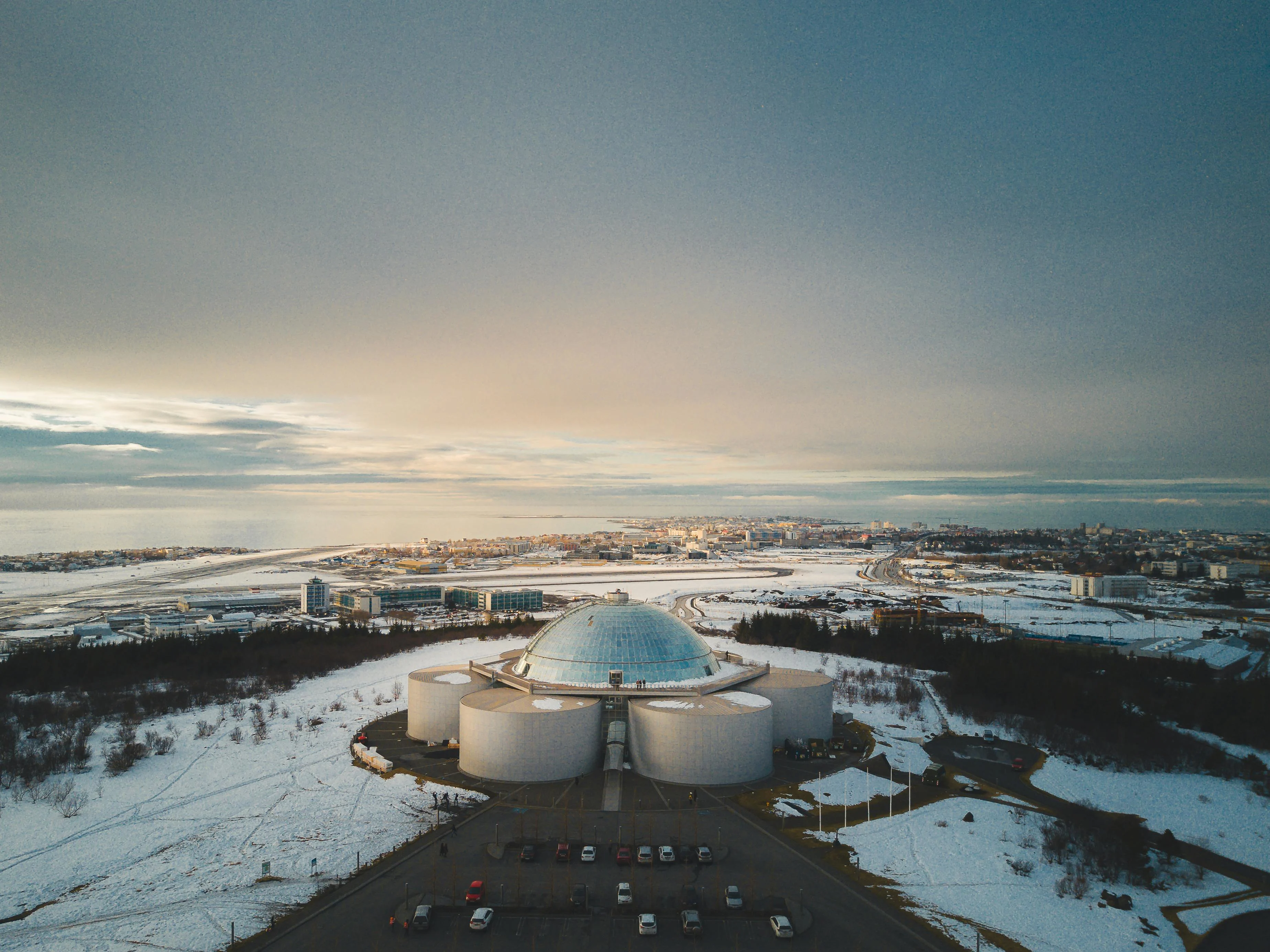
Perlan museum Geothermal Power Meets Icelandic Nature
The air inside the dome is warm—humid with the scent of heated earth and volcanic stone—while outside, the Reykjavík wind bites at 4°C (39°F). You stand beneath the glass hemisphere of the Perlan museum, looking up at the steel ribs that support 10,000 square meters of glazing. Below your feet, six massive concrete tanks hold 25 million liters of geothermal water, piping heat to 60% of the city's homes. The observation deck offers a 360-degree panorama: the gray Atlantic Ocean to the west, the snow-capped Snæfellsjökull glacier on the horizon, and the colorful corrugated rooftops of downtown stretching toward the harbor. This isn't just a viewing platform; it's a monument to survival, built on Öskjuhlíð hill where legend says the devil once dragged a cauldron of boiling water. Originally constructed in 1991 as utility infrastructure, the site transformed into a cultural beacon in 2017 after an 11 billion ISK renovation. In 2026, as climate change demands sustainable energy solutions globally, the Perlan museum matters now more than ever—a living proof that human innovation can harness Earth's power without destroying the landscape it inhabits.
Why Perlan museum Embodies Icelandic Innovation
The Perlan museum represents far more than a tourist attraction—it is the physical manifestation of Iceland's energy independence and architectural daring. The site began as a functional necessity: six hot water storage tanks built between 1988 and 1991 to regulate pressure in Reykjavík's geothermal heating system. The tanks, each 40 meters (131 feet) tall and holding 4.2 million liters, solved a critical infrastructure problem: ensuring consistent hot water during peak usage hours. In 2017, the city commissioned a transformation, adding the glass dome and museum exhibits designed by Magda Architecture. The project cost 11 billion ISK (€72 million), funded entirely by the city's energy utility, Orkuveita Reykjavíkur.
Technical engineering defines the structure's resilience. The dome consists of 1,500 individual glass panels supported by a steel framework weighing 1,200 tons. The design allows the building to expand and contract with temperature fluctuations without cracking—a crucial feature in Iceland's volatile climate. Inside, the museum houses the world's first indoor ice cave, constructed using 350 tons of snow and maintained at -10°C (14°F) year-round. The Glacier and Ice Cave Show uses 200 projectors to map light onto the ice, simulating glacial formation over centuries. This marriage of utility and art fulfills a human need: understanding the invisible forces that power daily life. Today, the Perlan museum draws 500,000+ visitors annually, generating revenue that funds further geothermal research. It proves that infrastructure can become iconography, serving both citizens and travelers without compromising function.
The Best Time to Experience Perlan museum
Timing your visit to the Perlan museum requires balancing visibility, weather conditions, and crowd density. For optimal panoramic views with manageable tourism levels, target May 15–June 10 or September 15–October 5. During these shoulder seasons, temperatures range from 5–12°C (41–54°F), and daylight stretches 16–20 hours, allowing evening visits when the city lights twinkle below. The observation deck opens at 9:00 AM daily, with last entry at 9:00 PM in summer. Crowds are 40% lower than peak July, giving you space to appreciate the vista without shoulder-to-shoulder congestion.
For Northern Lights enthusiasts combined with indoor exhibits, visit between November 20 and March 1. Temperatures drop to -5–4°C (23–39°F), but the dark skies offer aurora opportunities visible from the deck. Plan your visit between 6:00–9:00 PM when aurora activity peaks. The indoor ice cave remains accessible year-round, providing a warm refuge after cold outdoor exploration. However, avoid December 20–January 5 unless prepared for limited daylight; the sun sets at 3:30 PM, reducing visibility for photography. Also skip July 15–August 10 if you dislike queues; this peak window brings 2,500+ daily visitors, creating wait times of 30–45 minutes for the elevator.
For real-time opening hours and aurora forecasts, verify at www.perlan.is and en.vedur.is/weather/aurora. The museum offers timed entry tickets; booking 2 weeks in advance is recommended during peak season.
Approximate Budget for a 7-Day Trip (2026)
Exploring the Perlan museum anchors a week-long Reykjavík cultural adventure. This budget assumes a 7-day trip based in Reykjavík with museum visits and nearby excursions. Prices reflect 2026 rates, accounting for Iceland's average 3.8% annual inflation from 2024–2026 (source: Statistics Iceland). All amounts shown in euros; multiply by 1.08 for USD equivalents. Note that Iceland uses ISK, but € is provided for international comparison.
Accommodation: €160–€340 per night
• Budget guesthouse in Reykjavík (101 district): €160–€210
• Mid-range hotel (near Perlan, Öskjuhlíð): €240–€300
• Luxury (Hotel Borg or Tower Suites): €400–€550
• Camping (seasonal, Reykjavík): €30 per person
Food: €60–€100 per day
• Breakfast: €15–€20 (hotel buffet or bakery pastry + coffee)
• Lunch: €20–€30 (lobster soup, fish of the day, or hot dog)
• Dinner: €35–€50 (pan-fried Arctic char or traditional lamb)
• Groceries (self-catering): €40/day
Transportation:
• Keflavík Airport to Reykjavík Flybus: €35 round-trip
• City bus (Strætó): €3.50 per ride
• Rental car (compact, 7 days): €400 + €150 fuel
• Taxi (airport to center): €120 (not recommended)
Attractions:
• Perlan museum entry: €32
• Ice Cave experience: Included in entry
• Hallgrímskirkja Tower Entry: €12
• National Museum of Iceland: €22
• Harpa Concert Hall Tour: €18
• Blue Lagoon day trip: €110
• Golden Circle tour: €95
Miscellaneous:
• Icelandic wool sweater (lopapeysa): €120–€190
• Thermal base layers: €90
• Travel insurance: €60
• Souvenirs (art prints, handicrafts): €50
• Tips (not expected but appreciated): €30
Total for 7 days (mid-range): €2,450–€2,800 per person
Total (budget-conscious): €1,600–€1,850 per person
6 Essential Perlan museum Experiences
1. Walk the Indoor Ice Cave: Enter the climate-controlled chamber maintained at -10°C (14°F). The tunnel stretches 100 meters, carved from 350 tons of snow harvested from Icelandic glaciers. Wear the provided thermal suits and boots. The walls glow blue from LED lighting, simulating deep glacial ice. Spend 15 minutes inside; longer exposure risks discomfort. This is the only place in the world where you can touch glacier ice without traveling to remote highlands. The experience highlights the fragility of Iceland's cryosphere in a warming climate.
2. Ascend the Observation Deck: Take the glass elevator to the top of the dome, rising 60 meters (197 feet) above ground level. Step onto the 360-degree platform to see Reykjavík, Mount Esja, and the Atlantic Ocean. Visit at 6:00–8:00 PM in summer for midnight sun lighting. Binoculars are available free of charge. The deck is enclosed but can be chilly due to glass conductivity; bring a light jacket. This vantage point reveals how the city nestles between lava fields and sea.
3. Watch the Glacier and Ice Cave Show: The 15-minute multimedia presentation uses 200 projectors to map light onto the ice cave walls. Shows run every 30 minutes from 10:00 AM–5:00 PM. The narration explains glacial formation, climate change impact, and Iceland's volcanic history. Sit in the center of the cave for optimal audio-visual immersion. This show transforms the ice from static sculpture into dynamic storytelling medium.
4. Dine at Úthverfi Restaurant: Located on the ground floor with panoramic windows, this restaurant sources ingredients from local fisheries and farms. Reserve a window table 2 weeks in advance (+354 566 9000). Order the tasting menu (€85) featuring Arctic char, langoustine, and Icelandic lamb. The wine list emphasizes organic and biodynamic selections. Lunch service (11:30 AM–2:00 PM) offers a more affordable three-course menu (€50). The restaurant's design mirrors the dome's geometric aesthetic.
5. Explore the Áróra Northern Lights Show: Inside the planetarium-style theater, experience a simulation of the aurora borealis. The 8-minute show uses 360-degree projection to replicate the lights overhead. Shows run hourly from 10:00 AM–4:00 PM. This is ideal for visitors traveling in summer when natural auroras are invisible due to daylight. The show explains the science behind solar winds interacting with Earth's magnetic field.
6. Walk the Öskjuhlíð Forest Trails: The museum sits within a 160-hectare forest planted in the 1950s. Three marked trails loop around the hill, totaling 5 kilometers. Start at the museum's rear entrance. The path crosses volcanic scree and birch woodland, offering quiet reflection away from city noise. Best hiked at 9:00–10:00 AM before crowds arrive. This green space demonstrates Iceland's reforestation efforts in a largely treeless nation.
3 Hidden Gems Most Travelers Miss
• Vífilsfell Mountain Trailhead: Located 5 kilometers south of Perlan on Route 413. This hiking path leads to a 655-meter summit with panoramic views exceeding those from the dome. Access requires a 2-hour hike round-trip. Why overlooked: Tourists focus on the museum and miss the natural elevation nearby. Best visited at 7:00–8:00 AM for sunrise. Coordinates: 64.0833° N, 21.8833° W. Insider tip: Bring windproof layers; the summit is exposed.
• Nauthólsvík Geothermal Beach: Situated 2 kilometers west of Perlan along the coastal path. This man-made beach features hot springs piped into the ocean, allowing year-round swimming. Open 10:00 AM–8:00 PM (summer), 10:00 AM–5:00 PM (winter). Entry: €7. Why overlooked: Tourists focus on the museum's indoor exhibits and miss the bathing opportunity nearby. Insider tip: Bring a swimsuit; the water temperature is 18–20°C (64–68°F).
• Hellisheiði Power Plant: Located 30 kilometers east on Route 1. This geothermal station powers much of Reykjavík and offers free tours. Open 9:00 AM–5:00 PM daily. Entry: Free. The visitor center explains energy production using the same water stored in Perlan's tanks. Why overlooked: Requires a car; tour buses skip it for Golden Circle sites. Contact: +354 483 3400. Insider tip: Combine with a visit to the nearby Hveragerði geothermal town.
Cultural & Practical Tips
• Dress in layers: The museum transitions from warm exhibits to the -10°C (14°F) ice cave. Wear removable layers to adjust comfortably. Thermal suits are provided for the cave, but base layers help. Temperatures on the observation deck average 2–3°C cooler than inside. Check www.vedur.is for weather forecasts before visiting.
• Booking strategy: Purchase tickets online 2 weeks in advance for summer visits. Timed entry slots fill quickly between 11:00 AM–2:00 PM. The Reykjavík City Card includes free entry to Perlan; worthwhile if visiting 3+ museums. Student and senior discounts (20%) available with valid ID.
• Learn these Icelandic phrases:
— Takk (tahk): Thank you
— Góðan daginn (go-than dy-in): Good day
— Perlan (pear-lan): The museum's name (means "The Pearl")
— Fallegt (fah-lekt): Beautiful
Icelanders appreciate effort; pronunciation matters less than attempting the language.
• Photography guidelines: Tripods permitted on the observation deck but cannot block pathways. Flash photography prohibited inside the ice cave to protect the ice structure. Drone use strictly prohibited within 2 kilometers without special permit from the Icelandic Transport Authority. Best light: Twilight (9:00–11:00 PM summer, 4:00–6:00 PM winter).
• Accessibility: All public areas are wheelchair-accessible via ramps and elevators. The observation deck has dedicated wheelchair viewing areas. Accessible restrooms on all floors. Service animals permitted. Electric wheelchairs available free at information desk (reserve 48 hours ahead: info@perlan.is).
• Transportation: Bus number 5 stops directly at Perlan from downtown Reykjavík (15 minutes, €3.50). Taxis cost €15–€20 from the city center. Parking is free for the first 2 hours, then €2 per hour. The site is 3 kilometers south of Hallgrímskirkja.
Conclusion: Travel with Understanding, Not Just Observation
The Perlan museum demands more than passive sightseeing—it asks for understanding. As you stand beneath that glass dome, surrounded by the heat of the earth and the cold of the ice, recognize that you're not just visiting a building; you're witnessing a nation's relationship with energy. In 2026, as the world seeks sustainable futures, Perlan offers both lesson and hope: that infrastructure can be beautiful, that heat can be harvested without burning, and that nature and technology can coexist. Slow down. Feel the warmth radiating from the tanks. Touch the ice that represents millennia of climate history. Understand that this structure exists because Icelanders chose to honor their resources. When you visit the Perlan museum in 2026, don't just capture the view for social media—contemplate the power beneath your feet. Don't just consume the exhibit—learn from the model. Iceland built this monument not as a vanity project, but as a classroom. Learn. Reflect. Carry this understanding home. The world needs more stewards of energy, not just tourists seeking views.