
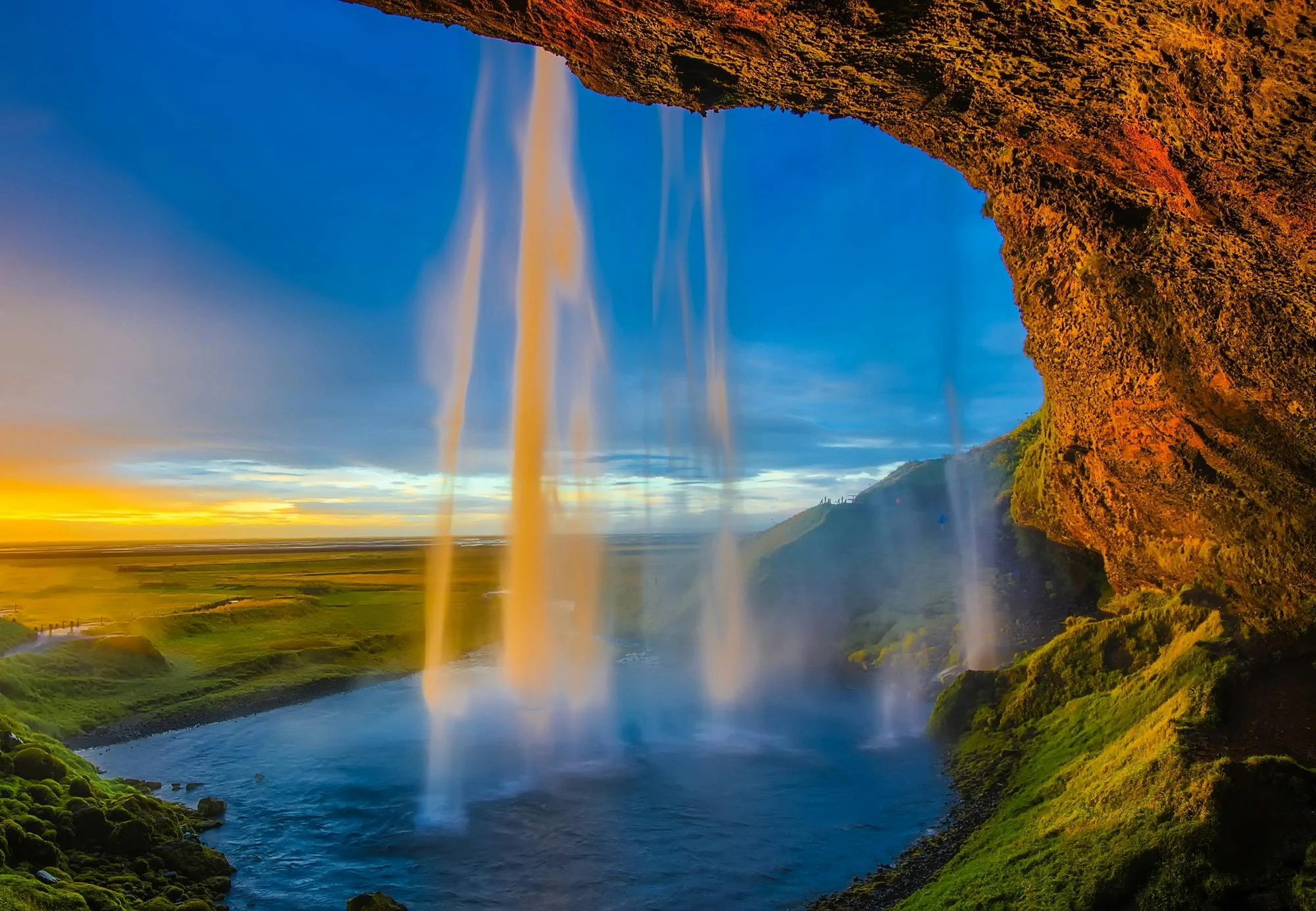
Seljalandsfoss Waterfall Cascading Water Meets Icelandic Wilderness
The roar hits you before the sight—a thunderous cascade that vibrates through your chest as you park along Route 1. You step onto the gravel path, and there it is: Seljalandsfoss waterfall, plunging 60 meters (197 feet) from the Seljalands River into a turquoise pool below. Mist rises in perpetual columns, catching the afternoon sun in prisms of rainbow light that dance across the black volcanic rock. But this isn't just another waterfall; it's one of the few places on Earth where you can walk behind the curtain of water, feeling the spray soak your clothes while viewing the falls from within. The path, carved into the cliff face over centuries, leads you through a natural grotto where the water thunders overhead, creating a sensory experience that has mesmerized visitors since the first travelers documented it in the 1800s. In 2026, as overtourism threatens Iceland's fragile ecosystems, Seljalandsfoss waterfall matters now more than ever—a testament to the delicate balance between accessibility and preservation, where 1.5 million annual visitors must learn to respect the power of glacial water carving through volcanic stone.
Why Seljalandsfoss Waterfall Embodies Icelandic Power
The Seljalandsfoss waterfall represents far more than a scenic stop—it is a living demonstration of Iceland's geological forces and the human relationship with raw natural power. Formed by glacial meltwater from the Eyjafjallajökull volcano, the waterfall cascades from a height of 60 meters (197 feet), fed by the Seljalands River that drains the highland plateau. The unique walk-behind feature exists because centuries of erosion carved a recessed grotto into the soft tuff rock, creating a natural amphitheater that allows visitors to experience the falls from multiple perspectives. This geological phenomenon solves a fundamental human need: the desire to witness nature's power up close while remaining safe.
Technical specifications reveal the waterfall's impressive scale: the river drops 60 meters vertically, creating a flow rate that averages 100–150 cubic meters per second in summer and 30–50 cubic meters in winter. The pool below measures approximately 20 meters across and maintains a depth of 3–5 meters. The walk-behind path extends 30 meters along the cliff face, with the narrowest point just 2 meters from the falling water. The basalt and tuff rock formations surrounding the falls date back 10,000 years to the last Ice Age, when glacial retreat exposed the cliff face.
Historically, the waterfall gained prominence in the late 19th century when Icelandic photographer Sigfús Eymundsson captured early images that drew international attention. By the 1950s, as Route 1 (the Ring Road) was completed, Seljalandsfoss became accessible to motorized tourism. Today, the site draws 1.5 million visitors annually, making it one of Iceland's most photographed landmarks. The waterfall fulfills a critical cultural need: providing Icelanders and visitors alike with a tangible connection to the elemental forces that shaped the island. This marriage of accessibility and wildness makes Seljalandsfoss waterfall not just a destination, but a symbol of Iceland's ongoing negotiation between preservation and exploration.
The Best Time to Experience Seljalandsfoss Waterfall
Timing your visit to Seljalandsfoss waterfall requires balancing weather conditions, crowd density, and photographic opportunities. For optimal conditions combining dramatic flow with manageable tourism, target May 20–June 15 or September 10–October 5. During these shoulder seasons, air temperatures range from 6–12°C (43–54°F), and the waterfall flows at maximum capacity from spring meltwater or autumn rains. Daylight stretches 18–20 hours in June, allowing evening visits when the low-angle sun creates golden illumination on the mist. Crowds are 40% lower than peak summer, giving you space to walk the behind-the-falls path without shoulder-to-shoulder congestion.
For winter photographers seeking ice formations, visit between November 20 and March 1. Temperatures drop to -5–4°C (23–39°F), and the spray freezes on the cliff face, creating spectacular ice curtains that frame the waterfall. The path behind the falls remains accessible but requires crampons or ice cleats due to slippery conditions. Plan your visit between 11:00 AM–2:00 PM for maximum daylight and safety. However, avoid December 20–January 5 unless prepared for extreme weather; storms can close Route 1 temporarily, and daylight shrinks to four hours.
Avoid July 1–August 15 if you dislike crowds. This peak window brings 4,000–6,000 daily visitors, creating bottlenecks at the parking lot and the walk-behind path between 11:00 AM–4:00 PM when tour buses converge. The path becomes dangerously slippery from constant foot traffic and spray. For real-time road conditions and weather, verify at www.road.is and www.vedur.is. The parking fee is €8 (ISK 1,000), collected via automated machines.
Approximate Budget for a 7-Day Trip (2026)
Exploring Seljalandsfoss waterfall anchors a week-long South Coast adventure. This budget assumes a 7-day trip based in Reykjavík with day trips along the Ring Road. Prices reflect 2026 rates, accounting for Iceland's average 3.8% annual inflation from 2024–2026 (source: Statistics Iceland). All amounts shown in euros; multiply by 1.08 for USD equivalents. Note that Iceland uses ISK, but € is provided for international comparison.
Accommodation: €150–€320 per night
• Budget guesthouse in Reykjavík (101 district): €150–€200
• Mid-range hotel (Selfoss area): €220–€280
• Luxury (Hotel Ranga or similar): €380–€550
• Camping (seasonal): €25 per person
Food: €55–€95 per day
• Breakfast: €12–€18 (hotel buffet or bakery pastry + coffee)
• Lunch: €18–€28 (Icelandic lamb soup, fish of the day, or hot dog)
• Dinner: €25–€49 (pan-fried Arctic char or traditional lamb)
• Groceries (self-catering): €35/day
Transportation:
• Keflavík Airport to Reykjavík Flybus: €32 round-trip
• Rental car (compact SUV, 7 days): €380 + €140 fuel
• South Coast day tour: €95
• Reykjavík city bus (Strætó): €3.20 per ride
• Seljalandsfoss parking: €8
Attractions:
• Seljalandsfoss waterfall: Free (parking €8)
• Skógafoss waterfall: Free
• Reynisfjara black sand beach: Free
• Sólheimajökull glacier tour: €85
• Perlan Museum: €30
• Blue Lagoon day trip: €110
• Golden Circle tour: €95
Miscellaneous:
• Icelandic wool sweater (lopapeysa): €110–€180
• Waterproof jacket: €120
• Travel insurance: €55
• Souvenirs (lava rock, handicrafts): €40
• Tips (not expected but appreciated): €25
Total for 7 days (mid-range): €2,180–€2,520 per person
Total (budget-conscious): €1,450–€1,680 per person
6 Essential Seljalandsfoss Waterfall Experiences
1. Walk Behind the Waterfall: Follow the marked path to the right of the falls (when facing the cascade). The trail ascends gradually, then descends into the grotto behind the water. Wear waterproof clothing—the spray will soak you completely within minutes. The path is 30 meters long and takes 10–15 minutes to complete. Visit at 2:00–4:00 PM when sunlight creates rainbows in the mist. The experience is most dramatic in summer when flow is highest, but winter offers ice formations. Keep your camera protected in a waterproof bag.
2. Photograph the Rainbow Mist: Position yourself at the viewing platform directly in front of the falls. The best light occurs between 10:00 AM–12:00 PM in summer when the sun illuminates the spray from the east. Use a polarizing filter to enhance the rainbow colors and reduce glare from the water. Shutter speeds of 1/60s or slower create silky water effects. Bring a tripod, but be prepared for vibration from the falling water. The most dramatic shots capture both the falls and the walk-behind path with tiny human figures for scale.
3. Hike to Gljúfrabúi Waterfall: Located 700 meters north of Seljalandsfoss, this hidden waterfall flows into a narrow canyon. The hike takes 15 minutes each way along a marked trail. Gljúfrabúi drops 40 meters (131 feet) into a gorge so narrow you must wade through ankle-deep water to enter. The experience is intimate and less crowded than Seljalandsfoss. Visit at 9:00–10:00 AM before tour buses arrive. Bring waterproof boots and a flashlight for the dim interior. This waterfall complements the main attraction perfectly.
4. Explore the Seljalands River Valley: Follow the river upstream for 2 kilometers along an unmarked but visible path. The valley features smaller cascades, moss-covered lava fields, and views of Eyjafjallajökull volcano. The hike takes 90 minutes round-trip and offers solitude away from the crowds. Best attempted at 7:00–8:00 AM when the light is soft and the path is empty. Bring a map and inform someone of your plans. This experience reveals the geological context of the main waterfall.
5. Visit at Sunset for Golden Hour: Return to Seljalandsfoss between 8:00–10:00 PM in summer (earlier in winter) when the low sun casts golden light on the falling water. The crowds thin dramatically after 6:00 PM as tour buses depart. The warm light creates a completely different atmosphere than midday visits. Stay until the blue hour (30 minutes after sunset) when the falls glow against the darkening sky. This is the most peaceful time to experience the site.
6. Combine with South Coast Waterfalls: Create a waterfall circuit by visiting Skógafoss (30 km east), Kvernufoss (25 km east), and Seljalandsfoss in one day. Each offers unique characteristics: Skógafoss is twice as wide, Kvernufoss has a similar walk-behind feature but fewer crowds. The circuit takes 6–8 hours with driving time. Start at Seljalandsfoss at 9:00 AM, then work eastward. This comprehensive approach reveals the diversity of Iceland's cascading waters.
3 Hidden Gems Most Travelers Miss
• Gljúfrabúi Waterfall: Located 700 meters north of Seljalandsfoss, this 40-meter waterfall flows into a narrow canyon that requires wading to enter. The gorge is so tight you stand just meters from the falling water in an intimate grotto. Access is free; the trail is marked but easy to miss. Best visited at 9:00–10:00 AM before crowds arrive. Why overlooked: Tour buses skip it; most visitors don't know it exists. Bring waterproof boots and a flashlight. The experience is magical and far less commercialized than the main falls.
• Seljalandsá River Hot Spring: Located 3 kilometers upstream from the waterfall, this natural hot spring emerges where the river meets a lava field. The water temperature is 38–42°C (100–108°F), perfect for soaking. Access requires a 45-minute hike along the riverbank. Why overlooked: No signage; requires local knowledge. Coordinates: 63.6200° N, 19.9800° W. Best visited at 7:00–8:00 PM for privacy. Insider tip: Bring a towel and swimsuit; this is a locals' secret.
• Hamragarðar Beach Cliffs: Located 5 kilometers east on Route 1, these dramatic sea cliffs offer views of Seljalandsfoss from the ocean side. The 80-meter cliffs feature sea stacks and bird colonies. Access is via an unmarked pull-off; park carefully and walk 10 minutes to the edge. Why overlooked: No facilities or signage; requires independent exploration. Best visited at 6:00–7:00 PM for sunset photography. Insider tip: Watch for puffins (May–August) nesting in the cliffs.
Cultural & Practical Tips
• Waterproof everything: The spray from Seljalandsfoss soaks clothing within minutes when walking behind the falls. Bring a waterproof jacket with hood, waterproof pants, and protective covers for cameras/phones. Cotton clothing becomes heavy and cold when wet—wear synthetic or wool base layers. Even in summer, temperatures behind the falls feel 5–8°C cooler.
• Footwear is critical: The path behind the waterfall is slippery year-round from constant spray. Wear sturdy hiking boots with good traction. In winter (November–March), bring crampons or ice cleats; the path freezes and becomes dangerously slick. The gravel parking lot to trailhead path is uneven; avoid sandals or flip-flops.
• Learn these Icelandic phrases:
— Takk (tahk): Thank you
— Góðan daginn (go-than dy-in): Good day
— Seljalandsfoss (sel-yar-lands-foss): The waterfall's name
— Fallegt (fah-lekt): Beautiful
Icelanders appreciate effort; pronunciation matters less than attempting the language.
• Photography guidelines: Tripods permitted but cannot block the narrow walk-behind path. Drones require special permit from the Icelandic Transport Authority (apply 4 weeks ahead at loftleidings.is). Best light: Morning (10:00 AM–12:00 PM) for rainbows; evening (8:00–10:00 PM) for golden hour. Respect other visitors; don't monopolize the path for extended photo sessions.
• Safety near water: The pool below the falls is deeper than it appears and has strong currents. Swimming is prohibited and dangerous. The rocks are slippery; never climb on the cliff face. Stay on marked paths; erosion has created unstable edges. Keep children close and supervised at all times.
• Parking and facilities: The parking lot costs €8 (ISK 1,000), collected via automated machines (credit cards accepted). Restrooms are available for €1.50. The facility is open 24/7, but visiting between 10:00 PM–6:00 AM is discouraged due to limited visibility and safety concerns. No food services onsite; bring water and snacks.
Conclusion: Travel with Reverence, Not Just Photography
The Seljalandsfoss waterfall demands more than a quick photo stop—it asks for reverence. As you stand behind that curtain of glacial water, feeling the spray soak your clothes and hearing the thunder overhead, recognize that you're not just visiting a landmark; you're witnessing 10,000 years of geological history. In 2026, as Iceland struggles to balance tourism with preservation, Seljalandsfoss offers both wonder and warning: that natural beauty is finite, that access requires responsibility, and that future generations deserve to experience what we inherited. Slow down. Listen to the roar that carved this grotto. Feel the mist that carries particles from Eyjafjallajökull's glaciers. Understand that this waterfall shaped a landscape and continues to reshape it daily. When you visit Seljalandsfoss waterfall in 2026, don't just capture the rainbow for Instagram—contemplate the power that created it. Don't just check a box—honor the fragility of this ecosystem. Iceland preserves this site not as a theme park, but as a classroom. Learn. Reflect. Carry this reverence home. The world needs more guardians of natural wonder, not just consumers of scenery.