
Red Beach: Where Volcanic Fire Meets Aegean Turquoise
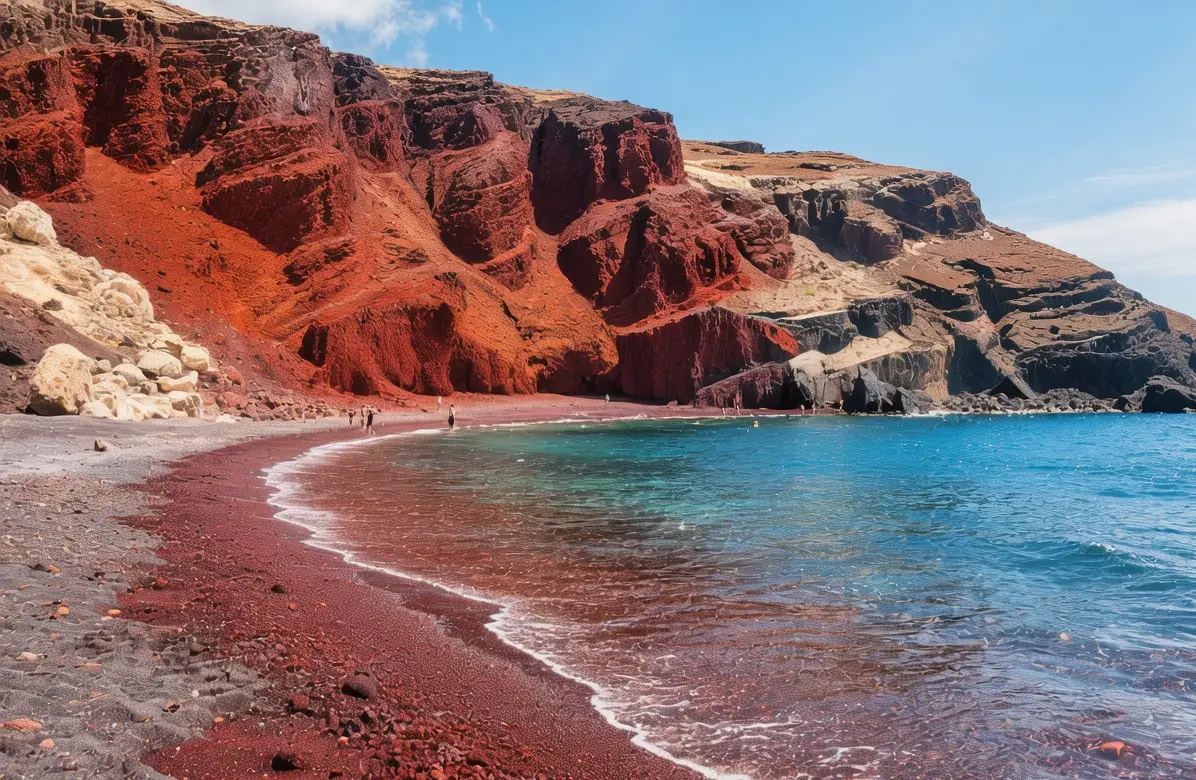
The morning sun ignites the crimson cliffs of Red Beach as you descend the narrow coastal path, where the air carries the sharp scent of volcanic minerals mingled with sea salt and wild thyme. Before you, the beach unfolds in dramatic contrast: a crescent of black and red pebbles stretching approximately 300 meters along the caldera's edge, framed by towering cliffs of iron-rich scoria that rise 60 meters above the turquoise Aegean. The only sounds are the rhythmic crash of waves against volcanic rock, the soft clatter of pebbles shifting with each retreating tide, and the distant cry of seabirds circling the thermal updrafts. This extraordinary shoreline—formed by the cataclysmic Minoan eruption around 1600 BCE—reveals geology in motion: layers of red lava, black obsidian, and pale pumice exposed like pages in Earth's most dramatic manuscript. Standing on this mineral-strewn shore, you understand: Red Beach matters because it offers a rare encounter with the raw forces that shaped not just Santorini, but our planet itself—a place where fire, water, and time collaborate to create a landscape that defies ordinary description and awakens profound wonder.
Why Red Beach Embodies Volcanic Drama
Red Beach represents one of the Mediterranean's most striking examples of volcanic geology made accessible—a shoreline that solves the fundamental human need to witness Earth's creative power while providing a tangible connection to planetary history. Formed during the Minoan eruption approximately 1600 BCE—one of the largest volcanic events in recorded history—the beach's distinctive crimson cliffs consist primarily of iron-rich scoria and lava flows that oxidize to brilliant red when exposed to air and seawater. The geological composition includes alternating layers of red volcanic tuff, black basalt, and pale pumice, creating a stratified canvas that reveals the eruption's complex sequence: initial explosive phases deposited ash and pumice, followed by lava flows that cooled into the dramatic cliffs visible today.
The beach's visual impact stems from precise mineralogical alignment: the iron oxide content in the volcanic rock—reaching concentrations of 15–20% in some layers—creates the intense red hue that contrasts dramatically with the deep blue Aegean and the black pebbles formed from rapidly cooled lava. The cliff face, measuring approximately 60 meters in height and extending 400 meters along the shoreline, displays clear stratification that geologists use to reconstruct eruption dynamics. This natural laboratory solves the challenge of making complex geological processes visible and comprehensible to non-specialists: every color shift, every textural change tells a story of fire, pressure, and time.
Today, Red Beach fulfills multiple roles: it serves as an outdoor classroom for earth science education, a photographic landmark that draws travelers worldwide, and a contemplative space where visitors confront the sublime power of natural forces. The ongoing monitoring by the Institute of Geodynamics in Athens—tracking seismic activity and rockfall risks—ensures visitor safety while preserving access to this geological treasure. Every glance at the crimson cliffs connects you to a landscape shaped by cataclysm and renewal, where the same forces that destroyed ancient settlements continue to create beauty—a reminder that destruction and creation are intertwined in Earth's eternal cycle.
The Best Time to Experience Red Beach
Timing transforms a visit to Red Beach from scenic stop to immersive geological encounter. The optimal windows stretch from May 18–June 12 and September 15–October 20, when temperatures hover between 18–25°C (64–77°F), atmospheric clarity allows the red cliffs to glow with maximum intensity, and visitor numbers remain manageable enough for unhurried exploration of the shoreline. During these shoulder seasons, you'll experience comfortable conditions for walking the pebble beach while capturing photographs in the directional light that reveals the volcanic strata's layered beauty.
Arrive precisely at 8:00–9:30 AM when the site opens—this golden hour delivers cooler temperatures, minimal crowds, and the most dramatic shadows cast by the crimson cliffs. Red Beach operates as a public space with no formal gates, but access via the coastal path from Akrotiri is safest during daylight hours. The nearby parking area fills by 10:00 AM during peak season; arriving early secures convenient parking and peaceful beach time. Winter months (November–February) offer minimal crowds and moody, storm-washed skies that create atmospheric photography conditions, though temperatures drop to 10–14°C (50–57°F) with increased rainfall that can make the volcanic rock extremely slippery.
Avoid July 15–August 31 unless absolutely necessary: temperatures regularly exceed 28°C (82°F), the exposed beach offers minimal shade, and cruise ship excursions create midday crowds that diminish the site's contemplative atmosphere. Also skip periods of high wind or seismic activity when the site may close temporarily for safety due to rockfall risk. For the most current information on access conditions, weather alerts, and safety updates, always check the official Greek tourism portal at https://www.santorini-view.com before your visit.
Approximate Budget for a 7-Day Trip
Santorini offers exceptional value for travelers seeking iconic Mediterranean beauty, though costs vary significantly between caldera-view accommodations and inland options. The following breakdown reflects mid-range travel—comfortable boutique accommodations, authentic taverna dining mixed with occasional upscale meals, and comprehensive island exploration—based on current pricing for a single traveler experiencing Red Beach and greater Santorini.
- Accommodation: €100–€250 per night in Akrotiri, Perissa, or Fira (€700–€1,750 total). Budget studios start at €50; luxury cave suites with caldera views run €400+.
- Food: €45–€70 per day total. Breakfast: €6–€10 (Greek coffee €3.50, bougatsa pastry €3, fresh fruit €3.50). Lunch: €12–€20 (Greek salad €9, grilled octopus €16, moussaka €13). Dinner: €20–€40 (seafood platter €30, lamb kleftiko €20, Assyrtiko wine €7/glass, dessert €7).
- Transportation: €110 total. Ferry from Athens: €45–€75 one-way (€90–€150 round-trip). Local bus day pass: €9. ATV rental: €25/day. Taxi to Red Beach from Fira: €15–€25 each way.
- Attractions: €85 total. Ancient Akrotiri entry: €12. Red Beach access: free. Caldera boat tour: €35. Wine tasting tour: €45. Lighthouse of Akrotiri visit: free.
- Miscellaneous: €120 total. Water/snacks €5/day, volcanic stone souvenirs €25–€60, local saffron €15, sunscreen €10, tips €25.
Total: €1,550–€2,350 for 7 days (excluding international airfare and Athens-Santorini ferry)
7 Essential Red Beach Experiences
- Photograph the crimson cliffs at sunrise: Arrive at 7:30 AM when the first light illuminates the iron-rich scoria from the east. Position yourself at the beach's southern end where the cliffs curve inward, creating a natural frame for the turquoise sea. Use a polarizing filter to enhance the red hues and reduce water glare. The best light occurs 30 minutes after sunrise when shadows accentuate the rock's layered texture.
- Explore the geological stratification up close: Walk along the cliff base (maintaining a safe 5-meter distance due to rockfall risk) and examine the distinct layers: red oxidized lava, black basalt flows, and pale pumice deposits. Each band tells a chapter of the Minoan eruption story. Bring a small geology guide or download an earth science app to identify mineral compositions. Visit between 9:00–10:00 AM when morning light reveals color variations most clearly.
- Swim in the mineral-rich waters: Enter the Aegean at the beach's center where the pebbles transition to smoother stones. The water temperature ranges from 19°C (66°F) in spring to 24°C (75°F) in summer. The high mineral content creates exceptional clarity—visibility often exceeds 15 meters. Swim early morning to avoid afternoon crowds; always check conditions with local authorities as currents can strengthen unexpectedly.
- Hike the coastal path from Akrotiri: Begin at the archaeological site of Akrotiri and follow the marked coastal trail (approximately 800 meters) to Red Beach. The path descends 40 meters in elevation via stone steps carved into volcanic rock. Morning light illuminates the trail's wild thyme and caper plants. Allow 20 minutes each way; wear sturdy shoes with grip for the uneven, occasionally slippery surface.
- Combine with Ancient Akrotiri: Visit the remarkably preserved Bronze Age settlement (entry €12) before descending to Red Beach. The archaeological site, buried by volcanic ash around 1600 BCE, provides essential context for understanding the eruption that created the beach. Allow 90 minutes for the site; the English-language audio guide (€4) illuminates daily life in pre-eruption Santorini.
- Watch sunset from the clifftop viewpoint: Ascend to the elevated terrace above Red Beach at 6:30 PM for panoramic views as the sun sets over the caldera. The crimson cliffs glow amber in the low light, creating a spectacular contrast with the darkening sea. Bring a light layer—winds increase significantly at elevation after sunset. This viewpoint offers photography opportunities impossible from beach level.
- Snorkel the volcanic underwater landscape: Rent snorkel gear (€10/day) from vendors near the beach entrance and explore the submerged volcanic formations. The clear water reveals black lava rocks, red mineral deposits, and marine life adapted to the unique environment. Swim parallel to shore (never beyond the marked buoy line) and avoid touching fragile underwater formations.
3 Hidden Gems Most Travelers Miss
- The White Beach access trail: Just 300 meters south of Red Beach, a narrow coastal path leads to White Beach—a secluded cove with pale pumice cliffs and crystal-clear water accessible only by foot or boat. The 10-minute hike rewards you with privacy and exceptional snorkeling among submerged volcanic formations. Access: From Red Beach's southern end, follow the unmarked coastal path; wear water shoes for the rocky approach. Best visited at 4:00–6:00 PM when afternoon light illuminates the white cliffs. Bring your own water and snacks—no facilities exist at White Beach.
- The Lighthouse of Akrotiri viewpoint: At Santorini's southwestern tip, the 1892 lighthouse stands on a volcanic promontory offering panoramic views of Red Beach from above. The elevated perspective reveals the beach's full crescent shape and the dramatic contrast between red cliffs and blue sea. Access: Drive or take the bus to Akrotiri village; follow signs to "Faros" (lighthouse). Open 24 hours; no admission fee. Best visited at 6:00–7:30 PM when the lighthouse silhouette frames the setting sun. Combine with a visit to Red Beach for complementary perspectives.
- The Volcanic Rock Collection at Akrotiri Museum: Near the archaeological site entrance, a small outdoor display features labeled samples of Santorini's volcanic rocks—including specimens identical to those at Red Beach. The collection explains mineral formation processes and eruption sequences in accessible terms. Access: Free with Akrotiri site admission; located 50 meters from the main entrance. Visit between 10:00 AM–12:00 PM when natural light illuminates the rock samples most clearly. Allow 15 minutes to appreciate how geology and archaeology intersect at this unique location.
Cultural & Practical Tips
- Safety first: Red Beach's cliffs are unstable—rockfalls occur without warning. Maintain a 5-meter distance from the cliff base at all times. Heed all warning signs and closure notices; the site may close temporarily during high winds or seismic activity. Never climb the cliffs or attempt to collect rocks—both actions accelerate erosion and violate Greek heritage protection laws.
- Footwear essentials: The beach consists of sharp volcanic pebbles that can cut bare feet. Wear water shoes or sturdy sandals with thick soles. The access path features uneven stone steps that become slippery when wet; avoid visiting immediately after rainfall.
- Hydration and sun protection: The beach offers minimal shade; carry at least 2 liters of water per person and apply broad-spectrum sunscreen (SPF 50+) every two hours. The volcanic rock reflects sunlight, increasing UV exposure. A wide-brimmed hat and UV-protective clothing provide additional defense.
- Local phrases: Kalimera (kah-lee-MEH-rah) = Good morning; Efharisto (ef-hah-REE-stoh) = Thank you; Parakalo (pah-rah-kah-LOH) = Please/You're welcome; Signomi (see-GNO-mee) = Excuse me. Using these greetings earns warm smiles from Santorini's hospitality-focused residents.
- Photography guidelines: Personal photography is permitted throughout Red Beach. Tripods are allowed but use caution on uneven pebbles. The best light for cliff photography occurs during the first and last hours of daylight. Avoid shooting directly into the sun to prevent lens flare on the water.
- Environmental respect: Red Beach's beauty depends on preservation. Carry out all trash—there are no bins on the beach itself. Do not remove rocks, shells, or minerals; Greek law protects geological specimens. Support local businesses in Akrotiri rather than international chains.
- Accessibility considerations: The coastal path to Red Beach is not suitable for wheelchairs or strollers due to steep, uneven steps. The beach itself has no accessibility infrastructure. Visitors with mobility challenges may view the cliffs from the elevated lighthouse viewpoint or book a caldera boat tour that passes Red Beach from the water.
Conclusion: Travel with Wonder, Not Just Checklists
Red Beach demands more than a hurried photograph and a quick checkmark—it asks for your curiosity, your respect, your willingness to stand on volcanic stone and contemplate the forces that shaped this extraordinary place. When you trace the layered cliffs with your eyes or feel the mineral-rich water against your skin, you participate in a dialogue with deep time: the ongoing story of Earth's creative power. This is not passive tourism; it is active engagement with geology, history, and the sublime beauty of natural processes.
Responsible travel here means understanding that Red Beach is fragile: every removed rock accelerates erosion, every footprint on unstable slopes increases rockfall risk, every discarded item mars the pristine landscape. Walk gently. Speak softly. Take only images; leave only gratitude. Support conservation by respecting closure notices and choosing eco-conscious operators for boat tours.
This is not a backdrop to be consumed but a testament to be experienced—a place where fire and water collaborate to create something transcendent. Slow down. Sit on a sun-warmed stone. Watch light change across crimson cliffs. Let Red Beach reveal its story gradually, as volcanic layers reveal their history to patient observers. The beach will still be here tomorrow, but your opportunity to encounter it with wonder and respect exists only in this moment. Choose presence over haste, understanding over completion, and carry not just photographs but a deeper appreciation for the enduring power of Earth's creative forces.