
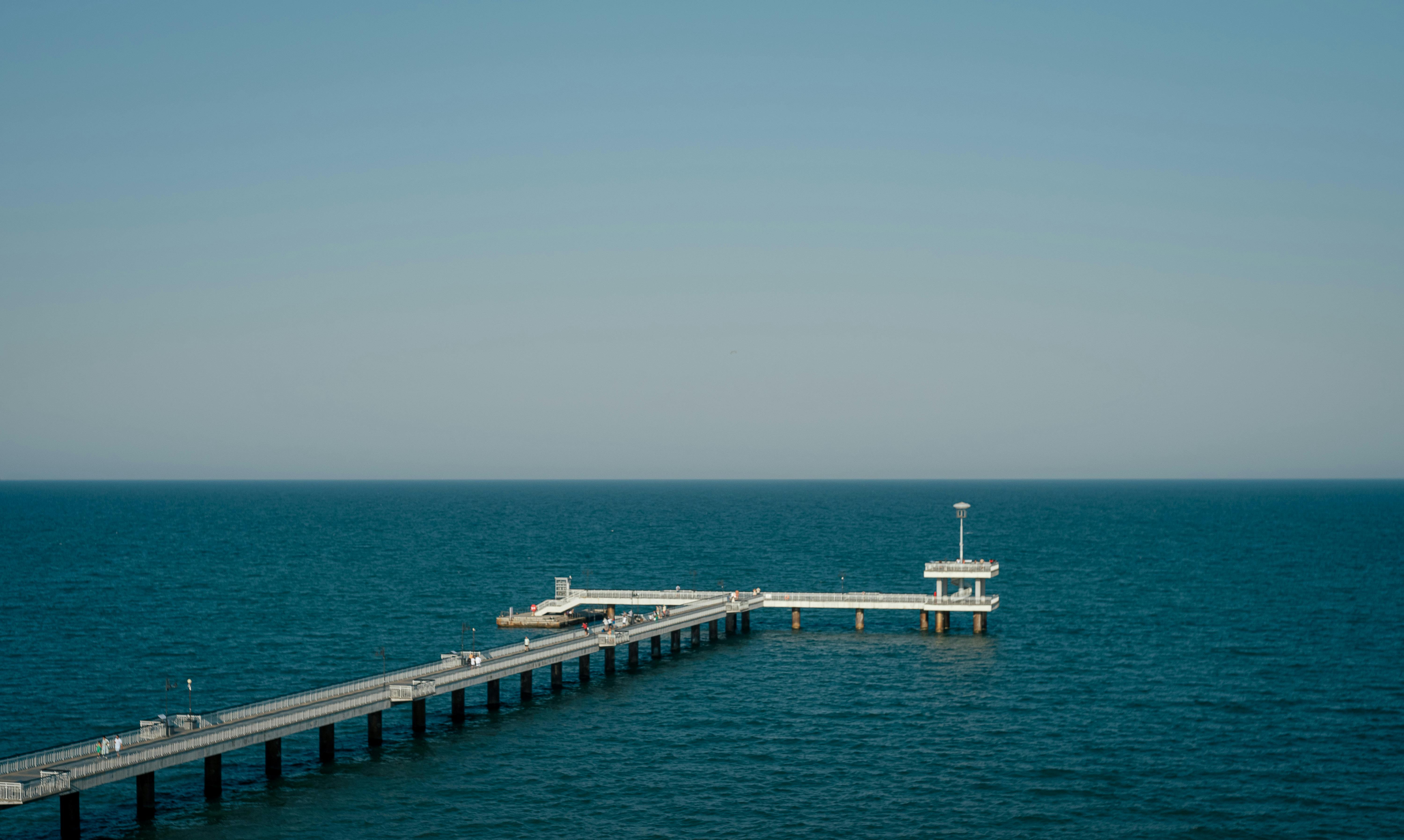
Image Description: Burgas Sea Bridge at twilight, the pier extending into the Black Sea with city lights reflecting on calm waters and the 22-meter watchtower silhouetted
Burgas Sea Bridge: Where Black Sea Horizons Meet Maritime Ritual
The wooden planks creak beneath your feet as you walk toward the edge of Bulgaria's most romantic pier. Extending nearly 300 meters (984 feet) into the Black Sea from the lush expanse of the Sea Garden, the Burgas Bridge—affectionately called "Mostik" by locals—is a T-shaped sanctuary where land dissolves into water and the horizon swallows all hurry . The sea breeze carries the scent of salt and the distant clang of fishing boats in the Port of Burgas. The 22-meter (72-foot) watchtower at the pier's peak offers a commanding view of the Mystic Island "St. Anastasia" floating on the horizon . This is not merely a bridge; it is an amphitheater of daily life—where grandmothers cast fishing lines beside giggling teenagers, where exhausted parents push prams toward the sea breeze, and where every evening, at precisely the golden hour, the pier transforms into a catwalk of pink clouds and violet reflections. Built in 1936, destroyed by storms, and reborn in concrete in the 1980s, the bridge keeps vigil over Bulgaria's fourth-largest city, witnessing both the quiet rituals of Epiphany and the raucous celebrations of St. Nicholas Day .
Why Burgas Sea Bridge Embodies Maritime Pilgrimage
The Burgas Bridge is more than infrastructure; it is a stage for Bulgarian tradition. Constructed originally in 1936 as a steel structure with wooden beams, the pier was connected by a special stone staircase to the panoramic promenade of the Sea Garden and the nearby Casino . After decades of salt corrosion and storm damage, the old bridge was reconstructed in the 1980s into the massive concrete structure you see today—a T-shaped pier 50 meters wide at its head, providing shelter for fishermen and swimmers alike. But the bridge's soul lies in its rituals. Every year on St. Nicholas Day—the feast of Burgas and the patron saint of sailors—wreaths are thrown from the pier into the sea in memory of fallen seamen and fishermen . A solemn service is performed for health and prosperity, with the local bishop ritually tossing a cross into the water while brave swimmers compete to retrieve it. The tradition holds that whoever recovers the cross will be healthy and happy throughout the year . The bridge also plays a central role in Epiphany celebrations, where this same ritual draws thousands of spectators to the pier's edge. For the city's residents, the bridge solves a spiritual need: it is the place where the faithful connect with the sea that has sustained Burgas for centuries.
The Best Time to Experience Burgas Sea Bridge
Late spring and early autumn deliver the most sublime conditions for walking the pier. From May 18 through June 30, daytime temperatures average 20°C to 24°C (68°F to 75°F), with the Black Sea warming to a swimmable 19°C (66°F) and the Sea Garden's roses in full bloom. September offers the true sweet spot: September 1 through September 30 sees highs of 22°C to 26°C (72°F to 79°F), sea temperatures of 21°C (70°F), and the summer crowds dispersed—September averages only five rainy days. July and August bring the heat, with daytime highs reaching 28°C to 30°C (82°F to 86°F) and sea temperatures peaking at 25°C (77°F)—perfect for swimming but also for shoulder-to-shoulder crowds on the pier. The golden hour of 6:30–7:30 PM offers the most dramatic light for photography, when the sun sinks directly into the sea and the watchtower casts long shadows across the wooden planks. For sunrise enthusiasts, 6:00–6:45 AM (depending on season) reveals the pier nearly empty, with only a few fishermen and early joggers. Avoid November through February, when daytime temperatures drop to 6°C–10°C (43°F–50°F), the wind off the Black Sea can be biting, and the pier's protective railings offer little shelter. For up-to-date information on Epiphany and St. Nicholas Day ceremonies, consult the official Burgas tourism website: www.gotoburgas.com
Approximate Budget for a 7-Day Trip
This budget assumes a comfortable mid-range stay in Burgas city center or along the beachfront, within walking distance or a short bus ride from the Sea Bridge. Bulgaria remains one of Europe's most affordable coastal destinations. Prices are in Bulgarian Lev (BGN) and Euros (EUR), with approximate US Dollars (1 BGN ≈ $0.55 USD).
- Accommodation: 60 BGN–330 BGN ($33–$180) per night. A 2-star guesthouse in Burgas center averages 75 BGN ($41) per night. The 5-star Grand Hotel & SPA Primoretz (beachfront, 100 meters from the Sea Garden) charges 151–280 EUR ($165–$305) for a double room depending on season . The boutique Hotel Residence Promenade offers classic French-style rooms from 107 USD per night . Mid-range apartments near the Sea Garden start at 120 BGN ($66).
- Food: 35–65 BGN ($19–$36) per day. Breakfast: 6–10 BGN for banitsa (cheese pastry) and Bulgarian yogurt from a local bakery. Lunch: 12–18 BGN for Shopska salad and grilled kyufte at a harbor-side taverna. Dinner: 18–30 BGN for fresh Black Sea turbot or fried tsatsa (small sprats) with a glass of local white wine. The beaches near the bridge have affordable snack bars offering fast food and salads for 8–15 BGN .
- Transportation: Bus from Burgas Airport (BOJ) to city center: Line 15, 2 BGN ($1.10) one way, journey time 25 minutes. Taxi from airport: 15–20 BGN ($8–$11). Daily bus to neighboring resort towns (Sunny Beach, Nessebar, Sozopol): 5–10 BGN each way . Burgas is compact and walkable; the Sea Bridge is a 15-minute stroll from the central train station.
- Attractions: Burgas Sea Bridge: free entry. Sea Garden Park (850 decares of landscaped coastline): free. Archaeological Museum Burgas: 5 BGN ($2.75). Boat tours to St. Anastasia Island: 20–30 BGN ($11–$17) per person . Poda Protected Area (birdwatching lagoon): 6 BGN ($3.30).
- Miscellaneous: Hand-painted ceramic magnet from the Sea Garden vendors: 5–10 BGN ($2.75–$5.50). Ice cream from the bridge-side kiosk: 3 BGN ($1.65). Sun lounger and umbrella on Burgas Beach: 12 BGN ($6.60) per day. Rose oil souvenir (5ml): 10–15 BGN ($5.50–$8.25).
- Total for 7 days (mid-range budget, excluding flights): 700–1,300 BGN ($385–$715) per person.
6 Essential Burgas Sea Bridge Experiences
- Walk to the T-Head at Sunset: Begin at the bridge's entrance in the Sea Garden—marked by a stone staircase descending from the casino terrace—and walk the full 300 meters to the T-shaped head . The wooden planks (replaced annually after winter storms) flex slightly beneath your weight. At the far end, turn around: the city skyline glows orange behind you, and the 22-meter watchtower frames the scene perfectly. Arrive by 6:30 PM in summer, 5:00 PM in autumn, to claim a spot at the railing.
- Spot St. Anastasia Island from the Watchtower: The 22-meter (72-foot) watchtower at the bridge's western end offers the best vantage point for spotting St. Anastasia Island—Bulgaria's only fully inhabited Black Sea island, just 1.5 kilometers offshore . On clear days, you can see the island's 15th-century monastery and lighthouse. The tower's spiral staircase is narrow (only one person at a time), so climb early in the morning to avoid queues.
- Photograph the Casino and Sea Garden Link: The bridge is connected "by a special stone staircase to the panoramic promenade Sea Garden and the Casino" . This staircase—ornate, early 20th-century stonework with wrought-iron railings—is one of the most photographed spots in Burgas. The best angle is from the bridge looking back toward the casino, especially at golden hour when the staircase's shadows create dramatic diagonals.
- Swim Off the Bridge's Eastern Side: Unlike many piers that prohibit swimming, the Burgas Bridge's eastern flank has a designated swimming area with ladder access. The water deepens quickly (3–4 meters at the head), and the view from the water—looking up at the bridge's concrete underside and the watchtower above—is surreal. Swim only between June and September when lifeguards are present (11:00 AM–7:00 PM). Bring water shoes; the ladder can be slippery.
- Join the Epiphany Cross Dive (January 6): If your travels bring you to Burgas on January 6, the Sea Bridge becomes the stage for one of Bulgaria's most dramatic religious rituals. A bishop blesses the Black Sea from the bridge's head, then tosses a wooden cross into the freezing water. Dozens of young men dive from the pier, competing to retrieve the cross—the winner is said to have health and happiness for the entire year . Spectators crowd the bridge and the adjacent Sea Garden embankment; arrive by 9:00 AM for a viewing spot.
- Watch the Wreath Ceremony on St. Nicholas Day (December 6): On Burgas's city holiday—St. Nicholas Day, patron saint of sailors—fishermen and families gather at the bridge to throw wreaths of flowers and ivy into the sea, honoring seamen lost at sea . A priest offers a prayer from the watchtower platform, and a small flotilla of fishing boats circles beneath the bridge. The ceremony begins at 11:00 AM and lasts about an hour, followed by free fish soup distributed from a tent on the pier.
3 Hidden Gems Most Travelers Miss
- The Fishermen's Morning Club (5:00–7:00 AM): Before the tourists arrive, the bridge belongs to Burgas's retired fishermen. Every morning from May through October, a half-dozen elderly men cast lines from the T-head's northern edge, using hand-tied rigs for Black Sea red mullet and horse mackerel. They arrive by 5:00 AM and leave by 7:00 AM, when the sun becomes too bright for the fish. They don't mind spectators, and one—a former merchant marine named Dimitar—speaks English and will show you his catch. He also sells fresh fish directly from a cooler for half the market price: 4 BGN per kilogram for mackerel, 8 BGN for red mullet.
- The Underwater Frescoes at the Bridge's Base: This requires snorkeling. On calm days (no wind, July–August), dive from the bridge's eastern ladder and swim toward the concrete pillars supporting the T-head. At a depth of 3–4 meters (10–13 feet), the pillars are covered in encrusting organisms—mussels, barnacles, and, in patches, what locals call "sea frescoes": colonies of pink and orange bryozoans (aquatic invertebrates) that form geometric patterns against the gray concrete. The best visibility is at 10:00 AM, before boat traffic stirs up sediment. Bring a waterproof camera; the effect is otherworldly.
- The Casino's Soviet Mosaic Abandoned Wing: Adjacent to the stone staircase connecting the bridge to the Sea Garden stands the Casino—a 1960s Socialist Modernist building now partially abandoned. On its eastern facade, behind a locked gate (the key is available at the Sea Garden's information kiosk, free with ID deposit), lies a 15-meter (49-foot) mosaic depicting Black Sea marine life—dolphins, sturgeon, and stylized waves—created in 1967 by Bulgarian artist Ivan Kirkov. The mosaic was covered in plaster during the 1990s and only rediscovered in 2018. The kiosk attendant must accompany you (schedule permitting), but the mosaic is free to view. It is the most forgotten masterpiece in Burgas.
Cultural & Practical Tips
- Nodding means NO: Bulgaria shares the famous head gesture quirk with Greece. A nod up and down means "no." A side-to-side shake means "yes." This confuses nearly every first-time visitor. Observe locals carefully; if uncertain, use "da" (yes) and "ne" (no) verbally.
- Phrases to learn: "Zdravete" (ZDRA-ve-te) means hello. "Blagodarya" (bla-go-DA-rya) is thank you. "Kade sa toaletnite?" (KA-de sa to-a-LET-nee-te?)—where are the restrooms?—will prove essential; the nearest public toilets are in the Sea Garden, 200 meters from the bridge (1 BGN). "Mostika" (MOSS-tee-ka)—the Bridge—is what locals call this pier.
- Photography guidelines: Drone flights over the Sea Bridge require permission from Burgas Municipality (application at gotoburgas.com, 14-day processing). No tripods on the bridge during peak hours (6:00–8:00 PM, June–August) when pedestrian traffic is heaviest. The best photo of the entire structure is taken from the beach 300 meters north of the bridge at 7:00 PM, when the sun aligns perfectly with the T-head.
- Wind warning: The bridge has no windbreaks. When the Black Sea breeze exceeds 15 knots (forecast available at weather.bg), walking the pier becomes a balancing act, and waves may splash over the eastern railing. Check the wind forecast before visiting; if sustained winds exceed 25 knots, the bridge is closed to pedestrians—a rare but prudent safety measure.
- Cash is preferred at the bridge: The ice cream kiosk, the fisherman selling fresh catch, and the occasional jewelry vendor (weekends only) operate on cash only. The nearest ATMs are on Aleksandrovska Street, a 10-minute walk from the bridge entrance. Arrive with at least 20 BGN in small notes.
- Epiphany and St. Nicholas Day planning: On both January 6 and December 6, the bridge becomes extremely crowded (estimates of 5,000+ people). Buses from Burgas center are rerouted; park at the Sea Garden's southern entrance (free parking on Dimitrov Street). The ceremonies are conducted entirely in Bulgarian, but the visual spectacle transcends language. Dress for cold, wet conditions (January) or cool, breezy conditions (December)—there is no shelter on the pier.
- Accessibility: The bridge is wheelchair-accessible from the Sea Garden entrance to the T-head—the wooden planks are flush with the concrete base, and the slope is gentle (approximately 2 percent grade). The watchtower is not accessible (stairs only). There are no public restrooms on the bridge itself—plan accordingly.
Conclusion: Travel with Stillness, Not Just Steps
You could walk the Burgas Sea Bridge in five minutes—briskly from the Sea Garden stairway to the T-head, snap a photo of the watchtower, and retreat to the casino's air-conditioned cafe. Or you could do what the old fishermen do: arrive at 5:00 AM, coffee in hand, and watch the Black Sea change color seven times before breakfast. The bridge does not care about your itinerary. It has been here since 1936, surviving storms and wars and Soviet reconstruction, witnessing Epiphany dives and wreath ceremonies and the first kisses of Burgas teenagers for nine decades . It does not need you to hurry. What it offers is not a destination but a pause—a 300-meter walk into the horizon where the city noise fades and the sea fills your ears. So stand at the railing long enough to feel the waves vibrate through the concrete. Watch the fishermen cast their lines. Stay until the sun sinks into the water and the bridge lights flicker on, one by one, casting gold reflections across the Black Sea. That is not a photo. That is a memory.