
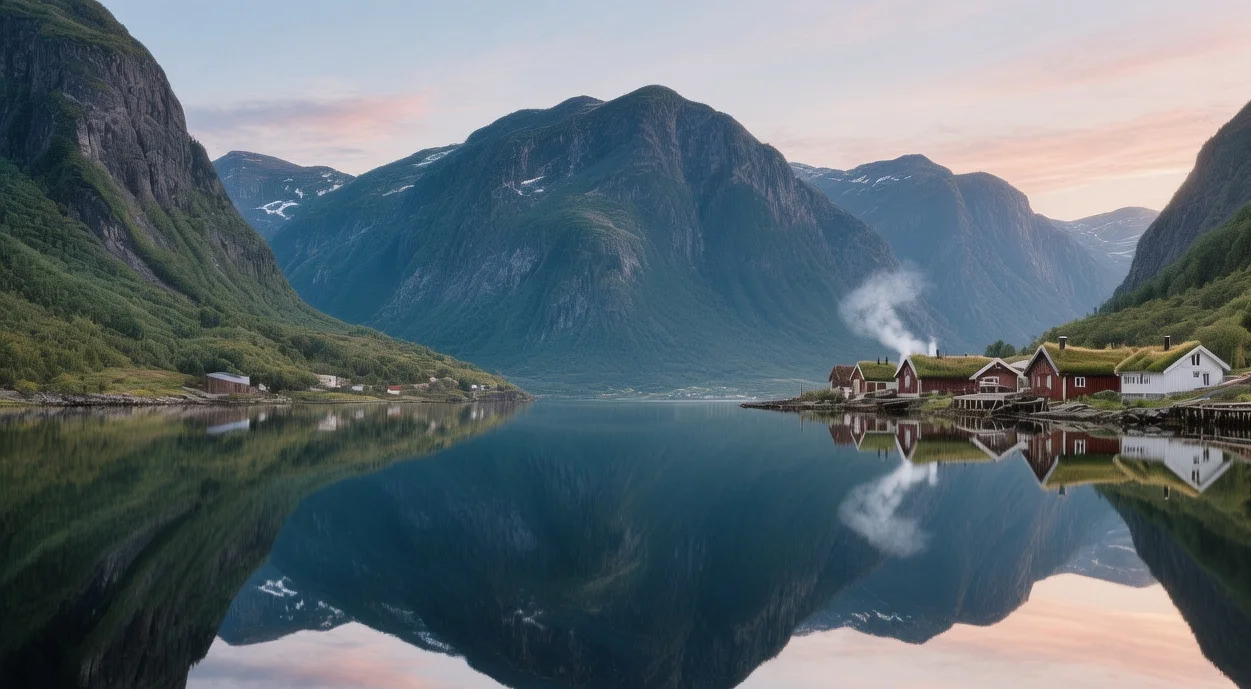
Sognefjord King of Fjords Meets Ancient Viking Heritage
The water lies still as polished obsidian, reflecting peaks that plunge 1,308 meters (4,291 feet) from snow-dusted summits to the deepest point of Norway's longest fjord. Dawn breaks over Sognefjord—a ribbon of liquid sapphire stretching 205 kilometers (127 miles) from the North Sea coast to the Jotunheimen mountains—and you stand on the deck of a heritage ferry, the only sound the gentle thrum of electric engines and the distant call of a white-throated dipper echoing off granite walls. This is not merely a body of water; it is a geological cathedral carved by Ice Age glaciers over 20,000 years, a liquid highway that once carried Viking longships and now guides electric catamarans through narrow channels where sunlight penetrates only four hours in winter. The air carries the scent of salt spray mixed with pine resin from forests clinging to impossible slopes; the temperature hovers at 8°C (46°F) even in summer, a reminder that you stand at the intersection of Arctic and Atlantic climates. In 2026, as mass tourism threatens to overwhelm Europe's natural wonders, Sognefjord matters because it remains vast enough to swallow crowds whole—a place where you can still find solitude on a 205-kilometer waterway that has witnessed a millennium of human history, from pagan sacrifices to sustainable travel revolutions.
Why Sognefjord Embodies Norwegian Natural Majesty
Sognefjord—the "King of Fjords" (Fjordenes konge)—represents Norway's geological and cultural soul compressed into a 205-kilometer waterway that contains 20% of Norway's total fjord volume. Carved during the Last Glacial Maximum approximately 20,000 years ago, when ice sheets over 2,000 meters thick ground through ancient river valleys, the fjord achieves depths that would submerge the Eiffel Tower with 986 meters to spare. This is not merely scenic; it is a textbook example of glacial overdeepening, where the fjord floor drops below sea level in a U-shaped trough that extends 20 kilometers inland from the coast before rising to meet the Jotunheimen plateau.
Historically, Sognefjord solved a fundamental transportation problem: how to navigate Norway's impossibly rugged terrain before roads existed. Viking chieftains used these waters as highways, establishing settlements at Flåm, Gudvangen, and Balestrand between 800–1050 CE. The fjord enabled trade in timber, fish, and iron ore; it connected isolated valleys to the Hanseatic League's trading posts in Bergen. When the first tourist steamers arrived in 1869, Sognefjord solved a different need: providing accessible wilderness for Europe's emerging middle class seeking the sublime. Today's electric ferries, introduced in 2021, continue this legacy while addressing modern environmental imperatives.
The engineering challenges of traversing Sognefjord have driven Norwegian innovation for centuries. The Flåm Railway (Flåmsbana), completed in 1940 after 20 years of construction, climbs 865 meters over 20 kilometers with gradients reaching 55%—one of the world's steepest adhesion railways. The Aurlandsfjord tunnel system, including the 24.5-kilometer Lærdal Tunnel (completed 2000), represents the longest road tunnel globally, solving the problem of year-round access when winter storms close mountain passes. These feats of engineering don't conquer nature; they negotiate with it, respecting the fjord's power while enabling human passage. In 2026, as climate change threatens glacial systems worldwide, Sognefjord stands as both monument and warning—a reminder of ice's sculpting power and fragility.
The Best Time to Experience Sognefjord
For optimal conditions combining accessibility, weather, and crowd management, target June 10–July 5 or September 1–20. During these windows, temperatures range from 14–20°C (57–68°F) at water level, daylight extends to 19 hours in June, and the probability of clear views exceeds 65% according to Norwegian Meteorological Institute data. The midnight sun period (June 15–30) offers photography opportunities between 10:00 PM–1:00 AM when the sun hovers above the horizon, casting amber light across vertical rock faces. Ferry schedules operate at full frequency with 6–8 daily departures on main routes.
For winter drama, visit February 15–March 25 when frozen waterfalls cascade down cliffs and temperatures hover between -2 to 5°C (28–41°F). The fjord rarely freezes completely due to salt content and depth, but ice forms in sheltered bays, creating surreal landscapes. Limited ferry service operates (2–3 daily departures), and some mountain roads close, but the solitude is absolute. Northern lights become visible from inland areas like Lærdal during clear nights, though coastal cloud cover reduces probability to 20%.
Avoid July 15–August 10 if you dislike crowds: European school holidays and cruise ship season converge, with 15–20 large vessels anchoring at Flåm and Gudvangen daily. Ferry queues exceed 90 minutes; accommodation prices surge 40–60%. Similarly, avoid Norwegian Constitution Day (May 17) when domestic tourism peaks and many services operate reduced hours. For real-time ferry schedules and weather, check www.fjords.com or call +47 57 63 20 00. Download the Entur app for integrated public transport planning across ferries, buses, and trains.
Approximate Budget for a 7-Day Trip (2026)
Sognefjord region pricing reflects Norway's high labor costs and remote location logistics. This budget assumes mid-range travel prioritizing authentic experiences over luxury, with prices adjusted for 3-4% annual inflation from 2024 baselines. Costs are estimated in Euros (€) though local currency is Norwegian Krone (NOK).
- Accommodation: €150–€240 per night for a double room in a 3-star hotel or quality guesthouse in Flåm, Aurland, or Balestrand. Budget hostels (Flåm Vandrerhjem): €50–€70 per bed. Upscale fjord hotels (Kviknes Hotel Balestrand): €280–€450 per night.
- Food: €70–€100 per day per person
- Breakfast: €14–€20 (hotel buffet with smoked salmon, eggs, brunost, lefse)
- Lunch: €20–€30 (ferry café sandwich €24, fish soup €28, or grocery picnic €18)
- Dinner: €36–€58 (restaurant main: lamb rack €42, Arctic char €40, vegetarian pasta €30; add €13 for local beer)
- Transportation:
- Sognefjord ferry (Flåm–Gudvangen): €45 round-trip adults, €22 children (4–15)
- Flåm Railway: €65 one-way, €95 round-trip
- Norway in a Nutshell tour package: €210–€280
- Car rental (7 days): €450–€650 including ferry crossings
- Local bus day pass: €15
- Attractions:
- Borgund Stave Church: €14
- Nærøyfjord UNESCO cruise: €55
- Stegastein viewpoint shuttle: €25
- Kayak rental (half-day): €45
- Guided glacier hike (Nigardsbreen): €85
- Miscellaneous:
- Souvenirs: Viking horn €35, wool sweater €95, local aquavit €40
- Fjord cruise with lunch: €75
- Travel insurance (7 days): €40–€60
- eSIM data plan: €18–€28
Total for 7 days (mid-range, per person, double occupancy): €1,650–€2,100
Budget travelers can reduce costs to €950–€1,250 by camping (€25–€35 per night), cooking meals, and using only public ferries. Luxury seekers should budget €3,500+ for boutique hotels, private RIB boat tours, and fine dining at Michelin-recommended establishments.
6 Essential Sognefjord Experiences
- Cruise the Nærøyfjord Branch: Board the 10:30 AM ferry from Flåm to Gudvangen for a 2-hour journey through UNESCO World Heritage waters. This 17-kilometer arm narrows to just 250 meters at its tightest point, with 1,700-meter cliffs rising vertically on both sides. Position yourself on the starboard side for optimal views of the Kjelfossen waterfall (755-meter drop). The ferry's electric engines create near-silence, allowing you to hear water dripping from moss-covered rocks. Disembark at Gudvangen to explore the reconstructed Viking village Njardardheimr before continuing by bus.
- Ride the Flåm Railway: Experience one of the world's steepest train journeys, departing Flåm at 11:00 AM or 2:00 PM for the 55-minute ascent to Myrdal station (867 meters elevation). The train climbs 865 meters over 20 kilometers, passing 20 tunnels and the 90-meter Kjosfossen waterfall where performers dressed as huldra (forest spirits) appear during summer. Sit on the right side for waterfall views. The railway's 5.5% average gradient required innovative zigzag engineering completed in 1940. Bring a jacket; temperature drops 6°C during the ascent.
- Visit Borgund Stave Church: Travel 30 kilometers east of Lærdal to Norway's best-preserved stave church, constructed circa 1180–1250. This triple-nave structure features 28 original pillars, dragon-head roof ornaments, and runic inscriptions carved into door frames. The interior remains dark and atmospheric, lit only by small windows and candlelight. A guided tour (included in admission) explains the synthesis of Viking and Christian symbolism. Allow 90 minutes; the adjacent visitor center displays medieval artifacts. Photography is permitted but flash is prohibited to protect 800-year-old wood.
- Walk to Stegastein Viewpoint: Take the 3:00 PM shuttle from Aurland to this architectural marvel extending 30 meters over the fjord at 650 meters elevation. Designed by Todd Saunders and Tommie Wilhelmsen (completed 2013), the curved laminated wood platform frames a perfect view of Aurlandsfjord. Visit during golden hour (8:00–10:00 PM in summer) when light illuminates the water's surface. The walk from the viewing platform to the parking area takes 15 minutes along a gravel path. Bring wind-resistant clothing; exposure is significant even on calm days.
- Kayak the Fjord at Dawn: Join a 6:00 AM guided sea kayak tour from Flåm or Balestrand for a 3-hour paddle on glass-calm waters. This is the only time you experience the fjord without motor noise and crowds. Paddle beneath waterfalls still frozen from the night; watch goats grazing on impossibly steep slopes. Guides provide dry suits, kayaks, and safety equipment. No experience necessary, but basic fitness required. The tour includes hot coffee and cinnamon buns served on a secluded beach. This intimate encounter reveals the fjord's scale—those mountains you're paddling beneath rise higher than any skyscraper.
- Hike to Kvitureid Viewpoint: For the adventurous, tackle this 8-kilometer round-trip hike from Bakka (Nærøyfjord) gaining 450 meters elevation. The trail follows an ancient postal route used from 1647–1890, with stone steps still visible. Reach the summit after 2 hours for panoramic views encompassing both Nærøyfjord and Aurlandsfjord simultaneously. The descent takes 90 minutes. Start by 9:00 AM to avoid afternoon clouds. Bring 2 liters of water, rain gear, and sturdy boots. This moderate-to-difficult trail rewards effort with perspectives few tourists witness.
3 Hidden Gems Most Travelers Miss
- Feigumfoss Waterfall: Located 15 kilometers east of Sogndal near the village of Feigum, this 218-meter waterfall drops in three distinct tiers through a narrow gorge. Unlike the crowded Kjelfossen, Feigumfoss sees fewer than 50 visitors daily. Access via Road 331, then follow the marked 2-kilometer trail (45 minutes) from the parking area. The path crosses wooden bridges and passes through old-growth forest. Best visited June–September when snowmelt creates maximum flow. The trail ends at a viewing platform 100 meters from the falls' base where mist creates permanent rainbows. No facilities exist; bring water and snacks. The 30-minute drive from Sogndal is worthwhile for this solitude.
- Urnes Stave Church: While Borgund attracts crowds, this UNESCO World Heritage site (built circa 1130) across the fjord near Solvorn remains accessible only by passenger ferry, limiting daily visitors to 200. The 20-minute ferry from Ornes departs 4 times daily (check www.skyss.no for schedules). Urnes features the finest example of Viking-age wood carving—the "Urnes style" interlacing animals on the north portal date to 1050 CE, predating the church itself. The interior contains medieval wall paintings and a 12th-century crucifix. Guided tours run hourly June–August; advance booking recommended (+47 57 67 33 00). The combination of ferry journey and architectural significance creates a more complete experience than drive-up churches.
- Bøyaheen Glacier: Near the village of Fjærland at the end of Fjærlandsfjord (a Sognefjord branch), this accessible glacier tongue extends to just 350 meters elevation. Unlike the commercialized Nigardsbreen, Bøyaheen requires no guide for viewing (though glacier walking requires certification). Drive to the parking area (coordinates 61.5333°N, 6.4167°E), then walk 15 minutes on a marked trail to the glacier's snout. The ice cave beneath the terminus changes shape daily—visit in morning light when blue ice glows. This is one of Norway's most accessible glaciers for close observation without crowds. Check with Fjærland Tourist Office (+47 57 69 10 30) for current safety conditions before visiting.
Cultural & Practical Tips
- Fjord etiquette: Norwegians practice allemannsretten (right to roam), allowing free access to uncultivated land. However, respect private property near farms; close gates behind you. Do not swim in the fjord without checking water temperature (typically 10–14°C/50–57°F in summer) and currents. Never stand too close to waterfall edges—rocks are slippery and water pressure is dangerous.
- Ferry logistics: Book vehicle ferry crossings in advance during July–August via www.fjord1.no or www.norled.no. Foot passengers can usually board without reservation, but arrive 20 minutes early. Ferries operate on reduced schedules Sundays and holidays. Electric ferries (like the Future of the Fjords) have limited vehicle capacity—prioritize foot passenger tickets if possible.
- Useful phrases:
- "Takk" (tahk) = Thank you
- "Unnskyld" (oon-shool) = Excuse me
- "Hvor går ferjen?" (voor gor fair-yen) = Where does the ferry go?
- "Hvor mye koster det?" (voor my-eh kos-tehr deh) = How much does it cost?
- Photography guidelines: Drone use requires registration with Luftfartstilsynet (Norwegian Civil Aviation Authority) and is prohibited in national parks without permission. Respect privacy when photographing farms—ask permission before entering private land. The best light occurs during golden hour (8:00–10:00 PM in summer); midday sun creates harsh shadows in deep fjords.
- Weather preparedness: Fjord weather changes rapidly. Pack waterproof layers even in summer; temperatures can drop 10°C when clouds move in. Wind chill on the water makes it feel 5–8 degrees colder. Wear sturdy hiking boots with ankle support for uneven terrain. Bring motion sickness medication if prone to seasickness—ferry rides through narrow channels can be choppy.
- Connectivity: Mobile coverage is excellent along the main fjord but spotty in side valleys and mountains. Download offline maps (Google Maps or Maps.me) before departing cities. Most cafes and hotels offer WiFi, but don't rely on it for navigation. Inform family of your itinerary; some hiking areas have no cell service.
- Sustainable travel: Choose electric ferries when possible (marked with "electric" on schedules). Pack reusable water bottles—tap water is safe and excellent quality throughout the region. Support local farms by purchasing cheese, jam, and souvenirs directly from producers. Follow Leave No Trace principles: pack out all trash, stay on marked trails, and respect wildlife (particularly grazing sheep and goats).
Conclusion: Travel with Reverence, Not Just Checklists
Sognefjord does not yield its secrets to hurried glances or checklist tourism. This 205-kilometer cathedral of water and stone demands patience—the patience to wait for fog to lift from mountain peaks, to sit quietly on a ferry deck as twilight descends, to understand that glaciers carved this landscape over millennia and deserve more than a 10-minute photo stop. In 2026, as overtourism threatens to transform natural wonders into theme parks, Sognefjord offers a different path: one of mindful engagement, of choosing the dawn kayak over the crowded midday cruise, of hiking to viewpoints that require effort rather than driving to parking lots steps from vistas.
Travel here not to collect Instagram posts but to feel small against the scale of geological time. Listen to the silence between waterfall roars; watch how light transforms granite from gray to gold to indigo. Respect the farmers whose ancestors have worked these impossible slopes for 1,000 years; support the communities keeping traditions alive. When you depart, carry with you not just photographs but a deeper understanding of what it means to coexist with wilderness. Sognefjord will endure long after we're gone—let our presence honor rather than diminish its majesty.