
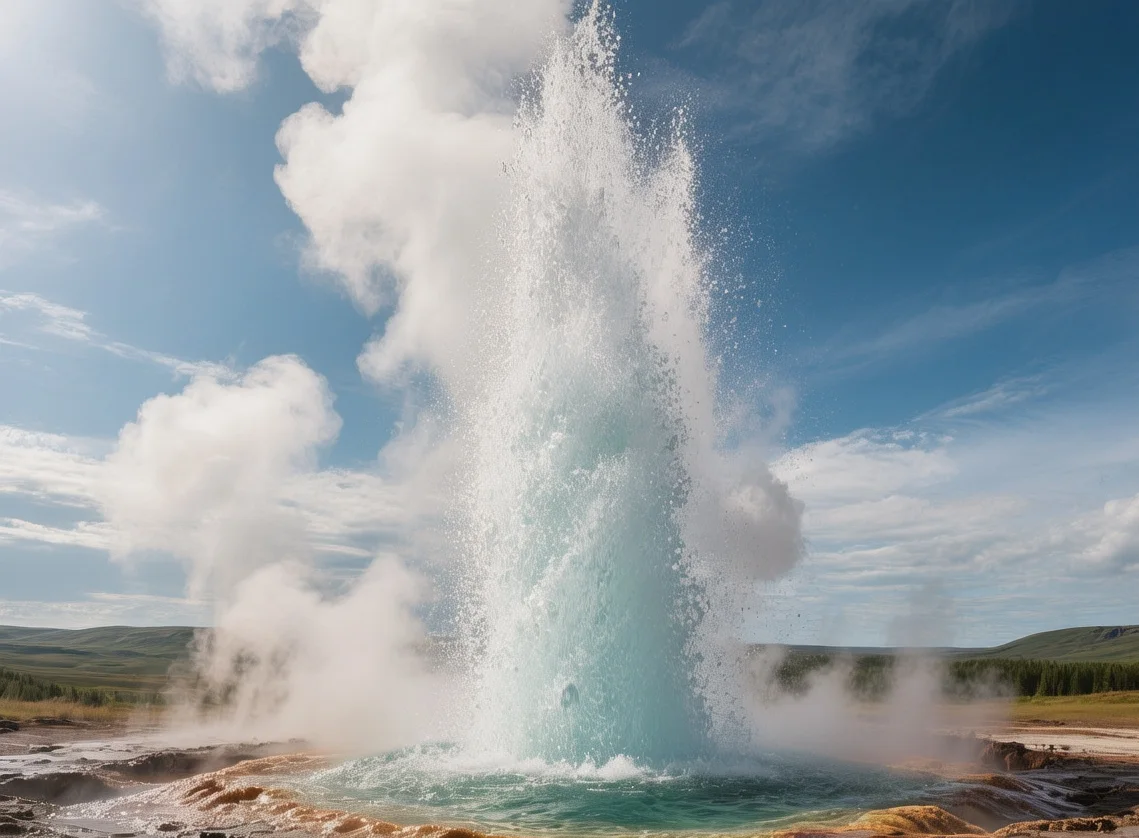
Strokkur Geyser Eruptions Geothermal Power Meets Nordic Wonder
The earth groans beneath your feet—a low, guttural rumble that vibrates through your boots and travels up your spine. You stand on the wooden boardwalk at Haukadalur valley, camera poised, as a pool of turquoise water begins to bubble violently. The surface heaves upward in a dome of liquid glass, then explodes: a column of boiling water and steam rockets 40 meters (131 feet) into the crisp Icelandic air, catching the afternoon sun in a prism of rainbow mist. The roar is deafening—a primal sound that drowns out conversation and sends Arctic terns scattering from their nests. This is Strokkur geyser eruptions in full fury, a spectacle that repeats every 6–10 minutes with the reliability of a geological metronome. The water, heated to 100°C (212°F) by magma chambers just kilometers below the crust, cascades back into the vent in a thunderous curtain of steam and spray. You smell sulfur and wet volcanic rock; you feel the warm mist on your face; you witness the raw power of a planet still being born. In 2026, as renewable energy becomes critical to humanity's survival, experiencing Strokkur geyser eruptions matters now more than ever—a visceral reminder that Earth's internal heat can power civilizations without burning fossil fuels.
Why Strokkur Geyser Eruptions Embody Icelandic Geothermal Heritage
The Strokkur geyser eruptions represent far more than a tourist attraction—they are Iceland's most reliable demonstration of the geothermal forces that power 90% of the nation's heating and 30% of its electricity. While the Great Geysir nearby lies mostly dormant since 2000, Strokkur has erupted consistently since 1963, when a cleanup operation cleared its blocked conduit. The geyser's plumbing system extends 200 meters underground, where groundwater pools in a silica-lined chamber heated by magma to supercritical temperatures. When pressure builds beyond the weight of the water column above, the entire system flashes to steam, ejecting 10,000–20,000 liters of water in a single eruption.
This natural phenomenon solves a critical human need: understanding renewable energy potential. Iceland's geothermal industry, which began in 1907 with the first hot water pipeline to Reykjavík, now operates 18 geothermal power stations generating 755 megawatts of electricity. Strokkur serves as a living laboratory where visitors witness the same forces that spin turbines at nearby Hellisheiði, the world's third-largest geothermal power plant. The geyser's silica cone—built up over centuries of mineral deposition—rises 1.5 meters above ground level, demonstrating how geological processes create infrastructure without human intervention.
Historically, Strokkur was first recorded in 1789, shortly after an earthquake opened its vent. It erupted regularly until 1815, when seismic activity blocked the conduit. For 148 years, it remained silent while the Great Geysir dominated attention. The 1963 restoration—led by geologist Árni B. Stefánsson—involved digging a channel through the silica buildup, instantly reactivating the system. Today, Strokkur geyser eruptions draw 1.5 million visitors annually to the Golden Circle, generating revenue that funds conservation across Iceland's fragile ecosystems. This reliability makes Strokkur not just a spectacle, but a symbol of Iceland's successful marriage between natural wonder and sustainable development.
The Best Time to Experience Strokkur Geyser Eruptions
Timing your visit to witness Strokkur geyser eruptions requires balancing eruption visibility, weather comfort, and photographic conditions. For optimal experiences combining dramatic steam columns with manageable crowds, target May 20–June 15 or September 5–25. During these shoulder seasons, air temperatures range from 6–12°C (43–54°F), creating maximum contrast between the ambient air and 100°C (212°F) eruption water. This temperature differential produces the densest steam columns and most vivid rainbows. Daylight stretches 18–20 hours in June, allowing evening visits when the low-angle sun creates golden illumination on the mist.
For winter photographers seeking dramatic ice formations, visit between November 20 and March 1. Temperatures drop to -8 to 2°C (18–36°F), and the spray freezes on contact with surrounding rocks, creating spectacular ice sculptures that frame each eruption. The cold air makes steam columns appear denser and more dramatic against dark winter skies. Plan your visit between 11:00 AM–2:00 PM for maximum daylight and safety. The boardwalks are heated to prevent ice accumulation, but wind chill can be severe—dress in layers with windproof outer shells.
Avoid July 1–August 20 if you dislike crowds. This peak window brings 5,000–7,000 daily visitors to the Geysir geothermal area, creating bottlenecks at viewing platforms between 11:00 AM–3:00 PM when tour buses converge. Parking fills by 10:00 AM, and photographers jostle for position as eruptions occur every 6–10 minutes. Also skip December 24–January 3 unless prepared for potential road closures on Route 35 due to blizzards and limited services. For real-time eruption webcams and road conditions, verify at www.geysircenter.is and www.road.is.
Approximate Budget for a 7-Day Trip (2026)
Experiencing Strokkur geyser eruptions anchors a week-long Icelandic adventure. This budget assumes a 7-day trip based in Reykjavík with day trips to the Golden Circle. Prices reflect 2026 rates, accounting for Iceland's average 3.8% annual inflation from 2024–2026 (source: Statistics Iceland). All amounts shown in euros; multiply by 1.08 for USD equivalents.
Accommodation: €150–€320 per night
• Budget guesthouse in Reykjavík (101 district): €150–€200
• Mid-range hotel (Laugardalur area): €220–€280
• Luxury (Hotel Geysir or nearby): €350–€500
• Camping at Haukadalur (seasonal): €25 per person
Food: €55–€95 per day
• Breakfast: €12–€18 (hotel buffet or bakery pastry + coffee)
• Lunch: €18–€28 (Icelandic lamb soup, fish of the day, or hot dog)
• Dinner: €25–€49 (pan-fried Arctic char or traditional hákarl tasting)
• Groceries (self-catering): €35/day
Transportation:
• Keflavík Airport to Reykjavík Flybus: €32 round-trip
• Golden Circle day tour (Strokkur/Gullfoss/Þingvellir): €85
• Rental car (compact SUV, 7 days): €380 + €140 fuel
• Reykjavík city bus (Strætó): €3.20 per ride
• Geysir parking fee: Free (donation suggested)
Attractions:
• Strokkur geyser viewing: Free
• Geysir Center Museum: €18
• Gullfoss waterfall: Free
• Þingvellir National Park: Free (parking €7)
• Friðheimar tomato farm lunch: €38
• Perlan Museum: €30
• Secret Lagoon entry: €32
Miscellaneous:
• Icelandic wool sweater (lopapeysa): €110–€180
• Thermal base layers: €85
• Travel insurance: €55
• Souvenirs (lava rock, handicrafts): €40
• Tips (not expected but appreciated): €25
Total for 7 days (mid-range): €2,180–€2,520 per person
Total (budget-conscious): €1,450–€1,680 per person
6 Essential Strokkur Geyser Eruption Experiences
1. Photograph the Full Eruption Cycle: Arrive at the viewing platform and wait for the pre-eruption phase. Strokkur typically gives warning signs: the water level drops slightly, then bubbles vigorously for 30–60 seconds before launching. Position yourself downwind to avoid spray on your lens. Use a shutter speed of 1/500s or faster to freeze the water column, or 1/60s for silky motion blur. The eruption lasts 5–10 seconds for the main column, followed by 20–30 seconds of steam release. Visit at 2:00–4:00 PM when sunlight illuminates the mist from the side.
2. Experience Multiple Eruptions in Sequence: Since Strokkur erupts every 6–10 minutes, plan to witness at least three cycles. The first eruption teaches you the timing; the second allows you to adjust your position; the third lets you capture variations in height and intensity. Eruptions range from 15 meters (49 feet) to 40 meters (131 feet) depending on underground pressure. Stand at the main viewing platform for safety—the silica crust around the vent is thin and dangerously hot.
3. Visit the Geysir Center Museum: Open daily 9:00 AM–6:00 PM (May–September) and 10:00 AM–4:00 PM (October–April), this facility explains the hydrothermal physics behind Strokkur geyser eruptions. Interactive displays show cross-sections of the 200-meter-deep conduit system. The café serves traditional rúgbrauð (rye bread baked using geothermal heat) with Icelandic butter. Entry is €18, which funds conservation. Use the clean restrooms and free Wi-Fi here.
4. Explore the Great Geysir Conduit: Walk 150 meters north to the Great Geysir itself, the dormant giant that gave all geysers their name. Though it hasn't erupted significantly since 2000, the 18-meter (59-foot) wide silica cone demonstrates centuries of mineral deposition. Read the information plaques detailing the 1963 cleanup that reactivated Strokkur. Touch the warm silica crust—gentle contact is permitted—but never throw objects into the vent.
5. Witness Winter Ice Formations: If visiting between December and March, bring a tripod and telephoto lens. The spray freezes on contact with surrounding rocks, creating massive ice sculptures that can reach 3 meters tall. The best vantage point is the upper boardwalk at 11:00 AM–1:00 PM when light penetrates the steam. Use a polarizing filter to reduce glare from ice and water. The contrast between boiling water and frozen spray creates surreal photography opportunities unique to winter.
6. Combine with Haukadalur Valley Exploration: The geothermal area contains over 50 hot springs, mud pots, and fumaroles beyond Strokkur. Walk the 1.5-kilometer loop trail (45 minutes) to see Blesi blue pool, Litli Geysir, and steaming fumaroles. The trail crosses volcanic scree and ancient lava flows with interpretive signs. Best hiked at 9:00–10:00 AM before crowds arrive. This broader context reveals how Strokkur fits into Iceland's larger geothermal system.
3 Hidden Gems Most Travelers Miss
• Litli Geysir (Little Geysir): Located 400 meters north of Strokkur, this smaller vent erupts less predictably but offers solitary viewing. The pool is surrounded by vibrant yellow sulfur deposits and green thermophilic algae. Access requires following the unmarked trail past the Great Geysir. Best visited at 7:00–8:00 AM before tour buses arrive. Why overlooked: No signage on main maps; requires independent exploration. Eruptions reach 5–10 meters when active. Coordinates: 64.3106° N, 20.3017° W.
• Blesi Blue Pool: Situated 500 meters northeast of Strokkur, this two-tiered hot spring features a boiling upper pool and a milky blue lower pool cooled to 45°C (113°F). The silica deposits create vibrant turquoise colors visible from the viewing platform. While bathing is prohibited to protect the formation, the colors rival Iceland's famous Blue Lagoon. Visit at 4:00–6:00 PM when the sun hits the blue water directly. Why overlooked: Requires 10-minute walk from main area; tour buses skip it.
• Faxi Waterfall (Vatnsleysufoss): Located 12 km from Strokkur on the Tungufljót river, this 20-meter (66-foot) wide cascade is often skipped for Gullfoss. A fish ladder allows salmon to migrate upstream, and there's a small café onsite serving fresh trout caught in the river. Open 10:00 AM–5:00 PM (summer). Entry: €5 parking fee. Why overlooked: Tour buses prioritize Gullfoss; Faxi offers intimate waterfall experience without crowds. Contact: +354 486 8222.
Cultural & Practical Tips
• Safety around hot water is critical: The ground near Strokkur can be thin crust over boiling water. Never step off marked boardwalks. The water is 100°C (212°F) and causes instant severe burns. Keep children close and leashed pets away from vents. If you hear hissing or feel ground vibration, move back immediately.
• Wind protection is essential: The Haukadalur valley is exposed. Even in summer, wind speeds reach 40 km/h (25 mph). Bring a windproof outer layer. The spray from eruptions can soak you quickly if you stand downwind; check wind direction before positioning for photos. The combination of wind and spray creates dangerous wind chill in winter.
• Learn these Icelandic phrases:
— Takk (tahk): Thank you
— Góðan daginn (go-than dy-in): Good day
— Strokkur (strohk-ur): The geyser's name
— Gos (gohs): Eruption
Icelanders appreciate effort; pronunciation matters less than attempting the language.
• Photography guidelines: Tripods are permitted on boardwalks but cannot block paths. Drone use is prohibited without special permit from the Icelandic Transport Authority (apply 4 weeks ahead at loftleidings.is). Best light: Early morning (8:00–10:00 AM) or evening (7:00–9:00 PM) in summer; midday (11:00 AM–2:00 PM) in winter when sun is highest.
• Facilities and accessibility: The Geysir Center has free Wi-Fi, café, and restrooms. The boardwalks are wheelchair-accessible (gravel paths, max 5% grade). Electric wheelchairs available free at visitor center (reserve 48 hours ahead: info@geysircenter.is). No ATMs onsite—bring cash for café purchases or parking donations.
• Seasonal considerations: Roads to Strokkur (Route 35) are paved and open year-round, but winter storms can cause temporary closures. Check road.is before traveling November–March. The eruptions continue year-round, but freezing spray can coat the boardwalks in ice during winter mornings. The visitor center provides real-time eruption predictions.
Conclusion: Travel with Wonder, Not Just Documentation
The Strokkur geyser eruptions demand more than a quick photo—they ask for wonder. As you stand where water defies gravity and earth breathes steam, recognize that you're not just visiting a destination; you're witnessing the planet's internal engine in miniature. In 2026, as geothermal energy becomes critical to humanity's sustainable future, Strokkur offers both spectacle and lesson: that Earth's power is infinite yet fragile, capable of heating homes and powering cities without burning fossil fuels. Slow down. Listen to the groan before the explosion. Feel the warm mist carrying minerals from 200 meters below. Understand that this landscape shaped a nation that now leads the world in renewable energy. When you witness Strokkur geyser eruptions in 2026, don't just capture the column for social media—contemplate the magma chamber beneath your feet. Don't just check a box—respect the boundary between observer and geological force. Iceland preserves this site not as a theme park, but as a classroom. Learn. Reflect. Carry this reverence home. The world needs more witnesses to Earth's power, not just consumers of spectacle.