
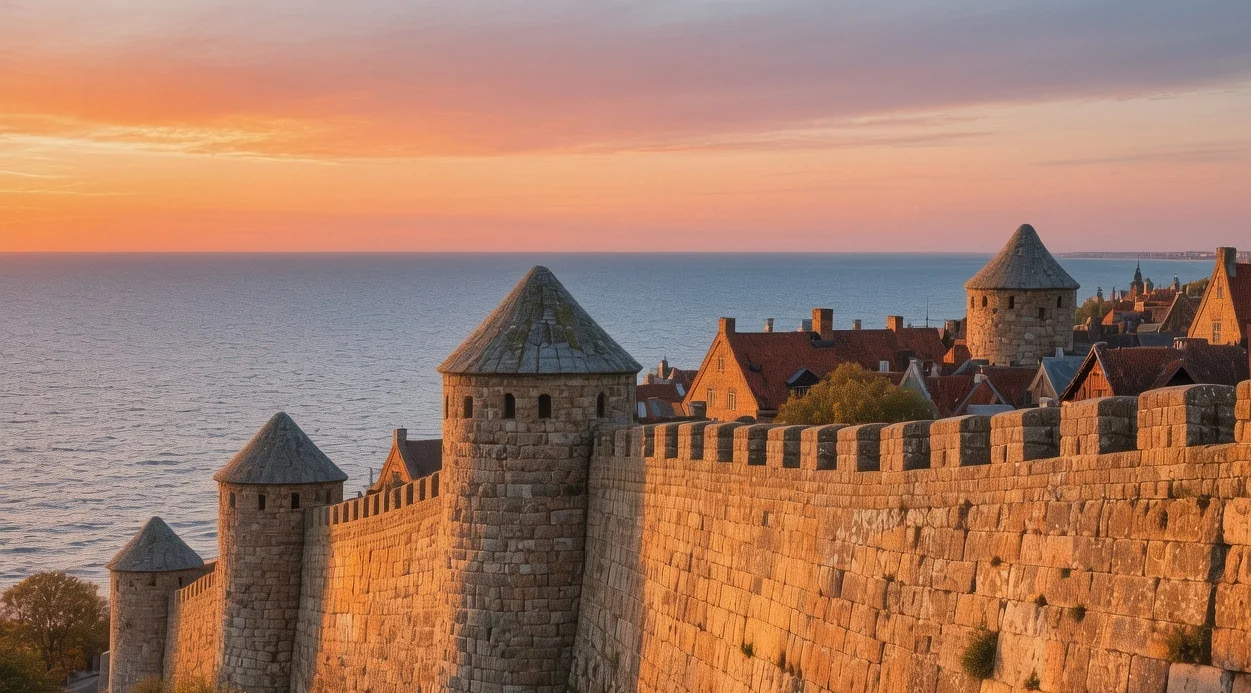
Visby Medieval Walls Hanseatic Stone Meets Baltic Breeze
The evening sun dips below the Baltic horizon at 9:15 PM, casting long amber shadows across the limestone ramparts that have encircled Visby for over seven centuries. You walk along the top of the Visby medieval walls, feeling the rough texture of 13th-century masonry beneath your palms while the scent of wild thyme and salt air drifts up from the grassy slopes below. Church bells toll from the town center—a sound that has marked the hours since the Hanseatic League ruled these trade routes—mingling with the distant crash of waves against the cliffs. This is not merely a ruin; it is Scandinavia's best-preserved medieval fortification, a 3.4-kilometer ring of stone that successfully defended one of Northern Europe's wealthiest ports during the height of the Viking Age transition. In 2026, as heritage sites worldwide struggle with overtourism and digital distraction, the Visby medieval walls remain a sanctuary of tangible history—a place where you can trace the same stones that merchants and soldiers touched in 1361. This matters now: in an era of virtual experiences, standing atop these ramparts offers something increasingly precious—the undeniable weight of physical continuity with a vanished world.
Why Visby Medieval Walls Embodies Hanseatic Power
The Visby medieval walls stand as the definitive symbol of Gotland's golden age, solving a critical historical need: protecting immense commercial wealth from rival powers and pirate raids during the 13th and 14th centuries. Construction began around 1280 following internal civil strife between the German merchants and local Gotlanders, with the main defensive ring completed by 1350—a timeline that coincides with Visby's peak as a Hanseatic trading hub. The wall stretches 3.4 kilometers in circumference, originally featuring 48 defensive towers of which 27 remain standing today, including the iconic Kruttornet (Powder Tower) by the harbor. Built primarily from local limestone quarried directly from the Gotland bedrock, the structure averages 12 meters in height and 2 meters in thickness at the base, engineered to withstand siege weaponry of the medieval period. The wall solved a strategic problem: it created a clear boundary between the privileged merchant town inside and the rural countryside outside, controlling access through six original gates (three remain: Norderport, Söderport, and Österport). UNESCO designated Visby a World Heritage Site in 1995, recognizing it as the finest example of a walled trading city in the Baltic region. Unlike many European fortifications that were dismantled for urban expansion, Visby's walls were preserved partly due to the town's economic decline after the 1361 Battle of Visby, when Danish King Valdemar Atterdag breached the defenses. Today, the walls embody a unique architectural fusion of military necessity and civic pride, maintaining their structural integrity through centuries of Baltic freeze-thaw cycles without major reconstruction.
The Best Time to Experience Visby Medieval Walls
For the optimal Visby medieval walls experience, target June 15–July 5 or August 10–September 10 when the weather is mild, daylight is extensive, and the summer crowds thin slightly. During these windows, daytime temperatures range from 17–22°C (63–72°F), perfect for walking the ramparts without the intense heat that can build on the limestone surfaces. The famous Almedalen Week (political festival) occurs in early July—avoid July 1–July 7 unless you specifically want to attend, as accommodation prices triple and the town becomes inaccessible to regular tourists. Arrive between 7:00–9:00 AM for sunrise photography when the mist lifts off the Baltic and the stones glow pink, or at 8:00–10:00 PM during June when the midnight sun allows evening exploration. Avoid late November–March unless you seek winter solitude; many restaurants close, ferry schedules reduce significantly, and temperatures drop to -5–3°C (23–37°F) with biting winds off the sea. For current ferry schedules and weather forecasts.
Approximate Budget for a 7-Day Trip (2026)
Gotland is a premium Swedish destination, with prices reflecting its island status and seasonal demand. The following estimates reflect 2026 rates with approximately 4% annual inflation from 2024 baseline data, assuming a comfortable mid-range travel style with a mix of self-catering and restaurant dining.
- Accommodation: €110–€190 per night for a double room inside the walls (historic guesthouses); budget hostels from €50/night outside the center; luxury hotels average €250–€400/night during peak season
- Food: €55–€75 per day total
- Breakfast: €12–€18 (hotel buffet or café with coffee and saffron bun)
- Lunch: €18–€25 (dagens lunch—daily special with main, salad, bread, and drink)
- Dinner: €25–€40 (restaurant main course; try Gotlandic lamb or saffron pancake)
- Transportation:
- Ferry Nynäshamn to Visby: €45–€85 one-way per person + €60 for car (Destination Gotland)
- Flight Stockholm to Visby: €90–€150 one-way (40 minutes)
- Local bus in Visby: €3.50 single ticket; €10 day pass
- Bicycle rental: €15/day (highly recommended for island exploration)
- Car rental: €55/day (useful for visiting northern Gotland)
- Attractions:
- Guided Wall Walk: €15 per person
- Gotland Museum: €12 adults, free under 19
- St. Karin's Church Ruin entry: Free
- Botanical Garden: Free
- Medieval Week ticket (August): €25 day pass
- Miscellaneous:
- Local crafts at market: €15–€60
- Fika (coffee + saffron bun): €7–€9
- Saffron pancake dessert: €10–€14
- Souvenir guidebook: €8
- Beach access: Free
Total estimated cost for 7 days: €1,100–€1,600 per person (excluding international flights to Stockholm)
7 Essential Visby Medieval Walls Experiences
- Walk the Full Rampart Circuit: Begin at Norderport gate and walk the entire 3.4-kilometer perimeter atop the walls. The path is uneven limestone, so wear sturdy shoes. This takes 90 minutes at a leisurely pace, offering views into private gardens inside the walls and the Baltic Sea outside. Stop at the 27 remaining towers to photograph the varying architectural styles from the 13th and 14th centuries. Best undertaken between 6:00–8:00 AM to avoid crowds and heat. The section between Kruttornet and Norderport offers the most dramatic sea views.
- Explore St. Karin's Church Ruin: Located just inside the southern wall, this 13th-century Gothic ruin is one of Visby's most atmospheric sites. Enter through the iron gates (open daily 8:00 AM–8:00 PM in summer) to stand among the towering stone arches that lost their roof centuries ago. The acoustics are remarkable—occasional organ concerts are held here in July. Spend 30 minutes walking the nave, noting the detailed stone carvings that survived the Reformation. The site is free, but donations support preservation. Visit at sunset when the light filters through the empty window frames.
- Visit the Gotland Museum: Housed in a complex of historic buildings at Strandgatan 14, this museum (€12 entry) holds the definitive collection of Gotlandic history. The Picture Stone Hall displays over 400 carved limestone slabs from the Iron Age, unique to the island. Open Tuesday–Sunday 10:00 AM–5:00 PM (June–August). Allow 2 hours to understand the context of the walls you are walking. The museum shop sells excellent local crafts and historical reproductions. Audio guides are available in English, German, and Swedish.
- Climb Kruttornet (Powder Tower): This round defensive tower by the harbor is the most photographed structure in Visby. While you cannot climb inside regularly, the exterior offers the best photo opportunity at low tide when the rocks are exposed. Position yourself on the harbor pier at 9:00 PM during June for the midnight sun reflecting off the limestone. The tower dates to the 13th century and was used to store gunpowder in later centuries. It marks the starting point for most guided wall walks.
- Attend Medieval Week (August): If visiting during the first week of August, experience the annual Medieval Week where the town transforms into a 14th-century marketplace. Over 50,000 visitors dress in period costume, jousting tournaments occur in the square, and merchants sell handmade goods. Book accommodation 6-8 months in advance. Even if you don't buy a ticket, the atmosphere in the streets is free to enjoy. This is when the Visby medieval walls feel most alive, echoing with the sounds they were built to withstand.
- Relax in the Botanical Garden: Located inside the walls near the cathedral, this free garden offers a peaceful contrast to the stone fortifications. Wander among medicinal herbs used in medieval times and enjoy views of the cathedral tower. Open daily dawn to dusk. It is a perfect spot for a picnic lunch purchased from the nearby market hall. The garden was established in 1984 but follows historical planting patterns. Sit on the benches facing the cathedral for a classic Visby view.
- Watch Sunset from Söderport: The southern gate offers the best vantage point for evening light hitting the wall's southern face. Arrive at 8:30 PM in summer to watch the stone turn golden as the sun lowers. The grassy slope outside the wall is a popular gathering spot for locals and visitors. Bring a blanket and enjoy the communal atmosphere. This area is less crowded than the harbor side, offering a more authentic local experience. The gate itself dates to the 14th century and retains its original iron fittings.
3 Hidden Gems Most Travelers Miss
- St. Lars Church Ruin: While St. Karin's gets the crowds, the ruin of St. Lars (near the hospital) is often empty and equally atmospheric. This 13th-century church was abandoned after the Reformation and now serves as a quiet garden space. Access is free and open 24 hours. The site is located on Sankt Larsgatan, just inside the walls. It is a perfect spot for reading or meditation away from the tourist throngs. The acoustics here are even more intimate than St. Karin's. Few guidebooks mention this serene space, making it a true refuge.
- The Secret Garden at Österport: Behind the eastern gate lies a small, unmarked community garden tended by local residents. While private, the gate is often open during daytime hours, and visitors are welcome to peek through the archway. The view from inside looking out through the medieval gate frame is spectacular. Access via Österportsgatan. Best visited between 10:00 AM–2:00 PM when gardeners are present. This spot highlights the living continuity of the town—people still cultivate the land within the ancient defenses. Respect the privacy of the gardeners and do not enter without invitation.
- Galgen (The Gallows Hill): Located just outside the northern wall, this grassy hill was the site of public executions in medieval times. Today, it offers the best panoramic view of the entire walled city without climbing the ramparts. Access via a footpath from Norra Hamngatan (10-minute walk from center). There is no signage, so use a map to locate the hilltop. It is a popular spot for locals at sunset. The view encompasses all 27 towers in a single frame. This vantage point provides context for the wall's defensive strategy that you cannot get from inside.
Cultural & Practical Tips
- Respect the stone: Climbing on the Visby medieval walls is strictly prohibited except on designated walkways. The limestone is fragile and erodes easily. Stay on marked paths to protect the archaeological integrity. Rangers patrol the area, and fines apply for violations. This is a UNESCO site, not a playground. Help preserve it for future generations by following all signage.
- Wind protection: Gotland is windy—the walls offer no shelter. Bring windproof layers even in summer. Temperatures on the ramparts feel 3-5°C cooler than in the sheltered streets below. Average summer temperatures: 18–23°C (64–73°F); spring/autumn: 10–16°C (50–61°F). Rain is possible year-round—pack a waterproof jacket. The wind off the Baltic can be biting in the evening.
- Essential Swedish phrases:
- "Hej" (hey) = Hello/Goodbye
- "Tack" (tahk) = Thank you
- "Ursäkta" (oor-shek-tah) = Excuse me
- "Var ligger...?" (var lig-er) = Where is...?
- "En kaffe, tack" (en kaf-fe tahk) = One coffee, please
- Photography guidelines: Photography is permitted throughout the public areas of the walls. Drones require permission from the County Administrative Board—contact lansstyrelsen@lansstyrelsen.se in advance. Tripods are allowed but must not obstruct pedestrian traffic. Be mindful of other visitors when composing shots. Golden hour (8:00–10:00 PM in June) provides the best light without harsh shadows.
- Ferry booking: Book Destination Gotland ferries at least 2 months in advance for summer travel. Prices increase significantly closer to departure. Cars are expensive to bring (€60+ one-way); consider renting on the island if staying only in Visby. The ferry takes 3 hours from Nynäshamn. Flights are faster but weather-dependent. Check baggage limits carefully for both options.
- Payment and connectivity: Sweden is nearly cashless—cards accepted everywhere, including small kiosks. Inform your bank of travel dates. Mobile coverage is excellent throughout Visby (Telia/Tele2). Free WiFi available at the Tourist Center and most cafés. ATMs available throughout the town but carry some cash for market vendors.
- Seasonal considerations: Many attractions operate seasonally (May–September only). October–April sees significant closures, though the walls are accessible year-round. Medieval Week (August) and Almedalen Week (July) dramatically affect availability and pricing. Book accommodations 3-6 months in advance for summer visits. Winter visitors should verify opening hours before traveling—many businesses close entirely December–March.
Conclusion: Travel with Reverence, Not Just Tourism
The Visby medieval walls ask something different of you than the hurried checklist approach of modern travel. This is not a place to photograph and flee; it is a living monument where 700 years of history press against the present moment. When you run your hand along the cold limestone, remember that a mason shaped this stone in 1320, that a soldier stood guard here in 1361, that a merchant walked these ramparts when Visby ruled the Baltic. That continuity is fragile. Every unauthorized climb erodes the mortar; every disregarded sign weakens the protection; every failure to support local preservation accelerates the decay. Travel here with reverence: walk gently on the ancient stones, support the local businesses that maintain the town's character, speak softly in the ruins, and leave only your footprints in the grass. In return, Visby offers something increasingly rare in our accelerated world—the chance to stand in deep time, to feel the weight of history not as a burden but as a gift, to understand that we are temporary custodians of beauty that must outlast us. This is why we travel: not to consume places, but to be transformed by them, to carry their stories forward with care and gratitude.