
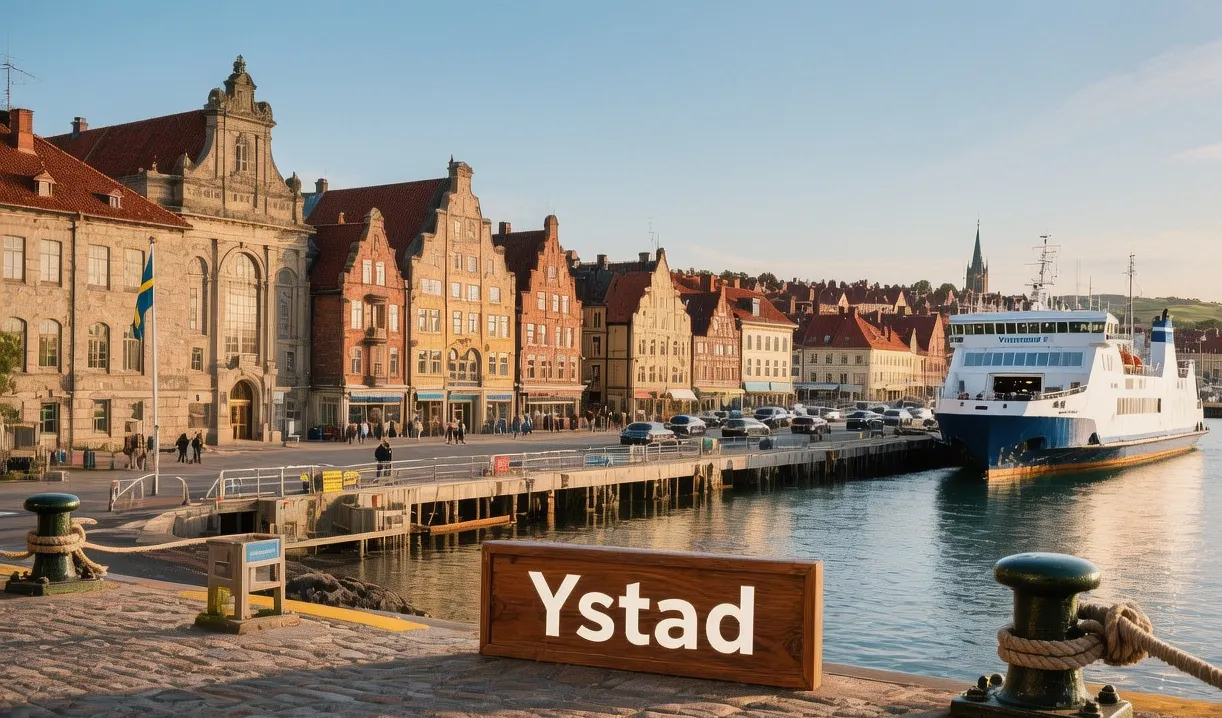
Ystad Medieval Town Half-Timbered History Meets Nordic Noir
The afternoon sun slants across Ystad's cobblestone streets at 4:30 PM, casting long shadows that dance along the colorful facades of half-timbered houses built when Sweden's southern province still belonged to Denmark. You walk past Mariakyrkan, the Gothic brick church whose 87-meter tower has watched over this town since 1285, while the scent of freshly baked skånsk spettekaka—that delicate Scanian spit cake—drifts from a corner bakery. Seagulls wheel overhead, their cries mingling with bicycle bells as locals pedal past 17th-century merchant houses painted in ochre, falu red, and mustard yellow. This is the town where Kurt Wallander walked the streets in Henning Mankell's beloved detective novels, but Ystad's story stretches far deeper than Nordic noir fiction: founded in the 1200s as a herring fishing settlement, it grew into one of Scania's most important medieval trading ports, its 300 preserved historic buildings forming one of Northern Europe's most intact medieval town centers. In 2026, as overtourism transforms European heritage sites into theme parks of themselves, Ystad medieval town remains refreshingly authentic—a place where you can still hear the echo of your footsteps on medieval stones, where shopkeepers greet you in melodic Scanian dialect, and where history breathes through every weathered wooden beam. This matters now: in our age of digital saturation and hurried travel, Ystad offers something increasingly precious—the chance to slow down and walk through living history.
Why Ystad Medieval Town Embodies Scanian Heritage
Ystad medieval town stands as Scandinavia's best-preserved example of a medieval market town, solving a critical historical need: protecting and showcasing the architectural heritage that survived the 1658 Treaty of Roskilde, when Scania transferred from Danish to Swedish rule. Of the town's original 400 medieval buildings, over 300 remain standing today—a preservation rate of 75% that rivals any European medieval center. The town's layout follows the classic medieval grid pattern established in the 1200s, with narrow alleys just 3-4 meters wide designed to maximize building plots while providing wind protection from the Baltic Sea just 500 meters away. The distinctive half-timbered construction technique—wooden frames filled with brick or wattle-and-daub—dominates the architecture, with buildings like the 1520s Kompanihuset (the Company House) showcasing intricate timber framing with diagonal bracing patterns that served both structural and decorative purposes. Mariakyrkan, built from red Baltic brick in the Baltic Gothic style, features a three-aisled basilica design measuring 65 meters in length with a nave height of 18 meters, its walls up to 1.5 meters thick to support the massive tower. The town solved a practical medieval problem: creating a defensible trading port with natural harbor access while maintaining strict building codes that required fire-resistant brick chimneys and regulated roof materials—a forward-thinking approach that preserved the town through centuries of fires that destroyed other medieval settlements. Today, Ystad's 18,000 residents live alongside this heritage, maintaining the delicate balance between preservation and modern life that keeps the medieval town breathing rather than fossilized.
The Best Time to Experience Ystad Medieval Town
For the optimal Ystad medieval town experience, target May 20–June 25 or September 1–October 15 when the light is magical, crowds manageable, and the town's gardens bloom with Nordic summer beauty. During these windows, daytime temperatures range from 14–20°C (57–68°F), perfect for wandering the cobblestone streets without summer's tourist surge. The famous Wallander filming locations are most atmospheric in early morning light—arrive between 7:30–9:00 AM when the streets are empty and photographers capture that perfect golden glow on the half-timbered facades. Avoid July 10–August 10 when Swedish school holidays bring peak crowds and accommodation prices spike 40-60%, and skip late November through February unless you specifically want to experience the town's atmospheric but dark winter months—sunset occurs as early as 3:15 PM in December, limiting sightseeing time. The annual Ystad Medieval Festival (last weekend of July) draws 30,000+ visitors and transforms the town with period costumes and markets—spectacular but crowded. For current event schedules and opening hours.
Approximate Budget for a 7-Day Trip (2026)
Ystad offers moderate pricing for a Swedish destination—more affordable than Stockholm but pricier than Eastern European medieval towns. The following estimates reflect 2026 rates with approximately 3.5% annual inflation from 2024 baseline data, assuming a comfortable mid-range travel style with a mix of self-catering and restaurant dining.
- Accommodation: €95–€155 per night for a double room in central Ystad (near Stortorget or within the medieval center); budget options from €55/night at hostels; boutique hotels in historic buildings average €180–€280/night
- Food: €50–€70 per day total
- Breakfast: €10–€15 (hotel buffet or café with coffee and smörgås)
- Lunch: €16–€22 (dagens lunch—daily special with main, salad, bread, and drink)
- Dinner: €24–€35 (restaurant main course; try local herring or Scanian pork)
- Transportation:
- Copenhagen Airport to Ystad: €28 one-way via Skånetrafiken train (90 minutes, change in Malmö)
- Local buses in Ystad: €3.80 single ticket; €10 day pass
- Bicycle rental: €12/day (highly recommended—Ystad is flat and bike-friendly)
- Day trip to Malmö: €14 round-trip train ticket (55 minutes)
- Day trip to Lund: €16 round-trip train ticket (35 minutes)
- Attractions:
- Ystad Studios (Wallander tours): €18 adults, €9 children
- Mariakyrkan church: Free (donations welcome); tower climb €6
- Ystad Museum: €10 adults, free under 19
- Medieval walking tour: €12 guided, free self-guided map
- Österlen region day tour: €45 including transport
- Miscellaneous:
- Local crafts at medieval market: €15–€50
- Fika (coffee + cinnamon bun): €6–€8
- Spettekaka (traditional cake): €8–€12
- Wallander merchandise: €10–€35
- Beach access at Ystad Sandskog: Free
Total estimated cost for 7 days: €950–€1,350 per person (excluding international flights)
7 Essential Ystad Medieval Town Experiences
- Walk the Wallander Route: Follow the bronze footprints embedded in Ystad's cobblestones marking Kurt Wallander's path through the town. Start at Ystad Studios (Österlenvägen 25) at 10:00 AM for the 90-minute guided tour (€18) that takes you to filming locations including Wallander's apartment at Svartbrödersgatan 12 and the police station at Norra Vallgatan 42. The tour includes behind-the-scenes footage and props from the Kenneth Branagh and Krister Henriksson series. Bring your camera—the contrast between medieval architecture and modern crime scene tape creates striking images.
- Climb Mariakyrkan's Tower: Purchase your €6 tower ticket at the church office, then ascend 167 steep wooden steps to the viewing platform at 45 meters. The climb takes you past medieval graffiti carved by 16th-century apprentices and offers intimate views of the church's Gothic vaulting. From the top, you'll see Ystad's red-tiled roofs spreading toward the Baltic Sea, with Denmark's coast visible on clear days 25 kilometers away. Best lighting for photography occurs between 5:00–7:00 PM in summer when the low sun creates dramatic shadows across the medieval townscape.
- Explore the Half-Timbered Houses of Svartbrödersgatan: This perfectly preserved street showcases 17th and 18th-century merchant architecture at its finest. Walk slowly along the cobblestones, noting the construction details: oak frames with diagonal bracing, brick infill painted in traditional colors, and overhanging upper floors that maximized space while protecting the street from rain. Stop at number 14, built in 1520, which now houses a craft shop selling traditional Scanian textiles. The street is particularly magical at dusk when warm light glows from small-paned windows.
- Visit Ystad Museum's Medieval Exhibition: Located in a former monastery at Norra Vallgatan 64, the museum's archaeological collection (€10 entry) displays artifacts excavated from Ystad's medieval layers—including 13th-century leather shoes, Hanseatic trading coins, and Viking Age jewelry found in the harbor. The highlight is the Ystad Codex, a 14th-century manuscript detailing the town's medieval laws and trade regulations. Open Tuesday–Sunday 11:00 AM–5:00 PM (June–August), Wednesday–Sunday 12:00–4:00 PM (September–May). Allow 90 minutes for a thorough visit.
- Taste Traditional Scanian Specialties: Make your way to Café Skansen (Österportsgatan 8) for authentic spettekaka—that delicate, cone-shaped spit cake made from potato starch, eggs, and sugar, baked over an open flame. Watch the demonstration (daily at 2:00 PM, included with café purchase) showing how the batter is poured in thin layers onto a rotating spit. Pair it with strong Swedish coffee and kanelbullar (cinnamon buns). For savory options, try the local herring at Restaurant Fisk (Hamngatan 5)—marinated in mustard, dill, or traditional vinegar brine, served with boiled potatoes and sour cream (€22–€28).
- Walk the Medieval Harbor: Follow Storgatan down to Ystad's small harbor, where fishing boats still unload their catch as they have for 700 years. The harbor area features restored 18th-century warehouses now converted to restaurants and galleries. At low tide, you can see the remnants of medieval wooden pier structures preserved in the mud—a reminder that Ystad's prosperity came from its strategic position on the Baltic trade routes. Visit between 8:00–10:00 AM to watch the fishermen return with the morning catch, or at sunset when the light reflects off the water and creates perfect photo opportunities.
- Experience the Österlen Countryside: Rent a bicycle (€12/day from Ystad Cykeluthyrning, Norra Vallgatan 38) and cycle 15 kilometers east into the Österlen region—Scania's agricultural heartland dotted with apple orchards, artisan studios, and white-sand beaches. Stop at Kivik village (20 km from Ystad) to visit Sweden's largest apple market and the Bronze Age Kivik King's Grave. The cycling route is flat and well-marked, passing through villages with names like Glimminge and Borrby that sound like fairy tales. Return before dusk when the light turns golden and the fields glow amber.
3 Hidden Gems Most Travelers Miss
- Sankt Petri Kloster (St. Peter's Monastery Ruins): Tucked behind modern buildings at Klostergatan 12, these 13th-century Franciscan monastery ruins are often overlooked by visitors focused on the more obvious medieval attractions. The remaining walls—up to 3 meters high in sections—reveal the monastery's original layout, including the chapter house and refectory. Access is free but unmarked; look for the small green door next to the modern apartment building (open daily 9:00 AM–6:00 PM April–October, 10:00 AM–4:00 PM November–March). The site includes informational panels in Swedish and English explaining the monastery's role in medieval Ystad. Bring a flashlight to examine the carved stone details in darker corners. This is where medieval monks once tended gardens and copied manuscripts—a quiet space for reflection away from tourist crowds.
- Ystad's Underground Cellars Network: Beneath the cobblestone streets lies a network of medieval cellars and storage vaults, accessible through guided tour only. Contact Ystad Heritage Society at info@ystadshembygd.se or +46 411 55 80 00 to book the 75-minute underground tour (€15, minimum 4 people). Tours run Tuesday and Thursday at 2:00 PM June–August, Saturday at 11:00 AM September–May. You'll descend into 14th-century brick-vaulted cellars once used by Hanseatic merchants to store herring, grain, and beer. The temperature remains a constant 8–10°C (46–50°F) year-round, so bring a jacket even in summer. The guide explains medieval construction techniques and shows original wooden support beams preserved in the oxygen-poor environment. This experience reveals the town's commercial importance during the Hanseatic League era.
- Bleke Mölla (Bleke Windmill): Located 3 kilometers southeast of the medieval center at Blekevägen 45, this restored 1864 windmill offers panoramic views and a glimpse into Ystad's agricultural heritage. The mill operates as a working museum, grinding grain using traditional methods during special events. Access by bicycle (15 minutes from center) or local bus #4 (stop: Bleke, 8-minute walk). Open Saturday and Sunday 1:00–4:00 PM May–September, or by appointment (+46 70 123 4567). The miller demonstrates the complex system of gears and millstones, explaining how wind power was harnessed before electricity. Climb to the top platform for views across the Österlen plains to the Baltic Sea. Entry €5 adults, €2 children. Most tourists never venture beyond the medieval center, missing this authentic piece of Scanian rural history.
Cultural & Practical Tips
- Photography guidelines: Photography is permitted throughout Ystad's public streets and most shop exteriors, but always ask permission before photographing inside private shops or restaurants. The Wallander filming locations welcome photography, but Ystad Studios prohibits flash photography during guided tours. Drone use requires permission from Ystad Municipality—contact tourism@ystad.se at least 10 days in advance.
- Swedish customs and etiquette: Swedes value personal space and quiet—speak softly in public areas and maintain arm's-length distance in queues. Remove your shoes when entering someone's home (and some traditional shops with historic floors). Tipping is appreciated but not mandatory—round up restaurant bills by 5-10% for good service. Say "tack" (tahk) frequently—it means both "please" and "thank you."
- Essential Swedish phrases:
- "Hej" (hey) = Hello/Goodbye
- "Tack så mycket" (tahk soh myk-et) = Thank you very much
- "Ursäkta" (oor-shek-tah) = Excuse me/Sorry
- "Hur mycket kostar det?" (hoo myk-et kos-tar deh) = How much does it cost?
- "Jag skulle vilja ha..." (yah skool-le vil-ya ha) = I would like to have...
- Weather considerations: Ystad's coastal location means weather changes rapidly—carry layers even in summer. The Baltic Sea moderates temperatures but creates unpredictable wind patterns. Average summer temperatures: 18–22°C (64–72°F); winter: -2 to 3°C (28–37°F). Rain is possible year-round—pack a waterproof jacket regardless of season. The town's cobblestone streets become slippery when wet, so wear shoes with good traction.
- Accessibility: Ystad's medieval center features cobblestone streets that can be challenging for wheelchairs and mobility aids. The main shopping streets (Storgatan, Norra Vallgatan) have been partially smoothed, but side streets remain authentically rough. Mariakyrkan has a ramp entrance on the south side; the tower climb is not accessible. Most restaurants and shops have step-free access, but some historic buildings retain original thresholds. Contact Ystad Tourist Office at +46 411 55 80 00 for detailed accessibility maps.
- Safety: Ystad is exceptionally safe with low crime rates. Normal precautions apply: secure valuables, lock bicycles (bike theft is the most common crime), and be aware of traffic—bicycles have right of way and move silently. The harbor area is well-lit but quiet after 9:00 PM. Emergency number: 112 (works throughout EU). Tourist police speak English and can be reached at the station on Norra Vallgatan.
- Payment and connectivity: Sweden is nearly cashless—most establishments accept only card or mobile payments (Swish app). Inform your bank of travel dates to avoid card blocks. Free WiFi is available at the tourist office, library, and most cafés. Purchase a Swedish SIM card at Pressbyrån convenience store (Storgatan 18) if you need data—Telia and Tele2 offer tourist packages from €20 for 10GB.
Conclusion: Travel with Reverence, Not Just Tourism
Ystad medieval town asks something different of you than the hurried checklist approach of modern travel. This is not a place to photograph and flee; it's a living community where 18,000 residents navigate the same cobblestones their ancestors walked for eight centuries. When you pause on Svartbrödersgatan to admire a 16th-century timber frame, remember that someone lives behind those small-paned windows—they wake to the same morning light, hear the same seagulls, walk the same streets. That continuity is fragile. Every year, weathering claims another wooden beam; every tour bus vibration loosens another cobblestone; every careless touch accelerates the decay of medieval plaster. Travel here with reverence: support local businesses rather than international chains, respect quiet hours after 10:00 PM, buy from artisan workshops rather than mass-produced souvenirs, and walk gently on stones worn smooth by generations. In return, Ystad offers something increasingly rare in our accelerated world—the chance to inhabit deep time, to feel the weight of history not as a burden but as a gift, to understand that we are temporary custodians of beauty that must outlast us. This is why we travel: not to consume places, but to be transformed by them, to carry their stories forward with care and gratitude.