
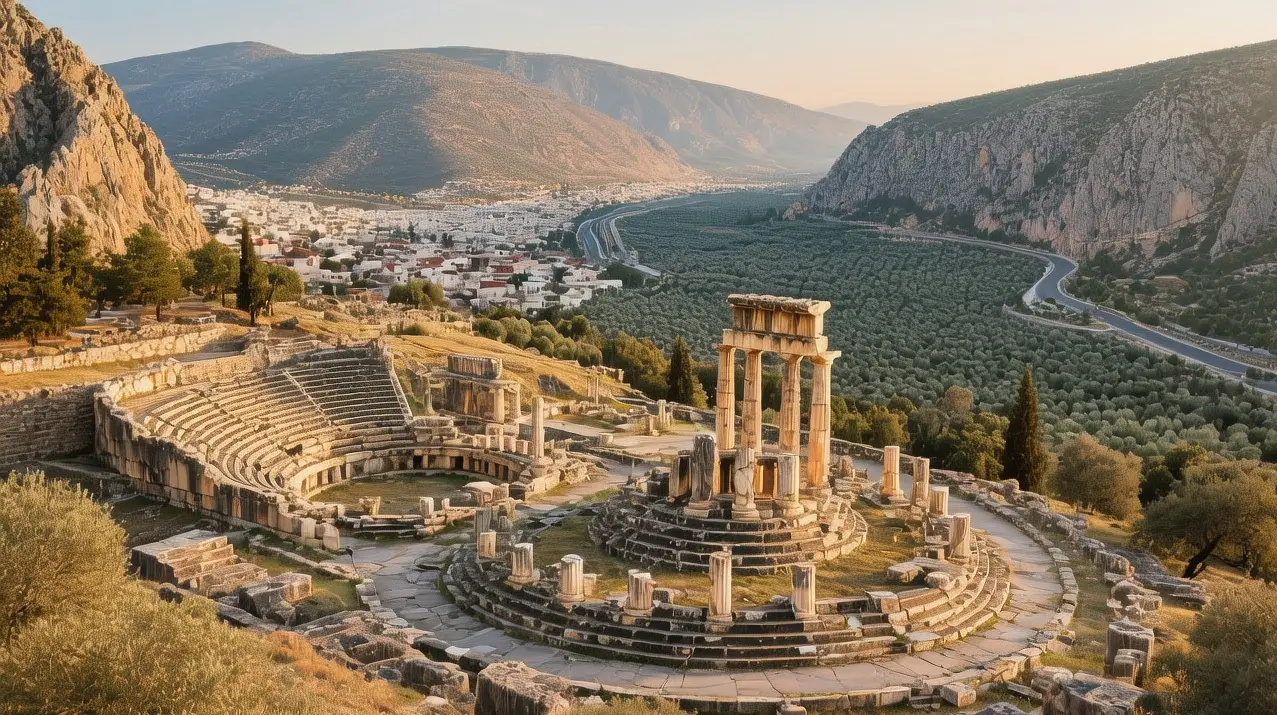
Delphi Archaeological Site: Where Oracular Wisdom Meets Parnassus Stone
Late morning light spills over the fissured slopes of Mount Parnassus, casting sharp, geometric shadows across the fractured limestone. The air smells intensely of dry thyme, heated rock, and ancient dust. You stand at the edge of the sanctuary, listening to the rhythmic crunch of gravel underfoot and the distant, haunting whistle of wind funneling through the Phaedriades cliffs. The Delphi archaeological site sprawls before you, ascending the steep terraces in a chaotic yet deliberate arrangement of ruined altars, treasuries, and temples. Perched 570 meters (1,870 feet) above the Corinthian Gulf, this precipitous complex once drew kings and commoners alike to the mouth of the Pythia. It matters because it is not merely a collection of architectural fragments; it is the physical manifestation of the ancient Greek psyche—a rugged, isolated amphitheater where humanity once conversed directly with the divine, firmly anchoring the mythological center of the earth to an unforgiving mountain.
Why the Delphi Archaeological Site Embodies Oracular Power
To understand the Delphi archaeological site is to recognize the profound geopolitical problem it solved for the ancient world. In an era of constant warfare and colonial expansion, Greek city-states required infallible divine guidance—and Delphi provided it, positioning itself as the ultimate spiritual arbiter. The engineering required to build a sanctuary on a 30-degree mountain slope is staggering. The centerpiece, the Temple of Apollo, measures 58 meters (190 feet) in length and originally featured a peristyle of 38 fluted Doric columns, each carved from local porous limestone and precisely oriented to catch the winter solstice sun. Constructed during the fourth century BC atop the ruins of earlier temples destroyed by earthquakes and landslides, the structure relied on massive, interlocking stone blocks that absorbed the violent seismic energy of the region. Below the temple, the Sacred Way winds upward for roughly 200 meters (656 feet), paved in uneven stone slabs designed to slow the progress of approaching pilgrims, building psychological tension before their audience with the oracle. This architectural choreography fulfilled a profound psychological need: creating a controlled, theatrical environment that transformed ambiguous natural geological phenomena—likely ethylene gas seeping from subterranean fault lines—into a structured, institutionalized religious experience that dominated Mediterranean politics for over a millennium.
The Best Time to Experience the Delphi Archaeological Site
To walk the Sacred Way without jostling through dense crowds requires precise seasonal timing. Plan your visit between April 22 and May 15, or from September 28 to October 18. During these specific windows, the ambient temperature hovers between 18°C and 22°C (64°F–72°F), providing the physical stamina needed to navigate the steep inclines. Arrive precisely at 8:00–9:30 AM, immediately as the main gates open. At this hour, the morning mist often lingers in the valley below, and the acoustic silence allows you to hear the distinct echo of your footsteps inside the empty theater. You must strictly avoid July 10 through August 20. During this brutal period, temperatures routinely exceed 35°C (95°F), and the site offers virtually zero shade. The reflective white limestone amplifies the heat, creating an oppressive environment that makes the steep climb to the stadium physically dangerous. Furthermore, massive tour buses from Athens disgorge thousands of visitors into the narrow pathways. For official ticketing updates, seasonal closure warnings, and real-time visitor caps, consult the official national tourism portal: https://delphi.culture.gr/.
Approximate Budget for a 7-Day Trip
Calculating the cost of a deep cultural immersion in Delphi requires prioritizing proximity over luxury. By staying in the modern village of Delphi rather than the coast, you eliminate daily transit friction and gain the ability to walk to the ruins at dawn.
- • Accommodation: €70–€110 per night (traditional stone guesthouse in Delphi village, featuring a balcony overlooking the Pleistos Valley)
- • Food: €50 per day (breakfast €6 for Greek yogurt and local honey, lunch €14 for a souvlaki wrap and Mythos beer, dinner €30 for slow-roasted lamb kleftiko with roasted potatoes and a carafe of regional PGI Arachova wine)
- • Transportation: €32 total (€22 for a round-trip KTEL bus from Athens Terminal B to Delphi; €10 for a local taxi to access the lower trailhead at the Sanctuary of Athena Pronaia)
- • Attractions: €24 individual prices listed (Delphi Archaeological Site: €6; Delphi Archaeological Museum: €6; Sanctuary of Athena Pronaia: included in main ticket; Ancient Stadium: included in main ticket; Hosios Loukas Monastery in nearby Distomo: €6)
- • Miscellaneous: €35 (hand-carved olive wood pestle from a village cooperative: €18, 500ml bottle of local Amfissa olive oil: €10, insulated water bladder for the steep hikes: €7)
Total: €701–€1,051
6 Essential Delphi Archaeological Site Experiences
- Ascending the Sacred Way: Begin your journey at the Roman Agora and walk the ancient processional path. Feel the smooth, polished texture of the original limestone paving slabs under your boots. Pause at the Polygonal Wall, running your fingers over the precisely interlocking, irregularly shaped stones that have withstood two millennia of earthquakes without mortar.
- Standing in the Temple of Apollo Cella: Step over the threshold into the inner chamber where the Pythia delivered her prophecies. Look down to see the exposed bedrock; this is the exact geological fissure where ancient historians claimed the sacred pneuma escaped. The heavy, chilling draft that constantly flows through this gap provides a visceral, physical connection to the site's mystical history.
- Examining the Treasury of the Athenians: Located halfway up the slope, this reconstructed building features exceptionally tight masonry. Crouch down to inspect the inscribed marble blocks—some still bear the precise chisel marks of the fifth-century BC sculptors who dedicated this structure to celebrate the Battle of Marathon.
- Sitting in the Ancient Theater: Climb the steep, 35-tiered seating area of the fourth-century BC theater. Sit in the exact center of the lowest row and speak in a normal voice; the perfectly engineered limestone acoustics will carry your whisper to the top row with startling clarity, framed by a sweeping view of the valley below.
- Running the Ancient Stadium: Trek to the highest point of the sanctuary to find the well-preserved athletic stadium, measuring 177 meters (580 feet) in length. Walk the raised starting line, marked by carved stone grooves where athletes once placed their feet. The total isolation up here, surrounded by sheer rock walls, highlights the intense physical danger of ancient chariot races.
- Viewing the Charioteer in the Museum: Leave the outdoor site to study the iconic bronze statue in the adjacent museum. Stand exactly three meters away to observe the meticulous inlaid glass eyes and the delicate silver detailing on the reins. The dark, controlled lighting perfectly captures the intense, focused psychological state of a victorious athlete.
3 Hidden Gems Most Travelers Miss
- The Upper Castalian Spring Niche: Most tourists photograph the visible Roman fountain below the road, but the true purification spring lies higher up. Access requires scrambling up a steep, unmarked rocky path behind the main ticket kiosk. It is overlooked because there are no signs directing visitors upward. You will find a deep, rectangular niche carved directly into the sheer cliff face, dripping with ice-cold spring water. This is the actual hidden gem where Pythia and visiting priests purified themselves before entering the temple.
- The Gymnasium Ruins: Located a 10-minute walk southwest of the main sanctuary, down a poorly marked dirt trail. It is overlooked because it sits below the main road, out of the primary sightline. It features an extensive, two-level complex of ancient running tracks, plunge pools, and changing rooms built directly into the hillside. Insider tip: visit at 4:00 PM when the lowering sun illuminates the submerged, algae-covered stone pillars of the indoor pool.
- The Corycian Cave: Situated at an elevation of 1,360 meters (4,462 feet) on the slopes of Parnassus. It is entirely missed by standard tourist itineraries because it requires a grueling 3-hour hike through dense pine forests from the village of Arachova. The cave is a massive, 90-meter (295-foot) deep cavern filled with stalactites, historically used for the worship of the god Pan. Insider tip: hire a local guide from Arachova (+30 22670 31249) as the trail network above the tree line is completely unmarked and prone to sudden alpine fog.
Cultural & Practical Tips
- • Wear shoes with aggressive, gripped rubber soles; the ancient limestone pathways are highly polished by millions of footsteps and become treacherously slick, especially when navigating the steep steps of the theater and stadium.
- • Learn a respectful Greek phrase: say "Yia sou" (YAH-soo) when purchasing tickets, and "Signomi" (SEEG-noh-mee) when squeezing past other visitors on the narrow Sacred Way.
- • Pack at least 2 liters of water per person; there is a single water fountain near the Roman Agora, but the upper sections of the site—the stadium and the theater—offer zero shade or water access during the summer months.
- • Photography with tripods is strictly prohibited without a special permit from the Ministry of Culture; to capture the intricate details of the Polygonal Wall, brace your camera firmly against the stone and use a high-ISO setting to compensate for the deep shadows.
- • Be acutely aware of the Parnassus microclimate; even in late spring, a sudden meltemi wind can drop the windchill at the stadium level to near freezing. Carry a lightweight, windproof layer in your daypack at all times.
- • Do not attempt to touch or climb on the fractured column drums; the ancient limestone is highly porous and friable, meaning human touch actively accelerates the erosion of the surviving fluting.
Conclusion: Travel with Reverence, Not Just Superficiality
The Delphi archaeological site is not merely an outdoor museum designed for rapid visual consumption; it is a rugged, deeply scarred landscape that once shaped the geopolitical destiny of the Western world. When you choose to travel with reverence rather than rushing to snap a photo of the Temple of Apollo, you begin to honor the immense human endurance required to carve a sanctuary out of a hostile mountain. Slow down. Resist the urge to sprint directly to the stadium and instead sit quietly on the steps of the Treasury of the Athenians, tracing the ancient inscriptions with your eyes. Mindful tourism recognizes that these fragile limestone walls have a finite tolerance for the friction of modern foot traffic. By engaging deeply—understanding the seismic engineering that kept the columns standing, respecting the silent acoustics of the theater, acknowledging the profound mysticism of the bedrock fissure—you shift from being a passive spectator to an active steward of Hellenic heritage. Let the sheer verticality of Mount Parnassus humble you; that is where the true magic of Delphi resides.