
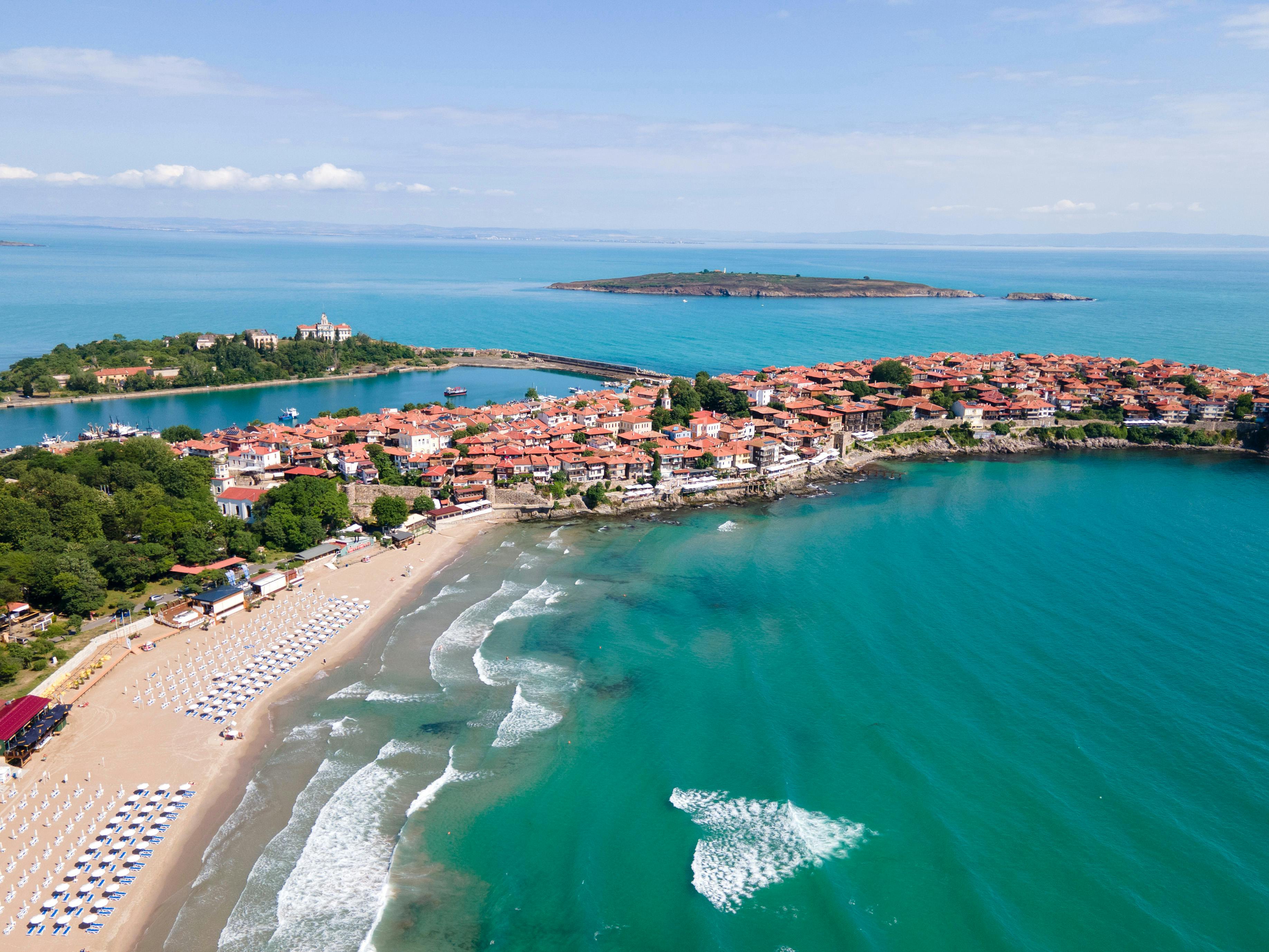
Sozopol Peninsula: Where Ancient Apollo Meets Black Sea Soul
The cobblestones still hold the morning's coolness at 8:00 AM as you step onto the narrow peninsula that has drawn sailors, pilgrims, and dreamers for twenty-seven centuries. Before you—the ancient heart of Sozopol—wooden houses of the Bulgarian Revival period lean toward one another across lanes so narrow that second-floor balconies nearly touch . The Black Sea slaps gently against the medieval fortress walls, a rhythm unchanged since Greek colonists named this place Apollonia in 611 BC . The air smells of salt and frying fish, of sun-warmed stone and the jasmine that spills from the gardens of 19th-century merchant homes. Behind you, the modern world hums; before you, a peninsula just 850 meters long holds the layered ghosts of Thracians, Greeks, Romans, Byzantines, and Bulgarians—a civilization sandwich pressed into less than a square kilometer of land. This is not merely an old town; it is Bulgaria's most soulful coastline, where the legendary 13-meter bronze statue of Apollo once guided ships and where, two millennia later, the remains of John the Baptist drew pilgrims from across the Orthodox world .
Why Sozopol Peninsula Embodies Black Sea Cultural Fusion
The Sozopol peninsula tells the story of the Black Sea in miniature. Founded in the 7th century BC by Greek colonists from Miletus and Phocaea, the city was named Apollonia Pontica—dedicated to Apollo, god of light and navigation . The city's crowning achievement was a colossal bronze statue of Apollo, standing more than 13 meters (43 feet) tall, crafted by Kalamis—one of Athens' most celebrated sculptors of the 5th century BC . This statue served not merely as an object of worship but as a lighthouse, guiding ships into the harbor from across the Black Sea. The Romans conquered the city, then the Byzantines, who renamed it Sozopolis—"city of salvation"—in the 4th century AD . The 19th century brought the Bulgarian Revival and the peninsula's iconic wooden houses: stone ground floors supporting dark wooden upper stories, designed to withstand both earthquakes and time. In a controversial archaeological discovery in 2010, relics believed to belong to St. John the Baptist were unearthed on nearby St. Ivan Island, transforming the peninsula into a pilgrimage site once more . Today, the old town—declared an "architectural reservation" in 1974—preserves the most intimate fusion of Greek, Byzantine, and Bulgarian cultures anywhere on the Black Sea coast.
The Best Time to Experience Sozopol Peninsula
Late spring and early autumn deliver the peninsula's most sublime conditions. From May 15 through June 20, daytime temperatures average 21°C (70°F), with the Black Sea warming to a swimmable 15–21°C (59–70°F) and wildflowers blooming across the surrounding hills . September offers the true sweet spot: September 1 through September 30 sees highs of 24°C (75°F), sea temperatures of 22°C (72°F), and the summer crowds melted away—September averages just four rainy days . July and August bring the heat, with daytime highs reaching 28–29°C (82–84°F) and sea temperatures peaking at 25°C (77°F)—perfect for swimming but also for shoulder-to-shoulder crowds on the peninsula's narrow cobblestone lanes . The golden hours of 7:00–8:30 AM and 5:30–7:00 PM offer the most dramatic light for photography, when the wooden houses glow amber and the fortress walls cast long shadows across the harbor. Avoid November through March, when temperatures drop to 6–10°C (43–50°F), many restaurants close, and the wind off the Black Sea can be biting . For updated church opening hours and festival dates (including the September Apollonia Arts Festival), consult the official website: www.sozopol.bg
Approximate Budget for a 7-Day Trip
This budget assumes a mid-range stay in Sozopol's New Town (just across the bridge from the peninsula) or in nearby holiday villages, with daily excursions to the old town. Bulgaria remains one of Europe's most affordable heritage destinations. Prices are in Bulgarian Lev (BGN), with approximate US Dollars (1 BGN ≈ $0.55 USD).
- Accommodation: 60 BGN–150 BGN ($33–$83) per night. A 3-star hotel in the New Town averages 75 BGN ($41) per night . Budget rooms in guesthouses start at 45 BGN ($25). The Apolonia Palace Hotel (on the peninsula's edge) charges approximately 120 BGN ($66) for a sea-view room .
- Food: 35–65 BGN ($19–$36) per day. Breakfast: 6–10 BGN for banitsa (cheese pastry) and Bulgarian yogurt. Lunch: 12–18 BGN for Shopska salad and grilled kyufte at a harbor-side restaurant. Dinner: 18–30 BGN for fresh Black Sea turbot or tsatsa (small fried fish) with a glass of local white wine . Mehanas (traditional taverns) offer mixed grill platters for 15–20 BGN .
- Transportation: Bus from Burgas Airport (BOJ) to Sozopol: Line 15, 5 BGN ($2.75) one way, journey time 45 minutes. Taxi from airport: 35–45 BGN ($19–$25). Walking: The peninsula is compact and best explored on foot—no internal transportation needed. Boat trips around St. Ivan Island: 15–25 BGN ($8–$14) per person .
- Attractions: Archaeological Museum (houses artifacts from ancient Apollonia): 5 BGN ($2.75) . Church of St. Cyril and Methodius (contains relics of St. John the Baptist): free entry (donations appreciated). Southern Fortress Wall and Tower: free entry . St. Ivan Island boat tour with landing: 20–30 BGN ($11–$17). Ravadinovo Castle (fairytale castle, 30 minutes away): 25 BGN ($14) .
- Miscellaneous: Hand-painted icon from a local artisan: 15–40 BGN ($8–$22). Jar of Sozopol honey (from the peninsula's wildflowers): 8 BGN ($4.40). Cocktail at a promenade bar overlooking the Black Sea: 10–15 BGN ($5.50–$8.25). Sunrise fishing trip with local fishermen: 40 BGN ($22) for two hours.
- Total for 7 days (mid-range, excluding flights): 700–1,200 BGN ($385–$660) per person.
- Walk the Southern Fortress Wall at Dawn: The medieval fortifications that encircle the peninsula's southern edge are partially restored, but they remain the most evocative access point to Sozopol's layered past . Begin at 6:45 AM, just as the sun climbs over the Black Sea. Climb the tower section—where the stone stairs are worn concave by centuries of footfall—for a panoramic vista of red-roofed houses, azure waves, and weathered battlements that photographers dream of . Angle your shot with the ancient gateway arch framing the water for extra drama .
- Trace 2,600 Years in the Archaeological Museum: Housed in a restored Revival-period building, this small museum contains the soul of ancient Apollonia. Among its treasures: decorated ceramics from the 6th century BC, stone anchors from the Hellenistic period, and fragments of the city's original defensive walls . The museum's prize piece is a marble kouros (youth statue) from 480 BC, discovered in the sea off the peninsula's coast. Allow 45 minutes; the museum is air-conditioned, a blessing in July .
- Stand Before the Relics of John the Baptist: The Church of St. Cyril and Methodius, perched near the peninsula's highest point, guards one of the Orthodox world's most controversial treasures: relics believed to belong to St. John the Baptist, discovered on nearby St. Ivan Island in 2010 . The reliquary sits to the right of the iconostasis, illuminated by a single candle. Whether you believe or not, the devotion of the pilgrims who travel here—some walking for days—is palpable. The church is free, but a 2 BGN donation helps maintain the building.
- Get Lost in the Wooden House Labyrinth: Sozopol's old town is a maze of cobbled lanes where 19th-century wooden houses crowd together so closely that their upper floors nearly kiss across the street . The most photogenic streets are behind the Church of St. Zosimo, where a staircase descends between two ochre-and-cream Revival homes toward a hidden courtyard. No map needed; the peninsula is only 850 meters long, so you cannot truly get lost. That is the point.
- Watch the Sunset from the Windmill Point: At the peninsula's southern tip, just beyond the last fortress tower, a low stone breakwater extends into the Black Sea. This spot—known to locals simply as "the windmill place"—offers an unobstructed view of the sun sinking directly into the sea. Arrive by 6:45 PM, find a flat rock, and watch as the wooden houses behind you catch fire in the fading light. After sunset, the harbor lights of Sozopol twinkle to life, reflected in the calm sea like scattered stars.
- Take the Boat to St. Ivan Island: Bulgaria's largest island lies just 2 kilometers offshore. A 20-minute boat ride (15–25 BGN round trip) carries you across waters that teem with dolphins in early summer . The island is uninhabited except for seabirds and the ruins of a 13th-century monastery where St. John the Baptist's relics were discovered. You can land and walk the island's 1.2-kilometer length in an hour. Bring water; there are no facilities. The boat departs from the old town harbor daily at 10:00 AM and 2:00 PM from May through September.
- Eat Fried Tsatsa at a Harbor Mehana: Sozopol's gastronomic signature is tsatsa—tiny Black Sea sprats, fried whole and served with a squeeze of lemon and cold beer . The harbor-side taverns serve them by the plate (6–8 BGN for a generous portion). For the full experience, order at Restaurant Neptune, a family-run mehana that has been frying tsatsa in the same spot since 1976. Pair it with a glass of local Dimyat white wine (4 BGN) and watch the fishing boats unload their morning catch two meters from your table.
- The Icon Gallery at the Church of the Holy Mother of God: The 14th-century Church of the Holy Mother of God—often overlooked in favor of more accessible churches—contains a side gallery of 19th-century Bulgarian Revival icons that is worth the admission alone (3 BGN). Mother-of-pearl inlaid into the halos, silver plating on the saints' vestments, and an unusual icon of St. George slaying a dragon with a distinctly Bulgarian-looking horse. The church is open 10:00 AM–1:00 PM and 2:00–5:00 PM, but the icon gallery is only accessible when the volunteer keeper, an elderly woman named Desislava, is present—usually Wednesday and Saturday afternoons.
- The Abandoned Greek Cemetery: Behind the Archaeological Museum, a narrow path leads up a hillside covered in wild rosemary and thyme. Here, hidden among knee-high weeds, lie the remains of Sozopol's Greek cemetery—the final resting place of families who fled or were expelled in the 1920s population exchanges between Greece and Turkey . The marble headstones are carved in Greek, weathered but legible: names like Papadopoulos, Georgiades, and Konstantinides, dates from the 18th and 19th centuries. It is a quiet, melancholy place, and almost no tourists find it. Enter from behind the museum; there is no sign.
- Morning Coffee with the Fishermen: At 6:00 AM, the old town harbor transforms into a fish market. Local fishermen sell their overnight haul directly to restaurant owners and a few knowing locals: red mullet, Black Sea turbot, and the occasional monkfish. Tucked between two fish stalls is a temporary coffee cart—just an espresso machine on a folding table, run by a man named Yasen. A coffee costs 1.50 BGN, and you drink it standing, surrounded by the sounds of bargaining boats and the smell of the morning's catch. Yasen speaks English and will translate the bargaining for you. The auction lasts about an hour, ending around 7:00 AM when the restaurants have bought their day's supply.
- Nodding means NO: Bulgaria shares the famous head gesture quirk with Greece. A nod up and down means "no." A side-to-side shake means "yes." This confuses nearly every first-time visitor. Observe locals carefully; if uncertain, use "da" (yes) and "ne" (no) verbally.
- Phrases to learn: "Zdravete" (ZDRA-ve-te) means hello. "Blagodarya" (bla-go-DA-rya) is thank you. "Kade sa toaletnite?" (KA-de sa to-a-LET-nee-te?)—where are the restrooms?—will prove useful; the cleanest public toilets are behind the Archaeological Museum (1 BGN). "Riba" (REE-ba) means fish—useful at the morning market.
- Photography rules: No flash photography inside any church—the medieval and Renaissance frescoes are fragile, and flash accelerates pigment degradation. Drones are prohibited over the peninsula entirely (the old town is a protected architectural reservation). The best photo of the peninsula is taken from the boat to St. Ivan Island at 7:00 PM, when the sun angles across the wooden houses.
- Cash is king on the peninsula: While hotels and larger restaurants accept cards, the small church entry fees, family-run taverns, and the morning fish market operate on cash only. ATMs are available in the New Town (across the bridge)—the peninsula has none. Arrive with at least 50 BGN in small notes.
- Wear proper footwear: The cobblestones of Sozopol's old town are original—meaning uneven, slippery when wet, and unforgiving to thin-soled shoes. Broken ankles are the most common tourist injury here. Wear closed-toe walking shoes or sturdy sandals with grip. The section between the harbor and the Church of St. Cyril and Methodius is particularly treacherous.
- September is festival month: The Apollonia Arts Festival, held annually from September 1–10, transforms the peninsula into a stage. Musicians, actors, and artists from across Bulgaria perform in the open-air theatre, in the churches, and on street corners . Accommodation prices double during festival week, and reservations should be made by February. If you can—go. The festival is Sozopol at its most alive.
- Sunday liturgy at St. Zosimo: The small Church of St. Zosimo holds a Bulgarian Orthodox service every Sunday at 8:30 AM. Visitors are welcome but should stand near the back, dress modestly (shoulders and knees covered), and refrain from photography. The choir—four elderly women in black dresses—sings a capella in close harmony, their voices filling the tiny stone space. It is the most beautiful hour you will spend in Sozopol.
7 Essential Sozopol Peninsula Experiences
3 Hidden Gems Most Travelers Miss
Cultural & Practical Tips
Conclusion: Travel with Reverence, Not Just Camera Shots
You could rush Sozopol—tick off the fortress in twenty minutes, photograph the wooden houses, eat your tsatsa, and declare it "done." Many do. Or you could do what the fisherman Yasen does at dawn: pour your coffee into a chipped ceramic cup, stand at the harbor's edge, and watch the sky lighten over St. Ivan Island. Sozopol has been here for 2,600 years—through Greek colonists and Roman legions, Byzantine priests and Ottoman admirals, population exchanges and democratic revolutions. The peninsula does not need you to hurry. It will still be here next week, next summer, next century. The stones of the fortress wall. The wooden balconies that lean toward each other. The relics of the Baptist in their silver reliquary. What it asks of you is not a checklist but a presence: to walk its cobbled lanes slowly enough to hear the sea between your footsteps. To sit in the ruined Greek cemetery long enough to read a stranger's name from a century ago. To realize that you are not visiting history—you are walking beside it. And if you are still, you might hear it breathe.