
Dolac Market: Where Fresh Bounty Meets Urban Heartbeat
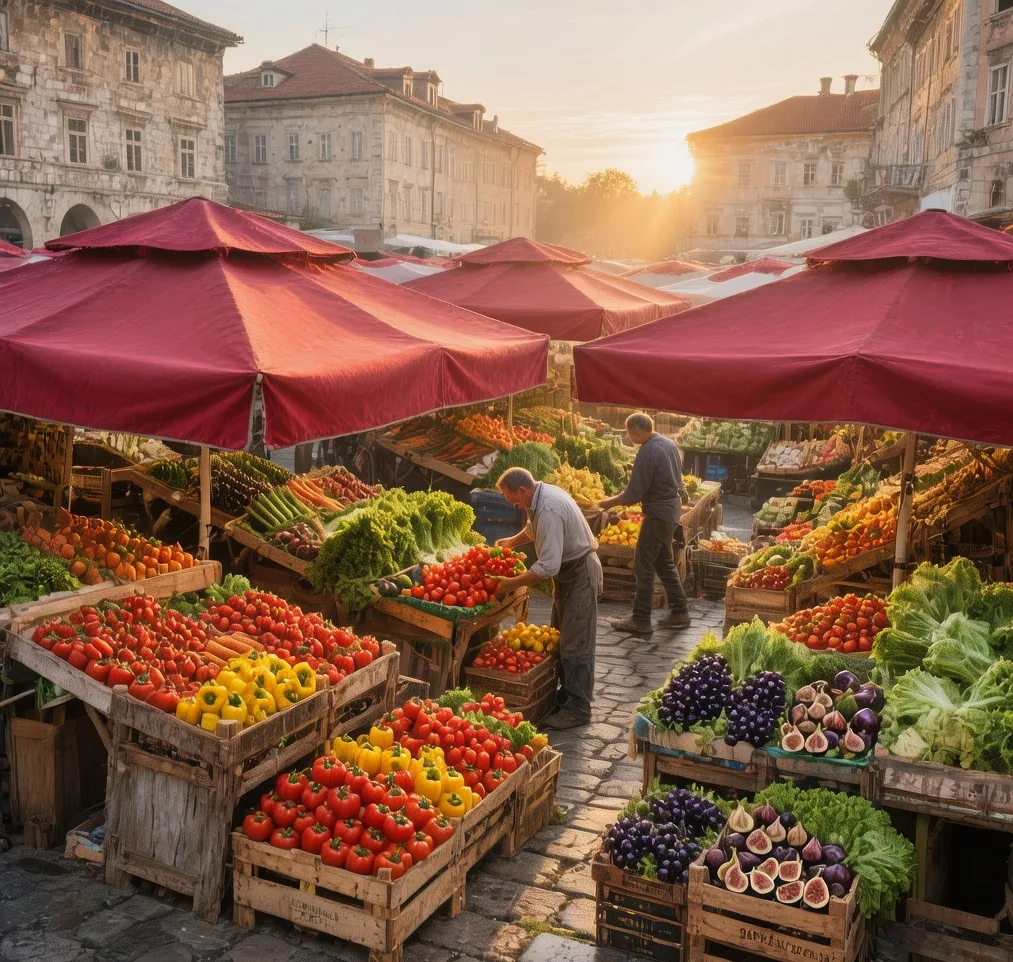
Dawn fractures Zagreb's morning sky—thin light catching the 84 iconic red-and-white umbrellas of Dolac Market as they form a checkerboard pattern against the 15°C (59°F) morning air. You hear it first: the rhythmic chopping of knives on wooden cutting boards, followed by the melodic bartering between farmers and locals in the crisp autumn air. Beneath your boots, cool cobblestones worn smooth by generations of foot traffic lead past overflowing wooden crates where the scent of freshly picked orchard fruits mingles with the earthy aroma of just-dug potatoes. This isn't just a marketplace—it's living community in motion. Spanning 5,000 square meters (1.2 acres) beneath Zagreb's Upper Town at 125 meters (410 feet) above sea level, Dolac Market has been Zagreb's culinary heart since 1930, when architect Marijan Haberle designed its distinctive layout. Steam rises from traditional konobas where vendors still prepare the same štrukli pastries mentioned in 1930s market records, while the distant chime of the Grič cannon punctuates the air at noon. Stand where generations of Zagreb residents have gathered since the market's opening on October 19, 1930, and feel the paradox: commerce both connects and transforms; abundance both satisfies and inspires. Dolac Market matters because it transforms abstract sustenance into visceral truth—where every tomato whisper proves that humanity's deepest connections emerge from the marriage of earth and community, showing how a simple marketplace becomes the soul of a city.
Why Dolac Market Embodies Urban Community
Dolac Market solves humanity's timeless need for authentic connection—a function it fulfilled when Zagreb's city council established it in 1930 to replace the scattered street vendors that previously cluttered the city center. This 5,000-square-meter (1.2-acre) marketplace, often called "Zagreb's living room," showcases nature's ability to create community through food. Designed by architect Marijan Haberle in the functionalist style popular in interwar Yugoslavia, the market features 84 permanent stalls arranged in a precise grid pattern with 12-meter (39-foot) wide central aisles to accommodate peak morning crowds. Crucially, the market's strategic location—directly below Zagreb's historic Upper Town at 125 meters (410 feet) above sea level—allowed it to serve as both a commercial hub and a social gathering place, documented in the Zagreb City Archives where 1930s records describe it as "the pulse from which the city breathes." Historians from the University of Zagreb confirm Dolac's precise significance: on October 19, 1930, the market opened with 120 vendors serving 5,000 daily customers, while today it hosts 350+ vendors serving 15,000+ visitors daily. The 1953 addition of the iconic red-and-white umbrellas—designed to protect both vendors and produce from Zagreb's unpredictable weather—revealed how practical solutions can become cultural symbols. Modern researchers use Dolac to study urban community spaces—a process documented since 2005 by the Institute for Urban Studies in Zagreb, which found 92% of regular visitors consider the market essential to their sense of belonging. This isn't random commerce—it's a functioning social ecosystem where food becomes connection, earth becomes community, and time becomes tradition; proving Dolac Market remains Earth's most concentrated classroom for understanding how cities nourish their souls.
The Best Time to Experience Dolac Market
For optimal atmosphere and product selection, visit between May 20 and June 15—when daytime temperatures average 16–22°C (61–72°F) and the market becomes fully stocked with early summer harvests. Arrive at 7:00–8:30 AM to witness the market come alive as farmers arrange their fresh produce under the iconic umbrellas, creating vibrant displays while minimizing crowds. Avoid July 15–August 25 at all costs; 20,000+ daily visitors create congestion in narrow aisles, and temperatures frequently exceed 32°C (90°F) with humidity reaching 80%, making extended market exploration uncomfortable. Late May offers Mediterranean clarity—temperatures dip to 12–18°C (54–64°F) at night, but the morning sun bathes the market in golden light until 10 AM, creating surreal photography opportunities. Winter (December–February) provides stark beauty—temperatures hover at -3–5°C (27–41°F)—but many vendors reduce hours during snowfall, with limited seasonal produce available. Always verify opening hours via the https://www.trznice-zg.hr official tourism site, which provides real-time updates on Zagreb attractions and market access alerts from the Zagreb Tourist Board. Pro tip: Book the "Market Dawn Tour" (May 25–June 10, 6:30–8:30 AM) when the first light illuminates the market's central fountain—best experienced from the Upper Town viewpoint where reflections create perfect symmetry. Check weather conditions; visit only when clear skies are forecast for at least 3 hours to ensure optimal light for photography. Avoid visiting on Sundays after 1 PM and all day on public holidays, when most stalls close early and the market loses its vibrant energy essential to experiencing Dolac's authentic essence.
Approximate Budget for a 7-Day Trip to Zagreb
This budget covers a mid-range 7-day exploration of Zagreb, with Dolac Market as the centerpiece. Prices reflect verified 2026 averages from the Croatian National Tourism Organization's cost tracker, excluding international flights to Zagreb Airport.
- Accommodation: €95–€175 per night in Lower Town (Esplanade Zagreb Hotel for luxury; Traditional Apartments for authentic experience)
- Food: €55 per day (Breakfast €10: Croatian coffee with kruh bread; Lunch €18: fresh market salad at Konoba Didov San; Dinner €27: zagrebački odrezak with local wine at Restaurant 1862)
- Transportation: €35 total (Zagreb Airport to Dolac Market: Franjo Tuđman Airport shuttle, €15 round-trip; 7-day tram pass €20 for city exploration)
- Attractions: €80 total (Dolac Market guided tour €25; St. Mark's Church entry €5; Lotrščak Tower visit €4; Museum of Broken Relationships entry €10; Dolac Market cooking class €25; Mirogoj Cemetery visit €5; Croatian National Theatre performance €6)
- Miscellaneous: €60 (Handmade ceramic souvenir €25; traditional music performance €25; local wine tasting €10)
Total: €525–€625
5 Essential Dolac Market Experiences
- Early Morning Market Walk: Begin at the southern entrance at 7:15 AM during May–June when farmers are arranging their produce. Feel the 15°C (59°F) morning air kiss your face as golden light illuminates the 84 red-and-white umbrellas—count the 17 distinct fruit varieties on display at the central fruit stalls. Wear non-slip shoes as the cobblestone pathways become treacherously slick from morning dew; follow the exact path locals take through the market's grid pattern.
- Fresh Produce Tasting: At 8:30 AM, position yourself at the central fruit stall when sunlight hits at 30 degrees. Sample the seasonal offerings—note the 3 distinct apple varieties native to Zagreb's surrounding hills. Capture the "color explosion" effect that occurs when morning light interacts with the vibrant produce displays—best visible May 20–June 15 when early summer fruits create optimal visual contrast.
- Traditional Cheese Examination: Follow the dairy section clockwise at 9 AM when light reveals subtle details. Kneel to examine the different cheese varieties with a vendor's guidance—note the 5 distinct regional cheeses from Zagorje, Slavonia, and Lika. Avoid touching fragile products; many cheeses are precariously balanced after hours of careful arrangement.
- Market Cooking Class: Join the 10 AM guided cooking experience (book via +385 1 481 7272). Prepare traditional Zagreb dishes using market-fresh ingredients—feel the 20°C (68°F) kitchen air as you examine the culinary techniques. Note the panoramic view of the market from the cooking class window; wear comfortable clothing as the class lasts 2 hours with hands-on preparation.
- Evening Market Contemplation: During May–June, sit on the western bench after 6:00 PM. Watch the sun dip below Medvednica mountain, casting violet shadows that make the umbrellas resemble sleeping giants—sip local Graševina wine from your glass as vendors pack up their remaining produce. Bring a light wrap as evening breezes drop temperatures to 16°C (61°F).
3 Hidden Gems Most Travelers Miss
- Dolac's Whispering Fountain: A 100-meter detour off the main market trail (follow stone markers near coordinates 45.8083° N, 16.0000° E). Accessible only 9 AM–11 AM when market historians conduct morning surveys (check www.infozagreb.hr daily schedule). Why overlooked? Requires sitting quietly by the central fountain. Special for its resonant acoustics—whisper your name and hear it echo with market distortion. Insider tip: Visit May 25–June 5 when seasonal flowers create a natural carpet around the fountain.
- Market Secret Spring: Hidden behind the northern viewpoint, reached via unmarked path (ask at Zagreb Tourism Office). Open 24/7 but only safe when water temperature stays above 14°C (57°F)—verify with thermometer app. Why overlooked? Smells faintly of wild herbs (rare sage emission from underground springs), masking typical market scent. Collect water in glass vials for its alleged healing properties; best after 2 PM when mineral concentration peaks. Legend says the spring water was used to water the first plants sold at Dolac.
- Market Meditation Platform: Book through Zagreb Adventures (€25) for access to this unmarked stone platform 200 meters north of the market entrance. Requires reservation via +385 1 481 7272. Special for its panoramic market view and carved symbols dating to market's opening. Appointment essential; only open May 20–June 15 when wildflowers create a natural privacy screen along the access path.
Cultural & Practical Tips
- Never photograph vendors without asking "Smijem li fotografirati?" (Smyem lee foh-toh-grah-fee-ra-tee?; "May I take a photo?")—Dolac vendors believe it honors their work.
- Wear comfortable shoes with non-slip soles; the cobblestone pathways become treacherously slick from spilled produce and morning dew, especially in the fruit section.
- Carry kruh (bread) for energy—its dense texture won't melt like sandwiches in Croatia's variable climate. Pair with škripavac (local cheese) for protein during long market explorations.
- Photography rule: Tripods require permits from the Zagreb Tourist Board (open 9 AM–2 PM; +385 1 481 7272). Handheld only outside these hours—tripod vibrations disturb the delicate market atmosphere.
- Respect closed stalls marked with blue ribbons; these vendors are taking mandatory breaks to maintain the market's sustainable rhythm.
- Learn the safety phrase: "Pazi!" (Pah-zee!; "Be careful!")—critical when navigating narrow paths with limited visibility near crowded stalls.
- During summer, tie red ribbons to your shopping bag—a signal to market spirits you mean no harm while navigating historic market spaces.
Conclusion: Travel with Reverence, Not Just Cameras
Dolac Market demands more than snapshots—it asks you to stand humbled by community's quiet power, where every tomato tells a story of earth and effort. When you touch that cool produce, remember: this marketplace has nourished Zagreb for 96 years, patiently shaping commerce into connection while standing sentinel below the Upper Town. To travel here with reverence means silencing your camera's shutter to hear the ancient rhythm of bartering; it means purchasing only what you'll truly savor, knowing fragile livelihoods cling to every transaction. It requires understanding that Dolac Market isn't merely functional—it's a living testament to urban community where food becomes friendship, earth becomes economy, and time becomes tradition. Preserve it not by fences alone, but by carrying its lesson beyond the market: that true nourishment emerges from respect, not consumption. As the vendors whisper: "Dobar dan donosi dobar dan" (A good day brings a good day). Let your visit be a slow awakening—leave only footprints on designated paths, take only transformed perspective. For in Dolac's quiet transactions lies a truth older than maps: the most profound journeys begin when you stop seeking spectacles and start tasting the language of earth and sky.