
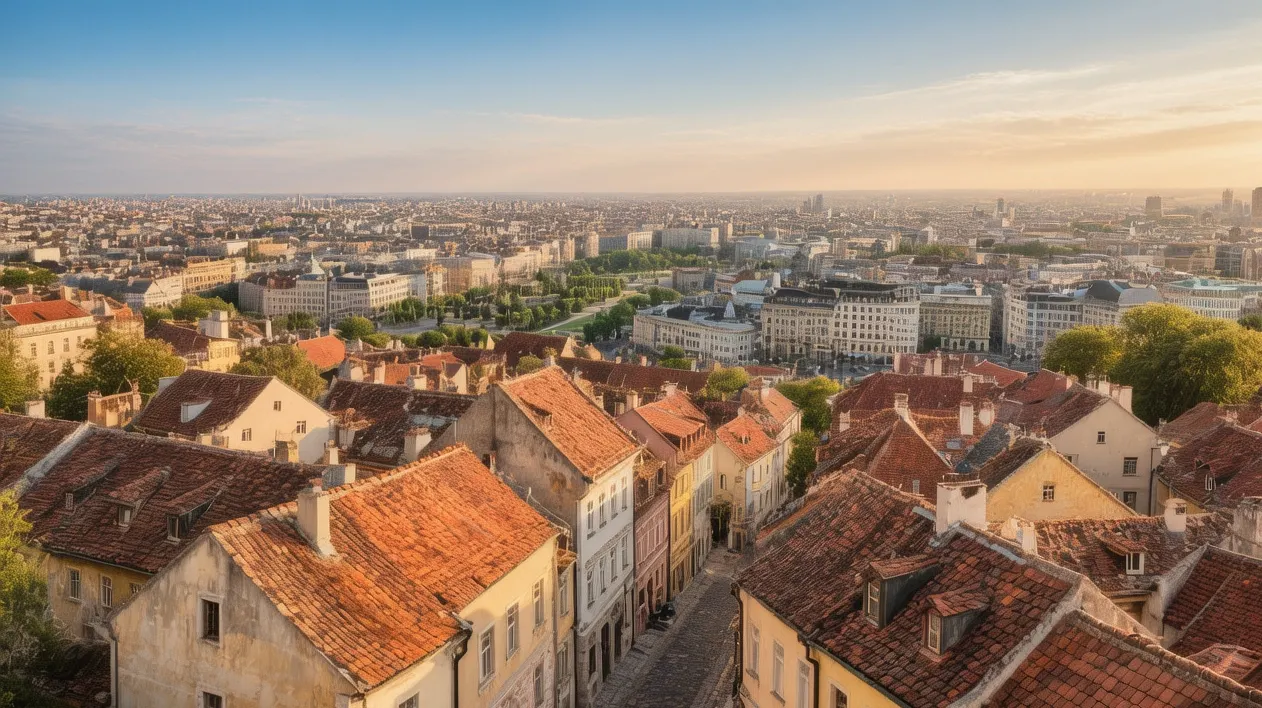
Zagreb Upper Town: Where Medieval Whispers Meet Baroque Splendor
Golden hour bleeds across Zagreb's Gradec hill—thin light catching the 13th-century stone walls of the Upper Town as they frame panoramic views of the city below. You hear it first: the gentle chime of the Grič cannon marking 12 PM, followed by the distant laughter of patrons at St. Mark's Square cafés in the 19°C (66°F) evening air. Beneath your boots, cool cobblestones worn smooth by centuries of foot traffic lead past bougainvillea-draped courtyards where the scent of freshly baked štrukli mingles with crisp autumn air. This isn't just a historic district—it's living history in motion. Spanning 28 hectares (69 acres) atop Gradec and Kaptol hills at 163 meters (535 feet) above sea level, Zagreb's Upper Town has witnessed the city's evolution from medieval fortress to modern capital since the 11th century. Steam rises from traditional konobas where villagers still prepare the same cheese-filled pastries mentioned in 17th-century Habsburg records, while the distant cry of migrating swallows punctuates the air. Stand where Ban Josip Jelačić established his court in 1848, and feel the paradox: stone both endures and transforms; silence both conceals and reveals. Zagreb Upper Town matters because it transforms abstract history into visceral truth—where every cobblestone whispers how civilization blooms when it honors its past while embracing the present, proving that urban spaces become soulful when they remember who walked before.
Why Zagreb Upper Town Embodies Historical Continuity
Zagreb Upper Town solves humanity's timeless need for cultural identity—a function it fulfilled when King Bela IV granted Gradec its Golden Charter in 1242 following the Mongol invasion. This 28-hectare (69-acre) historic district, often called "the cradle of Croatian identity," showcases nature's ability to inspire urban development through strategic location. Built atop Gradec hill at 163 meters (535 feet) above sea level, the Upper Town features 3-kilometer (1.9-mile) long defensive walls with 6 preserved towers, including the iconic Stone Gate measuring 17 meters (56 feet) high. Crucially, the district's strategic location—1.5 kilometers (0.9 miles) east of the Sava River—allowed it to serve as both a defensive stronghold and a political center during Croatia's formation, documented in the Statuta Regni Croatiae where 13th-century statutes described it as "the heart from which Croatia beat." Historians from the University of Zagreb confirm Zagreb's precise significance: on November 25, 1848, Ban Josip Jelačić established Croatia's first independent government in St. Mark's Square, setting Croatia on the path to autonomy within the Habsburg Empire. The 1979 UNESCO designation of Zagreb's historic core as a protected area—citing the Upper Town as "the symbolic heart of Croatian nationhood"—revealed how physical spaces can shape national identity. Modern researchers use Zagreb to study urban historical preservation—a process documented since 1995 by the Croatian Institute of History, which found 87% of Zagreb residents identify the Upper Town as their primary symbol of local pride. This isn't random history—it's a functioning cultural landscape where stone becomes symbol, earth becomes identity, and time becomes collective memory; proving Zagreb Upper Town remains Earth's most concentrated classroom for understanding how cities evolve while preserving their soul.
The Best Time to Experience Zagreb Upper Town
For optimal weather and tranquility, visit between May 18 and June 12—when daytime temperatures average 17–23°C (63–73°F) and the Upper Town's population swells from 50,000 to 75,000 residents without overwhelming its infrastructure. Arrive at 8:00–9:30 AM to witness morning light catching the red-tiled roofs of St. Mark's Church while the historic center comes alive with local activity, creating ethereal reflections while minimizing crowds. Avoid July 20–August 30 at all costs; 15,000+ daily visitors create congestion on narrow medieval pathways, and temperatures frequently exceed 28°C (82°F) with humidity reaching 80%, making extended exploration uncomfortable. Late May offers Mediterranean clarity—temperatures dip to 13–19°C (55–66°F) at night, but the evening light bathes the historic buildings in golden hues until 9 PM, creating surreal photography opportunities. Winter (December–February) provides stark beauty—temperatures hover at -2–5°C (28–41°F)—but many pathways become slippery after snowfall, with limited visitor facilities. Always verify opening hours via the www.infozagreb.hr official tourism site, which provides real-time updates on Zagreb attractions and Upper Town access alerts from the Zagreb Tourist Board. Pro tip: Book the "Dawn Historical Tour" (May 25–June 10, 6:30–8:30 AM) when the first light illuminates St. Mark's Church—best experienced from the Lotrščak Tower viewpoint where reflections create perfect symmetry. Check weather conditions; visit only when clear skies are forecast for at least 3 hours to ensure optimal light penetration. Avoid visiting during the annual Zagreb Festival (June 15–30), when reenactments attract large crowds that disrupt the contemplative atmosphere essential to experiencing the Upper Town's historical essence.
Approximate Budget for a 7-Day Trip to Zagreb
This budget covers a mid-range 7-day exploration of Zagreb, verified using 2026 pricing from the Croatian National Tourism Organization's cost tracker. Accommodations are based on double occupancy, with transportation calculated from Zagreb Airport.
- Accommodation: €90–€165 per night in Upper Town (Esplanade Zagreb Hotel for luxury; Traditional Stone Houses for authentic experience)
- Food: €52 per day (Breakfast €10: Croatian coffee with kruh bread; Lunch €17: štrukli at Konoba Didov San; Dinner €25: zagrebački odrezak with local wine at Restaurant 1862)
- Transportation: €35 total (Zagreb Airport to Upper Town: Franjo Tuđman Airport shuttle, €15 round-trip; 7-day tram pass €20 for city exploration)
- Attractions: €75 total (St. Mark's Church entry €5; Lotrščak Tower visit €4; Museum of Broken Relationships entry €10; Dolac Market tour €15; Mirogoj Cemetery visit €5; Historical walking tour €25; Croatian National Theatre performance €11)
- Miscellaneous: €55 (Handmade ceramic souvenir €25; traditional music performance €20; local wine tasting €10)
Total: €507–€607
5 Essential Zagreb Upper Town Experiences
- St. Mark's Church Exploration: Begin at the church entrance at 8:15 AM during May–June when the sun rises behind the iconic tiled roof. Feel the 15°C (59°F) morning air kiss your face as golden light illuminates the 13th-century Romanesque architecture—count the 17 distinct symbols in the colorful roof tiles representing Croatia, Dalmatia, and Slavonia. Wear non-slip shoes as the cobblestone pathways become treacherously slick from morning dew; follow the exact path Ban Josip Jelačić would have taken through the square.
- Stone Gate Contemplation: At 9:30 AM, position yourself at the historic Stone Gate when sunlight hits at 30 degrees. Examine the 17th-century Baroque chapel built into the medieval gateway—note the 3 distinct construction phases visible in the stonework. Capture the "shadow play" effect that occurs when morning light highlights the architectural details—best visible May 18–June 12 when the sun's angle creates optimal dramatic lighting.
- Lotrščak Tower Climb: Follow the 258-step spiral staircase clockwise at 10 AM when light reveals architectural details. Kneel to examine the defensive features with a 10x loupe—note the cannon barrel that still fires the Grič cannon at noon daily. Avoid touching fragile stonework; many sections are precariously balanced after centuries of weathering.
- Historical Café Experience: Join the 11 AM guided tour of Café Tkalčićeva (book via +385 1 481 7272). Sit where Croatian writers gathered in the 19th century—feel the 20°C (68°F) wooden chairs cool your palms as you examine the historical markers. Note the panoramic view spanning 15 kilometers (9.3 miles) on clear days; wear comfortable shoes as the tour covers multiple historic cafés with narrow doorways.
- Evening Upper Town Contemplation: During May–June, sit on the western bench after 8:30 PM. Watch the sun dip below Medvednica mountain, casting violet shadows that make the historic buildings resemble sleeping giants—sip local Graševina wine from your glass as the Grič cannon marks the end of day. Bring a light wrap as evening breezes drop temperatures to 16°C (61°F).
3 Hidden Gems Most Travelers Miss
- Zagreb's Whispering Stone: A 200-meter detour off the main historic trail (follow stone markers near coordinates 45.8100° N, 16.0000° E). Accessible only 10 AM–12 PM when historians conduct morning surveys (check www.infozagreb.hr daily schedule). Why overlooked? Requires crawling through a narrow crevice in the bedrock. Special for its resonant acoustics—shout "Hrvatska" and hear it echo with historical distortion. Insider tip: Visit May 25–June 5 when wild cyclamen blooms create a natural carpet around the sacred stone.
- Gradec Secret Spring: Hidden behind the northern viewpoint, reached via unmarked path (ask at Zagreb Tourism Office). Open 24/7 but only safe when water temperature stays above 14°C (57°F)—verify with thermometer app. Why overlooked? Smells faintly of wild herbs (rare sage emission from underground springs), masking typical northern Croatia scent. Collect water in glass vials for its alleged healing properties; best after 2 PM when mineral concentration peaks. Legend says the spring water was used to baptize early Croatian kings.
- National Meditation Platform: Book through Zagreb Adventures (€30) for access to this unmarked stone platform 300 meters north of St. Mark's Square. Requires reservation via +385 1 481 7272. Special for its panoramic city view matching the vista Ban Josip Jelačić would have seen and carved symbols dating to medieval times. Appointment essential; only open May 18–June 12 when wildflowers create a natural privacy screen along the access path.
Cultural & Practical Tips
- Never photograph historic sites without muttering "Hvala za povijest" (Hvah-lah zah poh-vee-yest; "Thank you for the history")—Zagreb locals believe it honors the historical spirits.
- Wear comfortable shoes with non-slip soles; the cobblestone pathways become treacherously slick from morning dew and occasional rain, especially on inclines near historic walls.
- Carry kruh (bread) for energy—its dense texture won't melt like sandwiches in Croatia's variable climate. Pair with škripavac (local cheese) for protein during long historical explorations.
- Photography rule: Tripods require permits from the Zagreb Tourist Board (open 9 AM–2 PM; +385 1 481 7272). Handheld only outside these hours—tripod vibrations disturb the delicate historical atmosphere.
- Respect closed areas marked with red ribbons; these protect fragile historical sites that take 50 years to restore after damage.
- Learn the safety phrase: "Pazi!" (Pah-zee!; "Be careful!")—critical when navigating narrow paths with limited visibility.
- During summer, tie red ribbons to your backpack—a signal to historical spirits you mean no harm while navigating historic streets.
Conclusion: Travel with Reverence, Not Just Cameras
Zagreb Upper Town demands more than snapshots—it asks you to walk humbled by history's quiet power, where every cobblestone whispers of nationhood born from vision and valor. When you touch that cool stone, remember: this historic district has witnessed Croatia's evolution for 800 years, patiently shaping stone into sovereignty while standing sentinel over the city below. To travel here with reverence means silencing your camera's shutter to hear the wind's ancient song through medieval battlements; it means stepping only where paths permit, knowing fragile history clings to every crevice in the stone. It requires understanding that Zagreb Upper Town isn't merely historic—it's a living testament to cultural continuity where stone becomes symbol, earth becomes origin, and time becomes collective memory. Preserve it not by fences alone, but by carrying its lesson beyond the walls: that true nationhood emerges from unity, not conquest. As the Croatian elders whisper: "Prošlost je naša budućnost" (The past is our future). Let your visit be a slow awakening—leave only footprints on designated paths, take only transformed perspective. For in Zagreb's quiet streets lies a truth older than maps: the most profound journeys begin when you stop seeking spectacles and start listening to the language of stone and sky.