
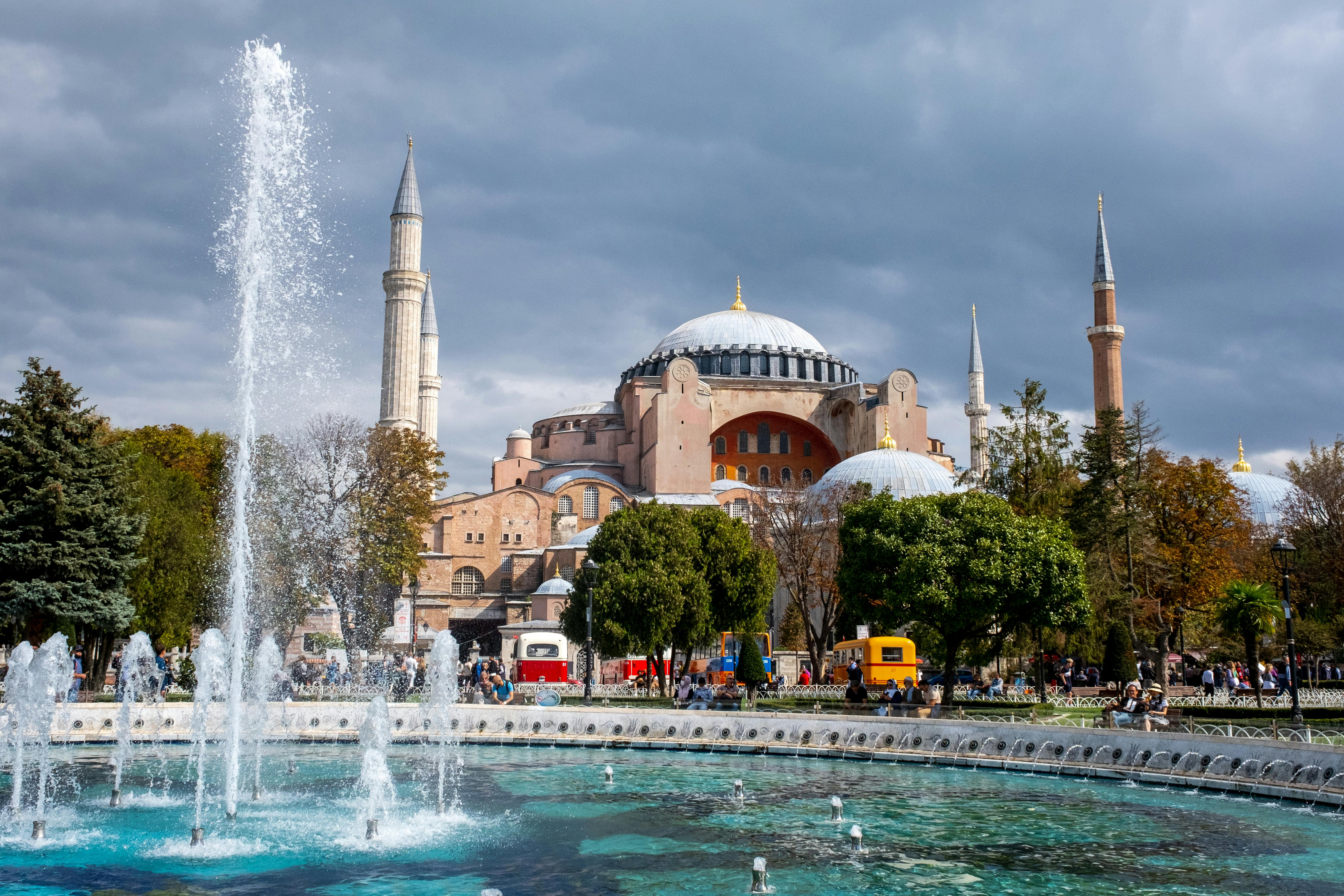
Hagia Sophia Byzantine Grandeur Meets Ottoman Devotion
The first light of dawn breaks over the Bosphorus, casting golden fingers across the Hagia Sophia's massive dome—55.6 meters of engineering brilliance that has dominated Istanbul's skyline for nearly fifteen centuries. The call to prayer echoes from four minarets, weaving through the morning mist that clings to the ancient stone walls, while inside, the last stars of the night fade against mosaics that have witnessed empires rise and fall. You stand in the vast nave, where the air carries the weight of history—Christian frescoes peek from behind Islamic calligraphy, marble columns gleam with the polish of countless pilgrims, and the scent of incense mingles with the quiet reverence of worshippers. This is not merely a building; it is a living palimpsest of human civilization, where Byzantine emperors once processed beneath the same dome where Muslims now bow in prayer. In 2026, as the world grows increasingly divided, the Hagia Sophia stands as a testament to cultural convergence—a monument that refuses to be confined to a single narrative, demanding instead that we embrace the beautiful complexity of our shared heritage.
Why Hagia Sophia Embodies Architectural Transcendence
The Hagia Sophia—or Ayasofya, as Turks call it—represents one of humanity's most audacious architectural achievements, a structure so revolutionary that it fundamentally altered the course of building design for a millennium. When Emperor Justinian I commissioned Anthemius of Tralles and Isidore of Miletus to construct this marvel in 532 AD, following the Nika Riots that destroyed the previous church, he demanded a building that would surpass Solomon's Temple in Jerusalem. The architects delivered: a central dome spanning 31.24 meters (102.5 feet) in diameter, supported by pendentives—a then-novel engineering solution that allowed a circular dome to rest on a square base. The structure required 10,000 workers and consumed vast quantities of materials scavenged from across the empire: porphyry columns from Ephesus, green marble from Thessaly, yellow stone from North Africa.
For 916 years, it served as the world's largest cathedral, the spiritual heart of the Byzantine Empire, where emperors were crowned and patriarchs celebrated the Divine Liturgy. The 1204 Fourth Crusade saw it sacked and desecrated by Western Christians—an irony not lost on historians. After Mehmed II conquered Constantinople in 1453, he converted it into a mosque, adding minarets and a mihrab while plastering over Christian mosaics rather than destroying them. This act of preservation-through-concealment allowed the Byzantine art to survive until its rediscovery in the 1930s. In 1935, Mustafa Kemal Atatürk transformed it into a museum, and in 2020, it returned to active use as a mosque—each transition layering new meaning onto ancient stone.
The building solves a fundamental human need: the desire to create spaces that transcend their physical function, becoming vessels for collective memory and spiritual aspiration. Its massive dome appears to float on a ring of light from 40 arched windows, creating the illusion that it hangs from heaven by a golden chain—a description Procopius, Justinian's court historian, penned in 563 AD. The acoustic properties are extraordinary: sound reverberates for up to 12 seconds, transforming spoken prayer into ethereal chant. Today, as both a functioning mosque and UNESCO World Heritage Site (since 1985), it continues to fulfill its original purpose: creating a space where the earthly and divine intersect, where visitors feel small in the best possible way.
The Best Time to Experience Hagia Sophia
Timing your visit to Hagia Sophia requires strategic thinking, as the building functions simultaneously as an active mosque and major tourist attraction. The optimal window runs from April 15–May 31 and September 15–October 31, when Istanbul's temperatures hover between 15–22°C (59–72°F), crowds remain manageable, and the light filtering through the dome's windows creates spectacular photographic conditions. During these shoulder seasons, you'll experience comfortable weather without the oppressive humidity of summer or the biting winds of winter.
For non-Muslim visitors, the sweet spot is 9:00–11:00 AM or 2:00–4:00 PM, avoiding the midday prayer period when the main prayer area closes to tourists for approximately 90 minutes. Friday prayers (12:00–2:30 PM) see the longest closures and largest crowds, so either arrive before 11:30 AM or after 3:00 PM on this day. Winter months (December–February) offer the fewest tourists but bring temperatures of 3–8°C (37–46°F) and frequent rain; however, the misty atmosphere can create hauntingly beautiful photography opportunities.
Avoid June 15–August 31 if possible: temperatures soar to 28–35°C (82–95°F) with humidity exceeding 70%, cruise ship crowds peak, and wait times regularly exceed 90 minutes. Also skip Turkish national holidays (April 23, August 30, October 29) when domestic tourism surges. For the most serene experience, visit during the first hour after opening (9:00 AM) when the morning light illuminates the Seraphim mosaics and the marble floor still holds the coolness of night.
Verify current visiting hours and prayer schedules at: ayasofya.gov.tr
Approximate Budget for a 7-Day Trip (2026)
Istanbul remains remarkably affordable for European destinations, though prices have risen approximately 35% since 2023 due to inflation. The following budget assumes mid-range travel with comfortable accommodations, quality meals, and comprehensive sightseeing—including Hagia Sophia and other Sultanahmet attractions. All prices reflect 2026 rates in euros (€1 ≈ 35 Turkish Lira).
Accommodation: €60–€120 per night
• Budget hostel in Sultanahmet: €25–€40/night
• Mid-range boutique hotel (3-star): €60–€90/night
• Upscale hotel with Bosphorus view: €120–€200/night
7 nights total: €420–€840
Food: €25–€45 per day
• Breakfast: €5–€8 (Turkish tea, simit, börek, olives)
• Lunch: €8–€15 (kebap, balık ekmek, lentil soup, meze)
• Dinner: €12–€22 (mezze platter, grilled fish, lamb shank)
• Street food/snacks: €3–€5 (döner, roasted chestnuts, Turkish coffee)
7 days total: €175–€315
Transportation:
• Istanbulkart (reloadable transit card): €2 initial fee
• Airport transfer (Havaist bus): €4 each way
• Tram/Metro/Bus rides: €0.50 per trip
• Ferry to Asian side: €0.75
• Taxi from Sultanahmet to Taksim: €8–€12
7 days total: €35–€50
Attractions:
• Hagia Sophia: Free (donations welcome)
• Topkapi Palace: €15
• Blue Mosque: Free
• Basilica Cistern: €10
• Galata Tower: €8
• Bosphorus cruise (2-hour): €15
• Archaeology Museums: €10
Total: €58
Miscellaneous:
• Turkish bath (hamam) experience: €35–€60
• Grand bazaar souvenirs (ceramics, textiles): €30–€100
• Travel insurance: €40
• SIM card (10GB data): €15
Total: €120–€215
TOTAL 7-DAY BUDGET: €808–€1,478
7 Essential Hagia Sophia Experiences
1. Witness the Seraphim Mosaics: Look directly upward to the four corners of the main dome, where six-winged seraphim gaze down in gold tesserae. These 14th-century Byzantine mosaics were covered with Islamic medallions for centuries before restoration revealed them. The southern seraphim retains its face; the northern one remains partially obscured—a poignant reminder of the building's layered history. Visit between 10:00–11:00 AM when sunlight illuminates the gold leaf.
2. Touch the Wishing Column: In the northwest corner, locate the column with a hole in its center, surrounded by bronze cladding. This is the "sweating column" or "wishing column" of Emperor Justinian. Legend claims that rubbing your thumb in the hole while making a wish brings good fortune—and the polished bronze proves millions have tried. The moisture from countless hands supposedly has healing properties; locals believe it cures headaches and ailments.
3. Experience the Acoustic Phenomenon: Stand in the exact center of the nave beneath the dome and whisper or clap once. Listen as the sound reverberates for 10–12 seconds, creating an ethereal echo that seems to ascend into the dome itself. Byzantine architects designed this intentionally to amplify the divine liturgy; today, it transforms the space into a living instrument. Visit during quiet hours (early morning) to fully appreciate this acoustic marvel.
4. Study the Deesis Mosaic: Ascend to the upper gallery (accessible via the ramp on the south side) to find the church's most celebrated artwork: the 13th-century Deesis mosaic depicting Christ Pantocrator flanked by the Virgin Mary and John the Baptist. The emotional intensity in Christ's eyes—simultaneously merciful and judgmental—represents the pinnacle of Byzantine artistic achievement. The mosaic survived the 1453 conquest because it was hidden behind plaster; it was uncovered in 1933.
5. Observe the Mihrab and Minbar: After admiring the Byzantine heritage, turn toward Mecca to see the Islamic additions. The mihrab (prayer niche) dates to the 16th century, crafted from carved marble with intricate muqarnas (stalactite vaulting). The adjacent minbar (pulpit) features delicate stonework and was commissioned by Murad III in 1599. These elements demonstrate how Ottoman architects respected the existing structure while adapting it for Islamic worship—a masterclass in cultural synthesis.
6. Explore the Upper Gallery: Don't skip the second floor, accessible via the long marble ramp on the southern side. The gallery offers a unique perspective of the dome's construction, revealing the brick-and-mortar techniques that have kept it standing through 15 major earthquakes. From here, you can also view the 9-meter-tall (30-foot) Omphalion, the coronation stone where Byzantine emperors stood during their crowning ceremonies. The runic graffiti carved by Viking mercenaries in the 9th century remains visible on the marble balustrade.
7. Attend Evening Prayer as a Observer: If your visit coincides with akşam (sunset prayer), position yourself respectfully at the back of the prayer hall. Watch as worshippers perform ritual ablutions, then align in perfect rows beneath the dome, their synchronized movements creating a living meditation. The call to prayer echoing through the vast space, combined with the sight of hundreds bowing in unison beneath 1,500-year-old mosaics, creates a transcendent moment that encapsulates the building's dual identity.
3 Hidden Gems Most Travelers Miss
• The Lapidarium (Sculpture Storage): Located in the former imperial lodge (Hünkâr Mahfili) on the upper level, this small museum displays architectural fragments, column capitals, and sarcophagi excavated from the site. Most visitors rush past, but here you'll find Byzantine crosses, Ottoman calligraphic panels removed during restoration, and pieces of the original ambo (pulpit) destroyed in 1204. Access requires asking permission from guards; it's open 10:00 AM–3:00 PM, closed during prayer times.
• The Baptistery and Tomb of Enrico Dandolo: Outside the southwest entrance, locate the small domed structure that served as the baptistery. More intriguingly, this is the supposed burial site of Enrico Dandolo, the blind Venetian Doge who orchestrated the 1204 Sack of Constantinople. His tombstone (likely a later addition) lies embedded in the floor—a bitter irony that the man who plundered the church now rests in its shadow. The baptistery's original 6th-century mosaic floor remains partially visible beneath protective glass.
• The Sultan's Loge (Hünkâr Mahfili): While most visitors focus on the main prayer hall, the ornate sultan's private prayer area on the upper level deserves attention. Built in 1850 during the Fossati restoration, this Ottoman Baroque chamber features gilded decorations, crystal chandeliers, and a private mihrab. It's typically closed, but polite inquiry to the imam after Friday prayers (around 3:00 PM) sometimes grants access. The view from the loge's windows—overlooking the Marmara Sea and Prince's Islands—remains unchanged since Abdulmecid I prayed here.
Cultural & Practical Tips
• Dress code is strictly enforced: Women must cover their hair (scarves provided free at entrance), shoulders, and knees; men must wear long pants (no shorts above the knee). Remove shoes before entering the prayer area—plastic bags are provided for storage. Modest dress shows respect for the building's current function as an active mosque.
• Photography etiquette: Photography is permitted in most areas, but never photograph people while they pray. Flash photography is prohibited to protect the mosaics. During prayer times, all photography stops—this is a house of worship first, tourist attraction second. The phrase "Fotoğraf çekebilir miyim?" (foh-toh-raf cheh-keh-bee-leer mee-yim) means "May I take a photo?"
• Respect prayer schedules: Five daily prayers occur at varying times (download the "Diyanet" app for accurate times). Tourist access is restricted for 60–90 minutes around each prayer, with Friday noon prayer seeing the longest closure. Plan your visit around these times rather than fighting them.
• Security screening: Expect airport-style security with metal detectors and bag checks. Large backpacks and suitcases are not permitted; use the luggage storage at Sultanahmet Tram Station (€3/day). Arrive 15 minutes early to clear security, especially during peak season.
• Learn essential Turkish phrases: "Teşekkür ederim" (teh-shek-kur eh-deh-rim) = Thank you; "Affedersiniz" (af-feh-der-si-niz) = Excuse me; "Camii" (jah-mee) = Mosque. Attempting Turkish, even poorly, earns warm smiles and better service.
• Beware of "helpful" touts: Outside the entrance, individuals may offer "skip-the-line" services or claim the mosque is "closed for prayer" to divert you to carpet shops. Ignore them; entry is free and lines move quickly. Only trust official guides wearing government-issued badges.
• Weather considerations: The marble floors become extremely slippery when wet. If visiting in winter (November–March), wear shoes with good traction. The building can be 5–8°C (9–14°F) cooler than outside in summer and equally colder in winter—bring layers.
Conclusion: Travel with Reverence, Not Just Curiosity
The Hagia Sophia demands more than casual observation—it asks for reverence. As you stand beneath that impossible dome, watching light dance across mosaics that have survived iconoclasm, crusade, and conquest, remember that you are not merely a tourist but a guest in a space that has witnessed the prayers of emperors and slaves, conquerors and refugees, Christians and Muslims. In 2026, as cultural tensions flare globally, this building offers a different narrative: one of synthesis rather than division, of preservation rather than destruction.
Travel here with intention. Speak softly. Remove your shoes without complaint. Wait patiently when prayer calls echo through the nave. Tip the woman who provides your headscarf. Purchase your simit from the elderly vendor outside rather than the tourist trap around the corner. These small acts of respect accumulate into something larger than sightseeing—they become participation in the ongoing story of this extraordinary place.
The Hagia Sophia will outlast us all, continuing its silent dialogue between cross and crescent, between past and present. Your visit should honor that continuity, leaving the building as you found it: a testament to humanity's capacity for both creation and reconciliation. Slow down. Look up. Listen to the echo of your own footsteps merging with fifteen centuries of history. That is how you truly experience the Hagia Sophia.