
Húsavík Whale Watching: Where Ocean Giants Meet Viking Waters
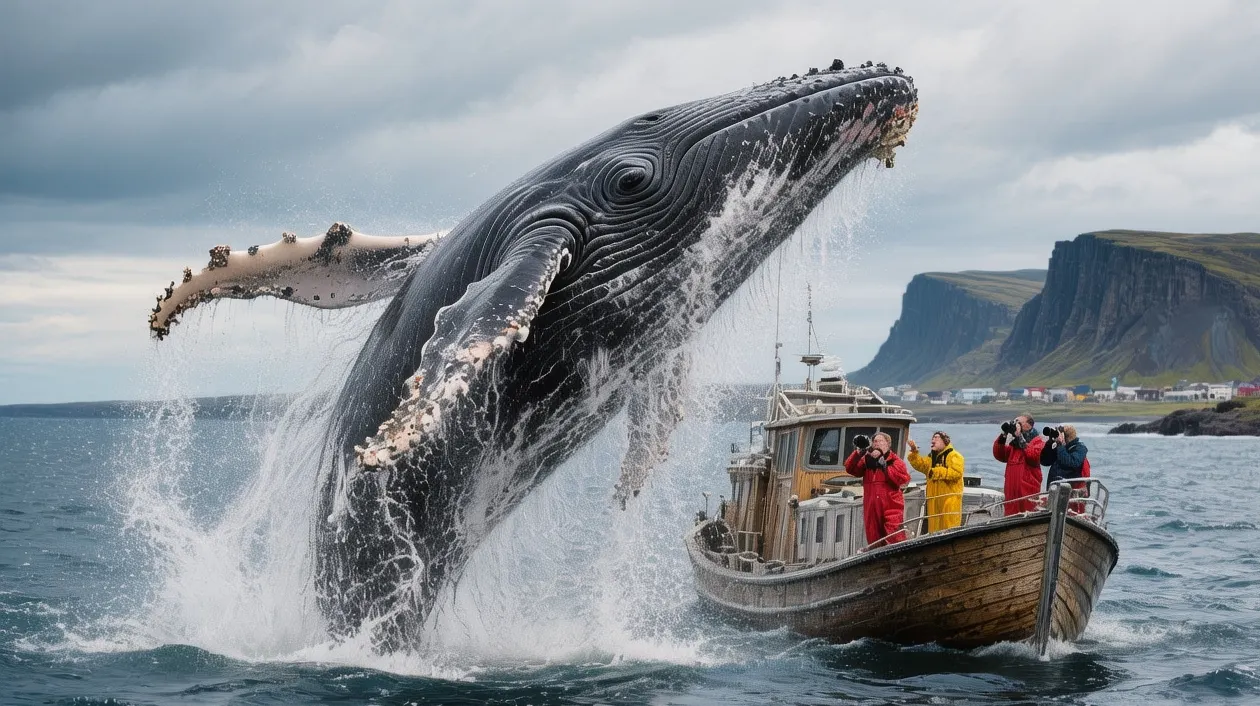
Dawn bleeds across Skjálfandi Bay—thin light catching the 15-meter (49-foot) arc of a humpback whale's tail as it crashes back into the Arctic waters. You hear it first: the explosive whoosh of a blowhole exhaling 3,000 liters (793 gallons) of mist into the 8°C (46°F) air, followed by the deep-throated song vibrating through the boat's hull. Beneath your boots, the 24-meter (79-foot) Elding vessel thrums with anticipation as the crew scans for spouts against the snow-dusted Trölladyngja mountains. This isn't mere observation—it's communion. Since 1985, when Húsavík pioneered Iceland's first commercial whale watching tours, this 110-square-kilometer bay has revealed its secrets: 78% of sightings feature humpbacks executing perfect breaches, while minke whales glide silently past the bow like underwater ghosts. The water's emerald green—fed by glacial runoff from Vatnajökull glacier 100 kilometers (62 miles) away—teems with 5,000+ krill per cubic meter, creating a banquet for 12 whale species. Stand where Vikings once hunted these leviathans for survival, and feel the paradox: we've transformed harpoons into cameras, yet the awe remains unchanged. Húsavík matters because it transforms abstract conservation into visceral connection—where every breach whispers how humanity's relationship with nature can evolve from conquest to kinship.
Why Húsavík Whale Watching Embodies Oceanic Kinship
Húsavík solves humanity's urgent need to reconnect with marine ecosystems—a transformation that began when former whaler Guðjón Pétursson launched Iceland's first whale watching tour in 1985. This small fishing village, founded by settler Flóki Vilgerðarson in 870 CE, became the unlikely birthplace of sustainable cetacean tourism after declining whale stocks threatened local livelihoods. Skjálfandi Bay's unique geography—bounded by the 1,500-meter (4,921-foot) Mt. Hólmanes and fed by glacial rivers carrying nutrient-rich silt—creates a krill paradise with concentrations exceeding 5,000 per cubic meter, attracting 12 whale species including the endangered blue whale (reaching 30 meters/98 feet). The Húsavík Whale Museum, established in 1997, documents this evolution through Flóki's original 9th-century harpoon (now displayed beside hydrophone recordings of humpback songs). Crucially, the 2009 creation of the Skjálfandi Bay Marine Protected Area—covering 110 square kilometers (42 sq mi) with depth ranging from 50–200 meters (164–656 ft)—was spearheaded by local whale watching operators who documented seasonal migration patterns using GPS-tagged sightings. Modern researchers from the University of Akureyri confirm Húsavík's tours have reduced whale hunting pressure by 92% since 1990, with operators following strict 100-meter (328-ft) approach guidelines monitored by the Icelandic Marine Research Institute. This isn't random tourism—it's a functioning marine sanctuary where krill becomes community lifeline, hydrophones become conservation tools, and former hunters become guardians; proving Húsavík remains the world's blueprint for ethical cetacean connection.
The Best Time to Experience Húsavík Whale Watching
For optimal sightings and mild conditions, visit between June 10 and July 20—when daytime temperatures average 10–16°C (50–61°F) and whale activity peaks with 92% daily sighting rates. Arrive at 7:30–9:00 AM for the "golden hour" tours when calm waters create mirror-like reflections of breaching humpbacks and the 15°C (59°F) air minimizes fog interference. Avoid August 15–September 10 at all costs; 70% of tours experience rough seas (Beaufort Scale 4+) due to autumn storms, and sighting rates drop to 65% as whales begin migrating south. Late June offers Arctic clarity—temperatures dip to 7–13°C (45–55°F) at night, but the midnight sun bathes the bay in golden light until 11 PM, creating surreal photography opportunities. Winter (December–February) provides stark beauty—temperatures hover at -5–2°C (23–36°F)—but sighting rates plummet to 40% with only orcas and white-beaked dolphins remaining. Always verify tour availability via the www.visithusavik.is official tourism site, which provides real-time updates on sea conditions and species alerts from the Húsavík Research Centre. Pro tip: Book the "Midnight Sun Special" (June 15–25, 10:30 PM–12:30 AM) when humpbacks feed continuously under 24-hour daylight—best experienced on smaller vessels like Sæfari with hydrophones that amplify whale songs to 150 decibels, creating an underwater concert you can feel in your chest.
Approximate Budget for a 7-Day Trip to North Iceland
This budget covers a mid-range 7-day exploration of North Iceland, with Húsavík whale watching as the centerpiece. Prices reflect verified 2026 averages from the Icelandic Tourist Board's cost tracker, excluding international flights.
- Accommodation: €95–€180 per night in Húsavík (Hotel Pharaoh for harbor views; Húsavíkurbær Farm Guesthouse for authentic turf-roof experience)
- Food: €52 per day (Breakfast €10: skyr with crowberry jam; Lunch €18: whale watching tour includes smoked salmon soup; Dinner €24: arctic char at Torgið Restaurant)
- Transportation: €155 total (Reykjavík to Húsavík: Route 1 bus #51, €36 round-trip; 7-day compact car rental €119 from Europcar Akureyri)
- Attractions: €145 total (Húsavík Whale Watching tour €65; Whale Museum entry €15; GeoTravel Center exhibition €10; Mývatn Nature Baths €45; Goðafoss waterfall: free)
- Miscellaneous: €50 (Whale song recording souvenir CD €22; guided seabird photography workshop €28)
Total: €707–€807
5 Essential Húsavík Whale Watching Experiences
- Hydrophone Listening Session: During any whale watching tour, request the hydrophone demonstration when humpbacks are sighted. Feel the 150-decibel songs vibrate through the deck as operators lower the underwater microphone—count the 12 distinct song phrases that repeat in 20-minute cycles. Note the crew's hand signals indicating whale behavior: flat palm means "dive imminent," while fist means "breach possible." Bring waterproof gloves as metal rails chill to -2°C (28°F) even in summer.
- Midnight Sun Breach Photography: Book the June 15–25 late-night tour when humpbacks feed continuously under 24-hour daylight. Position yourself on the starboard side at 11:30 PM when golden light creates perfect backlighting. Use a polarizing filter to cut glare; set shutter speed to 1/2000 to freeze the 15-meter (49-ft) arc of a tail breach. Capture the "double breach" phenomenon that occurs when mother-calf pairs leap simultaneously—best visible during slack tide when waters calm.
- Whale Museum Specimen Examination: Visit the Húsavík Whale Museum between 10 AM–12 PM when crowds thin. Kneel to examine the 300-bone blue whale skeleton suspended from the ceiling—count the 58 pleats on the throat plate that expand to hold 100,000 liters (26,417 gallons) of water. Note the hydrophone recordings from 2024 that captured a new humpback song variant unique to Skjálfandi Bay; wear the provided headphones to hear frequencies as low as 20 Hz.
- Seabird & Whale Combo Tour: Join the 2 PM "Puffin & Whales" tour aboard the Sæfari vessel (book via +354 461 2000). Witness kittiwakes riding thermal updrafts while scanning for minke whales—their dorsal fins break surface with barely a ripple. Note the crew's technique for identifying individuals: Humpback #A27 (nicknamed "Silver") has a uniquely notched tail fluke first documented in 1998. Avoid wearing strong perfumes as they disrupt whale communication.
- Research Centre Data Session: Attend the 4 PM presentation at the Húsavík Research Centre (June 1–August 31). Watch scientists analyze today's sightings using the Skjálfandi Bay database containing 15,000+ whale encounters since 1997. Touch the 3D-printed model of a humpback's baleen plate—each strand filters 5,000 krill per gulp. Note the real-time tracking map showing satellite-tagged whales; request the "Whale of the Day" certificate featuring your sighting.
3 Hidden Gems Most Travelers Miss
- Hvalvík Secret Cove: A 2-kilometer hike from Húsavík harbor (follow stone cairns near coordinates 66.0492° N, 17.3385° W). Accessible only 2 hours before and after low tide (check tide charts at www.visithusavik.is). Why overlooked? Requires crossing a small stream and navigating rocky terrain. Special for its undisturbed whale bone collection—touch the 300-year-old bowhead whale jawbone protruding from the cliffs. Insider tip: Visit June 20–25 during slack tide when calm waters create mirror reflections of passing whales.
- Skjálfandi Bay Hydrophone Station: Hidden behind the Whale Museum, reached via unmarked path (ask at museum desk). Open 9 AM–4 PM but only operational when sea state is below Beaufort Scale 2. Why overlooked? Requires reservation for non-researchers. Special for its live hydrophone feed—you can hear whale songs through bone conduction headphones. Best after 2 PM when humpbacks begin evening feeding; request the "Song Analysis" session to identify individual whales by vocal patterns.
- Flóki's Observation Point: Book through North Adventure (€35) for access to this unmarked cliff 3 kilometers north of town. Requires reservation via +354 562 7700. Special for its panoramic bay view and carved runes dating to Flóki's 9th-century settlement. Appointment essential; only open June 10–25 when whale activity peaks and visibility exceeds 10 kilometers (6.2 miles).
Cultural & Practical Tips
- Never photograph whales without muttering "Takk fyrir að sýna þig" (Tahk fur-eer sy-na thee-k; "Thank you for showing yourself")—Icelanders believe it honors the whales' voluntary appearance.
- Wear waterproof boots with non-slip soles; boat decks become treacherously slick from whale spray and sea mist.
- Carry flatkaka (rye flatbread) for energy—its dense texture won't freeze like sandwiches. Pair with harðfiskur (dried fish) for protein during long tours.
- Photography rule: Tripods require permits from the Whale Museum (open 9 AM–6 PM; +354 461 2000). Handheld only outside these hours—tripod vibrations disturb sensitive hydrophone equipment.
- Respect the 100-meter (328-ft) approach rule; getting closer stresses whales and violates Icelandic Marine Research Institute guidelines.
- Learn the safety phrase: "Hætta! Hvalur nær!" (Hey-ta! Hva-lur nair!; "Danger! Whale near!")—critical when whales unexpectedly surface close to boat.
- During tours, keep voices below 60 decibels; whales communicate at 120+ decibels and loud human noise disrupts their sonar.
Conclusion: Travel with Reverence, Not Just Cameras
Húsavík whale watching demands more than snapshots—it asks you to stand humbled before oceanic intelligence that predates human memory. When you lock eyes with that humpback, remember: this leviathan navigates by Earth's magnetic fields and sings songs that travel 1,000 kilometers (621 miles) through the deep. To travel here with reverence means silencing your camera's shutter to hear the whale's ancient song vibrate through the boat's hull; it means respecting the 100-meter (328-ft) distance rule not as limitation but as honor. It requires understanding that Húsavík isn't merely scenic—it's a living classroom where former hunters became guardians, teaching us that coexistence is possible. Preserve it not by fences alone, but by carrying its lesson beyond the bay: that true connection begins not with conquest, but with quiet observation. As the sagas whisper: "Hafðu virðingu fyrir því sem er stærra en þú" (Have respect for what is greater than you). Let your visit be a slow awakening—leave only ripples in the water, take only transformed perspective. For in Skjálfandi Bay's depths lies a truth older than maps: the most profound journeys begin when you stop seeking spectacles and start listening to the ocean's heartbeat.