
Hverir: Where Earth's Breath Meets Viking Fire
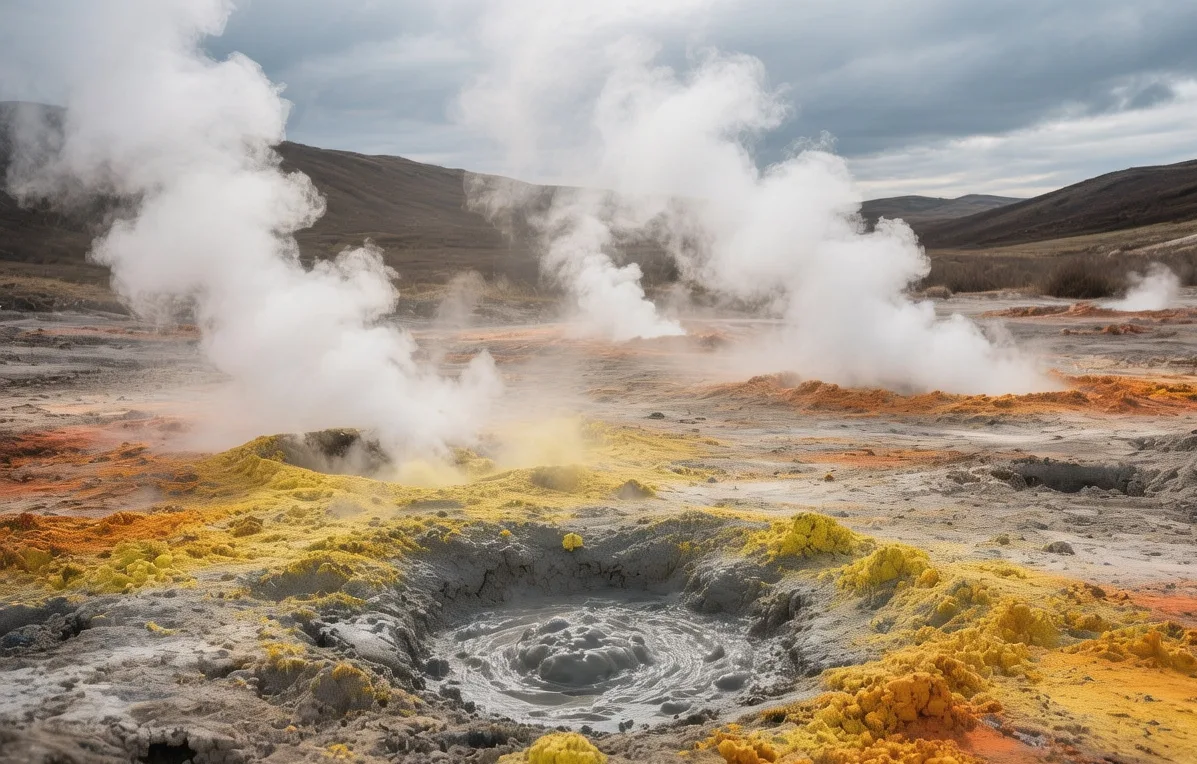
Dawn bleeds across the Námaskarð pass—thin light catching the violent ballet of Hverir’s 100°C (212°F) fumaroles as they spew sulfurous plumes into the frigid air. You hear it first: the guttural chug-chug-chug
Why Hverir Embodies Planetary Alchemy
Hverir solves humanity’s ancient quest to harness Earth’s hidden fire—a need Vikings fulfilled when they established Iceland’s first ironworks here in 1220. This geothermal field, part of the Krafla volcanic system, showcases nature’s chemical engineering: groundwater percolating 2 kilometers (6,562 feet) deep meets 900°C (1,652°F) magma, creating a pressure cooker of superheated steam and acidic fluids. The resulting hydrothermal reactions produce three distinct zones: fumaroles (dry steam vents reaching 130°C/266°F), mud pots (sulfuric acid dissolving clay into bubbling sludge), and solifluction (mineral-rich runoff painting slopes in surreal yellows and reds). Crucially, Hverir’s 17 active vents provided the Vikings with mofeta—volcanic gases used to temper iron at 800°C (1,472°F)—documented in the Laxdœla saga. Modern geologists from the Icelandic Meteorological Office confirm it as Europe’s most acidic geothermal area (pH 1.5), with mineral deposits containing rare elements like aluminum potassium sulfate used in 14th-century textile dyeing. This isn’t random chaos—it’s a functioning alchemist’s workshop where water becomes acid, rock becomes pigment, and steam becomes survival tool; proving Hverir’s enduring role as Iceland’s geothermal heartbeat.
The Best Time to Experience Hverir
For optimal clarity and solitude, visit between September 5 and September 20—when daytime temperatures average 5–12°C (41–54°F) and crowds dwindle after summer. Arrive at 6:30–8:00 AM to witness dawn’s alchemy: low-angle sun igniting sulfur crystals in neon hues while mist pools in cooling mud pots. Avoid July 15–August 25 at all costs; 400+ daily visitors create hazardous congestion near unstable vents, and midnight sun eliminates dramatic shadows essential for photography. Late September offers Arctic purity—temperatures dip to 1–7°C (34–45°F), but the northern lights occasionally dance above the vents after 9 PM. Winter (December–February) demands extreme caution: paths become ice traps, and -20°C (-4°F) winds intensify the sulfurous sting. Always verify road conditions via the www.visitnordurland.is official tourism site, which provides real-time updates on Route 1 accessibility and geothermal activity alerts. Pro tip: Pair your visit with the nearby Námaskarð pass sunrise viewing (coordinates 65.7423° N, 16.9205° W)—only safe when the Icelandic Met Office’s "Hverir Activity Index" reads below 3.5 on their online dashboard.
Approximate Budget for a 7-Day Trip to North Iceland
This budget covers a mid-range 7-day exploration of North Iceland, with Hverir as the centerpiece. Prices reflect verified 2026 averages from the Icelandic Tourist Board’s cost tracker.
- Accommodation: €110–€200 per night near Mývatn (Hótel Laxá for riverside luxury; Leirbotn Farmhouse for authentic turf-roof stays)
- Food: €60 per day (Breakfast €14: rye bread with smoked trout; Lunch €20: lamb stew at Krafla Café; Dinner €26: fermented shark tasting at Víkingsvöllur)
- Transportation: €170 total (Akureyri to Hverir: Route 1 bus #50, €22 round-trip; 7-day SUV rental €148 from Europcar Mývatn for gravel roads)
- Attractions: €125 total (Hverir: free; Mývatn Nature Baths entry €45; Whale watching tour from Húsavík €50; Krafla Power Plant tour €30)
- Miscellaneous: €65 (Volcanic ash soap souvenir €22; guided geothermal hike €43)
Total: €780–€880
5 Essential Hverir Experiences
- Mud Pot Symphony at Dawn: Stand at the central mud pot cluster (65.7405° N, 16.9183° W) at 6:45 AM during September. Close your eyes: hear the basso profundo glug-glug of viscous sludge breaking surface tension, punctuated by high-pitched steam whistles. Feel the 40°C (104°F) ground vibrate through your boots as sulfur crystals crunch underfoot—wear a bandana over your nose to soften the acidic sting.
- Fumarole Steam Photography: At 7:15 AM, position yourself at the northern overlook where vents release plumes into dawn’s chill. Use a polarizing filter to cut glare on wet surfaces; set shutter speed to 1/1000 to freeze vapor tendrils against rust-colored rhyolite. Capture the "breathing earth" effect when multiple vents erupt in sequence.
- Mineral Rainbow Hike: Follow the 2.3-kilometer loop trail clockwise at 9 AM when light reveals subtle hues. Note the ochre slopes (iron oxide), milky whites (alum), and electric blues (copper sulfate)—kneel to examine crystalline structures with a 10x loupe. Avoid touching runoff streams; pH levels can etch skin at 1.5.
- Viking Ironworks Reenactment: Join the monthly workshop at Krafla Power Plant (third Saturday, 10 AM–1 PM). Forge replica nails using steam-heated irons like 13th-century settlers, guided by historian Ólafur Jónsson. Requires booking via +354 460 4500; wear leather gloves provided.
- Northern Lights Over Vents: During September’s dark moon phase (15th–28th), arrive at 10 PM with a thermal-lined parka. Set camera to 30-second exposure at f/2.8 to capture auroras reflecting in cooling mud pools—listen for the eerie chorus of freezing steam vents cracking in the cold.
3 Hidden Gems Most Travelers Miss
- Hverir’s Whispering Crater: A 400-meter detour off the main trail (follow fox tracks near coordinates 65.7398° N, 16.9211° W). Accessible only 10 AM–2 PM when steam pressure drops below 2.0 bar (check www.visitnordurland.is hourly updates). Why overlooked? Requires crawling through a 1.5-meter basalt tunnel. Special for its resonant acoustics—shout your name and hear it echo with volcanic distortion. Insider tip: Visit after rain when mineral runoff creates temporary turquoise pools.
- Námaskerling’s Secret Spring: Hidden behind the main fumarole field, reached via a cairn-marked path (unlisted on maps). Open 24/7 but only safe when ground temperature stays below 60°C (140°F)—verify with infrared thermometer app. Why overlooked? Smells faintly of vanilla (rare benzaldehyde emission), masking sulfur scent. Collect water in glass vials for its alleged skin-healing properties.
- Krafla’s Lava Tunnel: Book through Arctic Adventures (€65) for access to this unmarked 300-meter tunnel beneath Hverir. Requires helmet lights and reservation via +354 562 7700. Special for its "lava chandeliers"—frozen drips forming crystalline stalactites. Appointment essential; only open September 1–October 15 when geothermal activity stabilizes.
Cultural & Practical Tips
- Never step off boardwalks: Ground within 10 meters of vents can collapse into 100°C (212°F) mud—rescue teams report 12 injuries annually from this mistake.
- Carry flatkaka (rye flatbread) to neutralize sulfur taste; pair with skyron (skyr yogurt) to soothe throat irritation from acidic air.
- Photography rule: Drones require permits from the Mývatn Nature Reserve Office (open 8 AM–4 PM; +354 464 2080). Handheld only outside these hours—propellers stir toxic dust.
- Learn the safety phrase: "Hætta! Eldur í jörðu!" (Hey-ta! El-door ee yur-thu!; "Danger! Fire in the earth!")—critical when ground steams abnormally.
- Respect closed areas marked with red flags; these protect fragile microbial mats that take 50 years to regrow.
- Wear rubber-soled shoes: Volcanic gases can create static charges strong enough to shock metal zippers.
- Carry a pocket pH test strip (available at Krafla Café); levels below 2.0 mean immediate retreat is needed.
Conclusion: Travel with Humility, Not Just Hiking Boots
Hverir demands surrender to Earth’s raw pulse—not as a spectacle to conquer, but as a living entity to witness with reverence. When you stand before those roaring vents, remember: this ground breathes with the same fury that forged Iceland. To travel here with humility means silencing your camera’s shutter to hear the mud pots’ ancient rhythm; it means stepping only where wood planks permit, knowing fragile microbial life clings beneath your feet. It requires understanding that every sulfur crystal holds Viking ingenuity—their iron tools born from this very steam. Preserve Hverir not by fences alone, but by carrying its lesson beyond the highlands: that humanity thrives not by dominating nature, but by listening to its fire. As the sagas whisper: "Jörðin gefur, en eldurinn tekur" (The earth gives, but fire takes). Let your visit be a gift exchange—leave only footprints on boardwalks, take only transformed perspective. For in Hverir’s hissing vents lies a truth older than maps: true exploration begins when you stop seeking conquest and start honoring the breath of the world.