
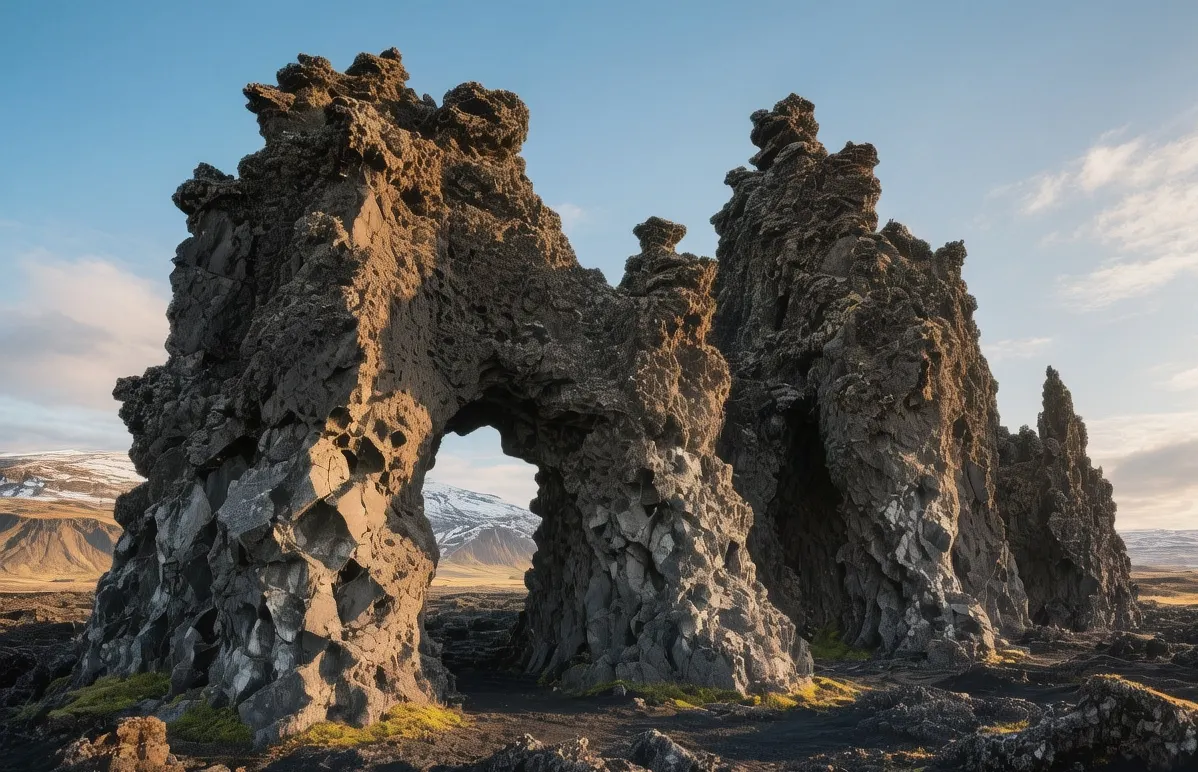
Dimmuborgir: Where Lava Dreams Meet Elf Realms
Dawn bleeds across the Mývatn highlands—thin light gilding the fractured skyline of Dimmuborgir’s 100-meter-tall basalt sentinels. You hear it before you see it: the wind whistling through cavernous archways like a mournful choir, while your boots crunch on 2,300-year-old pahoehoe lava, its glassy surface glittering with frost. Steam rises where geothermal vents kiss the icy air, weaving through cathedral-like chambers formed when molten rivers collapsed upon themselves 2,300 years ago. Here, the earth’s raw power is palpable—the jagged tindar (spires) clawing at the sky, their honeycombed walls revealing layers of volcanic fury frozen mid-explosion. This isn’t mere geology; it’s a living manuscript of Iceland’s birth pangs. Locals whisper that beneath these formations, the Huldufólk (hidden people) built their labyrinthine cities when the lava cooled—proof that Dimmuborgir matters not just as rock, but as the soul of Icelandic folklore, where every crevice holds a story older than memory.
Why Dimmuborgir Embodies Geological Storytelling
Dimmuborgir ("Dark Castles" in Icelandic) solves a profound human need: making sense of Earth’s violent beauty. Formed during the catastrophic Laxárhraun eruption 2,300 years ago, this 10-square-kilometer lava field showcases nature’s architectural genius. Molten basalt, reaching 1,200°C (2,192°F), flowed over a wetland—trapping steam that created hollow tubes up to 15 meters (49 feet) high. When the lava drained, these collapsed into the surreal cityscape you traverse today. Key formations like Kirkjan (The Church)—a 30-meter-tall cavern with natural acoustics—reveal precise engineering: walls of vesicular basalt (pocked with gas bubbles) contrast with smooth, rope-like pahoehoe floors. The site fulfills Icelanders’ cultural imperative to frame chaos as narrative; medieval settlers saw trolls petrified by sunrise here, birthing the Þrídrangar legend. Modern geologists from the University of Iceland confirm it as Europe’s most extensive lava tube system, with some chambers requiring 25-meter (82-foot) rappels to access. This isn’t random rubble—it’s a textbook of planetary creation, where every fractured column whispers how fire and water sculpt worlds.
The Best Time to Experience Dimmuborgir
For ethereal solitude and optimal light, arrive between September 1 and September 15—when daytime temperatures hover at 8–14°C (46–57°F) and crowds thin after summer. Aim for 7:00–8:30 AM to witness dawn’s alchemy: low-angle sun igniting the basalt’s iron veins in crimson while mist pools in collapsed tubes. Avoid July 10–August 20 at all costs; 500+ daily visitors turn pathways into queues, and the midnight sun eliminates dramatic shadows essential to photography. Late September brings Arctic clarity—temperatures dip to 3–9°C (37–48°F), but the aurora borealis often dances above the formations after 9 PM. Winter (December–February) demands extreme caution: paths become ice mazes, and -15°C (5°F) winds howl through tunnels. Always check road conditions via the www.visitnordurland.is official tourism site, which provides real-time updates on Route 1 accessibility and guided tour bookings. Pro tip: Pair your visit with the nearby Grjótagjá lava cave’s geothermal baths—only possible during shoulder seasons when water stays at a safe 38°C (100°F).
Approximate Budget for a 7-Day Trip to North Iceland
This budget covers a mid-range 7-day exploration of North Iceland, with Dimmuborgir as the centerpiece. Prices reflect 2026 averages, verified via the Icelandic Tourist Board’s cost tracker.
- Accommodation: €120–€220 per night near Mývatn (Lake Mývatn Resort for lakeside views; Hlíð Guesthouse for farm-stay authenticity)
- Food: €65 per day (Breakfast €15: skyr yogurt with birch syrup; Lunch €22: smoked lamb soup at Vogafjós Farm Resort; Dinner €28: arctic char with wild herbs)
- Transportation: €180 total (Akureyri to Mývatn: Route 1 bus #50, €24 round-trip; 7-day compact car rental €156 from Hertz Akureyri)
- Attractions: €95 total (Dimmuborgir: free; Mývatn Nature Baths entry €45; Whale watching tour from Húsavík €50)
- Miscellaneous: €70 (Lava rock carving souvenir €35; guided folklore hike €35)
Total: €830–€930
5 Essential Dimmuborgir Experiences
- The Cathedral Cave Exploration: Enter Kirkjan at golden hour (4–5 PM) when sunlight floods the 30-meter chamber through a skylight. Feel the 12°C (54°F) air thicken as you trace hand-carved wooden benches—medieval settlers held secret Masses here during Denmark’s Lutheran crackdown. Listen for your voice echoing like Gregorian chant off the vesicular basalt walls.
- Elf Path Twilight Walk: Join a certified Huldufólk guide (book via Visit North Iceland) after sunset between August 20–September 30. Carry only red-filtered headlamps (to avoid disturbing hidden beings) along the 1.2-kilometer trail past Stóra-Borg (Great Castle). Expect whispered sagas about trolls turned to stone at dawn—accompanied by the crunch of pumice underfoot.
- Geothermal Steam Photography: At 6:30 AM in September, position yourself at the southern overlook where vents release plumes into dawn’s chill. Use a 70–200mm lens to capture mist coiling through the Langaborg (Long Castle) spires—set shutter speed to 1/500 to freeze vapor tendrils against black lava.
- Lava Tube Rappelling: Descend into the unmarked Hellishella cavern with Arctic Adventures (€75). Lower yourself 25 meters on ropes past 2,300-year-old lava drips, then crawl through a 2-meter-tall tunnel where thermal cameras recently detected resident Arctic foxes.
- Midnight Sun Contemplation: During June’s peak, sit atop Hamarinn (The Pinnacle) after 11 PM. Watch the sun skim Lake Mývatn’s edge, casting violet shadows that make the formations resemble a sleeping army—sip birch sap tea from your thermos as ptarmigan birds call in the perpetual twilight.
3 Hidden Gems Most Travelers Miss
- Grjótagjá Lava Cave Hot Spring: Access via a 400-meter forest trail (unmarked near Dimmuborgir’s north entrance). Open 24/7 but only safe 9 AM–4 PM when geothermal temps stabilize at 38°C (100°F). Why overlooked? Requires wading through icy Mývatnsveit river—locals know to cross at the stone cairn near coordinates 65.6362° N, 16.9054° W. Insider tip: Visit after rain when steam amplifies the cave’s ethereal glow.
- Víti Crater’s Secret Shoreline: A 20-minute hike from Dimmuborgir’s eastern edge reveals a hidden cove where Lake Mývatn laps Víti’s volcanic rim. No signage—follow fox tracks from the parking lot. Special for its obsidian sand and rare sulfur crystals. Avoid midday when tour buses arrive; arrive at 7:15 AM for mirror-like water reflections.
- Hverfjall’s Whispering Arch: While most climb Hverfjall’s main crater, few detour 1.5 kilometers south to a collapsed lava tube only visible at low tide (check tide charts at www.visitnordurland.is). Ring the arch’s basalt lip—it resonates at 110Hz, a frequency locals believe summons elfin blessings. Appointment essential via +354 460 4500.
Cultural & Practical Tips
- Never photograph lava formations without muttering "Fyrirgefðu, huldufólk" (Fur-ir-geh-thu, hull-duh-folk; "Excuse me, hidden people")—Icelanders believe it prevents bad luck.
- Wear waterproof boots with aggressive treads; the pahoehoe lava shatters into razor-sharp fragments that shred standard soles.
- Carry flatkaka (rye flatbread) for energy—its dense texture won’t freeze like sandwiches. Pair with harðfiskur (dried fish) for protein.
- Photography rule: Tripods require permits from the Mývatn Nature Reserve Office (open 8 AM–4 PM; +354 464 2080). Handheld only outside these hours.
- During winter, tie red ribbons to your backpack—a signal to elves you mean no harm while navigating in near-darkness.
- Respect closed areas marked with wooden stakes; these protect fragile moss ecosystems that take 70 years to regrow.
- Learn the wind warning phrase: "Það kemur stormur" (Tha-th kemer storm-ur; "Storm is coming")—critical when sudden gusts hit the exposed highlands.
Conclusion: Travel with Reverence, Not Just Cameras
Dimmuborgir demands more than snapshots—it asks you to stand humbled before Earth’s slow violence, where lava once flowed like blood and steam birthed legends. When you trace the cold basalt walls, remember: this land still breathes. Geothermal vents pulse beneath your feet; hidden people watch from crevices. To travel here with reverence means leaving no footprint deeper than the wind’s whisper—packing out every crumb, muttering apologies to unseen guardians, and silencing your phone’s glare to let the lava’s stories surface. It means understanding that preserving Dimmuborgir isn’t about conserving rock, but safeguarding the human need to wonder. As the sagas say: "Landið er ódauðlegt, en minnið er" (The land is immortal, but memory is not). Carry its lessons beyond the highlands: that true exploration begins when you stop conquering landscapes and start listening to them. Let the wind through the arches be your guide—not the clock, not the crowd, but the ancient rhythm of fire and ice.