
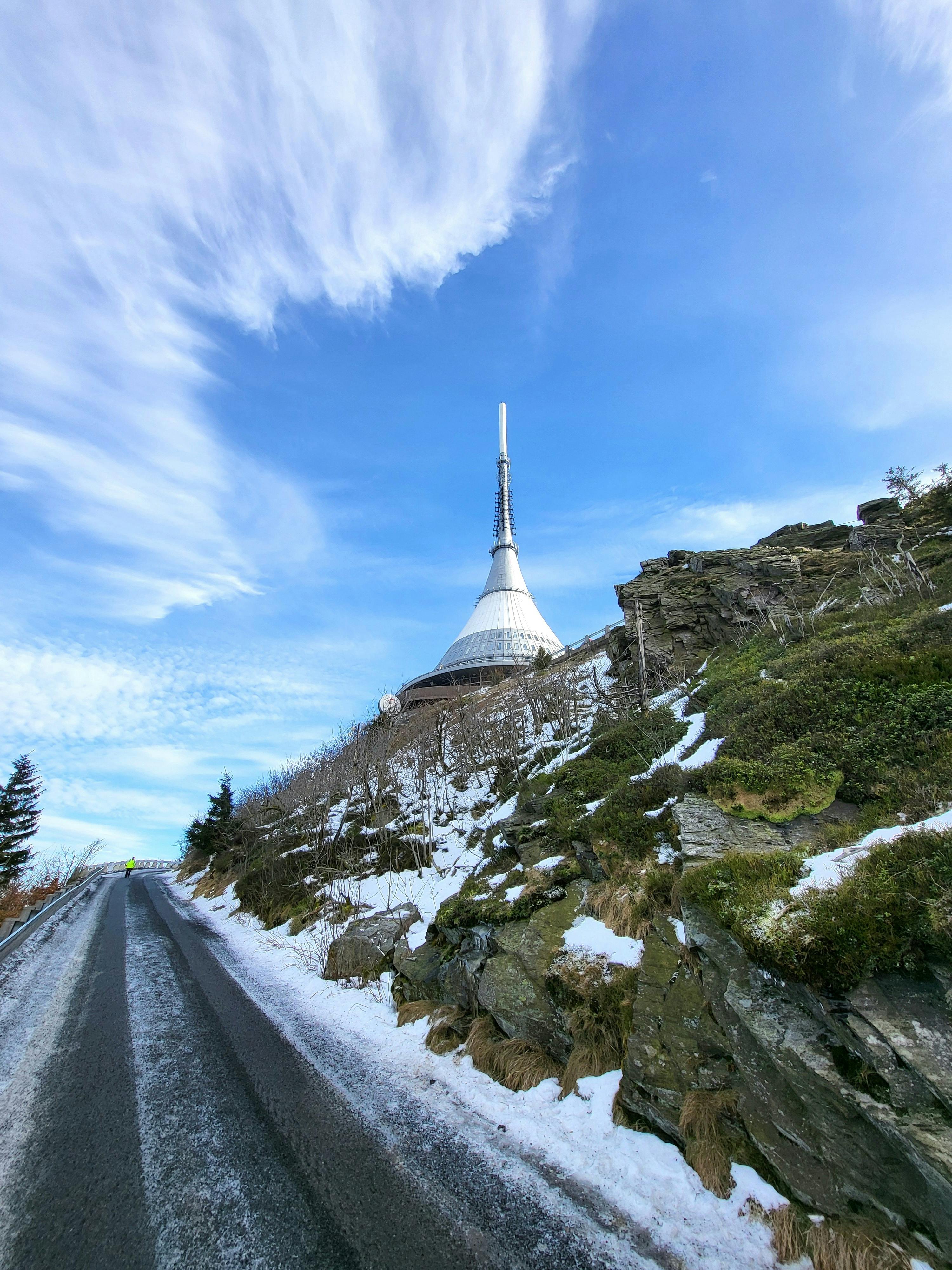
Ještěd Tower: Where Hyperboloid Architecture Meets Bohemian Mountain Majesty
Mist clings to the slopes of Mount Ještěd as the cable car ascends through a canopy of spruce and beech, the gentle hum of machinery accompanying your climb toward one of Central Europe's most audacious architectural achievements. At 1,012 meters above sea level, the summit reveals itself through breaking clouds—a 94-meter hyperboloid tower that seems to grow organically from the mountain itself, its curved concrete form echoing the peak's natural silhouette against the sky. This is Ještěd Tower, a masterpiece designed by architect Karel Hubáček and completed in 1973 after seven years of construction, standing as a testament to the bold vision of 20th-century Czech modernism. The structure rotates subtly with the wind, its restaurant offering 360-degree panoramas that stretch across four countries on clear days, while the hotel's geometric rooms provide shelter at an altitude where weather changes in minutes. This is not merely a television transmitter or a viewing platform—it is a philosophical statement about harmony between human ingenuity and natural landscape, a place where engineering ambition learned to bow to the mountain's ancient presence.
Why Ještěd Tower Embodies Architectural Innovation
Ještěd Tower represents one of the most daring architectural experiments of the late 20th century—a structure that refused to choose between function and poetry. When architect Karel Hubáček won the competition to design a new television transmitter for North Bohemia in 1963, he faced an extraordinary challenge: create a functional broadcast tower that would not scar the distinctive conical peak of Mount Ještěd, a mountain already sacred to locals and visible from dozens of kilometers away. His solution was revolutionary—a hyperboloid structure whose curved silhouette would extend the mountain's natural profile rather than interrupt it, creating what architectural historians now call a "mountain with a mountain on top."
The engineering behind this vision required unprecedented precision. The tower's reinforced concrete shell, just 30-40 centimeters thick in most sections, supports not only transmission equipment but also a 16-room hotel and a restaurant seating 80 guests. The hyperboloid shape—mathematically derived from rotating a straight line around an axis—provides exceptional structural stability while using minimal material. Construction began in 1966 and required specialized techniques: workers poured concrete in continuous cycles, creating the seamless curved form that now defines the Liberec skyline. The tower reaches 94 meters in height, with the restaurant positioned at 983 meters above sea level and the hotel occupying floors between 70-85 meters up the structure.
Beyond its technical achievements, Ještěd Tower solved a cultural problem: how to modernize without betraying place. In an era when television transmission towers were purely utilitarian steel skeletons, Hubáček created a building that became a symbol of Czech architectural identity. The structure was nominated for UNESCO World Heritage status and has been featured in architectural textbooks worldwide. It proved that infrastructure could be art, that a television transmitter could house a luxury hotel, and that modernism could respect landscape rather than dominate it. Today, it remains one of the most photographed buildings in the Czech Republic, drawing architecture pilgrims and casual tourists alike to this windswept summit where concrete and cloud meet.
The Best Time to Experience Ještěd Tower
The optimal window for visiting Ještěd Tower stretches from May 20 through October 15, when temperatures at the summit range from 12–20°C (54–68°F) during daytime hours, and the hiking trails remain clear of snow and ice. For the clearest visibility—essential for those panoramic views spanning the Jizera Mountains, Bohemian Paradise, and even Poland and Germany—plan your visit between June 10 and September 5, when atmospheric conditions most frequently allow 100-kilometer visibility. Early morning visits between 8:00–10:00 AM offer the best chance of catching the tower emerging from morning mist, while late afternoon arrivals between 4:00–6:30 PM position you for sunset photography when the concrete facade glows amber in horizontal light.
Winter (December through March) transforms Ještěd into a different experience entirely—temperatures drop to -8 to -2°C (18–28°F) at the summit, and the tower becomes accessible primarily via the cable car, which operates year-round. While winter brings dramatic snow-covered landscapes and the possibility of viewing the tower rising from cloud inversions, be prepared for frequent closures due to high winds (sustained speeds above 70 km/h force cable car shutdowns) and whiteout conditions that can reduce visibility to zero. The tower's restaurant and hotel remain open year-round, but outdoor terraces close from November through April.
Avoid visiting during Czech national holidays—particularly May 1 (Labor Day), July 5–6 (Saints Cyril and Methodius Day), and September 28 (Czech Statehood Day)—when domestic tourism peaks and the cable car experiences 45-minute wait times. Also skip the week between Christmas and New Year's, when the tower hosts ski tourists and hotel rooms book six months in advance.
Approximate Budget for a 7-Day Trip
Exploring Ještěd Tower and the broader Liberec region requires moderate financial planning, with costs significantly lower than Western European destinations while maintaining high-quality experiences. The following budget assumes a comfortable mid-range travel style with quality accommodations, regional Czech cuisine, and comprehensive exploration of North Bohemia over seven days.
- Accommodation: €55–€95 per night for a double room in Liberec city center (three-star hotels and boutique guesthouses); budget options from €30–€45 per night; Ještěd Tower hotel rooms €120–€160 per night (includes breakfast and cable car access)
- Food: €28–€40 per day (breakfast €6–€10 at hotel or café with coffee, pastries, and eggs; lunch €10–€14 for traditional Czech dishes like svíčková na smetaně or duck with dumplings at mountain restaurants; dinner €12–€18 for roasted pork, goulash, or fresh trout at Liberec establishments)
- Transportation: Train from Prague to Liberec €14 round-trip (2.5 hours); local tram/bus day pass €4; Ještěd cable car €8 round-trip (€5 one-way); parking at cable car base €4 per day; regional bus to Český ráj (Bohemian Paradise) €6 round-trip
- Attractions: Ještěd Tower observation deck free with restaurant visit; guided architecture tour €12; Liberec Zoo €8; North Bohemian Museum €5; Terezín Memorial day trip €25; Bohemian Paradise hiking tours €18
- Miscellaneous: Local beer and wine €8–€12 per evening; souvenir glassware and ceramics €15–€30; travel insurance €28 for the week; hiking equipment rental €15; bottled water and snacks €12
Total estimated cost for 7 days: €580–€820 per person (depending on accommodation choices and dining preferences)
5 Essential Ještěd Tower Experiences
- Ride the Historic Cable Car at Dawn: Board the Ještěd cable car at Horní Hanychov station for the 8:00 AM departure, when morning light filters through the forest canopy and the three-minute ascent offers glimpses of Liberec awakening in the valley below. The cable car, originally built in 1933 and modernized in 2009, climbs 412 meters in elevation with a maximum gradient of 38%. Stand near the front windows for the dramatic moment when the tower emerges above the treeline—a concrete spire against blue sky that signals your arrival at one of Europe's most spectacular viewpoints.
- Dine in the Rotating Restaurant: Reserve a table at the Ještěd restaurant for lunch between 12:00–2:00 PM, when natural light floods the panoramic windows and the slow rotation (one complete revolution every 45 minutes) reveals different vistas without you moving from your seat. Order the regional specialty—smoked trout from nearby mountain streams served with potato pancakes and cranberry compote—while watching clouds drift across the Jizera Mountains. The restaurant sits at an altitude of 983 meters, and on clear days you can identify individual villages in Poland to the northeast and German towns to the northwest.
- Stay Overnight in the Tower Hotel: Book one of the 16 geometrically-designed hotel rooms for a night at altitude, where you'll experience the tower's transformation from daytime tourist attraction to serene mountain refuge. Rooms feature angular, space-age interiors with built-in furniture following the hyperboloid curve, and waking before dawn allows you to watch sunrise from your window as the valley below remains shrouded in darkness. The hotel includes access to a small wellness area with sauna, and the evening brings an intimacy with the mountain that day-trippers never experience—listen to wind singing around the tower's concrete form while stars emerge in unpolluted skies.
- Hike the Ridge Trail to Černá studnice: After visiting the tower, follow the blue-marked hiking trail eastward along the Ještěd-Kozákov Ridge for 12 kilometers to Černá studnice (Black Well), a 40-meter observation tower built in 1905. This moderately challenging 4-hour hike traverses beech forests and alpine meadows, passing several mountain huts where you can rest and sample local beer. The trail gains and loses approximately 400 meters in elevation, and the views from Černá studnice provide a different perspective—looking back at Ještěd Tower as a distinctive silhouette against the horizon.
- Photograph the Tower from Liberec: Descend to Liberec city and hike or drive to the Horní Růžodol district for the classic postcard view of Ještěd Tower rising above the urban landscape. The best vantage point is from the path behind the Liberec Castle, approximately 2.5 kilometers from city center, where you can frame the tower against the historic Old Town. Visit during blue hour (30 minutes after sunset) when the tower's illumination creates a beacon visible from across the entire Liberec basin, and use a telephoto lens to compress the distance between foreground architecture and the mountain peak.
3 Hidden Gems Most Travelers Miss
- Přepeře Sandstone Formations: Located 25 kilometers southeast of Ještěd Tower, this labyrinth of weathered sandstone towers and narrow passages remains virtually unknown to international visitors despite being closer to Prague than the famous Pravčická brána. Access from the village of Přepeře via the green hiking trail—the 2-kilometer route takes 45 minutes and passes through moss-covered rock corridors where light filters through gaps 2 meters wide. The formations rise 30–40 meters high and create natural amphitheaters where acoustics amplify whispers. Best visited between 10:00 AM–3:00 PM when sunlight penetrates the deepest passages. No entrance fee; open year-round but avoid after heavy rain when sandstone becomes dangerously slippery.
- Špičák Observation Tower: This 25-meter wooden tower on Špičák mountain (724 meters elevation), located 15 kilometers northwest of Ještěd, offers equally spectacular views with virtually no crowds. Built in 2008 using traditional carpentry techniques, the tower requires climbing 112 steps but rewards you with 360-degree panoramas that include Ještěd Tower itself, the Lusatian Mountains, and on clear days, Dresden in Germany. Access via red trail from the village of Kryštofovo Údolí (45-minute uphill hike); the trailhead has limited parking (arrive before 9:00 AM on weekends). The tower has no facilities, so bring water and snacks. Open dawn to dusk; free admission.
- Kryštofovo Údolí Viaduct and Nativity Scene: This picturesque village 12 kilometers from Liberec features a 40-meter-high railway viaduct with 14 arches, built in 1900 for the Liberec-Frýdlant railway line, and a year-round nativity scene (betlém) carved into local sandstone cliffs. The viaduct, still used by regional trains, creates a dramatic photographic subject—position yourself on the footpath below for shots of trains crossing 15 meters above the stream. The nativity scene, accessible via a 15-minute forest walk from the village center, features 40 life-sized figures carved between 1999–2006 by local artisan Josef Škoda. Visit during the first two weeks of December for evening illumination, or any time of year for free. The village café serves exceptional apple strudel made from a 100-year-old family recipe.
Cultural & Practical Tips
- Weather Preparedness is Essential: Summit conditions at Ještěd differ dramatically from Liberec valley—temperatures average 6–8°C (11–14°F) cooler, and wind speeds can exceed 100 km/h even when the valley experiences calm conditions. Always bring a windproof jacket, layered clothing, and sturdy footwear regardless of season. Check the mountain weather forecast at www.chmi.cz before ascending, and be prepared for the cable car to close with less than one hour's notice if winds intensify.
- Learn Essential Czech Phrases: While younger Czechs in tourist areas speak English and German, knowing basic Czech demonstrates respect: "Dobrý den" (DOH-bree den) means "Good day"; "Děkuji" (DYEH-kooyi) means "Thank you"; "Prosím" (PROH-seem) means "Please" or "You're welcome"; "Na shledanou" (nah skhleh-DAH-noh) means "Goodbye."
- Cable Car Etiquette: The Ještěd cable car operates with continuous circulation during peak hours (9:00 AM–5:00 PM), departing every 15 minutes. Allow passengers to exit before boarding, and be prepared to share the cabin with up to 25 other passengers. Large backpacks must be carried in your lap, not worn. The last descent runs at 8:45 PM (6:15 PM in winter), so plan accordingly if dining at the restaurant.
- Photography Guidelines: Tripods are permitted on the observation deck but not inside the rotating restaurant during busy periods. Drone flights require written permission from the tower administration and the Czech Aviation Authority—contact info@jested.cz at least two weeks in advance. Interior photography of the hotel is restricted to guests; the restaurant welcomes exterior shots but prohibits flash photography during meal service.
- Currency and Payment: The Czech Republic uses Czech koruna (CZK), not euros. Current exchange rate hovers around 25 CZK to €1. While the tower restaurant and hotel accept credit cards, many mountain huts and smaller establishments operate on cash only. ATMs are available in Liberec city center but not at the summit or cable car stations.
- Respect the Architecture: Ještěd Tower is a protected cultural monument. Do not touch or lean against the concrete surfaces—natural oils from skin accelerate weathering. Writing, carving, or attaching anything to the structure is strictly prohibited and carries fines up to €400. The tower's unique hyperboloid form required decades of research to perfect; treat it as the architectural treasure it is.
- Hiking Safety: If you plan to hike rather than take the cable car, the red trail from Horní Hanychov to the summit takes 90 minutes and gains 412 meters in elevation. Trail markers use the Czech system: red for main long-distance routes, blue/green/yellow for secondary paths. Carry a physical map (KČT Club maps available at tourist information centers) as GPS signal can be unreliable in forested areas. Inform someone of your route if hiking alone.
Conclusion: Travel with Wonder, Not Just Sightseeing
Ještěd Tower endures not because it conquered a mountain, but because it learned to listen to one—because Karel Hubáček understood that the most profound architecture doesn't impose itself upon landscape but enters into conversation with it. When you stand on that observation deck, watching clouds spiral around the hyperboloid form you've just ascended, you participate in a dialogue between human ambition and natural permanence that began fifty years ago and will continue long after we're gone. This tower asks something of you: to slow down long enough to notice how light moves across concrete throughout the day, to appreciate the courage it took to build something so audacious in such an exposed location, to recognize that progress need not mean destruction. In an age of disposable architecture and forgettable skylines, Ještěd reminds us that buildings can be poems written in reinforced concrete, that function and beauty need not choose sides, that a television transmitter can become a symbol of national pride. Carry this lesson forward: travel not to collect destinations, but to encounter visions of what humanity can create when it respects the places it inhabits.