
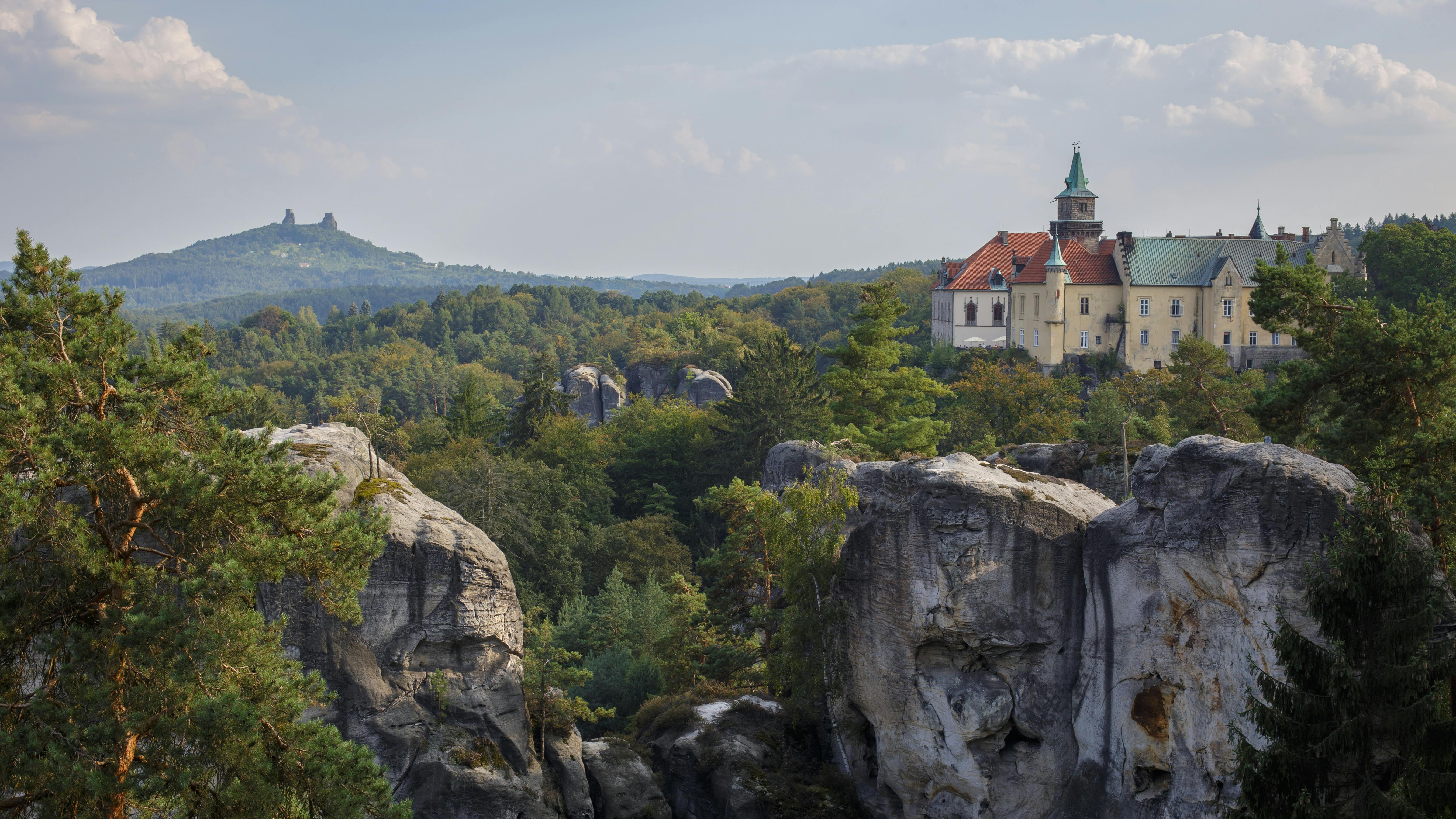
Hrubá Skála Rock Town: Where Ancient Sandstone Towers Meet Medieval Castle Dreams
Dawn breaks over the Bohemian Paradise, casting long amber shadows across a labyrinth of weathered sandstone spires that rise like petrified giants from the forest floor. The air carries the crisp scent of pine resin and damp earth as you follow a narrow trail carved between towering rock walls, their honey-colored surfaces striated with millions of years of geological history. Then, through a natural archway of stone, the silhouette emerges—Hrubá Skála Castle, perched precariously atop a 60-meter sandstone pinnacle, its Gothic-Renaissance façade seeming to grow from the rock itself rather than rest upon it. This extraordinary formation, first documented in 1350 and expanded through centuries of careful adaptation to the unstable stone, represents one of Central Europe's most dramatic marriages of human architecture and natural geology. Standing here, with the forest canopy spreading below and the jagged skyline of the rock town stretching toward the horizon, you understand why this place has inspired poets, painters, and pilgrims for nearly seven centuries: it reminds us that some of humanity's most enduring creations are those that learn to listen to the landscape rather than command it.
Why Hrubá Skála Rock Town Embodies Geological Poetry
Hrubá Skála is not merely a castle ruin or a hiking destination—it is a living textbook of Earth's patient artistry and human adaptation. The sandstone formations that define this rock town were deposited during the Cretaceous period, approximately ninety million years ago, when the region lay beneath a shallow sea. Layers of quartz sand, compacted under immense pressure and cemented by silica and iron oxides, created the distinctive honey-colored stone that now rises in towers up to 80 meters high. These formations were sculpted into their current dramatic shapes by freeze-thaw cycles, wind erosion, and the persistent action of rainwater seeping through natural fractures—a process that continues today at a rate of approximately 0.5 millimeters per year.
The castle itself, first mentioned in written records in 1350, was built by the Vartemberk noble family who recognized the strategic advantage of constructing directly upon a sandstone pinnacle. Rather than leveling the rock, medieval masons adapted their foundations to its irregular contours, carving rooms and passages directly into the stone. This approach solved a critical engineering problem: how to build a defensible structure on unstable, porous sandstone without triggering collapse. The solution—shallow foundations reinforced with timber framing, drainage channels to redirect water infiltration, and flexible mortar mixes that accommodate minor rock movement—allowed the castle to survive earthquakes, wars, and centuries of weathering.
Today, Hrubá Skála serves as the crown jewel of the Bohemian Paradise Protected Landscape Area, designated a UNESCO Global Geopark in 2005. The site fulfills multiple needs: it preserves a unique geological ecosystem, provides accessible outdoor recreation for hikers and climbers, and offers a tangible connection to Central European medieval history. The castle now operates as a boutique hotel and restaurant, allowing visitors to sleep within walls that have witnessed nearly 700 years of history—a rare opportunity to experience heritage not as a museum exhibit, but as a living space where past and present converge.
The Best Time to Experience Hrubá Skála Rock Town
The optimal window for visiting Hrubá Skála stretches from May 22 through September 28, when temperatures at the rock town range from 16–24°C (61–75°F) during daytime hours, creating ideal conditions for hiking the network of trails that weave between sandstone towers. For the clearest visibility and most comfortable climbing conditions, plan your visit between June 15 and September 10, when humidity levels drop and afternoon thunderstorms become less frequent. Early morning visits between 7:30–9:30 AM offer the dual advantage of softer light for photography and significantly fewer crowds, as most tour groups from Prague arrive after 10:00 AM.
Spring (late April through June) brings blooming wildflowers—including rare Bohemian gentians and mountain avens—and rushing waterfalls fed by snowmelt from the nearby Jizera Mountains, though temperatures can dip to 6–12°C (43–54°F) in early mornings. Autumn (mid-September through October) offers spectacular foliage as beech and oak forests surrounding the rock town turn brilliant shades of gold and crimson, with comfortable temperatures of 10–18°C (50–64°F) and dramatically fewer visitors after the summer peak.
Avoid visiting during Czech national holidays—particularly May 1 (Labor Day), July 5–6 (Saints Cyril and Methodius Day), and September 28 (Czech Statehood Day)—when domestic tourism peaks and parking at the trailhead fills by 8:00 AM. Also skip the week between Christmas and New Year's, when the castle hotel books solid and some trails close due to ice. Rain makes sandstone extremely slippery; check weather forecasts carefully and postpone climbs if precipitation is expected within 24 hours.
Approximate Budget for a 7-Day Trip
Exploring Hrubá Skála Rock Town and the broader Bohemian Paradise region requires modest financial planning, as the Czech Republic remains significantly more affordable than Western European destinations while offering exceptional value. The following budget assumes a comfortable mid-range travel style with quality accommodations, regional Czech cuisine, and comprehensive exploration of the rock town and surrounding UNESCO Geopark over seven days.
- Accommodation: €60–€110 per night for a double room at Hrubá Skála Castle Hotel (includes breakfast and castle access); nearby guesthouses in Turnov or Hrubá Skála village €40–€75 per night; budget hostels from €25–€40 per person
- Food: €26–€38 per day (breakfast €6–€9 at accommodation with coffee, pastries, and eggs; lunch €9–€13 for traditional Czech dishes like svíčková na smetaně or duck with dumplings at castle restaurant; dinner €11–€16 for roasted pork, goulash, or freshwater fish at local hospoda)
- Transportation: Train from Prague to Turnov €13 round-trip (1.5 hours); local bus from Turnov to Hrubá Skála €3 each way; regional day pass for Bohemian Paradise buses €7; parking at castle trailhead €4 per day if driving
- Attractions: Hrubá Skála Castle tour €7; guided rock town hiking tour €18; rock climbing instruction half-day €35; Bohemian Paradise visitor center €4; nearby Trosky Castle entry €6; Prachov Rocks entry €5
- Miscellaneous: Local craft beer and wine €7–€11 per evening; souvenir sandstone crafts and local honey €12–€25; travel insurance €26 for the week; hiking map and guidebook €10; bottled water and trail snacks €14
Total estimated cost for 7 days: €540–€780 per person (depending on accommodation choices and dining preferences)
5 Essential Hrubá Skála Rock Town Experiences
- Hike the Rock Town Loop at Sunrise: Begin at the castle parking area at 7:00 AM and follow the red-marked trail clockwise around the rock town. This 4.2-kilometer loop gains 180 meters in elevation over approximately 2 hours, passing through narrow sandstone corridors where morning light creates dramatic chiaroscuro effects. Pause at the Kapelník viewpoint (elevation 425 meters) for your first panoramic glimpse of the castle perched on its pinnacle, then continue to the Devil's Kitchen—a natural amphitheater where acoustics amplify whispers. Bring a wide-angle lens to capture the scale of formations rising 60–80 meters above the trail.
- Dine on the Castle Terrace at Sunset: Reserve a table at the Hrubá Skála Castle restaurant for 6:00–7:30 PM, when the setting sun bathes the sandstone towers in warm amber light. Order the regional specialty—smoked trout from nearby mountain streams served with potato pancakes and cranberry compote—while seated on the terrace that extends over the forest canopy. The restaurant occupies a 16th-century hall with original timber beams and stone walls; request a window table for views of the rock formations silhouetted against the twilight sky.
- Stay Overnight in the Castle Hotel: Book one of the 12 historically-appointed rooms for a night within the castle walls, where you'll experience the rock town's transformation from daytime attraction to serene mountain refuge. Rooms feature exposed stone walls, antique furnishings, and modern amenities; some include small balconies overlooking the forest. Waking before dawn allows you to explore the castle courtyards and lower rock passages in solitude, hearing only the call of black woodpeckers and the rustle of deer moving through the undergrowth.
- Try Beginner Rock Climbing with Local Guides: Hrubá Skála offers over 300 climbing routes on sandstone, ranging from easy slabs to challenging overhangs. Book a half-day introductory session (€35) with a certified guide from the Czech Mountaineering Association, who will provide equipment and teach essential techniques for climbing on porous sandstone—a material that requires specialized ethics to preserve. Routes like "Cesta přátelství" (Friendship Path, grade III) offer stunning views with minimal technical difficulty. Sessions run 8:00–11:30 AM or 2:00–5:30 PM; advance booking recommended.
- Photograph the Castle from the Valley Floor: Descend to the meadow 500 meters southeast of the castle for the classic postcard view: Hrubá Skála's silhouette rising above a sea of green, framed by foreground wildflowers in spring or golden ferns in autumn. Visit during blue hour (30 minutes after sunset) when the castle's subtle illumination creates a beacon against the darkening sky. Use a telephoto lens (70–200mm) to compress the distance between foreground elements and the castle, and bring a tripod for long exposures as light fades.
3 Hidden Gems Most Travelers Miss
- Čertova ruka (Devil's Hand) Formation: This distinctive sandstone pillar, located 1.8 kilometers northeast of Hrubá Skála Castle along the blue trail, features a natural rock arch that frames distant views of Trosky Castle. Access requires a 35-minute hike from the main rock town loop; the trailhead is marked by a small wooden sign near the Kapelník viewpoint. The formation is overlooked because it requires a short detour, but the reward is a peaceful spot where you can sit on natural sandstone benches and watch hawks circle above. Best visited between 10:00 AM–2:00 PM when sunlight penetrates the arch. No entrance fee; open year-round but avoid after heavy rain when sandstone becomes dangerously slippery.
- Staré Hrady Castle Ruins and Pond: Located 8 kilometers southwest of Hrubá Skála, this romantic Renaissance castle ruin sits on an island in a tranquil pond, accessible via a wooden footbridge. Built in 1560 and abandoned in the 18th century, the ruins feature preserved arcades and a tower offering 360-degree views of the Bohemian Paradise. Most day-trippers to Hrubá Skála never make it here, but the 2-hour round-trip hike through forest and meadow reveals a different side of the region's heritage. Access via green trail from the village of Staré Hrady; the site has no facilities, so bring water. Open dawn to dusk; free admission.
- Podkost Village and Medieval Mill: This picturesque village 12 kilometers from Hrubá Skála features a restored 17th-century water mill (now a small museum) and serves as the gateway to Kost Castle, one of the best-preserved Gothic castles in the Czech Republic. The mill, powered by the Klenice River, demonstrates traditional grain-grinding techniques and offers workshops in historical crafts. Visit on Saturday mornings between 9:00–11:00 AM to watch the miller demonstrate the process using century-old equipment. The village café serves exceptional apple strudel made from a family recipe dating to 1890. Access via bus from Turnov (line 715, hourly); mill entry €3; castle entry €8.
Cultural & Practical Tips
- Respect the Sandstone: The porous nature of Bohemian Paradise sandstone makes it exceptionally vulnerable to erosion. Never climb on formations outside designated routes, avoid touching rock surfaces with oily hands, and stay on marked trails. Rangers patrol the area and can issue fines up to €200 for violations. Chalk use is prohibited on climbing routes to prevent staining.
- Learn Basic Czech Phrases: While many park staff speak English and German, knowing a few Czech phrases enhances your experience: "Dobrý den" (DOH-bree den) means "Good day"; "Děkuji" (DYEH-kooyi) means "Thank you"; "Prosím" (PROH-seem) means "Please" or "You're welcome"; "Kde je záchod?" (gdeh yeh ZAH-hod) means "Where is the restroom?"
- Footwear is Critical: Sandstone becomes extremely slippery when wet, and trails include steep sections with exposed roots and loose gravel. Sturdy hiking boots with aggressive tread and good ankle support are essential—smooth-soled shoes or sandals are dangerous, especially in spring and autumn when moisture is prevalent. Consider bringing gaiters to keep sand out of boots on dusty trails.
- Carry Cash (Czech Koruna): While the castle hotel and restaurant accept cards, many smaller establishments, trailside vendors, and parking facilities operate on cash only. The currency is Czech koruna (CZK), with an approximate exchange rate of 25 CZK to €1. ATMs are available in Turnov and nearby towns but not at trailheads or the castle.
- Photography Guidelines: Tripods are permitted on viewing platforms but not on narrow trails where they obstruct other hikers. Drone use requires written permission from the Bohemian Paradise Protected Landscape Area administration—contact info@ceskyraj.cz at least two weeks in advance. Commercial photography requires advance authorization.
- Weather Preparedness: Mountain weather changes rapidly—pack layers even in summer, including a waterproof jacket. Afternoon thunderstorms are common from June through August; if you hear thunder, descend immediately as exposed sandstone formations attract lightning. Check the forecast at the Turnov visitor center before starting your hike.
- Wildlife Awareness: The park is home to red deer, wild boar, lynx (rarely seen), and over 150 bird species. Maintain a safe distance, never feed animals, and make noise while hiking to avoid surprising wildlife. If you encounter wild boar, back away slowly—never run. Dawn and dusk offer the best wildlife viewing opportunities.
Conclusion: Travel with Reverence, Not Just Sightseeing
Hrubá Skála endures not because it dominates the landscape, but because it learned to embrace it—because medieval masons understood that the most enduring architecture doesn't conquer rock but converses with it. When you stand beneath those sandstone towers, feeling the cool shadow and hearing wind whisper through ancient stone, you participate in a continuum of wonder that stretches from 14th-century nobles to your own footsteps. But with that privilege comes obligation: to tread lightly on marked paths, to leave only footprints in the soft forest soil, to speak softly in this natural cathedral, and to carry forward the understanding that places like this survive only through mindful visitation. The rock town will reshape itself over millennia long after we've departed—let our presence here be measured not in visitor numbers, but in the care we show to ensure that future generations can experience the same awe that draws us here today. Slow down. Touch the stone gently. Listen to what the mountain has to teach.