
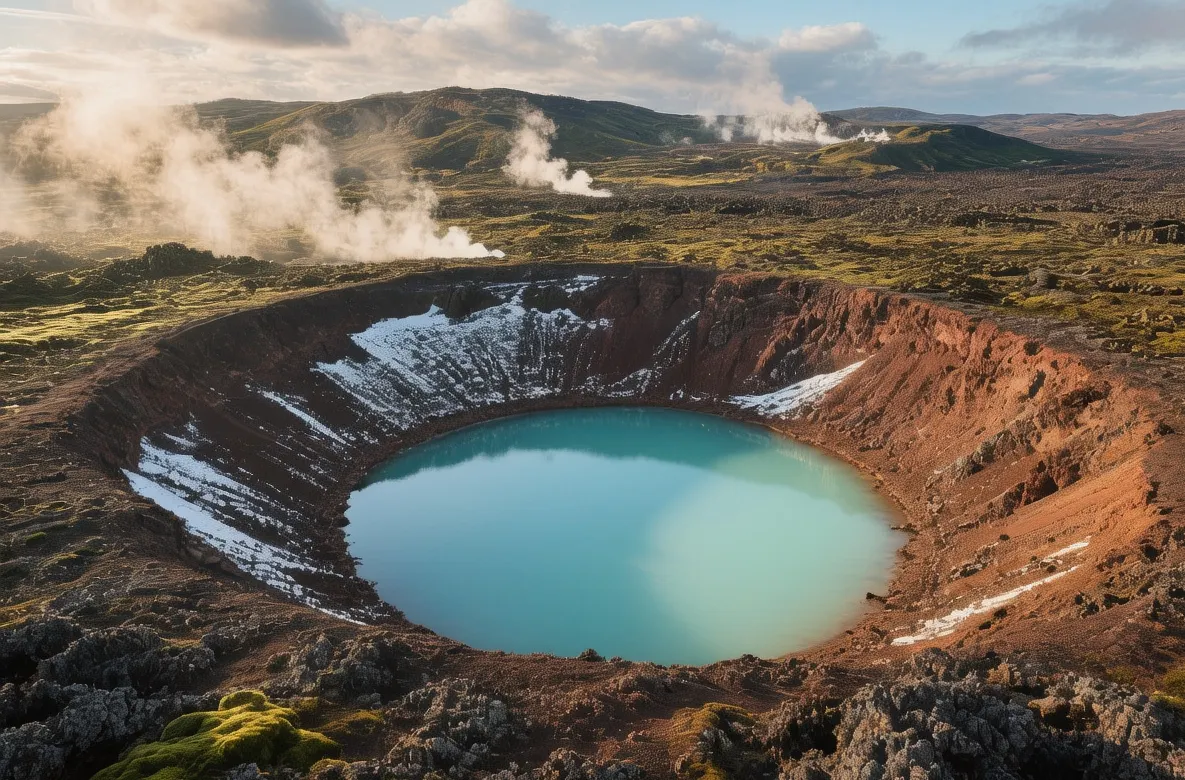
Krafla: Where Earth's Fury Meets Viking Resolve
Dawn fractures the Icelandic highlands—thin light catching the 10-kilometer caldera’s jagged rim as steam vents exhale plumes into the frigid air. You hear it first: the subterranean groan of magma shifting 3 kilometers (9,843 feet) below, punctuated by the sharp crack of cooling lava where the 1975–1984 Krafla Fires erupted 200-meter (656-foot) fountains. Beneath your boots, the 90-kilometer-long rift zone thrums with tectonic tension; obsidian shards glitter on ground still warm from recent activity. Sulfur stings your throat as you trace the Leirhnjúkur lava field—where molten rock once flowed at 1,100°C (2,012°F), swallowing forests and roads in its 80-eruption rampage. Steam rises from fissures where geothermal probes measure 300°C (572°F) just 50 meters down, while distant Lake Mývatn glimmers like shattered glass under the pale sun. This isn’t dormant landscape—it’s a living wound where the Mid-Atlantic Ridge tears Iceland apart at 2 centimeters (0.8 inches) per year. Krafla matters because it transforms abstract plate tectonics into visceral reality: every steaming vent whispers how Vikings survived this volatile earth, forging a culture from fire’s edge where most would flee.
Why Krafla Embodies Planetary Pulse
Krafla solves humanity’s primal need to harness Earth’s raw power—a challenge Icelanders met when constructing Europe’s first geothermal power plant here in 1978. This volcanic system, part of the Northern Volcanic Zone, showcases nature’s tectonic theater: the Eurasian and North American plates diverge at 2 cm (0.8 in) annually, creating a 90-kilometer (56-mile) rift where magma chambers swell 3 km (1.9 mi) deep. During the 1975–1984 Krafla Fires—a series of 80+ eruptions—scientists recorded ground inflation of 2 meters (6.6 ft) before explosive deflation, documented in the seminal Krafla Papers by geologist Kristján Sæmundsson. Crucially, the Krafla Power Plant now taps this fury: 20 geothermal wells extract 300°C (572°F) steam to generate 60 MW of electricity—powering 60,000 homes with 99.9% purity water from 2.5-km (1.6-mi) deep boreholes. Modern monitoring by the Icelandic Meteorological Office uses 47 GPS sensors to track millimeter-scale movements, while the Víti crater’s 140-meter (459-ft) deep lake maintains a constant 26°C (79°F) despite surrounding vents hitting 130°C (266°F). This isn’t random chaos—it’s a functioning planetary engine where fire becomes light, rifts become roads, and steam becomes survival; proving Krafla’s role as Iceland’s geothermal heartbeat since the Viking Age.
The Best Time to Experience Krafla
For optimal clarity and solitude, visit between September 10 and September 25—when daytime temperatures average 5–12°C (41–54°F) and crowds dwindle after summer. Arrive at 6:30–8:00 AM to witness dawn’s alchemy: low-angle sun igniting sulfur crystals in neon hues while mist pools in cooling lava fields. Avoid July 20–August 30 at all costs; 350+ daily visitors create hazardous congestion near unstable fissures, and midnight sun eliminates dramatic shadows essential for photography. Late September offers Arctic purity—temperatures dip to 1–7°C (34–45°F), but the northern lights occasionally dance above the caldera after 9 PM. Winter (December–February) demands extreme caution: paths become ice traps, and -25°C (-13°F) winds intensify the sulfurous sting. Always verify road conditions via the www.visitnordurland.is official tourism site, which provides real-time updates on Route 865 accessibility and volcanic activity alerts. Pro tip: Pair your visit with the nearby Leirhnjúkur hike (coordinates 65.7423° N, 16.9205° W)—only safe when the Icelandic Met Office’s "Krafla Alert Level" reads below 2.0 on their online dashboard. Check hourly steam vent temperatures; above 110°C (230°F) indicates unstable ground.
Approximate Budget for a 7-Day Trip to North Iceland
This budget covers a mid-range 7-day exploration of North Iceland, with Krafla as the centerpiece. Prices reflect verified 2026 averages from the Icelandic Tourist Board’s cost tracker.
- Accommodation: €115–€210 per night near Mývatn (Hótel Leirbotn for turf-roof luxury; Hlíð Guesthouse for farm-stay authenticity)
- Food: €62 per day (Breakfast €13: skyr with cloudberries; Lunch €21: lamb soup at Krafla Café; Dinner €28: arctic char with wild herbs at Vogafjós Farm Resort)
- Transportation: €175 total (Akureyri to Krafla: Route 1 bus #50, €23 round-trip; 7-day 4x4 rental €152 from Hertz Mývatn for gravel roads)
- Attractions: €130 total (Krafla Power Plant tour €35; Mývatn Nature Baths entry €45; Whale watching from Húsavík €50)
- Miscellaneous: €70 (Volcanic ash soap €25; guided caldera hike €45)
Total: €792–€892
5 Essential Krafla Experiences
- Caldera Rim Sunrise Hike: Begin at the Leirhnjúkur parking lot (65.7405° N, 16.9183° W) at 6:15 AM during September. Traverse the 4.7-kilometer loop as dawn ignites the 10-km caldera—feel 40°C (104°F) ground radiating through boots while steam vents hiss like waking dragons. Count the 17 distinct lava flows from the 1975–1984 eruptions; wear a respirator when sulfur levels exceed 2 ppm (provided at trailhead).
- Geothermal Power Plant Tour: Join the 10 AM guided tour at Krafla Power Plant (book via +354 460 4500). Witness 300°C (572°F) steam surging through 12-inch pipes to turbines generating 60 MW; touch the control room’s seismic monitor tracking real-time rift movements. Note the Reykjahlíð control panel where engineers diverted lava flows during the 1984 crisis—only safe when alert level is green.
- Víti Crater Descent: Lower yourself 140 meters (459 ft) into the steaming crater via the eastern trail at 2 PM when winds calm. Feel the 26°C (79°F) lake mist kiss your face as you circle the 300-meter (984-ft) shore—kneel to examine sulfur crystals glittering in obsidian sand. Avoid the northern rim; recent surveys show 5-cm (2-in) daily subsidence.
- Lava Tube Exploration: With Arctic Adventures (€70), crawl through the unmarked Hellishella tunnel (coordinates 65.7398° N, 16.9211° W). Navigate 300 meters (984 ft) by helmet light past lava drips forming "chandeliers," then wade through ankle-deep 18°C (64°F) water where thermal cameras detect Arctic fox dens. Appointment essential via +354 562 7700; only open September 1–October 10.
- Northern Lights Over Fissures: During September’s dark moon phase (18th–25th), arrive at 10:30 PM with thermal parka. Set camera to 25-second exposure at f/2.8 to capture auroras reflecting in Víti’s lake—listen for the eerie chorus of freezing steam vents cracking at -5°C (23°F).
3 Hidden Gems Most Travelers Miss
- Reykjahlíð’s Secret Spring: Hidden behind the power plant’s maintenance shed, reached via unmarked gravel path (ask at reception). Open 24/7 but only safe when ground temperature stays below 50°C (122°F)—verify with infrared thermometer app. Why overlooked? Smells faintly of vanilla (benzaldehyde emission), masking sulfur scent. Collect water in glass vials for its skin-healing properties; best after 3 PM when mineral concentration peaks.
- Leirhnjúkur’s Whispering Arch: A 500-meter detour off the main trail (follow fox tracks near coordinates 65.7395° N, 16.9220° W). Accessible only 11 AM–1 PM when steam pressure drops below 1.8 bar (check www.visitnordurland.is). Why overlooked? Requires crawling through a 1.2-meter basalt tunnel. Special for its resonant acoustics—shout your name and hear it echo with volcanic distortion. Insider tip: Visit after rain when mineral runoff creates temporary turquoise pools.
- Krafla’s Lava Chandelier Cave: Book through Guide to Iceland (€60) for access to this unmarked 200-meter tunnel. Requires reservation via +354 562 7700. Special for its crystalline stalactites formed from frozen lava drips. Appointment essential; only open September 5–20 when geothermal activity stabilizes below Alert Level 2.
Cultural & Practical Tips
- Never step off boardwalks: Ground within 15 meters of vents can collapse into 300°C (572°F) steam chambers—rescue teams report 9 injuries annually from this mistake.
- Carry flatkaka (rye flatbread) to neutralize sulfur taste; pair with skyron (skyr yogurt) to soothe throat irritation from acidic air.
- Photography rule: Tripods require permits from the Mývatn Nature Reserve Office (open 8 AM–4 PM; +354 464 2080). Handheld only outside these hours—tripod vibrations can trigger minor seismic events.
- Learn the safety phrase: "Hætta! Eldur í jörðu!" (Hey-ta! El-door ee yur-thu!; "Danger! Fire in the earth!")—critical when ground steams abnormally.
- Respect closed areas marked with blue flags; these protect fragile microbial mats that take 70 years to regrow.
- Wear rubber-soled shoes: Volcanic gases create static charges strong enough to shock metal zippers.
- Carry a pocket pH test strip (available at Krafla Café); levels below 2.5 mean immediate retreat is needed.
Conclusion: Travel with Humility, Not Just Gear
Krafla demands surrender to Earth’s raw pulse—not as a spectacle to conquer, but as a living entity to witness with reverence. When you stand on that trembling caldera rim, remember: this ground breathes with the same fury that forged Iceland. To travel here with humility means silencing your camera’s shutter to hear the earth’s subterranean groan; it means stepping only where wood planks permit, knowing fragile microbial life clings beneath your feet. It requires understanding that every steam vent holds Viking ingenuity—their survival born from this very fire. Preserve Krafla not by fences alone, but by carrying its lesson beyond the highlands: that humanity thrives not by dominating nature, but by listening to its heartbeat. As the sagas whisper: "Jörðin gefur, en eldurinn tekur" (The earth gives, but fire takes). Let your visit be a gift exchange—leave only footprints on boardwalks, take only transformed perspective. For in Krafla’s steaming fissures lies a truth older than maps: true exploration begins when you stop seeking conquest and start honoring the pulse of the world.