
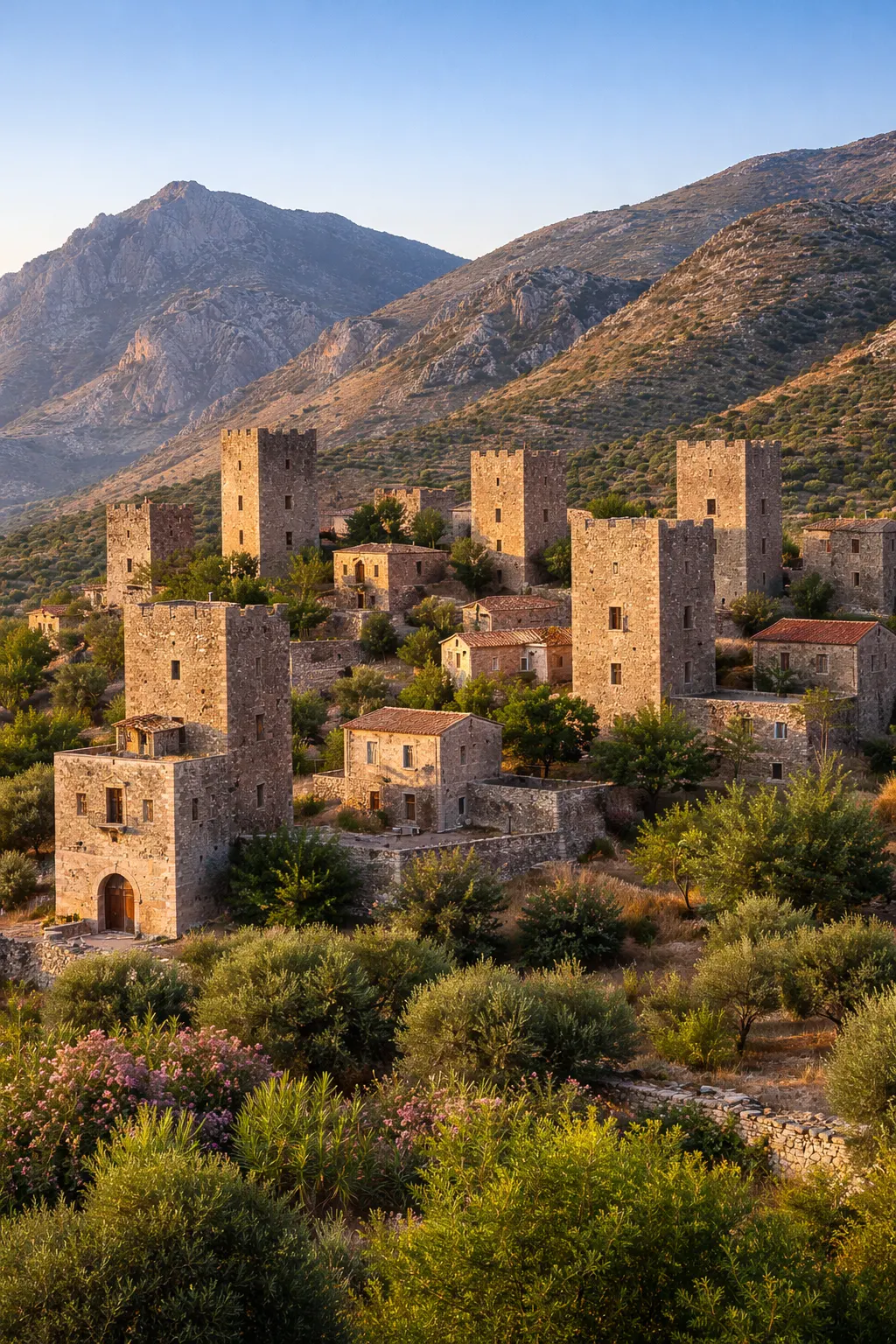
Mani Peninsula Towers: Where Ancient Stone Sentinels Meet Wild Olive Groves
Golden light spills across weathered limestone as you approach a cluster of tower houses rising like stone sentinels from the arid Mani landscape—sea breezes carry the scent of wild thyme and sun-baked olive leaves, while the distant cry of a kestrel echoes over terracotta rooftops. You stand within a living museum of defensive architecture, where 18th-century clan fortresses—some soaring 20 meters high with walls 1.2 meters thick—once protected families during centuries of vendettas and Ottoman rule. The Messenian Gulf stretches below in shades of turquoise and sapphire, framed by the jagged Taygetos mountains that have shaped Maniot culture for millennia. This is the Mani Peninsula, Greece's southernmost finger, where over 800 stone towers punctuate villages like Areopoli, Vatheia, and Kardamyli, each structure telling a story of honor, survival, and fierce independence. The Mani towers matter because they preserve not just architecture, but a way of life: a testament to human resilience where every crenellated parapet and narrow arrow slit whispers of clans who chose freedom over submission, building vertical fortresses that still define this rugged, beautiful landscape.
Why Mani Peninsula Towers Embodies Defensive Architectural Ingenuity
The Mani Peninsula towers represent one of the Mediterranean's most distinctive examples of vernacular defensive architecture—a landscape transformed by centuries of clan conflict into a forest of stone fortresses that solved the fundamental problem of protecting families in a region where central authority rarely reached. Constructed primarily between the 17th and 19th centuries during Ottoman occupation and the Greek War of Independence, these towers emerged from a culture where blood feuds (venetta) could span generations, requiring homes that doubled as fortresses.
Architecturally, Maniot towers showcase sophisticated adaptation to both conflict and climate. Typical structures rise three to four stories—12 to 20 meters high—with ground floors dedicated to livestock storage, middle floors for family living, and top floors featuring crenellated parapets with arrow slits for defense. Walls constructed from local limestone reach 1.2 meters thick at the base, tapering slightly upward to distribute weight while deflecting projectiles. Narrow entrance doors—just 60 centimeters wide—forced attackers to enter single-file, while internal wooden ladders could be pulled up to isolate upper floors during sieges.
Beyond defense, these towers fulfilled profound social functions: they signaled clan status within village hierarchies, provided secure storage for olive oil and wine harvested from terraced groves, and created vertical communities where extended families lived in close proximity yet maintained privacy through separate floor assignments. The engineering required precise stone-cutting techniques passed through generations, with master builders (mastores) employing dry-stone construction that allowed structures to flex during earthquakes—a critical feature in this seismically active region. When vendettas finally subsided in the late 19th century, many towers were abandoned or repurposed, inadvertently preserving a unique architectural heritage. Today, restored towers serve as boutique accommodations and cultural landmarks, offering visitors an immersive window into a world where home and fortress were one.
The Best Time to Experience Mani Peninsula Towers
Timing your visit to the Mani Peninsula towers requires balancing weather, lighting for photography, and seasonal programming. The optimal window runs from April 15 through June 10, when temperatures range 17–25°C (63–77°F) and wildflowers—poppies, cyclamen, and orchids—bloom among ancient olive groves. During this period, morning light between 8:00–9:30 AM illuminates limestone facades without harsh shadows, perfect for capturing the textured stonework and dramatic silhouettes of tower villages.
A second exceptional season spans September 22 through October 28, with temperatures of 16–24°C (61–75°F) and clearer atmospheric conditions that enhance visibility across the Messenian and Laconian Gulfs. The late afternoon sun between 4:30–6:00 PM casts warm amber tones across stone towers, creating dramatic contrasts ideal for architectural photography.
For the most atmospheric experience, arrive in tower villages like Vatheia or Areopoli by 7:30 AM when light first touches the limestone. The morning breeze remains gentle for exploring cobblestone lanes, and you'll have key viewpoints nearly to yourself before day-trippers arrive. Midday visits between 12:00–3:00 PM should be avoided during July and August, when temperatures exceed 34°C (93°F) and the exposed limestone radiates intense heat with minimal shade.
Avoid visiting during peak cruise excursion season (July 18–August 22) when narrow village lanes become congested and parking fills by 9:00 AM. Winter months (November–February) bring frequent rain and temperatures of 8–14°C (46–57°F); while crowds thin and prices drop, some mountain roads close during heavy weather, limiting access to remote tower villages.
For official information and site hours: www.visitgreece.gr and www.mani.org.gr
Approximate Budget for a 7-Day Trip
Exploring the Mani Peninsula towers as part of a Peloponnese cultural itinerary offers exceptional value, combining medieval heritage with coastal relaxation at prices well below Greek island destinations. The following breakdown assumes a mid-range travel style with comfortable accommodation in restored tower houses or boutique guesthouses, dining at traditional tavernas, and a mix of independent exploration and guided experiences.
- Accommodation: €50–€90 per night for restored tower houses or traditional stone guesthouses in Areopoli, Kardamyli, or Vatheia. Budget rooms in nearby Gytheio start at €35; luxury heritage tower suites reach €130.
- Food: €26–€36 per day. Breakfast €4 (Greek coffee, honey yogurt, fresh bread); lunch €10 (horiatiki salad, grilled octopus, house wine); dinner €15–€19 (slow-cooked goat, wild greens pie, local olive oil).
- Transportation: Bus from Athens to Gytheio €21 (4 hours, KTEL route); local taxi between villages €15–€25 round-trip; rental car €32/day (essential for accessing remote tower villages); parking typically free in villages.
- Attractions: Tower village exploration free; guided Maniot history tour €40; Diros Caves entrance €12; Ancient Messene site €8; combined Peloponnese heritage ticket €20.
- Miscellaneous: Handmade olive wood souvenirs €12–€28; local thyme honey 250g €7; traditional woven textiles €22; travel insurance €35/week; water/snacks at site €5.
Total for 7 days: €690–€890 per person (excluding international flights to Athens)
7 Essential Mani Peninsula Towers Experiences
- Explore Vatheia's iconic tower cluster at sunrise: Arrive at this dramatic hilltop village by 7:00 AM to photograph the dense concentration of stone towers bathed in golden light. Walk the narrow cobblestone lanes that wind between fortresses, noting the varying states of restoration. The best viewing angle is from the eastern approach road; allow 30 minutes to absorb the atmosphere before crowds arrive.
- Enter a restored tower house: Book accommodation or a guided tour of a renovated tower in Areopoli or Kardamyli to experience vertical living firsthand. Climb the original stone staircase to the rooftop terrace, where crenellated parapets frame panoramic sea views. Visit mid-morning (10:00–11:30 AM) when light illuminates interior stone walls and wooden beam ceilings.
- Walk the Areopoli waterfront at golden hour: Stroll the harbor promenade in this historic town, where stone towers rise directly from the sea. The late afternoon sun between 5:00–6:30 PM casts warm tones across limestone facades while fishing boats bob in turquoise waters. Stop at a seaside taverna for fresh seafood and local Malvasia wine.
- Photograph tower details with macro lens: Focus on architectural elements: arrow slits, carved stone lintels, weathered cornerstones bearing family initials. The best light for texture photography occurs mid-morning (9:00–10:30 AM) when side lighting accentuates stone grain. Bring a polarizing filter to reduce glare on sunlit limestone.
- Visit the Tower Museum in Areopoli: This small but informative collection displays artifacts from Maniot history: weapons, household items, and photographs documenting tower construction techniques. Visit between 9:00–10:30 AM when natural light illuminates exhibits without glare. Entry €4; guided explanations available in English upon request.
- Drive the coastal tower route: Follow the scenic road from Kardamyli to Stoupa, stopping at viewpoint pullouts to photograph towers perched on cliffs above the Messenian Gulf. Allow two hours for the 35-kilometer drive, with frequent photo stops. The most dramatic vistas occur between 4:00–5:30 PM when low-angle light enhances landscape contours.
- Attend a traditional Maniot music evening: Many guesthouses host intimate performances of polyphonic singing—a UNESCO-recognized tradition where voices weave complex harmonies reflecting the region's isolation. Inquire at your accommodation upon arrival; events typically begin at 8:30 PM and last 90 minutes. Bring a light wrap—sea breezes cool evenings even in summer.
3 Hidden Gems Most Travelers Miss
- The Abandoned Tower of Pyrgos Dirou: Located 2 kilometers inland from the famous Diros Caves, this solitary 19th-century tower stands amid olive groves with original wooden floors and a partially intact rooftop parapet. Most visitors bypass it because guided tours focus on the caves. Access via the unmarked dirt road behind the cave parking area; follow signs for "Pyrgos." Visit early morning (8:00–9:00 AM) to avoid heat; bring a flashlight to explore the dim interior safely.
- The Secret Chapel of Agios Nikolaos: Tucked behind a cluster of towers in the village of Lagia, this tiny 17th-century chapel features remarkably preserved frescoes depicting Saint Nicholas protecting sailors. The entrance is unmarked; ask locals for "to ekklisaki tou Agiou Nikolaou." Visit mid-morning (10:00–11:00 AM) when light filters through the small western window to illuminate the frescoes. Bring a small donation for preservation efforts.
- The Ancient Olive Press of Exochori: Hidden in a terraced grove above the village of Exochori, this 18th-century stone olive press features original wooden beams and stone crushing wheels. Still occasionally used by local families during harvest, it demonstrates the agricultural foundation that supported tower-dwelling clans. Access via the footpath behind Exochori's main square; follow the scent of crushed olives during harvest season (November). Visit late afternoon (3:00–4:30 PM) when dappled light creates atmospheric photography opportunities.
Cultural & Practical Tips
- Respect private property: Many Mani towers remain private residences or family heritage sites. Do not enter unmarked properties or photograph through windows without permission—ask "Boro na dóla to pyrgo?" (May I see the tower?) before approaching. Always close gates behind you to contain livestock.
- Carry cash for small villages: Remote tower villages often lack ATMs and credit card terminals. Withdraw €100–€150 in Gytheio or Areopoli before exploring. Family tavernas and artisan shops prefer cash; small vendors may add surcharges for card payments.
- Learn essential Greek phrases: "Yassou" (YAH-soo) = hello; "Efharisto" (ef-hah-REE-stoh) = thank you; "Poso kani?" (POH-soh KAH-nee) = how much?; "Nero parakalo" (neh-ROH pah-rah-kah-LOH) = water please; "Pou ine o pyrgos?" (poo EE-neh oh PEER-gohs) = where is the tower?
- Prepare for rugged terrain: Mani's villages feature steep, uneven cobblestone lanes and occasional goat paths. Wear sturdy, closed-toe shoes with good grip. Carry at least 1.5 liters of water per person; refill stations are limited in remote areas. Visit early morning or late afternoon to avoid peak heat.
- Photography guidelines: Handheld photography is permitted throughout public areas. Tripods are allowed but cannot obstruct narrow lanes. Drone use requires written permission from the Hellenic Ministry of Culture (+30 210 8211000) and is rarely granted for heritage villages. Commercial shoots require permits obtained 48 hours in advance from the Laconia Ephorate of Antiquities.
- Weather considerations: Strong meltemi winds can reach 40 km/h (25 mph) on exposed coastal towers, especially July–August. Secure loose items and be cautious near unprotected parapets. Afternoon thunderstorms develop rapidly in mountainous areas; descend from high villages immediately if you hear thunder—the limestone becomes extremely slippery when wet.
- Accessibility considerations: Mani's tower villages feature steep, uneven cobblestone lanes not suitable for wheelchairs. However, waterfront areas in Areopoli and Kardamyli offer relatively flat pathways. Visitors with mobility issues can experience key viewpoints from accessible harbor promenades. Request assistance at local tourist information offices; staff can suggest accessible routes.
Conclusion: Travel with Reverence, Not Just Sightseeing
The Mani Peninsula towers ask for more than a quick photograph and a checklist mark—they invite reverence for the human resilience that transformed raw limestone into enduring symbols of independence. This isn't merely an architectural curiosity; it's a landscape where every stone tells a story of clans who chose freedom over submission, building vertical fortresses that still define this rugged, beautiful terrain. When you stand beneath a crenellated parapet and trace your fingers along sun-warmed limestone, you're not just viewing history—you're participating in a continuum of human determination that has thrived for centuries.
Responsible travel here means understanding that you're a guest in a space where legacy breathes through every arrow slit. It means moving slowly enough to appreciate the craftsmanship of a dry-stone wall, pausing to imagine the families who once watched for danger from these very parapets, and supporting the local communities that preserve this heritage. Purchase directly from artisan shops, dine at tavernas sourcing ingredients from Maniot groves, and respect the quiet rhythms of village life.
Slow down. Sit on a sun-warmed stone step and watch light shift across the Taygetos peaks. Listen to church bells echoing between tower walls, mingling with the gentle rustle of olive leaves. Share a glass of local wine with fellow travelers, letting the Mani's timeless beauty inspire not just admiration, but understanding. These towers will endure—if we treat them not as backdrops for selfies, but as teachers of resilience, witnesses to human perseverance, legacies to protect. Travel here with humility, and the stones will share their secrets.