
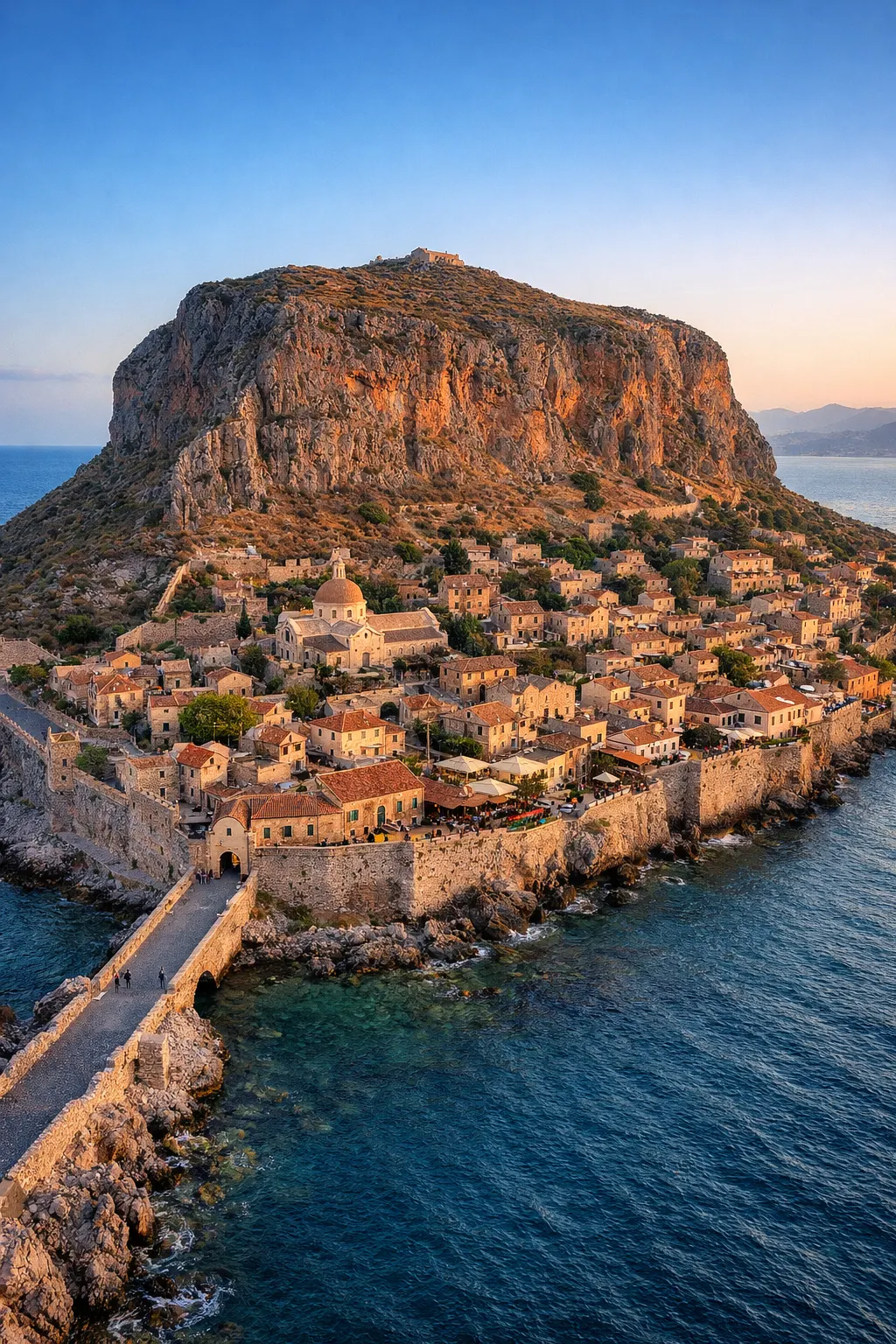
Monemvasia Castle Town: Where Medieval Stone Meets Aegean Light
Golden light washes over honey-colored limestone as you cross the causeway—sea breezes carry the scent of wild capers and salt, while the gentle lap of waves against ancient harbor walls creates a rhythmic underscore to your arrival. You stand before a fortress carved from a single rock outcrop rising 300 meters above the Laconian Gulf, its narrow cobblestone lanes winding between Byzantine chapels and Venetian mansions that have witnessed eight centuries of history. This is Monemvasia, the "Gibraltar of the East," a castle town accessible through a single fortified gate—its very name meaning "single entrance" in Greek. The lower town's vaulted archways shelter boutique guesthouses and tavernas serving fresh octopus and local Malvasia wine, while the upper town's ruins offer panoramic views where eagles circle above turquoise waters. Monemvasia matters because it preserves not just architecture, but a way of life: a living museum where medieval streets still echo with footsteps, where Byzantine frescoes glow in candlelit chapels, and where time seems to slow beneath the watchful gaze of stone fortifications that have defended this sacred rock since the sixth century.
Why Monemvasia Castle Town Embodies Timeless Fortress Architecture
Monemvasia represents one of the Mediterranean's most extraordinary examples of adaptive fortress architecture—a natural rock citadel transformed into an impregnable medieval town that solved the fundamental problem of coastal defense while fostering vibrant cultural life. Founded in 583 CE when Laconian residents fled mainland invasions, the settlement flourished under Byzantine, Frankish, Venetian, and Ottoman rule, each leaving architectural layers that tell a story of resilience and adaptation.
The town's engineering brilliance lies in its harmonious integration with geology. The massive limestone monolith—approximately 1 kilometer long and 300 meters high—provides natural defensive walls on three sides, while human builders fortified the western approach with a 12-meter-thick curtain wall and twin towers. The lower town's urban plan features vaulted passageways that channel cooling sea breezes through narrow lanes just 2 meters wide, creating natural air conditioning that keeps temperatures 4–6°C cooler than the mainland in summer.
Beyond defense, Monemvasia fulfilled profound cultural needs: it became a major maritime trading hub where silk, wine, and olive oil flowed between East and West; its scriptorium produced illuminated manuscripts that preserved classical knowledge; and its churches—like the iconic Agia Sofia perched on the upper town's edge—showcased Byzantine artistic mastery. The famous Malvasia wine, named for the town itself, was exported across medieval Europe, enriching local merchants who built the elegant stone mansions that still line the main street. When earthquakes damaged the upper town in the 18th century, residents gradually relocated below, inadvertently preserving the medieval fabric above as an archaeological treasure. Today, this UNESCO-listed site offers an unparalleled window into fortified urban life, where every stone arch and frescoed chapel whispers stories of faith, commerce, and survival.
The Best Time to Experience Monemvasia Castle Town
Timing your visit to Monemvasia requires balancing weather, lighting for photography, and seasonal programming. The optimal window runs from April 20 through June 8, when temperatures range 18–26°C (64–79°F) and wildflowers—bougainvillea, jasmine, and sea daffodils—cascade over stone walls. During this period, morning light between 8:00–9:30 AM illuminates the eastern facades without harsh shadows, perfect for capturing the interplay of light and ancient limestone.
A second exceptional season spans September 18 through October 25, with temperatures of 16–24°C (61–75°F) and clearer atmospheric conditions that enhance visibility across the Laconian Gulf. The late afternoon sun between 5:00–6:30 PM casts warm amber tones across harbor walls, creating dramatic contrasts ideal for architectural photography.
For the most atmospheric experience, arrive at the causeway entrance by 7:30 AM when light first touches the fortress. The morning breeze remains gentle for exploring cobblestone lanes, and you'll have key viewpoints nearly to yourself before day-trippers arrive. Midday visits between 12:00–3:00 PM should be avoided during July and August, when temperatures exceed 33°C (91°F) and the exposed limestone radiates intense heat with minimal shade.
Avoid visiting during peak cruise excursion season (July 15–August 20) when narrow lanes become congested and parking fills by 9:00 AM. Winter months (November–February) bring frequent rain and temperatures of 9–15°C (48–59°F); while crowds thin and prices drop, some upper-town pathways close for safety during wet weather.
For official information and site hours: www.visitgreece.gr and www.monemvasia.gr
Approximate Budget for a 7-Day Trip
Exploring Monemvasia as part of a Peloponnese cultural itinerary offers exceptional value, combining medieval heritage with coastal relaxation at prices well below Greek island destinations. The following breakdown assumes a mid-range travel style with comfortable accommodation in the castle town or nearby Gefyra, dining at traditional tavernas, and a mix of independent exploration and guided experiences.
- Accommodation: €55–€95 per night for boutique cave hotels or traditional stone guesthouses within Monemvasia castle walls. Budget rooms in Gefyra (mainland) start at €40; luxury sea-view suites reach €140.
- Food: €28–€38 per day. Breakfast €5 (Greek coffee, honey yogurt, fresh bread); lunch €11 (horiatiki salad, grilled sardines, house wine); dinner €16–€20 (slow-cooked lamb, fresh octopus, local Malvasia wine).
- Transportation: Bus from Athens to Monemvasia €22 (4 hours, KTEL route); local taxi from Gefyra to castle €5; rental car €30/day (recommended for exploring Laconia); parking in Gefyra €3/day.
- Attractions: Monemvasia castle town entrance free; guided medieval history tour €35; Byzantine museum €4; boat tour to nearby coves €18; combined Peloponnese heritage ticket €20.
- Miscellaneous: Handmade Malvasia wine bottles €12–€25; local thyme honey 250g €7; traditional woven textiles €20; travel insurance €35/week; water/snacks at site €5.
Total for 7 days: €710–€910 per person (excluding international flights to Athens)
7 Essential Monemvasia Castle Town Experiences
- Walk the main cobblestone artery at sunrise: Enter through the fortified gate at 7:30 AM and stroll the vaulted main street before crowds arrive. The morning light filters through stone arches, illuminating boutique shop windows and the textured limestone walls. Allow 20 minutes to absorb the atmosphere, stopping to photograph the intricate doorways and hanging flower baskets that define Monemvasia's charm.
- Climb to the upper town for panoramic views: Ascend the stepped pathway behind the Church of Christ in Chains to reach the ruined upper settlement. The 15-minute climb rewards with 360-degree vistas of the Aegean, the causeway, and the Taygetos mountains. Visit between 5:00–6:30 PM in summer for golden-hour photography; bring water and wear sturdy shoes for the uneven stone steps.
- Explore the Church of Agia Sofia: This 13th-century chapel perched on the upper town's edge features remarkable frescoes and a dramatic setting overlooking the sea. Enter through the small wooden door and allow your eyes to adjust to the dim interior. The best light for viewing frescoes occurs mid-morning (10:00–11:00 AM) when natural illumination filters through the eastern windows.
- Savor Malvasia wine at a harbor taverna: Reserve a seaside table at a family-run taverna in the lower town for sunset dining. Order the local Malvasia—a sweet, amber dessert wine historically exported across medieval Europe—paired with fresh grilled octopus or lamb kleftiko. Arrive by 6:00 PM to secure a table with harbor views; reservations recommended July–September.
- Photograph the causeway at blue hour: Position yourself on the mainland side of the causeway 20 minutes after sunset, when the sky turns deep indigo and castle lights begin to glow. The reflection of illuminated stone walls on calm harbor waters creates a magical composition. Use a tripod for long exposures; a 24–70mm lens captures both the causeway and fortress in one frame.
- Visit the Archaeological Collection: Housed in a restored Ottoman mosque near the main gate, this small museum displays artifacts from Monemvasia's layered history: Byzantine pottery, Venetian coins, and Ottoman-era weapons. Visit between 9:00–10:30 AM when natural light illuminates exhibits without glare. Entry included with guided tours or €4 standalone.
- Attend a traditional music evening: Many guesthouses host intimate performances of rebetika (Greek blues) or Byzantine chant in their courtyards. Inquire at your accommodation upon arrival; events typically begin at 8:30 PM and last 90 minutes. Bring a light wrap—sea breezes cool evenings even in summer.
3 Hidden Gems Most Travelers Miss
- The Secret Cistern of the Upper Town: Beneath the ruined Church of Panagia Chrysafitissa lies a vaulted cistern carved into bedrock, capable of storing 50,000 liters of rainwater to sustain the fortress during sieges. This engineering marvel features a corbelled dome and original plaster lining. Access requires asking the site guardian for the key—most visitors never discover it. Visit mid-afternoon (2:00–4:00 PM) when lighting reveals construction details; bring a small flashlight to examine the dome's interior.
- The Venetian Governor's Mansion Courtyard: Tucked behind an unmarked wooden door on the main street, this restored 16th-century courtyard features a marble fountain, climbing jasmine, and original stone arches. Now a private residence, the owner occasionally welcomes respectful visitors for brief tours. Look for the small brass plaque near the entrance; knock gently and ask "Boro na do to arhontiko?" (May I see the mansion?). Best visited late morning (10:00–11:00 AM) when the courtyard receives optimal light.
- The Hidden Beach Below the Causeway: A narrow footpath descending from the mainland side of the causeway leads to a secluded pebble beach sheltered by limestone cliffs. The water remains crystal-clear and refreshingly cool even in peak summer. Access via the unmarked trail 100 meters before the castle entrance; follow signs for "Paralia." Visit early morning (7:00–8:30 AM) for solitude and optimal swimming conditions; bring water shoes for the rocky entry.
Cultural & Practical Tips
- Respect residential spaces: Monemvasia remains a living community with permanent residents. Keep voices low in narrow lanes, especially after 10:00 PM. Do not photograph private courtyards or windows without permission—ask "Boro na fotografía?" (Can I photograph?) before raising your camera.
- Carry cash for small purchases: Many boutique shops and family tavernas prefer cash transactions. ATMs exist only in Gefyra (mainland) and Sparta—withdraw €100–€150 before entering the castle town. Small vendors accept credit cards, but minimum purchases may apply.
- Learn essential Greek phrases: "Yassou" (YAH-soo) = hello; "Efharisto" (ef-hah-REE-stoh) = thank you; "Poso kani?" (POH-soh KAH-nee) = how much?; "Nero parakalo" (neh-ROH pah-rah-kah-LOH) = water please; "Pou ine i paralia?" (poo EE-nee ee pah-lee-AH) = where is the beach?
- Prepare for cobblestone terrain: Monemvasia's streets feature uneven, slippery limestone paving. Wear closed-toe shoes with good grip; avoid heels or smooth soles. The town involves gentle inclines but no steep climbs within the lower settlement. Carry a small daypack with water and sun protection.
- Photography guidelines: Handheld photography is unrestricted throughout the castle town. Tripods are permitted but cannot obstruct narrow lanes or doorways. Drone use requires written permission from the Hellenic Ministry of Culture (+30 210 8211000) and is rarely granted for heritage sites. Commercial shoots require permits obtained 48 hours in advance from the Laconia Ephorate of Antiquities.
- Weather considerations: Afternoon sea breezes can reach 25 km/h (16 mph) on exposed upper-town pathways. Secure loose items and be cautious near unprotected edges. Summer thunderstorms develop rapidly; descend from upper town immediately if you hear thunder—the limestone becomes extremely slippery when wet.
- Accessibility considerations: Monemvasia's cobblestone lanes and stepped pathways are not wheelchair accessible. However, the lower town's main street and harbor area are relatively flat and navigable with assistance. Visitors with mobility issues can experience key viewpoints from the causeway and harbor promenade. Request assistance at the tourist information office in Gefyra; staff can suggest accessible routes.
Conclusion: Travel with Reverence, Not Just Sightseeing
Monemvasia asks for more than a quick photograph and a checklist mark—it invites reverence for the human ingenuity that transformed a solitary rock into a living sanctuary. This isn't merely a picturesque village; it's a testament to resilience, where generations adapted stone to shelter, faith to art, and isolation to community. When you walk these vaulted lanes and trace your fingers along sun-warmed limestone, you're not just viewing history—you're participating in a continuum of human adaptation that has thrived for fourteen centuries.
Responsible travel here means understanding that you're a guest in a space where legacy breathes through every archway. It means moving slowly enough to appreciate the craftsmanship of a Venetian doorway, pausing to imagine the merchants who once traded Malvasia wine in these very lanes, and supporting the local families who preserve this heritage. Purchase directly from artisan shops, dine at tavernas sourcing ingredients from Laconian farms, and respect the quiet rhythms of residential life within the walls.
Slow down. Sit on a harbor-side step and watch light shift across the Aegean. Listen to church bells echoing between stone walls, mingling with the gentle lap of waves. Share a glass of Malvasia with fellow travelers, letting the castle town's timeless beauty inspire not just admiration, but understanding. Monemvasia will endure—if we treat it not as a backdrop for selfies, but as a teacher of patience, a witness to human perseverance, a legacy to protect. Travel here with humility, and the stones will share their secrets.