
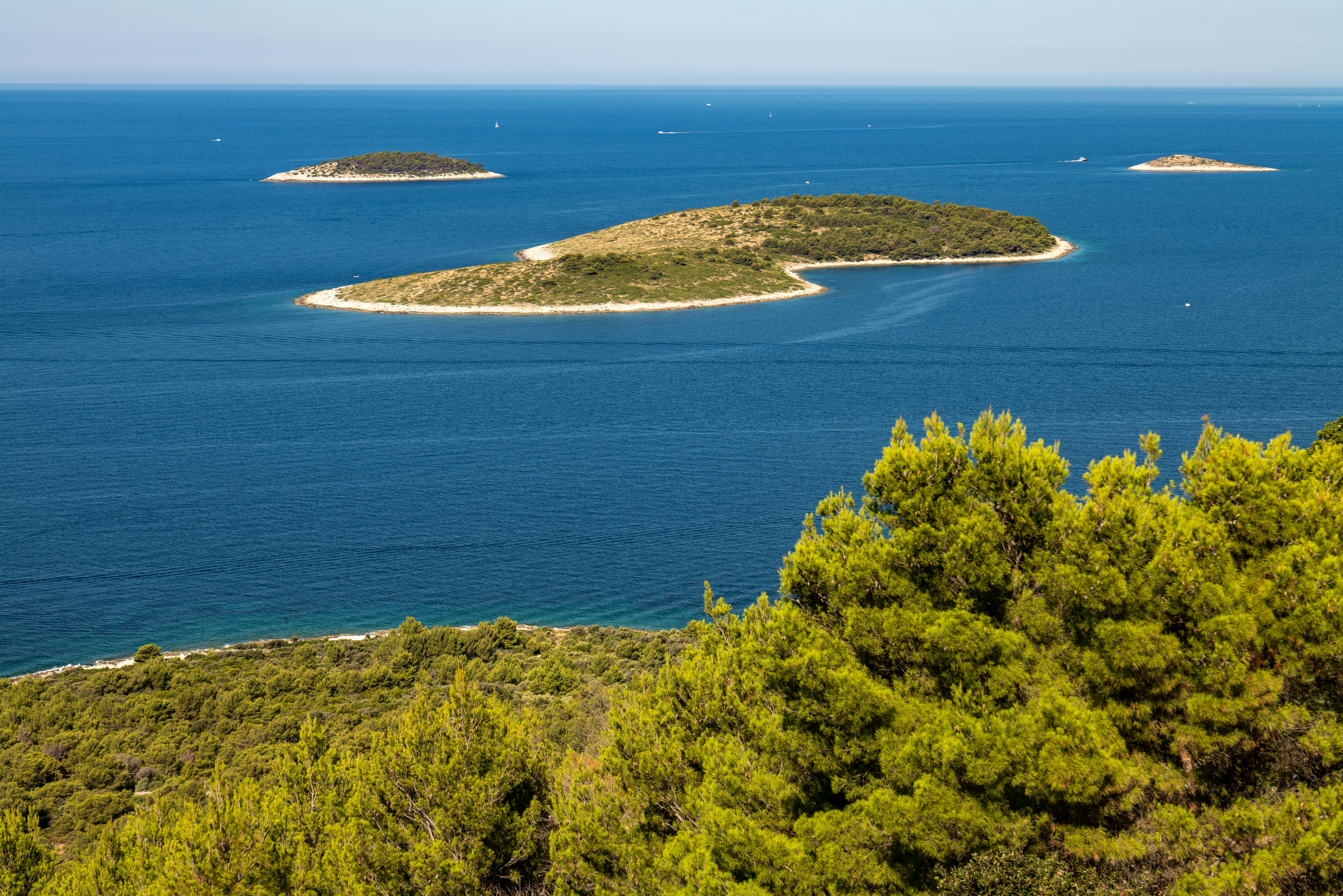
Pakleni Islands: Where Adriatic Turquoise Meets Ancient Pine Forests
The late afternoon light turns the shallow Adriatic into liquid glass—shimmering, impossibly turquoise—as your wooden boat cuts through the channel separating Hvar from the Pakleni Islands. Pine resin mingles with salt air; the rhythmic slap of waves against the weathered hull provides a metronome for the journey, punctuated by the distant, echoing cry of a shearwater slicing through the thermals. Ahead, a necklace of 20 islets stretches across 10 kilometers of open sea, their jagged limestone coastlines fringed with fragrant macchia and ancient olive groves. The Pakleni Islands—derived from pakleni, meaning resinous, a nod to the pine sap once harvested here—have served as a sanctuary since Illyrian tribes sought refuge in these secluded coves over two millennia ago. Today, the archipelago remains a masterclass in Mediterranean restraint: no cars, no sprawling resorts, just a tapestry of rocky beaches, modest stone chapels, and hidden swimming grottos. This place matters not for what it displays, but for what it preserves—a slower, saltier cadence of life that the Dalmatian coast is rapidly forgetting.
Why the Pakleni Islands Embody Mediterranean Purity
For centuries, the Pakleni Islands served a vital strategic purpose: they acted as a natural breakwater shielding the affluent Hvar commune from the open sea’s destructive southern winds—the jugo. When the Venetian Republic consolidated control over Dalmatia in the early 15th century, they recognized the archipelago’s defensive value, establishing lookout posts on Sveti Klement, the largest island measuring 5.3 square kilometers. Yet the islands’ true historical significance lies in their economic utility. The dense Aleppo pine forests—covering roughly 70% of the landmass—were systematically harvested for paklina (resin), a crucial commodity used for waterproofing wooden vessels. By the 17th century, local fishermen constructed dry-stone terraces spanning 18 kilometers across the islands to cultivate olives and grapes, transforming rugged karst into arable land. This engineering feat solved the problem of sustaining a permanent population in an environment with virtually no topsoil; the terraces trapped rainwater and prevented erosion. Today, those same walls stand silent but intact—a testament to human ingenuity blending seamlessly into the limestone bedrock.
The Best Time to Experience the Pakleni Islands
To witness the Pakleni Islands at their most transcendent, plan your visit between May 18–June 12. During this precise window, the sea temperature sits at a comfortable 20°C–22°C (68°F–72°F), the crowds have not yet arrived, and the islands are blanketed in wild fennel and blooming cistus. Arrive at the Hvar waterfront at 8:00–9:30 AM to catch the earliest taxi boat; this ensures you secure a solitary patch of pebble beach on Jerolim before the midday flotillas appear. September 10–28 offers a secondary golden window, with water temperatures peaking at 24°C (75°F) and the pine forests taking on a rich amber hue. You should aggressively avoid July 15–August 20, when daytime temperatures routinely exceed 32°C (90°F) and daily visitor counts swell to unsustainable levels. During these weeks, the narrow channels become congested with motorized vessels, the water quality noticeably degrades from sunscreen runoff, and securing a table at any waterfront konoba becomes virtually impossible. For official ferry schedules and seasonal updates, consult the local tourism authority at www.visithvar.com.
Approximate Budget for a 7-Day Trip
Calculating the cost of a week among the Pakleni Islands requires understanding the archipelago's unique geography; there are no large hotels, meaning expenses lean heavily toward day-tripping from Hvar or securing private villa rentals on Sveti Klement. The following budget assumes a comfortable, mid-tier luxury experience for two people.
- • Accommodation: €180–€320 per night (stone villa with sea view in the Stari Grad or Hvar outskirts, deliberately avoiding the premium town center)
- • Food: €110 per day (breakfast at a local pekara €8, lunch of fresh grilled octopus with blitva €35, dinner at a konoba like Konoba Meneghello on Marinkovac €67)
- • Transportation: €140 total (return taxi boat from Hvar at €15 per person per day; occasional private water taxi €45 for late-night transfers)
- • Attractions: €65 total (entrance to the Carpe Diem Beach Club daytime area €25; Stipanska beach lounge chairs €15 per day; transparent kayak rental €25)
- • Miscellaneous: €90 total (bottle of local Hvar olive oil €18, artisan lavender sachets €12, high-SPF sunscreen and snorkeling gear €30, evening aperitivo at a seaside bar €30)
Total: €1,345–€1,885 for one week (for two people)
6 Essential Pakleni Islands Experiences
- Swimming the Green Cave of Mala Grabova: Located on the southern side of Mala Grabova islet, this karst cavity features a submerged entrance barely one meter above sea level. Time your entry between 10:00–11:30 AM when the sun's angle refracts through the water, bathing the interior walls in an ethereal emerald glow. You will need to swim through the narrow fissure—hold your breath for roughly five seconds—to access the cavern.
- Dining at Konoba Meneghello: Accessible only by a 25-minute walk from the Stipanska jetty or by private boat, this family-run restaurant on Marinkovac serves plates that define Dalmatian simplicity. Order the peka (lamb and veal slow-cooked under an iron bell), which requires a 24-hour advance reservation. Eat on the stone terrace overlooking the bay as the cicadas fade into the dusk.
- Kayaking the Vinogradišće Channel: Rent a transparent kayak from the main pier on Sveti Klement and paddle east through the narrow channel separating Sveti Klement from Marinkovac. The water clarity here reaches 15 meters of visibility, revealing Posidonia seagrass meadows undulating on the seabed. Depart by 9:00 AM to avoid afternoon crosswinds.
- Watching Sunset from the Carpe Diem Cliff: While the infamous Carpe Diem Beach Club thrums with bass at night, the adjacent cliff edge at 7:45–8:30 PM offers an unobstructed western view. Order a glass of local Bogdanuša white wine and watch the sun dip behind the Biokovo mountain range, painting the sky in streaks of crushed velvet and copper.
- Hiking the Fortica Viewpoint Trail: Beginning near the deserted village of Vlaka on Sveti Klement, this 3.2-kilometer trail ascends 145 meters through dry-stone walls and Aleppo pines. The 40-minute climb yields a panoramic vantage point where you can see the entirety of the Pakleni archipelago, Hvar town, and the distant mainland.
- Snorkeling the Taršće Reef: On the northeastern edge of Jerolim island lies a submerged limestone reef that drops off sharply into the deep channel. The coral-encrusted rock faces host dense colonies of dusky grouper and rainbow wrasse. Accessible via a 200-meter swim from the pebble shore, hold your breath and dive down three meters to inspect the overhangs.
3 Hidden Gems Most Travelers Miss
- • The Deserted Village of Vlaka: Perched on a hillside on Sveti Klement, this abandoned 19th-century settlement features stone houses with intact roofs overgrown by fig trees. It is overlooked because there are no signs marking the trailhead—located 400 meters east of the ACI Marina on Sveti Klement. Visit in the early morning when the golden light illuminates the vacant doorways; wear sturdy shoes, as the path is uneven karst.
- • St. Nicholas Chapel on Marinkovac: A diminutive, single-nave church built in 1834, tucked behind a dense grove of wild olives. Most travelers bypass it because the path is entirely obscured by macchia. To find it, walk 15 minutes inland from the Stipanska pier, bearing left at the fork near the dry stone well. The wooden door is usually unlocked; the interior contains a fragile, unpainted stone altar that smells deeply of aged limestone.
- • The Mud Flats of Vodnjok Bay: At the far western tip of Sveti Klement, this shallow, landlocked cove features a silty seabed rich in mineral clay. Locals have used it for therapeutic mud baths for generations, yet it is ignored by tourists because the water appears murky. Visit at low tide (check local tidal charts; typically early afternoon), smear the cool grey mud on your skin, let it dry in the sun for 15 minutes, and rinse in the adjacent clear rock pools.
Cultural & Practical Tips
- • When greeting locals, say "Dobar dan" (DOH-bar dahn)—Good day. Use this from morning until early evening; switching to "Dobra večer" (DOH-brah VEH-cher) after 6:00 PM is a sign of cultural respect.
- • The islands operate on a strict "take nothing but pictures" ethos, but this extends to natural materials: do not pocket pieces of limestone, dried lavender, or seagrass, as locals view this as a removal of the islands' spirit.
- • Photography is welcomed, but pointing your lens directly into private residences or private konoba gardens without asking is considered intrusive. A simple "Smijem li?" (SMYEH-m lee)—May I?—goes a long way.
- • Fresh water is exceptionally scarce on the outer islands. Carry at least 1.5 liters per person when hiking Sveti Klement; the public taps near the marinas are the only reliable sources.
- • Jellyfish (meduza) are occasionally present in late August. If stung, do not rinse with freshwater; instead, use vinegar (ask any boat captain, who always keeps a bottle onboard) or seawater to neutralize the nematocysts.
- • The Bura wind—a dry, ferocious northeasterly gale—can appear without warning between October and April. If you hear a roaring sound from the mainland mountains, immediately seek shelter away from the northern cliffs, as the wind can easily knock an adult off their feet.
Conclusion: Travel with Reverence, Not Just Itineraries
To visit the Pakleni Islands is to step into a landscape that has resisted the aggressive march of modern tourism—not through legislation, but through its own stubborn, rocky inaccessibility. These islands do not cater to passive consumption; they demand participation. You must navigate their waters, seek out their hidden coves, and adapt to the rhythm of the sun and wind. Traveling with reverence here means recognizing that the dry-stone walls were built by calloused hands over centuries, that the silence you cherish is a fragile commodity, and that the turquoise water is a living ecosystem dependent on your restraint. When you choose a paddle over a motor, a quiet cove over a branded beach club, and a local wine over an imported cocktail, you are not merely having a different experience—you are actively participating in the preservation of this archipelago’s soul. Slow down. Let the resin-scented air fill your lungs. The Pakleni Islands will reward your patience with a profound, unspoken stillness that no itinerary can manufacture.