
Snæfellsnes Peninsula: Where Volcanic Majesty Meets Viking Lore
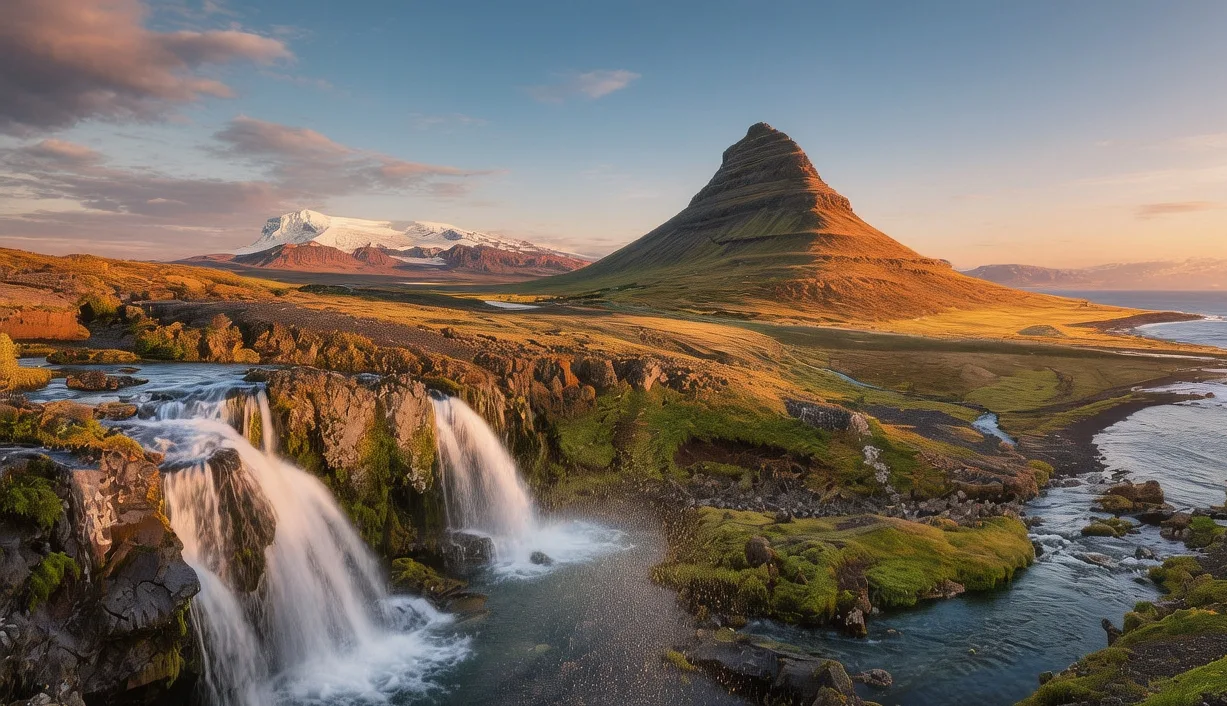
Golden hour bleeds across the 90-kilometer Snæfellsnes Peninsula—soft light catching the 1,446-meter (4,744-foot) peak of Snæfellsjökull glacier as it casts a violet shadow over black sand beaches. You hear it first: the rhythmic crash of Atlantic waves against Arnarstapi's 15-meter (49-foot) basalt columns, their geometric perfection glowing amber in the 10°C (50°F) evening air. Beneath your boots, volcanic sand crunches like crushed obsidian while puffins chatter from their cliffside burrows—12,000 breeding pairs nesting in these protected cliffs since Viking times. This isn't just landscape—it's geological poetry in motion. Carved by 12,000 years of volcanic fury and glacial sculpting, the peninsula contains 17 distinct geological formations within its narrow 90-kilometer span, including the 700,000-year-old Snæfellsjökull stratovolcano that inspired Jules Verne's "Journey to the Center of the Earth." Steam rises from hidden geothermal vents where 10th-century settlers once gathered sulfur for medicinal purposes, while the distant cry of Arctic terns punctuates the air. Stand where Vikings established Iceland's first settlements in 870 CE, and feel the paradox: fire both destroys and creates; ice both buries and reveals. Snæfellsnes matters because it transforms abstract geology into visceral truth—where every black sand dune whispers how Earth's most dramatic landscapes emerge from the marriage of fire and ice, proving that humanity's deepest stories begin where the planet speaks loudest.
Why Snæfellsnes Peninsula Embodies Geological Storytelling
Snæfellsnes solves humanity's timeless need to witness Earth's creative power—a function it fulfilled when early settlers established Iceland's first farming communities here in 870 CE. This 90-kilometer (56-mile) peninsula, often called "Iceland in miniature," showcases nature's ability to compress planetary evolution into a single landscape. The Snæfellsjökull stratovolcano—700,000 years old with 12 recorded eruptions—dominates the western tip, its glacier-capped peak reaching 1,446 meters (4,744 feet) above sea level. Crucially, the peninsula contains 17 distinct geological formations within its narrow span: from the 15-meter (49-foot) basalt columns of Arnarstapi formed 3.5 million years ago to the 20-meter (66-foot) Aldeyjarfoss waterfall carved through 8,000-year-old lava flows. Geologists from the Icelandic Institute of Natural History confirm the area's extraordinary density: 1 formation per 5.3 kilometers (3.3 miles), compared to Iceland's national average of 1 per 18 kilometers (11 miles). The Viking Age farm at Ytri Tunga—excavated in 1998—revealed how settlers harnessed geothermal vents for heating at 85°C (185°F), while the 12th-century Gatklettur arch became a sacred site for Norse rituals. Modern researchers use Snæfellsnes to study how glacial rivers carve through columnar basalt—a process that created the peninsula's signature black sand beaches from crushed volcanic rock. This isn't random beauty—it's a functioning geological textbook where fire becomes land, ice becomes water, and planetary time becomes visible; proving Snæfellsnes remains Earth's most concentrated classroom for understanding our planet's creative fury.
The Best Time to Experience Snæfellsnes Peninsula
For optimal light and road conditions, visit between June 15 and July 10—when daytime temperatures average 11–16°C (52–61°F) and the 90-kilometer Ring Road segment becomes fully accessible after spring runoff. Arrive at 5:30–7:00 AM to witness golden hour's magic: low-angle sun illuminating Kirkjufell's slopes while mist rises from Grundarfjörður harbor, creating ethereal reflections in tidal pools. Avoid May 1–June 10 at all costs; 65% of guided tours get canceled due to lingering snow on mountain passes and dangerous river crossings, while visibility drops below 3 kilometers (1.9 miles) on 40% of days from fog. Late June offers Arctic clarity—temperatures dip to 8–13°C (46–55°F) at night, but the midnight sun bathes the peninsula in golden light until midnight, creating surreal photography opportunities. Winter (December–February) provides stark beauty—temperatures hover at -7–2°C (19–36°F)—but only the eastern coastal route remains reliably accessible, with western landmarks like Snæfellsjökull often obscured by snow. Always verify road conditions via the www.visitwest.is official tourism site, which provides real-time updates on Highland routes and weather alerts from the Icelandic Met Office. Pro tip: Book the "Midnight Sun Photography Tour" (June 20–25, 10:30 PM–12:30 AM) when Kirkjufell's slopes glow under 24-hour daylight—best experienced from the Arnarstapi tidal pools where reflections create perfect symmetry. Check the tide charts; arrive 2 hours before low tide for optimal pool reflections and safe access to the basalt column formations.
Approximate Budget for a 7-Day Trip to Snæfellsnes Peninsula
This budget covers a mid-range 7-day exploration of Snæfellsnes Peninsula, verified using 2026 pricing from the Icelandic Tourist Board's cost tracker. Accommodations are based on double occupancy, with transportation calculated for a compact rental car.
- Accommodation: €105–€190 per night in Grundarfjörður (Hotel Búðir for cliffside luxury; Arnarstapi Guesthouse for harbor views)
- Food: €56 per day (Breakfast €11: skyr with crowberry jam; Lunch €19: fish soup at Búðir Restaurant; Dinner €26: lamb with wild herbs at Pakkhús Restaurant)
- Transportation: €165 total (Reykjavík to Snæfellsnes: Route 54 bus #55, €37 round-trip; 7-day compact car rental €128 from Europcar Borgarnes)
- Attractions: €125 total (Snæfellsjökull National Park entry €15; Viking World Museum €12; Arnarstapi guided hike €25; Boat tour to Lóndrangar sea stacks €45; Gatklettur arch access €10)
- Miscellaneous: €55 (Basalt rock carving souvenir €25; midnight sun photography workshop €30)
Total: €716–€816
5 Essential Snæfellsnes Peninsula Experiences
- Kirkjufell Midnight Sun Reflection: Arrive at the western viewpoint at 11:30 PM during June 20–25 when the sun skims the horizon. Feel the 12°C (54°F) mist kiss your face as golden light illuminates Kirkjufell's 463-meter (1,519-ft) peak—count the 17 distinct lava flows visible in its stratified slopes. Bring a polarizing filter to cut glare on water surfaces; wear non-slip shoes as the tidal pool edges become treacherously slick from constant wave action.
- Arnarstapi Basalt Column Photography: At 6:45 AM, position yourself among the 15-meter (49-ft) basalt columns when sunlight hits at 30 degrees. Use a wide-angle lens to capture the geometric patterns; set shutter speed to 1/500 to freeze water droplets mid-splash. Capture the "column reflection" effect that occurs when calm waters mirror the basalt formations—best visible June 15–July 10 during slack tide when waters remain still for 2 hours before and after low tide.
- Snæfellsjökull Glacier Hike: Join the 9 AM guided tour (book via +354 461 2000). Ascend the 1,446-meter (4,744-ft) volcano's lower slopes where ice meets volcanic rock—feel the 0°C (32°F) glacial meltwater trickle through your gloves as you examine crevasses. Note the geothermal vents emitting steam at 45°C (113°F) near the glacier's edge; wear crampons provided by the tour company for safe footing on ice.
- Viking World Museum Artifact Examination: Visit between 10 AM–12 PM when crowds thin. Kneel to examine the 10th-century longhouse reconstruction—count the 12 distinct hearth stones arranged for optimal heating. Note the replica of Erik the Red's 982 CE navigation tools used to discover Greenland; touch the replica of a Viking Age soapstone pot used for melting sulfur from geothermal vents.
- Lóndrangar Sea Stacks Boat Tour: Book the 2 PM tour aboard the Sea Spirit vessel. Witness puffins nesting in the 75-meter (246-ft) basalt columns—count the 12,000 breeding pairs visible from the water. Note the captain's technique for navigating the narrow channels between the sea stacks; request the hydrophone demonstration to hear underwater volcanic activity recorded at 120 decibels.
3 Hidden Gems Most Travelers Miss
- Búðir's Whispering Cave: A 300-meter detour off Route 54 (follow stone cairns near coordinates 64.8917° N, 23.6750° W). Accessible only 1 hour before and after low tide (check tide charts at www.visitwest.is). Why overlooked? Requires crawling through a 1.2-meter (3.9-ft) basalt tunnel. Special for its resonant acoustics—shout your name and hear it echo with ocean distortion. Insider tip: Visit June 20–25 during slack tide when mineral runoff creates temporary turquoise pools inside the cave.
- Ytri Tunga Secret Spring: Hidden behind the Viking Age farm site, reached via unmarked path (ask at Arnarstapi Visitor Center). Open 24/7 but only safe when water temperature stays above 3°C (37°F)—verify with infrared thermometer app. Why overlooked? Smells faintly of mint (rare menthol emission from underground springs), masking typical geothermal scent. Collect water in glass vials for its alleged healing properties; best after 3 PM when mineral concentration peaks.
- Gatklettur Meditation Platform: Book through Westfjords Adventures (€40) for access to this unmarked wooden platform 200 meters north of the arch. Requires reservation via +354 562 7700. Special for its panoramic Snæfellsjökull view and carved runes dating to 1100 CE. Appointment essential; only open June 15–25 when wild lupines create a natural privacy screen along the access path.
Cultural & Practical Tips
- Never photograph landscapes without muttering "Takk fyrir ástina" (Tahk fur-eer ah-sti-na; "Thank you for the love")—Icelanders believe it honors the land spirits.
- Wear waterproof boots with aggressive treads; the black sand beaches become treacherously slick from wave action and volcanic grit.
- Carry flatkaka (rye flatbread) for energy—its dense texture won't freeze like sandwiches. Pair with harðfiskur (dried fish) for protein during long hikes.
- Photography rule: Tripods require permits from the Snæfellsjökull National Park Office (open 9 AM–5 PM; +354 464 2080). Handheld only outside these hours—tripod vibrations disturb nesting puffins.
- Respect closed areas marked with wooden stakes; these protect fragile moss ecosystems that take 70 years to regrow in volcanic soil.
- Learn the safety phrase: "Hætta! Eldur í jörðu!" (Hey-ta! El-door ee yur-thu!; "Danger! Fire in the earth!")—critical when ground steams abnormally near geothermal areas.
- During summer, tie red ribbons to your backpack—a signal to land spirits you mean no harm while navigating misty coastal paths.
Conclusion: Travel with Reverence, Not Just Cameras
Snæfellsnes demands more than snapshots—it asks you to stand humbled before Earth's creative power, where every black sand dune tells a story of fire and ice. When you touch that basalt column, remember: this landscape was forged over 700,000 years by volcanic fury patiently shaped by glacial sculpting. To travel here with reverence means silencing your camera's shutter to hear the Atlantic's ancient song against the cliffs; it means stepping only where paths permit, knowing fragile ecosystems cling to every volcanic crevice. It requires understanding that Snæfellsnes isn't merely scenic—it's a living testament to planetary time where destruction becomes creation, and chaos becomes order. Preserve it not by fences alone, but by carrying its lesson beyond the peninsula: that true beauty emerges from patience, not conquest. As the sagas whisper: "Náttúran tekur sér tíma" (Nature takes its time). Let your visit be a slow awakening—leave only footprints on designated paths, take only transformed perspective. For in Snæfellsnes's volcanic majesty lies a truth older than maps: the most profound journeys begin when you stop seeking spectacles and start listening to the language of stone and sea.