
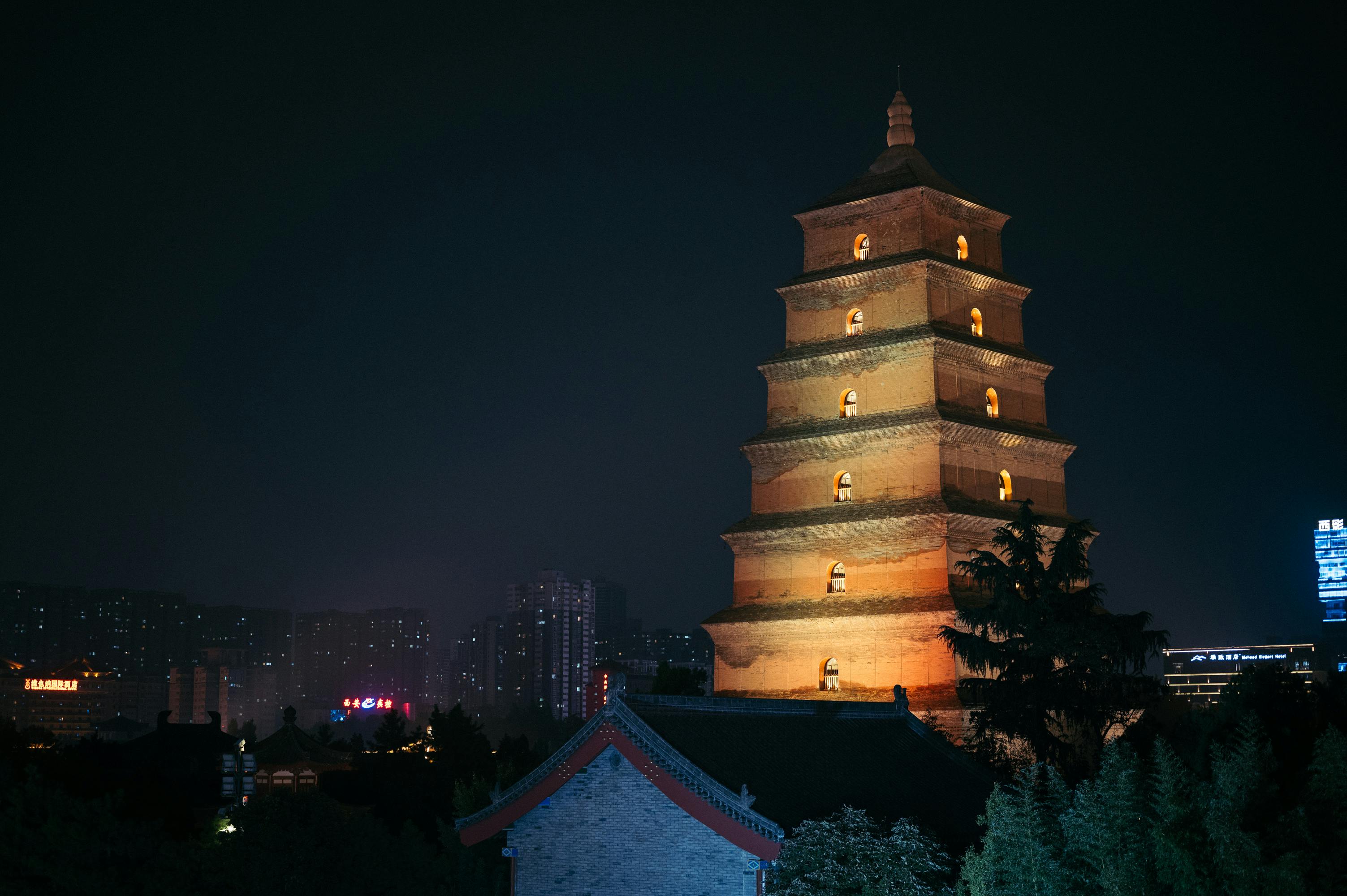
Big Wild Goose Pagoda: Where Ancient Buddhist Wisdom Meets Tang Dynasty Grandeur
Golden hour bathes the seven-story brick silhouette of the Big Wild Goose Pagoda as late afternoon light ignites the weathered gray masonry that has stood sentinel since 704 CE, its 64.5-meter height casting long shadows across the temple courtyards where pilgrims have circumambulated for over 1,300 years. You hear the gentle chime of bronze bells suspended from upturned eaves, the soft murmur of monks chanting sutras within the Da Ci'en Temple halls, and the distant splash of Asia's largest musical fountain dancing in the North Square just beyond the temple walls. This is not merely a historic tower; it is a UNESCO-recognized monument to cultural exchange, a sacred structure built to house Buddhist scriptures brought from India by the legendary monk Xuanzang—a testament to spiritual devotion and architectural mastery that continues to inspire modern visitors beneath the loess skies of Shaanxi Province. Standing before the pagoda's simple yet majestic form, you feel the profound continuity of a place designed to preserve wisdom—and the enduring responsibility to protect this irreplaceable bridge between ancient faith and contemporary understanding.
Why Big Wild Goose Pagoda Embodies Cultural Transmission
Originally constructed in 652 CE under Emperor Gaozong of the Tang dynasty and rebuilt to its current seven-story form in 704 CE during Empress Wu Zetian's reign, the Big Wild Goose Pagoda was engineered to solve a singular spiritual need: to create a secure repository for Buddhist scriptures, statues, and relics brought back from India by the monk Xuanzang after his 17-year pilgrimage. The pagoda's architectural design reflects sophisticated Tang engineering: a square brick structure with 64.5-meter height and 25-meter base width; walls tapering from 2.05 meters thick at the base to 0.9 meters at the summit; internal wooden staircases connecting seven levels while maintaining structural integrity through seismic activity. Construction techniques showcase remarkable precision: bricks bonded with lime mortar mixed with glutinous rice for enhanced durability; each story's overhanging eaves supported by traditional dougong brackets that distribute weight while creating the pagoda's distinctive silhouette; the interior's hollow core allowing natural ventilation to protect delicate manuscripts. The pagoda fulfilled its purpose so completely that it safeguarded 657 Sanskrit texts and 150 Buddha relics for centuries; today, its preservation alongside ongoing scholarly research creates a unique dialogue where ancient Buddhist scholarship meets modern cultural appreciation, proving that architectural stewardship can honor both spiritual heritage and historical truth when intentional conservation respects both memory and meaning.
The Best Time to Experience Big Wild Goose Pagoda
For optimal conditions, target April 9–May 27 or September 14–October 29, when daytime temperatures range 16–26°C (61–79°F) with low humidity and clear skies that enhance visibility of the pagoda's brickwork details and temple garden vistas. Arrive at the Da Ci'en Temple entrance between 8:00–9:30 AM when the complex opens, morning light illuminates the gray brick facade, and crowds are light enough for contemplative exploration before tour groups converge around 10:30 AM. Avoid July 11–August 26, when temperatures reach 30–37°C (86–99°F) with high humidity that makes climbing the pagoda's narrow staircases uncomfortable, and October 1–7 (National Day holiday), when domestic tourism peaks and visitor numbers exceed 25,000 daily. Winter visits (December–February) offer atmospheric mist-draped views but require preparation for temperatures averaging -3–8°C (27–46°F) and occasional icy conditions on stone pathways. Entry fees: ¥40 ($5.50) for temple grounds; additional ¥30 ($4) for pagoda ascent; combined ticket ¥60 ($8.50).. Note: the temple operates daily 8:00 AM–5:30 PM (March–October) / 8:00 AM–5:00 PM (November–February); pagoda ascent closes at 4:30 PM. The North Square musical fountain show runs Tuesday–Sunday at 7:00 PM and 9:00 PM (weather permitting).
Approximate Budget for a 7-Day Trip
Pricing methodology reflects mid-range travel with authentic local experiences, excluding international flights. Costs quoted in Chinese Yuan (CNY/¥) with USD equivalents (¥7.2 ≈ $1 USD).
-
• Accommodation: ¥300–¥700 ($42–$97) per night for a boutique hotel or upscale guesthouse in Yanta District, within walking distance of Big Wild Goose Pagoda
• Food: ¥138 ($19) per day: breakfast ¥23 ($3) for roujiamo (Chinese hamburger) and soy milk at a local vendor; lunch ¥48 ($6.50) for biangbiang noodles or dumplings at a traditional eatery; dinner ¥67 ($9) for Shaanxi cuisine like lamb stew or cold noodles with jasmine tea
• Transportation: Metro Line 3 to Dayanta Station ¥3 ($0.40); taxi from airport to city center ¥105–¥155 ($15–$22); bicycle rental ¥20/day ($3); 7-day transportation card deposit ¥20 ($3)
• Attractions: Big Wild Goose Pagoda combined ticket ¥60 ($8.50); Terracotta Army ¥120 ($17); Xi'an City Wall ¥54 ($7.50); Muslim Quarter food tour ¥52 ($7); Tang Dynasty show ¥170 ($24)
• Miscellaneous: Official temple guidebook ¥32–¥85 ($4.50–$12); miniature pagoda replica souvenir ¥40–¥120 ($5.50–$17); traditional calligraphy experience ¥68 ($9.50); travel insurance ¥40 ($5.50)
Total estimated budget: ¥5,900–¥8,900 ($820–$1,235) for one person
6 Essential Big Wild Goose Pagoda Experiences
- Climb the Pagoda at Opening Time: Ascend the narrow wooden staircases at 8:15 AM to reach the seventh-floor observation platform. The 64.5-meter climb reveals panoramic views of Xi'an's blend of ancient and modern architecture; pause on each level to study the brickwork and Buddhist inscriptions. Morning light through lattice windows enhances interior details; allow 45 minutes for this experience.
- Explore Da Ci'en Temple Halls: Enter the main prayer hall to experience original Tang dynasty Buddhist statues, intricate murals, and incense-filled atmosphere. Visit between 9:00–10:30 AM when natural light filters through wooden lattices; photography permitted without flash in public areas.
- Photograph the Pagoda's Architectural Details: Focus on the distinctive Tang features: tiered eaves with upturned corners, brick-laying patterns, and bronze bell fixtures. Position yourself at the temple's eastern courtyard for the iconic perspective where the seven-story tower frames traditional rooflines; shoot during golden hour (5:00–6:30 PM) when sidelight accentuates brick textures.
- Attend Evening Prayer Ceremony: Experience the daily chanting ritual in the main hall at 4:00 PM (check schedule at entrance). Observe respectfully from the periphery; the low-frequency vibrations of sutras create a meditative atmosphere. Photography of rituals is prohibited—experience this moment fully present.
- Witness the North Square Fountain Show: Arrive at the plaza by 6:30 PM for the 7:00 PM musical fountain performance (free admission). Secure a viewing position near the pagoda's northern facade; the illuminated tower reflected in dancing water jets creates unforgettable photographic opportunities. Best experienced Tuesday–Sunday; shows cancel during heavy rain.
- Explore the Xuanzang Memorial Hall: Located within the temple complex (included with entry), this exhibition features historical artifacts, manuscripts, and interactive displays tracing the monk's 17-year journey to India. Allow 35 minutes; best visited weekday afternoons to avoid crowds.
3 Hidden Gems Most Travelers Miss
-
• Temple Garden's Stone Stele Forest: Tucked behind the main prayer hall, a quiet courtyard houses 28 stone tablets featuring Tang dynasty Buddhist inscriptions and calligraphy. Access via the eastern pathway; open daily 9:00 AM–4:00 PM. Insider tip: Visit Thursday mornings when a resident scholar occasionally offers brief explanations of classical characters—a profound glimpse into living cultural practice.
• Early Morning Monk Meditation: At 6:30 AM, monks gather in the western courtyard for silent meditation before morning prayers. Observe respectfully from 10 meters away; many welcome quiet visitors who ask permission before photographing. Best experienced on clear weekday mornings when mist rises gently from the temple gardens.
• Traditional Tea House in Temple Grounds: A small courtyard teahouse near the pagoda's base serves jasmine oolong and local snacks in a serene setting. Open daily 10:00 AM–4:00 PM; order tea while watching sunlight move across ancient roof tiles—a peaceful pause most visitors miss by rushing to the fountain show.
Cultural & Practical Tips
-
• Photography etiquette: Handheld photography permitted in temple courtyards and exterior areas; flash and tripods require advance permission. Photography of interior statues and rituals is prohibited—respect sacred spaces.
• Local phrases: Learn "Āmítuófó" (ah-mee-two-foh = Buddhist greeting) and "Xièxie" (SHYEH-shyeh = thank you). Pronounce with level tones; temple staff appreciate cultural effort.
• Footwear matters: You'll walk 2–4 kilometers on stone pathways and climb 150+ narrow steps inside the pagoda; wear comfortable, closed-toe shoes with good grip—wooden staircases can be slippery when humid.
• Weather preparedness: Xi'an's air quality fluctuates; download the AirVisual app. The temple grounds offer partial shelter under eaves—carry a compact umbrella for sudden showers; layer clothing for temperature shifts between sunlit courtyards and shaded halls.
• Dress code: Cover shoulders and knees as a sign of respect in Buddhist temples; remove hats upon entering prayer halls. Carry a lightweight scarf for easy adaptation to dress codes.
• Crowd navigation: The complex is busiest Friday–Sunday afternoons; visit weekday mornings (8:00–10:00 AM) for quieter exploration. During peak hours, start with the pagoda ascent before exploring temple halls.
• Respectful observation: Remember: this is an active place of worship. Speak softly in prayer halls, never touch religious artifacts, and follow all posted guidelines to help preserve this irreplaceable heritage.
Conclusion: Travel with Contemplation, Not Just Observation
Big Wild Goose Pagoda does not surrender its spiritual depth to hurried climbing. To truly engage with this ancient sanctuary, slow your step—linger where brick meets sky; pause to feel the cool smoothness of a 1,300-year-old threshold beneath your palm; listen for the echo of centuries in the gentle chime of temple bells. Your visit becomes an act of cultural stewardship when you choose mindful presence over passive tourism, when you honor the monks' devotion by respecting sacred protocols, when you carry home not just photos but a deeper appreciation for humanity's enduring quest to preserve wisdom across time. This pagoda has maintained its serene authority through dynasties and revolutions because each generation recognized its value beyond spectacle. As you depart beneath the upturned eaves, let your final intention be this: we are temporary witnesses to a dialogue between earth and enlightenment. Travel with contemplation—not just to see, but to understand; not just to visit, but to honor.