
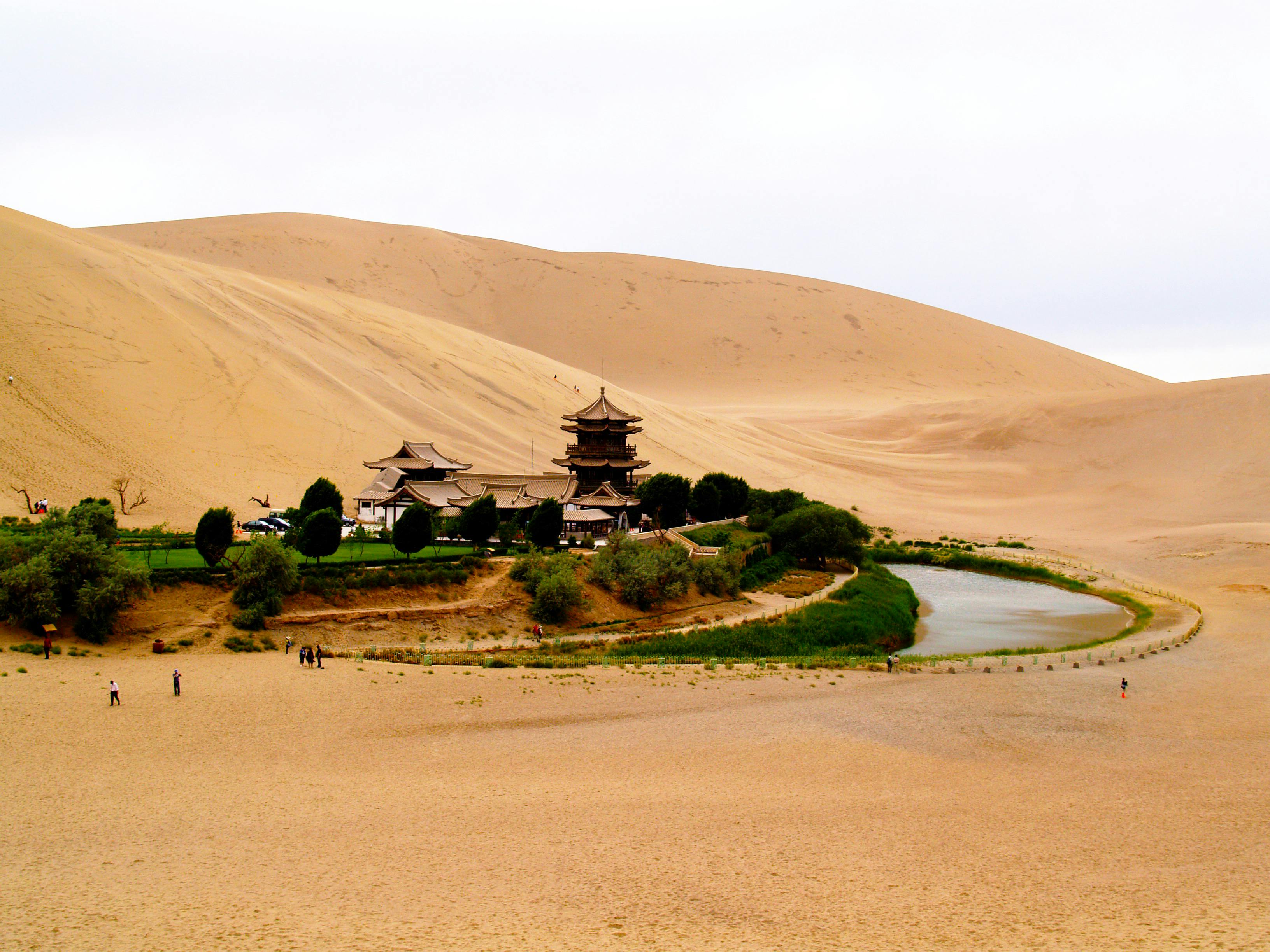
Crescent Lake: Where Desert Silence Meets Silk Road Reverence
Dawn breaks over the Mingsha Shan dunes—soft amber light spilling across 1,200-meter-high singing sands that hum when the wind shifts. You stand at the edge of a miracle: a crescent-shaped lake, just 50 meters long and 4 to 5 meters deep on average, cradled in the Gobi's endless ochre embrace [[75]]. The water, cool and clear, reflects the pale sky like polished jade; a lone pagoda stands sentinel on its northern shore, its eaves whispering secrets carried by caravans two millennia ago. This is Yueyaquan—Crescent Lake—a freshwater spring that has defied desertification since the Han Dynasty (202 BCE–220 CE), when Silk Road travelers first quenched their thirst here [[9]]. It matters not merely as a geographical anomaly, but as a living testament to resilience: where water persists against entropy, where culture endures against time, and where you, too, can pause and remember what it means to find refuge in the unexpected.
Why Crescent Lake Embodies Timeless Resilience
Crescent Lake endures not by accident, but by geological grace. Nestled in a natural depression where underground aquifers meet surface runoff, the lake maintains its form through a delicate hydrological balance that has fascinated scientists for decades [[73]]. Its crescent shape—measuring approximately 50 meters in length and historically reaching depths of 7.5 meters at its deepest point—was formally documented in 1960 surveys, though local lore claims it has mirrored the moon's curve for over two thousand years [[67]]. During the Han Dynasty, Dunhuang served as the westernmost garrison of imperial China, and Yueyaquan became a critical waypoint where merchants, monks, and messengers replenished supplies before crossing the formidable Taklamakan Desert [[47]]. The lake solved an existential problem: survival in one of Earth's most arid landscapes. Its persistence relies on subterranean springs fed by snowmelt from the distant Qilian Mountains, channeled through porous sandstone layers that filter and regulate flow—a natural engineering feat no human system has ever replicated. Today, conservation efforts monitor water levels closely, ensuring this Silk Road relic remains not just a postcard image, but a functioning ecosystem where reeds sway, dragonflies dart, and the past breathes alongside the present.
The Best Time to Experience Crescent Lake
For optimal conditions, visit during two precise windows: April 18–May 31 or September 10–October 20. During these periods, daytime temperatures range from 18°C to 26°C (64°F to 79°F), with mornings especially crisp at 8:00–9:30 AM—ideal for photography before the sun intensifies [[3]]. Avoid July 1–August 20, when temperatures can soar to 38.9°C (102°F), making midday exploration physically demanding [[3]]. Winter visits (November 15–March 10) offer stark beauty and solitude, but temperatures drop to -5°C to 5°C (23°F to 41°F), requiring layered clothing [[3]]. The lake opens daily from 5:00 AM to 11:30 PM, allowing flexibility for sunrise or stargazing sessions. Booking tickets online in advance is now mandatory, streamlining entry while supporting sustainable visitor management [[3]].
Approximate Budget for a 7-Day Trip
Pricing methodology: Estimates reflect mid-range travel preferences in 2026, based on verified local sources and current exchange rates (1 USD ≈ 7.2 CNY). Costs assume shared transportation, modest dining, and standard admission fees.
-
• Accommodation: $40–$85 USD per night (guesthouses near Mingsha Mountain or central Dunhuang hotels) [[3]]
• Food: $12–$18 USD per day (breakfast $2: congee with pickles; lunch $5: lamb noodles with hand-pulled dough; dinner $8: roasted eggplant with cumin and local beer) [[84]]
• Transportation: $3–$7 USD per taxi ride within Dunhuang; $15 USD round-trip for airport transfers; bus to Crescent Lake: $1 USD [[3]]
• Attractions: Crescent Lake entry $15 USD peak season / $7.50 USD off-peak (valid 3 days); Mogao Caves $25 USD; Yangguan Pass $8 USD [[29]][[31]]
• Miscellaneous: Camel ride at dunes $10 USD; souvenir silk scarf $6 USD; desert camping experience $25 USD including dinner
Total estimated budget: $650–$920 USD for 7 days
7 Essential Crescent Lake Experiences
- Sunrise photography at the lake's eastern rim: Arrive by 5:30 AM to capture the first light gilding the water's crescent curve; use a polarizing filter to reduce glare on the still surface.
- Camel trek across Mingsha Shan dunes: Book a 45-minute ride departing from the southern entrance; the sand "sings" under hooves—a low-frequency hum caused by grain friction [[3]].
- Visit the lakeside pavilion at golden hour: Climb the wooden staircase to the traditional structure overlooking the water; the interplay of shadow and reflection creates unparalleled compositional opportunities.
- Stargazing after 9:00 PM: Dunhuang's minimal light pollution reveals the Milky Way; bring a red-light headlamp to preserve night vision while navigating paths.
- Sample Shazhou Night Market delicacies: Try lürou huoshao (donkey meat pastry) and sweet apricot tea; vendors open around 6:30 PM near the city center [[3]].
- Walk the dune ridge at sunset: Ascend the western dune slope 30 minutes before dusk; watch the lake shift from emerald to copper as shadows lengthen across the water.
- Attend an evening cultural performance: Check the official schedule for traditional music or dance shows held near the entrance on select nights; included with admission [[31]].
3 Hidden Gems Most Travelers Miss
-
• Leiyin Temple's rear meditation garden: Tucked behind the main lakeside pagoda, this quiet courtyard features ancient juniper trees and stone inscriptions; access via the eastern pathway after 4:00 PM when tour groups depart.
• Desert botanical trail near the northern dune base: A 200-meter unmarked path reveals hardy oasis flora like Nitraria tangutorum; best visited at 7:00 AM to observe dew-dependent species; bring water and wear closed-toe shoes.
• Local artisan workshop in Dunhuang's old quarter: Master calligrapher Li Wei offers impromptu demonstrations of Silk Road-era script on handmade paper; find his studio at No. 47 Shazhou Lane; appointments preferred via WeChat: liwei_dh_art; tip customary (¥20–50).
Cultural & Practical Tips
-
• Remove hats when entering temple structures; bow slightly when passing monks as a sign of respect.
• Carry cash (CNY): many small vendors and taxi drivers do not accept mobile payments from foreign accounts.
• Learn key phrases: Nǐ hǎo (nee how) = Hello; Xièxie (shyeh-shyeh) = Thank you; Duōshǎo qián? (dwo-shao chyen) = How much?
• Photography: Drones require prior authorization from the Dunhuang Cultural Heritage Bureau; tripod use is permitted but avoid blocking pathways.
• Weather preparedness: Sandstorms can arise suddenly; carry a lightweight scarf to cover nose/mouth and protect camera lenses.
• Hydration: Drink 2–3 liters of water daily; the desert air accelerates dehydration even in cooler months.
• Sustainable practice: Pack out all waste; the oasis ecosystem is fragile and recovery from litter is exceptionally slow.
Conclusion: Travel with Reverence, Not Just Curiosity
Crescent Lake does not merely invite observation—it asks for reverence. Each ripple on its surface carries the echo of camel bells from Tang Dynasty caravans; each grain of surrounding sand holds the memory of poets who paused here to compose verses under infinite stars. To visit responsibly means moving slowly, speaking softly, and leaving only footprints that the wind will gently erase. It means choosing the shoulder-season dates that ease pressure on conservation efforts, supporting local artisans whose crafts sustain cultural continuity, and recognizing that your presence is a privilege granted by centuries of careful stewardship. When you stand at the water's edge at dawn, let curiosity deepen into connection: feel the cool mist on your skin, listen to the dunes' low song, and carry forward not just photographs, but a commitment to protect places where wonder still defies the odds. Slow down. Breathe deeply. Let Yueyaquan remind you that some miracles endure—not despite the desert, but because of the balance we choose to honor.